Rated PG-13 for some sexual references, mature thematic material and historical smoking
Profanity:
Some strong language
Alcohol/ Drugs:
Drinking, smoking
Violence/ Scariness:
Wartime violence
Diversity Issues:
A theme of the movie, homophobia, suicide
Date Released to Theaters:
November 21, 2014
Date Released to DVD:
March 30, 2015
Amazon.com ASIN:
B00RY85CQI
Copyright 2014 The Weinstein Company
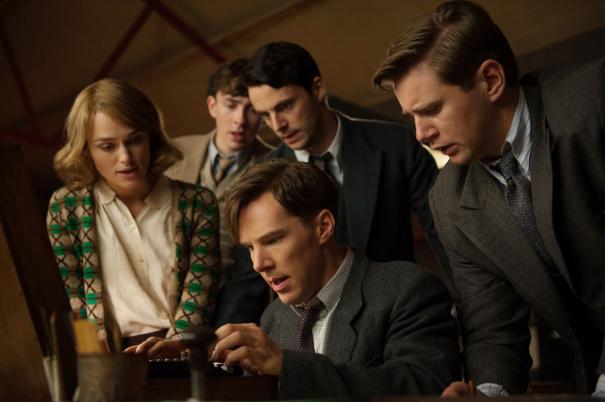
Alan Turing was a brilliant mathematician with an enormous intellect, an almost equally enormous ego, and an almost equally enormous secret. He was one of the founding thinkers behind modern computing and it is his name that we use for the test that determines whether a computer has achieved true artificial intelligence status. The Turing test standard is human conversation. If a human cannot tell whether he or she is communicating with a person or a computer, than the program has passed the Turing test and is true artificial intelligence.
I’m not sure that Alan Turing could have passed the Turing test. Cumberbatch, who also plays a super-smart, arrogant, and obnoxious guy in “Sherlock,” creates a very different character here. Turing himself is an Enigma. In the opening scene, a sort of job interview nightmare in which Commander Denniston (Charles Dance) is trying to interview Turing (Benedict Cumberbatch) for a spot on the team working at the famous Bletchley Park estate to break the code the Germans were using to send orders to their troops. If passing as human means meeting even the most minimal standards of civility and responsiveness, Turing failed that interview. He seemed to think that it was he who was interviewing Denniston to determine whether the task was of sufficient interest and import to merit his attention.
Denniston begins to dismiss him. But when Denniston says that everyone thinks the code, known as Enigma, is unbreakable, Turing says briskly, “Let me try, and then we’ll know for sure.” Denniston does not have a better idea or a better option.
The German code is unbreakable because it is constantly changing, so by the time any one message has been decrypted, whatever was learned could not be applied to whatever comes next. The Allies are perpetually behind. [The process, complicated as it is, has been simplified for the purposes of the movie, glossing over the important work done by Polish mathematicians, the contributions of the French, and the challenges faced as the Germans continued to make the Enigma more complicated and impenetrable as the war continued.) While a bunch of brilliant mathematicians, scientists, and puzzle-solvers (including Joan Clarke, played by Keira Knightley) worked away, Turning realized not only that what made the code unbreakable was the inability of any then-existing computational mechanism to perform enough calculations fast enough to decrypt the messages before the code was reconfigured the next morning, but that he could create a machine to do it.
We know how it turned out. But director Morten Tyldum keeps the story gripping on several levels. First, there is the conflict between Turing and just about everyone, and the pressure for immediate results as he is spending a lot of time (years) and money on something no one has ever seen before. Second, there are the interpersonal struggles, and Turning’s internal difficulties. He did want intimacy, and we see in his memories of his first love, a boy at his school. He likes Joan, and is briefly engaged to her. But he was gay at a time when being gay was punishable by prison. Then there are other kinds of secrets. One of the people working on breaking the code may be a spy. And once the code is broken, the Allies have the wrenchingly painful decision about what to do with the information. It’s not just a puzzle. It is statecraft, and terrible compromises and terrible losses are part of the job.
The film adds some unnecessary drama and oversimplifies parts of the story. But it is a powerful, complex drama and a long-overdue tribute to a true hero and visionary.
Parents should know that this film includes wartime themes and images, some disturbing, wrenching moral choices, betrayal, the pressures of being a closeted homosexual when it was a crime, drinking, smoking, and some sexual references.
Family discussion: Do you agree with the decision to withhold the news that the code had been broken? To allow the mole to keep spying?
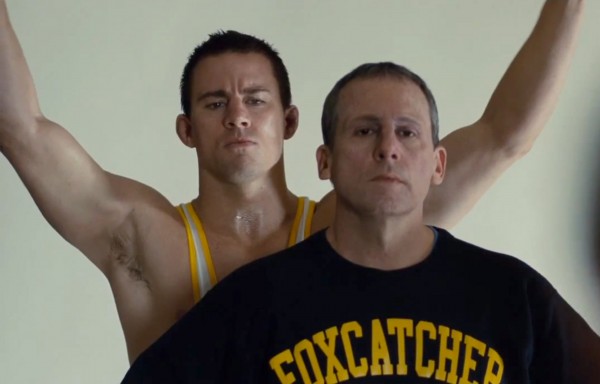
John Eleuthère Du Pont was of the wealthiest men in the world. He was an ornithologist, a philatelist, a purchaser of military weapons (including a tank), a wrestling fan who set up a luxurious training facility for the US Olympic team, and a murderer who died in prison in 2010. Steve Carell, almost unrecognizable, does a better job of erasing himself than of creating a different character. He has a hawkish nose, a set of small, inbred-looking teeth, a clenched posture, and the aristocratic delivery of a prep school graduate used to deference from everyone but his mother. But he is never able to make it all into anything but a cipher. Director Bennett Miller (“Capote,” “Moneyball”) and screenwriters Dan Futterman and E. Max Frye wisely stay away from simple explanations and Lifetime Made-for TV-style histrionics. Miller’s pallette is drab and his presentation is spare, in contrast to the opulence of the Du Pont estate and the training facility. But the film overcorrects, as though underplaying and long, silent stretches without even a musical score can somehow convey seriousness and import.
It begins promisingly as we see Olympic gold medalist Mark Schultz (a somber Channing Tatum) stumbling his way through a talk to some bored schoolkids about character and America, and then waiting awkwardly for his pay, $20. And one of the best scenes of the year is his practice session with his brother, best (and only) friend, and coach, David Schultz (Mark Ruffalo), also a gold medalist. There is enormous tenderness in David’s touch as he pushes on Mark’s arms to stretch him, and even as it seamlessly turns into a wrestling match that eloquently conveys intimacy, trust, dependence, and some competition as well.
Mark gets a call from some Du Pont factotum, inviting him to come to Delaware to meet John on his luxurious estate, called Foxcatcher because of the fox hunting history of the Du Ponts, a rare family that has been wealthy since the earliest days of American history.
On the surface, John conveys an easy noblesse oblige as he introduces himself, and Mark is nowhere near worldly enough to see the arrogance and instability under the surface. Mark has been listening to coaches all his life. When John says he likes to be called “Eagle,” Mark sees leadership. When John says he wants to help Mark be the best in the world, Mark sees a chance for something he did not let himself realize he wanted, a chance to be more independent. And independence is what John is looking for, too. He is an adult dependent in many ways on his mother, bitter about her focus on horses and her obvious feelings for him, somewhere between indifference and contempt.
John builds a lavish training facility (in real life for more sports than just wrestling). “Foxcatcher” is emblazoned everywhere. The athletes are polite, even respectful, but no one thinks John has anything but money to contribute. Mark loves being seen as special and gets caught up in John’s decadent lifestyle. But then John, who has the attention span of a mayfly, decides he needs to bring Dave in, too. Dave’s lack of interest only makes him more determined. Soon, Dave and his wife and children are at Foxcatcher. Mark is resentful. John is increasingly unstable and there is no one there to stop him until it is too late. When it’s over, he is affectless. The problem is, too much of the movie is as well.
Parents should know that this film has tense and disturbing confrontations, some violence including murder, strong language, drinking, and drugs
Family discussion: What was John hoping to achieve by sponsoring wrestlers? How did he feel about John? How did he feel about Dave? Why?
If you like this, try: “Capote” and “Reversal of Fortune”
Rated R for language including some crude references, and violent content
Profanity:
Strong and crude language
Alcohol/ Drugs:
Drinking
Violence/ Scariness:
Riots and brutal attacks on rioters and rebels, torture
Diversity Issues:
A theme of the movie
Date Released to Theaters:
November 14, 2014
Copyright 2014 Open Road Films
First-time writer/director Jon Stewart has made a remarkably assured film about the imprisonment and torture of Iranian journalist Maziar Bahari It is an absorbing drama that is at the same time the story of a very specific individual and a thoughtful consideration of contemporary geopolitics that avoids stereotypes or jingoism. This not only makes it a better story; it elevates the level of discourse without preachiness.
Bahari (a superb Gael Garcia Bernal) was working for Newsweek when he returned to Iran to cover the election in 2009. He knew the dangers of posing a threat to the government in Iran. His father and sister both died in prison as accused enemies of two different regimes. And now, as he filmed the protests over the disputed election victory of Mahmoud Ahmadinejad and the “Dish University” maintained by dissidents, he knows he is putting himself and his subjects and sources at risk. It is possible he does not consider the risks posed by his decision to be interviewed by “The Daily Show,” where he jokes about being a spy.
He is asleep at his mother’s home when officials arrive to take him to prison. It is disturbing and shocking that he is neither disturbed or shocked. While his mother (Shohreh Aghdashloo) bravely snaps at the man who orders her to wear a headscarf, Bahari is calm and polite.
Stewart wants us to understand the pressure that Bahari’s interrogator (Danish actor Kim Bodnia) is under. Stewart shrewdly introduces us to the man who smells of rose water as he is on the phone to his family, and showing us that he is just one link in a chain of oppression and bureaucracy. And he is not afraid to use cinematic touches to show us what is going on in Bahari’s mind. We see a face reflected on the walls as he walks through the streets. Later, in prison, he has conversations with his father and sister. They seem real to us, but they are not hallucinations. They are just visual embodiments of Bahari’s thought processes or fantasies has the weeks in solitary confinement turn into months, with no contact from the outside world. These memories of his family members who were also imprisoned help him stay strong. They even help him briefly outsmart Rosewater, as he fabricates a series of sexual encounters to describe in questioning, his “specialist” (interrogator) listening in horrified fascination, Bahari having, for once, the upper hand.
Stewart wisely also keeps us confined with Bahari, not telling us more than he knows about efforts to get him out of prison. When we finally see archival footage of then-Secretary of State Hillary Clinton talking about the importance of having him freed, we share his sense of relief that the world knows what is going on and cares about it. The other prisoners have no such support. And yet, Stewart finds a way to end on an image of hope that circles back to origins of the film itself. In moving out from behind the “Daily Show” desk, he is inviting us, as he has and as Bahari has, to shift from observer to participant.
Parents should know that this film includes some mature material: riots, abuse and torture (not graphic), some sexual references, and some strong language.
Family discussion: In what way did Maziar use his imprisoners’ weakness? What were their most effective tactics and what were his?
Interview: A.J. Edwards of the Lincoln Movie “The Better Angels”
Posted on November 16, 2014 at 8:00 am
A. J. Edwards is the writer and director of “The Better Angels,” a lyrical new film about the early years of Abraham Lincoln, when he was a boy growing up in a small log cabin. The title comes from Lincoln’s famous quote:
“We are not enemies, but friends. We must not be enemies. Though passion may have strained, it must not break our bonds of affection. The mystic chords of memory will swell when again touched, as surely they will be, by the better angels of our nature.”
I very much enjoyed talking with him about making this movie.
I’m from Illinois and we take Abraham Lincoln very, very seriously. I have heard about him all my life growing up. I have been to his home in Springfield, the Lincoln Museum, and the Library. But I did not know about this cousin, whose memories of growing up with Lincoln provide the narration for the film. So tell me a little bit about how you learned about the cousin and his story.
Dennis Hanks, Abraham Lincoln’s cousin, is essential to understanding the Indiana years because he provides one of the best and most thorough accounts of that time. And it is all available in a text in the form of an interview conducted by a journalist named Eleanor Atkinson when Dennis was what must have been his late 80s or 90s. He was a very old man sitting by the fire and over a series of nights, Atkinston interviewed him and got all these precious memories of his that give us a full picture of Lincoln as a boy, told by man who was with him. And it’s hilarious and tragic and so it’s just bittersweet and it reads like Mark Twain.
Was it difficult to cast the boys?
The boys and girls were found through a year-long search throughout Kentucky and it was one led by producer Jake DeVito and Casting Director Stephanie Coley. They scoured schools and youth groups, churches, camps for over a year. And we looked at thousands and thousands of kids all from rural Kentucky. Children of coal miners and everything just as Kentucky as we could get. And all for their athleticism, being outdoorsy, thoughtful, ready to engage with the world, young and old people alike. So we didn’t want video gamers and internet kids and kids that may have a little more boredom to them. And also their accents, they have this beautiful Appalachian accents, the same one Lincoln spoke with, and so that was very important to us.
You begin the film with Lincoln’s famous quote about owing everything to his mother. Most people think he was speaking of Nancy Hanks but some people think that was really reference to his stepmother. Which do you think it was?
You’re absolutely right. That’s good research. There is disagreement about it and I think in fact maybe even the majority say that it was his biological mother Nancy, who was very dear to him. But the thesis of the film is how his stepmother was really a light to him in much darkness, the way that she guided him to the end of his life. She was just a positive force for good. And she is the one that really pulled him out of despair and grief when he was 10 years old. And she encouraged him towards education. She had a great amount of humanity. Her compassion, tolerance, gentleness — and their bond was a very special one. She also had a very beautiful interview that you can read when she was quite old. And the stories she tells are just very tender and there also some funny ones about him cutting up.
Where did you do your research?
We went to the Lincoln library in Springfield, went to the Boyhood Memorial in Indiana, went to his home as well in Springfield, the Coles County Cabin there in Lerna, and Thomas and Sarah Lincoln’s Cabin. We tried to travel around a lot and also read a lot over an extended period. Studying him is infectious and it’s a lifelong study. Anyone that picks up books about him you can’t stop, you’re it so fascinated.
Amazingly in a hundred years of cinema no one has ever shown his Indiana years.
Why do you think it’s so important to explore that?
Well, it’s the most mysterious chapter; it’s the one that most people don’t know. They know his birth in Kentucky, they know his lawyer years in Illinois. But the tragic events that befell him in Indiana as well as the hope and joy that he experienced are essential to understanding his character. So much of him was shaped during the decade and a little bit more in Indiana. And it was shaped mainly by the positive influences of his two mothers and his teacher Andrew Crawford, the Catholic and veteran.
And even in just the strength of his father. He’s a disciplinarian, he’s a harsh man but he still has integrity, a strong sense of faith. He built their church, attended it regularly. He was a primitive Baptist to oppose slavery and moved his family from Kentucky to Indiana to get away from the institution of slavery. And Indiana was a free state. It was brought into the union that way. And so all of these people Lincoln were a reflection of, the best in them he absorbed. And certainly a good amount of him was God-given and a miracle, his greatness I mean. But there was definitely so much that he was reflecting. And that is all to say his better angels that he was reflecting.
There are two elements of the look of the film that were very powerful. And one was the beauty of the natural world, living out in the wilderness. And the other is the isolation, the incredible isolation of that world. Both were conveyed visually in the film. So how do you think those really affected him?
Oh yes, it was wild country for sure as Carl Sandburg, the great Illinois poet described. He said it was “land unknown to the plough” in his biography of Lincoln. And so many wild animals. Lincoln and his father would go on bear hunts. And for sure the isolation must have affected him when his father left them during a very brutal winter in order to go find a new wife, which he did in Sarah Lincoln. He brought her home but during that time, during that absence, Lincoln was left to fend for himself with his sister and their 18-year-old cousin, Dennis. They were very lonely times. Dennis recounts them in that interview, they just sound very despairing. And when Sarah returned with Thomas to find these children, her description of them was that they looked hardly human. They were so malnourished and so dirty that it was her first task to feed them, dress them, bathe them which she does in the film. But nature is in the film as more than ornamentation, not just to be pretty but rather because that is their character, that was their life, they moved at the rhythm of nature be it Little Pigeon Creek that they lived beside, their source of water or the Ohio River which separated Indiana from Kentucky that was the main passageway by which all people traveled. There were the ponds and brooks that they enjoyed, the meadows, the fields that they worked. So many people are of a cynical view when they see the film and just talk about being pretty but no, it’s the locale and their entire universe.
Copyright Brothers K Productions 2014
I was very impressed by the way that the texture of the clothing seemed very authentic the way it came across in black and white.
The costume designer is a brilliant woman name Lisa Tomczeszyn and in this film she had quite a task ahead of her not only in the research that’s required and the authenticity that is expected in the costumes but also the fact that it’s a monochromatic palette. And so any film the goal is separation. You need people to separate from the background and in color that can be a lot easier, because blue and red are completely different, blue wall, red shirt, the actor will separate. But in black and white blue and red can be the same shade. And so we had to do many tests to figure out how to get them to stand out from the darkness of the trees or the lightness of the sky or the kind of mid tones that the grass would be when they were out in the meadows. And so she was always having to switch things out to be getting them to separate from the background. She did a beautiful job, she really did her research and one of my favourite costumes in the picture is the dark big coat Sarah Lincoln arrives in, which is very iconic looking. The bonnet that Diane Kruger wears just looks so cinematic.
I also loved the score of the film, which really helped to set the mood.
The music is in part an original score by Hanan Townshend but the majority of it is some classical music by an Armenian-American composer, Alan Hovhaness, and Aaron Copland. That Copland I really loved, it so emotional. It plays over the young boys reuniting after some time and they enjoyed some days together cutting up. Then there is a piece by 19th century Russian composer named Kalinnikov. That’s sort of the theme of the film and usually associated with the mothers. And then also there’s the work of 19th century German composer Bruckner and that’s a sort of grander theme that suggest the ideas of his growth every time its used.
What is it you hope people will take from the film?
One thing I don’t usually get a chance to speak about is a sense of the Calvinistic views of the time, the sense of destiny and faith that they were bound for something. It was not uncommon for families lose three or four siblings to sickness and death, a lot of children not living past three or four years old including Lincoln’s brother. He had a brother that died in infancy. If you lived to be 17, 18 years old that was quite an accomplishment, you had a greater sense of destiny that you were being preserved for something greater than yourself. There were forces in this world that were invisible to you that were guiding you always and sometimes guiding you through others, being the better angels.
But that sense of faith and destiny not only applies to all that Lincoln accomplished, some of the greatest accomplishments in this country’s history, but it applies to all of us that the film should act as a mirror that our circumstances now don’t determine the ones that will come later. Maybe we started in poverty, we started in sickness or we faced a job loss, divorce, death but those things aren’t eternal. And that hope, faith charity, these ideas can guide us to something better. And just as Lincoln pulled himself out of deep grief and loss and suffering, and was also pulled out of those things by his stepmother, a new chapter began for him. A door was opened and he was led further down the road to his great destiny. And so this movie is just a slice of that but you can make it about anyone because we all have these chapters of our lives. And so hopefully it’s a family film that young and old alike can enjoy because of these universal ideas. You know a picture without cynicism and instead it’s one that is hopefully filled with light for people.
We have seen many film biographies of great individuals (mostly men). But we have seen almost no films, fact-based or fictional, about great marriages. And we have certainly never seen any films about great marriages that end up with the couple married to other people. But that is what this is. It is the story of a “marriage of true minds,” an equal partnership in every way, with two very intelligent and committed people working as hard as they can to be the best they can for one another.
And they are portrayed by two people of enormous talent, with both Felicity Jones and Eddie Redmayne giving performances of enormous depth and understanding. Of course Redmayne has the showier, awards-bait role, and he is meticulous in Hawking’s physical decline. In his previous films like “Les Miserables” and “My Week With Marilyn,” Redmayne has shown a gift for the sensitive, doe-eyed young hero. But as Hawking, he shows a shrewdness and wit we have not seen from him before, even at the end, when Hawking has just one cheek muscle he can control. There is never a hint of stunt-ishness. It is always about the character whose mind is perhaps even freer to roam the farthest reaches of the universe and of human comprehension as his body is failing and he is completely physically dependant.
The luminous Jones matches him every bit of the way as Jane Hawking ages and as she grapples with finding a way to continue to relate to her husband as an adult and an equal while caring for him. She is also a scholar in her own right who wants to do her own work, while somehow caring for her children and her husband, an intellectual supernova who is becoming an icon.
The screenplay is based on the book by Jane Hawking, the first wife of the scientist many people think of as the greatest mind of our generation, the physicist Stephen Hawking, best known for his appearances on “The Big Bang Theory” and his mega-best-selling book for the lay audience, A Brief History of Time. (The book’s purported status as the most-bought but least-read best-seller has inspired the “Hawking Index.”) And so we get a rare glimpse into what it was like from the point of view of the “wife of.”
Jane met Stephen when they were both students. They had very little in common. He was studying physics. She was studying Spanish poetry. He was an atheist. She was a churchgoer and believer. He was disorganized, not socially adept or at least not interested in fitting in. She was a natural rule-follower and very comfortable in social situations. There was never anything conventional about their encounters or conversations.
And yet, they felt the kind of pull that is better described by poetry than physics, the kind that seems to mean that only the similarities matter. She smiles, “I like to time travel. Like you.”
And then Hawking is given the devastating diagnosis of motor neuron disease (ALS), with a life expectancy of perhaps two years of calamitous decline of all muscles. “Your thoughts won’t change,” he is told, “but eventually no one will know what they are.”
Hawking’s father warns Jane away. “This will not be a fight. This will be a heavy defeat for all of us.” But Jane is resolute. She is determined that they will get married and they will fight. They get married, with him leaning heavily on a cane. They have two children. And he loses muscular control, more every day. Each downward ratchet is wrenching, but ultimately he has to give up walking and move to a wheelchair as eventually he will have to give up speech and learn to operate a computer with one muscle in his cheek to have it speak for him. Adding insult to injury, it will be with an American accent.
In the meantime, he is transforming our understanding of the universe and our place in it, and then turning those theories upside down and starting over as he attempts to synthesize the two areas of physics into one simple, elegant, beautiful formula that will explain how it all fits together.
Screenwriter Anthony McCarten and director James Marsh (“Project Nim”) show deep understanding and extraordinary sensitivity in conveying with small, intimate details what is going on in this marriage. Hands reach casually across a dinner table while two of the people at the table watch, just a slight tightening of the muscles around the eyes or mouth revealing what it is like to see it be so easy for other people. They can love each other despite his awful knowledge of being a burden while resenting the healthy. And despite her equally awful knowledge of his humiliation in being a burden. We see the combined beauty and soul-destroying relentlessness of being a caretaker.
They try to keep relating to each other as a couple, not as patient and nurse. They have another baby. That is joyous but it is more work and more of a reminder of how little he can do as a parent. He is in many respects more dependent than the children. And Jane is exhausted.
Jane’s mother (Emily Watson) has some advice. She tells Jane to sing in the church choir. “That is the most English thing anyone has ever said,” Jane replies, but she goes, and as soon as we see the handsome young choir leader, just widowed, (Charlie Cox of “Stardust” as Jonathan), we know there is going to be trouble. Jonathan, at a loss in his grief, offers to be of help to the family. He is kind and understanding but he is also healthy and in a beautifully poignant scene at the beach, he runs with the children while Hawking’s wheelchair sinks into the wet sand.
Jonathan and Jane develop feelings for each other. Hawking and his new nurse Elaine (Maxine Peake) develop feelings for each other. Perhaps it is because she never sees him as less than a version of himself that is long gone. Perhaps it is just that he wants Jane to have a chance to be with a healthy man. Perhaps he knows that there is some parallel universe where they are living happily ever after. I’d like to think so.
Parents should know that this is a sad movie about a family dealing with a very serious disease. There are some sexual references.
Family discussion: Why did Stephen chose that moment to talk about God to Jane? Why was it important to her?






 . (The book’s purported status as the most-bought but least-read best-seller has inspired the “