Kill the Messenger

Posted on October 9, 2014 at 5:59 pm

B+
Lowest Recommended Age: High School
MPAA Rating: Rated R for language and drug content
Profanity: Very strong language
Alcohol/ Drugs: Drinking, including teen drinking, drug dealing
Violence/ Scariness: Gangster-style violence, sad death, suicide
Diversity Issues: Diverse characters
Date Released to Theaters: October 10, 2014
Amazon.com ASIN: B00KSPL01K
Copyright 2014 Focus Features

Sometimes an honest, crusading, investigative reporter uncovers corruption and deceit and the result is triumph, a Pulitzer Prize, humiliating resignations and criminal convictions of the guilty and an Oscar-winning movie starring Robert Redford and Dustin Hoffman. And sometimes, instead, the result is killing the messenger. Gary Webb was a passionate, dedicated journalist at the San Jose Mercury News who managed to infuriate not only the CIA but his far bigger journalistic rivals. He uncovered a story no one much wanted told and no one much wanted to hear. Jeremy Renner plays Webb in this effort to give him his due.

Although it is set in the mid-90’s, director Michael Cuesta gives the film a 70’s paranoia, one man against The Man vibe that harks back to “The Parallax View,” “All the President’s Men,” “Z,” and “Serpico.” Renner, who also co-produced, brings his coiled energy and electric physicality to Webb, making journalism seem like a full-contact sport. His Webb is a guy who runs up the courthouse steps like Rocky. We see him early on, walking to his desk in the paper’s outpost near the state capital, going past the grand, imposing signs marking the areas occupied by the big national daily papers to his modest little corner. He’s a small fish in a very big ocean. But he has enormous determination, integrity, a sense of something to prove, and a healthy ego.

And then he gets the lead of a lifetime. A beautiful woman (Paz Vega), the girlfriend of a drug dealer, has some information for him that sounds preposterous. She says he “sold drugs for the government.” Seven tons worth. And it leads to the discovery that the government, specifically the CIA, is funneling money to the Contras in Nicaragua by underwriting the drug trade that is pouring crack into the poorest areas in the inner cities. “National security and crack cocaine in the same sentence — does that not sound strange to you?” And there’s a warning. “My friend, some stories are just too true to tell.”

The problem with writing about bad things done by powerful people is that they will use their power to attack whoever is trying to expose them. “Good investigative reporting ruffles feathers.” Sometimes the creature sporting those feathers will use its claws. To use a neologism from the movie, they will “controversialize” whoever is putting their reputations at risk. Webb was not perfect. He had enemies. At first, his newspaper celebrates his journalistic coup. But when his bosses are put under pressure, they buckle. Soon the once-superstar reporter is exiled to Cupertino. Without the support of his family and the chance to do the work that defines him, he has nothing to hold onto.

The story is still a murky and complicated one, despite post-credit updates on revelations confirming Webb’s reporting. Renner is a magnetic presence and he makes Webb’s passion for telling the story honestly and exposing the dishonesty of others almost palpable. Webb’s scenes with his children are especially touching, though it is too bad to see the talented Rosemary DeWitt relegated to a dull “don’t work so hard, don’t take risks” role. A scene near the end at an awards dinner has an emotional punch.  Renner’s performance has enormous integrity, illuminating the murky compromises and betrayals he exposes and the ones that get the better of him as well.

Parents should know that this film has very strong language, drugs, drug dealing, and gangster violence, as well as tense family confrontations.

Family discussion: Who is doing the work that Gary Webb did today? Has the CIA become more accountable as a result of his work? Do we still kill the messenger?

If you like this, try: “Serpico” and Dark Alliance: The CIA, the Contras, and the Crack Cocaine Explosion and more of the work of real-life reporter Gary Webb
Related Tags:


Based on a book Based on a true story Crime Journalism Movies -- format

Tracks

Posted on September 25, 2014 at 6:00 pm

B+
Lowest Recommended Age: High School
MPAA Rating: Rated PG-13 for thematic elements, some partial nudity, disturbing images and brief strong language
Profanity: Some strong language, one F-word
Alcohol/ Drugs: Drinking
Violence/ Scariness: Animals and humans in peril, sad animal death, references to suicide
Diversity Issues: Diverse characters
Date Released to Theaters: September 26, 2014

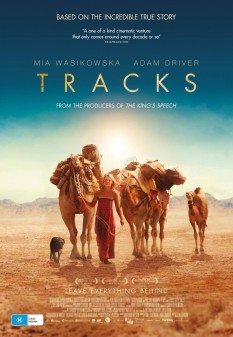
tracks-movie-posterIn 1977, a 27-year-old woman named Robyn Davidson took a dog and four camels and walked 1700 miles across the Australian desert. A National Geographic photographer met up with her four times to cover it for the magazine. That led to a book, the international best-seller Tracks.  And now it is a film, starring Mia Wasikowska, with Adam Driver as photographer Rick Smolan, and directed by John Curran, whose previous films (“The Painted Veil,” “We Don’t Live Here Anymore”) show a gift for letting the environment be an essential part of the story-telling.  The result is a journey set in surroundings of punishing conditions but spectacular beauty that manages to be meditative and internal, and all the more illuminating for it.

This is the first of two movies based on soul-restoring real-life hikes taken by real-life women that we will be seeing this fall, both based on best-selling books, with Reese Witherspoon’s more high-profile “Wild” coming out December 5, 2014.  While there are flashbacks to suggest that Davidson took on the trip to deal with some family losses, in real life Davidson has not just refused to give a reason; she has insisted that it is a foolish question to ask.  She walked across Australia for the same reason that Mallory climbed Mount Everest.  “Because it’s there.”  Her version of a response: “Why not?”  It’s pretty clear why not.  It is very dangerous.  The terrain is blisteringly hot and with very little water.  If she is injured or lost, no one will be there to help her.  But she is determined to go, indenturing herself with camel dealers to learn how to train camels and earn some to take with her.  When the first one cheats her out of what is due to her, she reluctantly agrees to allow National Geographic to sponsor the trip, though it means she will have to allow Smolan to meet up with her four times to take photos.

This is not the usual travelogue, with adventures that include quirky characters, daunting dangers, and lessons learned, though all are there.  Along the way, she meets up with Aboriginal people, including one who serves as a guide for a part of the journey because it includes sacred land which she is not permitted to travel on without him.  She comes across a farmhouse, and the couple who live there welcome her in a beautifully understated manner.

You’d also expect spectacularly gorgeous and exotic scenery, and that is there, too.  And, with just one person on screen much of the time, a lot of voiceover narration, though that’s not too bad.  Most of all, this is a spiritual saga, a pilgrimage.  Davidson wanted to be alone — she admits that she is much more comfortable with animals than with people.  And she wanted to accomplish something difficult by herself.  It almost seems at moments as though we are intruding in her beautiful solitude.  But mostly, we are sharing it, and feel grateful for the privilege.

Parents should know that this film includes sad and disturbing material including suicide of a parent (off-screen) and putting down animals, dangerous activities, peril, animals shot and poisoned, some disturbing images of dead animals, some strong language (one f-word), and non-sexual nudity (female rear).

Family discussion: Why was Robyn happiest away from people? What was the hardest moment of her trip and why?

If you like this, try: other movies set in the Australian desert, including “Walkabout” and “Priscilla, Queen of the Desert”

Related Tags:


Action/Adventure Animals and Nature Based on a book Based on a true story Drama Movies -- format

Trailer: Effie Gray, Starring Dakota Fanning and Emma Thompson

Posted on September 17, 2014 at 3:30 pm

Emma Thompson won an Oscar for her “Sense and Sensibility” screenplay. She wrote and stars in “Effie Gray,” with Dakota Fanning, the real-life story of the Victorian art critic, John Ruskin (David Suchet), and his much-younger bride, Effie Gray. Tom Sturridge plays John Millais, the artist she married after the unconsummated marriage to Ruskin was annulled.

Related Tags:


Based on a true story Trailers, Previews, and Clips

Contest: Win a DVD of “Louder than Words” starring David Duchovny

Posted on September 7, 2014 at 3:59 pm

Copyright Identity Films 2014

David Duchovny, Tim Hutton, and Hope Davis star in Louder than Words, a fact-based story about parents who find a way to pay tribute to the daughter they lost by building The Maria Fareri Children’s Hospital, a state of the art facility in Westchester, New York that recognizes the essential role of the family in caring for a sick child.

I have three copies of this heartwarming story to give away.  To enter, send me an email at moviemom@moviemom.com with “Maria” in the subject line and tell me what helps you feel better when you are sick.  Don’t forget your address!  (US addresses only)  I will pick three winners at random on September 15, 2014.


Related Tags:


Based on a true story Contests and Giveaways

When the Game Stands Tall

Posted on August 21, 2014 at 5:59 pm

C
Lowest Recommended Age: Middle School
MPAA Rating: Rated PG for thematic material, a scene of violence, and brief smoking
Profanity: Mild language
Alcohol/ Drugs: Smoking
Violence/ Scariness: Shooting, very sad death, serious illness, parental abuse, tense confrontations
Diversity Issues: Diverse characters
Date Released to Theaters: August 22, 2014


Copyright 2014 Sony Pictures
This dreary assemblage of every possible sports cliché has one thing in common with the game it portrays. Every time it seems to be going somewhere, it stops.

More frustratingly, it wastes the opportunity to tell a good story by trying to squeeze in too many great ones. There are too many crises, too many story arcs, too few resolutions, too few reasons for us to invest in the outcome. When a movie is based on (or even “inspired by”) something that really happened, the first step has to be deciding what the theme is and streamlining all of the real-life details that are not central to that theme. Or, as a coach might say, “Don’t lose focus.”

The real-life high school football team that inspired this story is Concord, California’s De La Salle Spartans, from a small, all-boys Catholic school. They hold the all-time winning streak record for any sport in any category and at any level. We meet the team just as the streak is about to end. The last game of the season is the 151st win in a row. But then Coach Bob Ladouceur (Jim Caviezel) has a heart attack.  A player is killed in a drive-by shooting.  Another one becomes an orphan, responsible for his younger brother.  The other teams do not want to play the Spartans anymore, so they take on the number one team in the state (in a game that is the subject of a book. The winning streak that went from 1992-2004 came to an end.

That’s an interesting place for a sports movie to begin, a refreshing change from the over-familiar sports movie storyline of a scrappy group of underdogs who have to learn to work together.  And the film is sincere and good-hearted, though not much we haven’t learned from reading Kipling’s If, especially the part about understanding that winning and losing are both imposters.  But the dramatic force of the narrative keeps being mowed down by so many over-familiar sports movie lines that the film’s greatest appeal may be as a drinking game.  How many times do we have to hear about how the teammates are family, especially when we hear it more than we see it?  (Though I did enjoy seeing the team come on the field holding hands like a kindergarten field trip.)

There is a lot to explore here about what we learn from winning and how much more we learn from losing.  Ladouceur’s techniques include “commitment cards” with training goals, practice goals, and game goals, each one written by a player and shared with a teammate to help them understand they are responsible for each other’s performance as well as their own.  It is good to hear a coach say that end zone antics are inappropriate and that the purpose of the training is not to produce great high school football players but responsible men.

A number of issues are set up or glancingly referred to without any real connection or follow-through, including some of the coach’s lessons about what matters more than winning.  The coach’s son says that when he needed a dad he got a coach and when he needed a coach all he got was a “lame dad.”  The coach’s wife (a criminally under-used Laura Dern) says he does not share himself with her or their children.  Ladouceur acknowledges that he has been “a bad husband and a worse dad.”  But all we see as a response is Ladouceur burning some burgers when he tries to grill.

We do not get enough of the history between the two players who struggle over whether they will stay together through college for it to be meaningful.  A brutish father (Clancy Brown) pushes his quarterback son to break the state record in scoring, but the resolution is not set up in a way that makes it a triumph for anyone.  Intrusive product placement from a sporting goods store is a distraction as well.  As though to keep us on track, equally intrusive sports announcers keep reminding us what the stakes are.  Even more intrusive is a musical score that is ploddingly obvious, with hip-hop in a black player’s home and syrupy pop over the white characters. Meanwhile, over on the sidelines (literally), Michael Chiklis as the assistant coach turns in the film’s most intriguing performance.

“It’s no longer about who the bigger, stronger, faster players are,”  the coach who has the bigger, stronger, faster players says about playing against the Spartans.  (You can tell what’s coming next, right?) “It’s about who plays with more heart.”   The heart in this film is mostly over the end credits, where we see the truly inspirational Ladouceur and wish we had just seen a documentary about him instead.

Parents should know that this film includes the tragic murder of a teenager, serious illness of a parent, death of a parent, parental abuse of a teenager, scenes of wounded warriors in rehab, smoking, and brief crude sexual references

Family discussion: What goals will you put on your commitment card? Why didn’t the coach want his players to pay attention to the streak? What was his most important lesson?

If you like this, try: “Friday Night Lights” (the movie and the television series) and “Remember the Titans,” as well as the books about the Spartans: When the Game Stands Tall: The Story of the De La Salle Spartans and Football’s Longest Winning Streak and One Great Game: Two Teams, Two Dreams, in the First Ever National Championship High School Football Game

Related Tags:


Based on a book Based on a true story Drama High School Movies -- format Sports
THE MOVIE MOM® is a registered trademark of Nell Minow. Use of the mark without express consent from Nell Minow constitutes trademark infringement and unfair competition in violation of federal and state laws. All material © Nell Minow 1995-2025, all rights reserved, and no use or republication is permitted without explicit permission. This site hosts Nell Minow’s Movie Mom® archive, with material that originally appeared on Yahoo! Movies, Beliefnet, and other sources. Much of her new material can be found at Rogerebert.com, Huffington Post, and WheretoWatch. Her books include The Movie Mom’s Guide to Family Movies and 101 Must-See Movie Moments, and she can be heard each week on radio stations across the country.

Website Designed by Max LaZebnik