Trailer: Unbroken

Posted on July 15, 2014 at 8:00 am

One of the most anticipated films of the year is “Unbroken,” directed by Angelina Jolie, and based on Laura Hillenbrand’s best-seller, Unbroken: A World War II Story of Survival, Resilience, and Redemption.  It is the story of Louis Zamperini, who died this month at age 97, after an extraordinary and heroic life that included competing as an Olympic athlete, 47 days on a raft in the Pacific Ocean after his plane crashed during WWII, and then surviving torture and starvation in a Japanese prisoner of war camp. Perhaps most remarkably, he found peace after the way by learning to forgive the men who tortured him. This first trailer looks like the film will do justice to Zamperini’s story.

But it can never be as powerful as the man himself.

https://www.youtube.com/watch?v=vVFsx9fA19w
Related Tags:


Based on a book Based on a true story Trailers, Previews, and Clips

Trailer: Kevin Kline Plays Errol Flynn in “The Last of Robin Hood”

Posted on July 10, 2014 at 8:00 am

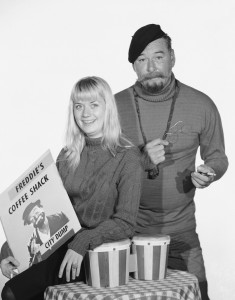
Errol Flynn became one of the greatest movie stars of all time, specializing in swashbucklers like “Captain Blood” and “The AdveBeverly Aadland and Errol Flynn pose in costume for a skit they performed on the “The Red Skelton Show” that aired on Sept. 29, 1959, two weeks before Flynn’s death. Photo by The Associated Press.ntures of Robin Hood.”  No one was better than Flynn at playing the dashing, gallant hero.

But the Tasmanian actor became almost as legendary for his off-screen debauchery as for his on-screen triumphs. Peter O’Toole plays a faded movie star who has had too many drinks and too many women, based on Flynn, in the delightful comedy, “My Favorite Year.”

In “The Last of Robin Hood,” Kevin Kline plays Flynn who, in the last year of his life, fell in love with a teenager named Beverly Aadland (he did not know she was underage).  Flynn put Aadland into his final film, “Cuban Rebel Girls.”

They were traveling together in Canada when he died.  Dakota Fanning plays Aadland, and Susan Sarandon plays her mother, who was accused of being unfit for allowing her then-15-year-old daughter to be romanced by Flynn.

https://www.youtube.com/watch?v=esOj4uzrU0Q


Related Tags:


Actors Based on a true story Trailers, Previews, and Clips

Jersey Boys

Posted on June 19, 2014 at 6:00 pm

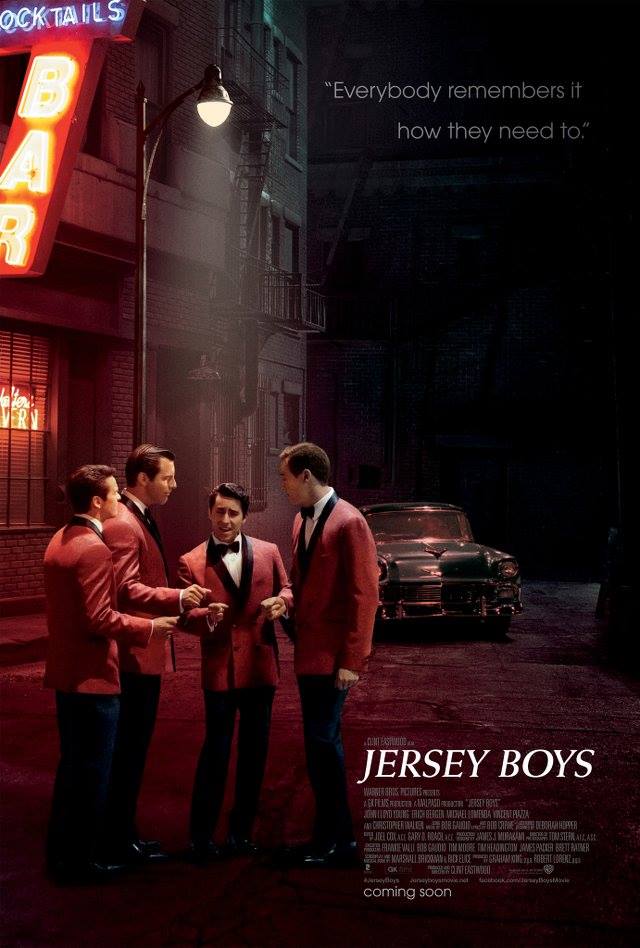
Winston Churchill famously said that history is written by the victors.  In movie terms, that means that when you see the names of just two of the original Four Seasons listed as the film’s producers, it is clear we are going to get their side of the story.jersey boys

This film, like the Tony Award-winning musical, is the “VH1 Behind the Music”-style story of four guys from the scrappy streets of New Jersey who grow up with only three possible career paths: the military, the mob, and somehow achieving fame.  The first two have a high risk of getting killed.  The last seems unobtainable.  But the four guys, brought together in part by a fifth guy who took the fame option, Oscar-winner Joe Pesci (played in the film by Joseph Russo), became one of the most successful pop acts of all time, with number one hits through the 60’s-70’s.

Clint Eastwood, a composer himself, who made a fine musical biopic about Charlie Parker (“Bird”), has taken on this story, beautifully performed, but too focused on the lives of the group’s members, with very little about what it was that made them stars, or even what the music meant to them aside from a way to get out of New Jersey and support their families.

Tony Award-winner John Lloyd Young plays the undisputed star of The Four Seasons, Frankie Valli, whose pure-toned, remarkably elastic three-octave range was the pure aural joy amidst the sweet harmonies of the Four Seasons sound.  It was that voice that persuaded 15-year-old Bob Gaudio (Erich Bergen), already the composer of a hit single (“Who Wears Short Shorts”), to join the group.  A handshake deal between Gaudio and Valli continues to this day.

Eastwood and cinematographer Tom Stern give the movie a bleached-out look that gives the skin tones of the cast the consistency of putty.  This is intended to express the grittiness of the New Jersey community, but it just looks drab.  And it undermines the points that Eastwood and the Jersey boys themselves try to make about their rough-and-tumble environment when the kindly cop knows everyone in the community so well he remembers Frankie’s curfew.  Even the mob boss (a deliciously droll performance by Christopher Walken) is so cute and cuddly that he cries openly when Frankie sings a sentimental number.  And he’s there to step in when another mob guy is less understanding.

The predictable temptations and stresses of life on the road are predictably laid before us.  Some day, I hope someone will make a movie about a famous guy that won’t have the screaming fight with the wife about how he’s never home.  This is not that film.  And there are the struggles for leadership, the poor judgment with money, also resolved the Jersey way.  We briefly see decisions that led to iconic details.  After several other names, the group picked “The Four Seasons” from a sign at a bowling alley that would not hire them to perform.  “Big Girls Don’t Cry” came from a Billy Wilder movie they saw on television.  But we never get a real sense of the era, of how they fit into the culture musically, how they interacted with the fans, how they were affected by experiencing the world outside of New Jersey.

It is absorbing, largely because of excellent performances by all four of the Jersey Boys, but uneven, largely because the script assumes that we will be as fascinated with the relationships of the four men as they are themselves.  At the end, Frankie says that for him the high point was finding their sound, just four guys harmonizing under a street light.  That’s a moment we never get to experience.  The only time we feel their pleasure in performing is in what has to be seen as the curtain call number, an odd piece of theatricality that, after two and a half hours of running time, finally shows us what made the Four Seasons so thrilling to experience.

Parents should know that this film has very strong language including crude sexual references, a non-explicit sexual situation, smoking, drinking, off-screen drug abuse, and references to mob activity.

Family discussion: Why does Frankie take responsibility for what Tony did? Why did he leave his daughter with her mother? What do you think was their high point and why did Frankie pick the one he did?

If you like this, try: other musician biopics like “Ray” and “Walk the Line” and the music of the Four Seasons.  And to get a glimpse of Frankie Valli today, look for him in a small role in Rob Reiner’s “And So It Goes” with Michael Douglas and Diane Keaton.

Related Tags:


Based on a play Based on a true story Biography Crime Drama Musical

Million Dollar Arm

Posted on May 15, 2014 at 6:00 pm

milliondollararm

The folks behind feel-good, based-on-a-true-sports-Cinderella-story, Disney movies “The Rookie” and “Miracle” are back with another.  This time it is the story of a real life Jerry Maguire sports agent named J.B. Bernstein (a terrific Jon Hamm) who has fallen on hard times, despite the optimistic name of his firm: 7 Figures Management.  Think of it as Jerry if Cuba Gooding, Jr.’s character quit him, too.  He needs some athletes to sell to major league baseball and there isn’t anyone in the world who plays baseball who isn’t already represented.  He even has a line almost identical to Jerry’s famous “Help me help you.”

In one of those crazy ideas borne out of complete desperation (plus watching Susan Boyle wow the judges on “Britain’s Got Talent”), Bernstein figures that the only place left to look is India, which must be perfect because (1) no one there plays baseball, so no agents have signed anyone up, and (2) it is the second most populous country in the world, so the odds are that there must be someone there who can throw a fastball.  What do they play in India instead of baseball?  Among other sports, they play cricket, which J.B. describes, with all the cultural diplomacy we might expect from someone who has some important lessons to learn by the time we finish our popcorn, as looking like “the insane asylum opened up and all the inmates made up a game.”

He decides to go to India to look for what we like to call a long shot.  He will stage an “American Idol”-style competition with (per the title) a million dollar prize.  He gets the money for this from the wealthy Mr. Chang (Tzi Ma), who is not too worried about whether there really is a major league throwing arm in India because he figures that the competition will stir up interest in baseball for the first time in a brand new country with up to a billion new fans.  And that is money in the bank.

So J.B. goes off to India where, predictably, he runs into problems with exotic food and cultural and language barriers.  “Indians love honking and bypassing the system,” his affable new aide advises him.  Less predictably, he runs into not one but two young men who can throw fastballs hard, Rinku (Suraj Sharma, who had his own “Million Dollar Arm” moment in real life when he was selected from 3000 actors who auditioned to star in “The Life of Pi”) and Dinesh (Madhur Mittal of “Slumdog Millionaire”).  He finds them with the help of an adorably cranky old scout played by Alan Arkin, as always, the best part of any movie he’s in.  Of course he’s the old guy showing everyone how it’s done playing the old guy who shows everyone how it’s done, so he’s got that going.  “Don’t wake me up until someone’s throwing a baseball,” he says, explaining he does not have to look at the contestants because he can hear pitching speed.  And he can.

Slight problem: they not only have never played baseball before; they have never seen a baseball game and have no idea how to play or what the rules are.  And it is difficult for them to learn because (1) their knowledge of English is only slightly better than their completely nonexistent knowledge of baseball, and (2) playing any sport at the professional level is very, very, very, very hard for people who have been working on it for decades and has to be impossible for anyone who has never played before.

But then, if they couldn’t do it, we wouldn’t be here, now, would we?

J.B. brings two young men back home to California.  The only thing he has paid attention to is the number on that radar gun that clocks the speed of the throws, which is an impressive number.  And maybe the number in his bank account, which is not a good number.  He has not noticed that these are very fine young men or that they have never been away from home before.  He learns very quickly that he cannot leave them in a hotel.

They move into his bachelor pad, marveling over the room for just one man but confused that they don’t see anywhere to pray.  They are befriended by his tenant, a beautiful and kind-hearted doctor (Lake Bell).

JB turns the young men over to college coach Tom House (Bill Paxton), who explains why you can’t turn a non-baseball player into a major league pitcher in a matter of months, in time for the try-out Mr. Chang has put together.  “It’s completely different motions, biometrics.”  They do not know what a baseball glove is.  But J.B. is good at one thing, persuasion.  “You certainly don’t need any help with your pitching,” House tells J.B. He agrees to try to teach them that “it is not about throwing hard, but throwing right.”  And they study a copy of Baseball for Dummies.

Writer Tom McCarthy (“The Station Agent,” “Win Win”) keeps things from getting too twee.  The film clearly respects Rinku and Dinesh and their country, though it skirts very close to Magical Negro territory and the fish-out-of-water cultural clashes stay on the surface.  The young men are not allowed to be much more than amiable innocents whose job is to give the soulless white guy an important opportunity to reconnect with his humanity (and, as a consequence, with the beautiful doctor as well).  This is J.B’s story and Hamm is a pleasure to watch, with full-on, big-time movie star magnetism, and his scenes with the lovely Bell (“In a World”) have a real warmth that makes the happy ending feel earned.

Parents should know that this movie includes some mild language and sexual references.  Characters have casual sex (off-screen).

Family discussion:  What were the most important things JB learned in India?  When he got home?

If you like this, try: “The Rookie” and “Miracle” from the same producers and also “Bend it Like Beckham”

Related Tags:


Based on a true story Sports

Belle

Posted on May 8, 2014 at 6:00 pm

B+
Lowest Recommended Age: Middle School
MPAA Rating: Rated PG for thematic elements, some language and brief smoking images
Profanity: Some brief language
Alcohol/ Drugs: Drinking, smoking
Violence/ Scariness: Sad death of parent (offscreen), tense family confrontations
Diversity Issues: Race and gender issues the theme of the film
Date Released to Theaters: May 9, 2014

belle-posterWriter Misan Sagay, director Amma Asante, and actress Gugu Mbatha-Raw have created a film of exceptional understanding, honoring the life of the real-life woman who inspired the story with intelligence, sensitivity, and insight that illuminate her time and our own.  Mbatha-Raw plays the title character, who must navigate her way across lines of gender, class, race, and legitimacy — in its legal and broader senses.  Mbatha-Raw (“Larry Crowne”) is mesmerizing, a beautiful, thoughtful performance in a film that has all of the trappings of the best sumptuous costume dramas but has a story with unexpected contemporary meaning.

Dido Elizabeth Belle was the illegitimate daughter of a titled officer in the British navy and a West Indian slave woman.  When her mother died, he brought his daughter to live with his uncle, Lord Mansfield, the chief judge of England (Tom Wilkinson), his wife (Emily Watson), and their other niece, Elizabeth (Sarah Gadon).  The girls are raised like sisters but there are always distinctions.  They eat together as a family if they are alone, but if there are guests, Dido is not permitted to eat with them but can join them in the parlor afterward.  After her father’s death, Dido is an heiress with a respectable fortune while Elizabeth, a legitimate heiress, is cut off from her inheritance by her father’s second wife.  As Dido and Elizabeth are introduced to society (Elizabeth formally, Dido does not “come out”), the eligible young men rate the women as shrewdly as Jane Austen characters.  Does an impoverished young man of good breeding in need of money find Dido’s fortune sufficient to overcome her race and unmarried parents?  If he does, will Dido have a choice in evaluating his proposal?

Meanwhile, a case is wending its way toward the judge that is of vital interest to Dido.  Slaves being transported were jettisoned from a cargo ship.  Are they to be seen as property or as people?  Dido gets more information about the case from a fiery but poor young law student, risking his opportunity to study with the judge by communicating with her.  As she learns more about her mother’s people and understands more about the kinds of restrictions she and Elizabeth face — some alike, some different, she begins to understand that some of those restrictions are freeing as well.  If she cannot travel the usual path for young women in her society, she can learn to forge her own.

Parents should know that this movie includes discussions of legitimacy, mixed-race relationships, and slavery.  There are references to the slaughter and mistreatment of slaves.

Family discussion:  How many different distinctions did the family and the culture make between Elizabeth and Dido?  Between the two women and the men around them?

If you like this, read more about the real story in Belle: The Slave Daughter and the Lord Chief Justice and watch “Amazing Grace” and “Amistad.”

Related Tags:


Based on a true story Drama Family Issues Movies -- format Romance
THE MOVIE MOM® is a registered trademark of Nell Minow. Use of the mark without express consent from Nell Minow constitutes trademark infringement and unfair competition in violation of federal and state laws. All material © Nell Minow 1995-2026, all rights reserved, and no use or republication is permitted without explicit permission. This site hosts Nell Minow’s Movie Mom® archive, with material that originally appeared on Yahoo! Movies, Beliefnet, and other sources. Much of her new material can be found at Rogerebert.com, Huffington Post, and WheretoWatch. Her books include The Movie Mom’s Guide to Family Movies and 101 Must-See Movie Moments, and she can be heard each week on radio stations across the country.

Website Designed by Max LaZebnik