The Fifth Estate

Posted on October 17, 2013 at 6:05 pm

B
Lowest Recommended Age: High School
MPAA Rating: Rated R for language and some violence
Profanity: Very strong language
Alcohol/ Drugs: Drinking
Violence/ Scariness: Some violence including murder of two people and footage of military killings
Diversity Issues: None
Date Released to Theaters: October 18, 2013
Amazon.com ASIN: B00BEIYRYM

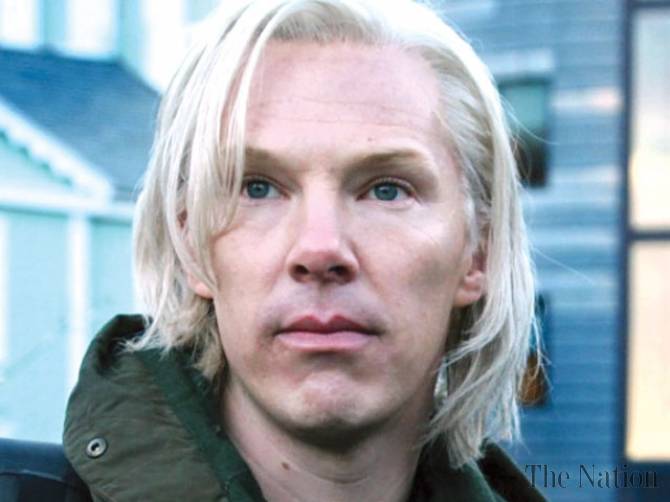
the-fifth-estateIn late medieval times, when people first began to divide each other into groups defined by status and power, they began to speak of a “first estate” (the clergy), a “second estate” (the nobility, which also at the time meant the government), and a “third estate” (the common people.  Later, the “fourth estate” was added to describe journalists and what today we call news media.  Julian Assange, the Australian teenage hacker turned founder of Wikileaks is singular, unprecedented, gui generis.  He collects masses of “secret” data and publishes it without editing, digesting, analysing, or redacting any of it.  And so, this movie, with Benedict Cumberbatch as the white-haired Assange, is called “The Fifth Estate.”

This movie, from director Bill Condon (“Kinsey,” “Dreamgirls”), and based on a book by Assange’s now-estranged former partner Daniel Berg (played in the film by “Rush’s” Daniel Brühl) at times feels as though it is un-digested and un-analyzed.  As a government official forced to resign due to some of the disclosures says near the end of the film, “I don’t know which of us history’s going to judge more harshly.”  I would advise anyone interested in Wikileaks to begin with the documentary, “We Steal Secrets: The Wikileaks Story,” directed by Alex Gibney.

Assange says that he has two goals for what he calls “a whole new form of social justice.”  He says he wants transparency for institutions and privacy for individuals.  The problem, or, at least, one problem is that institutions are made up of individuals.  And so, when one of Wikileaks’ early scoops is a list of British members of the far right “National Party,” it does not bother him that the members’ contact information is disclosed.  Assange is an absolutist.  He refuses to edit or redact (remove identifying information from) any of the documents he publishes.  “Editing reflects bias,” he says.  He is also something of a monomaniac and a megalomaniac, at least in the view of his one-time colleague.  According to this film, he grew up in an odd Australian cult called “The Family,” with severe beatings, and has been diagnosed as being on the autism spectrum.  He is very protective of his own privacy as he exposes the secrets of others.  And, as they say, just because you’re paranoid does not mean they’re not really out to get you.  Once Assange starts exposing the secrets of the wealthy and powerful, they start coming after him, and the thing about being wealthy and powerful is that they have the resources to inflict a lot of harm.  Two of his sources are murdered.

Condon does his best to minimize the scenes of people staring intently into monitors while they bang on the keyboards.  He has some nice visualizations to evoke the experiences, some fantastic, some just the rocky topography of Iceland, one of many places Assange hid.  And he takes a balanced approach.  Everyone would agree with some of what Assange has uncovered.  And everyone would object — even be horrified — by something he has done.  Both sides quote Orwell.  Big Brother is watching.  Like “The Social Network,” the movie focuses on the rise and fall of the friendship and partnership more than the impact of the product they were working on.  In this case, that is in part because we don’t know what that impact will be.  But in this case, we do know that the impact is transformational.  This is not some Facebook advertiser using an algorithm on your status posts to figure out what to sell you.  This is a 22-year-old destroying the confidentiality that allows candid conversations between diplomats, including information about the foreign nationals who are giving them information.

Assange explains early in this film that the program he has developed to protect the identity of the providers of leaked documents is to drown them in false and phony data.  He can say that editing reflects bias, but in the case of terabytes of information dumped in undigested and unredacted form, the data dump can be just as distorting.  Like the journalists Assange worked with on the Bradley Manning material, this film tries to put some shape and perspective on a story that is still too big and too new to frame as a definitive narrative.  But it is an absorbing story and as good an assessment as we can get for now.

Parents should know that this film has very strong language, violence including shooting and wartime scenes with some disturbing images.

Family discussion:  What is the answer to the State Department official’s question about whose side history will be on?  Who should decide what gets released?  If Wikileaks makes other organizations accountable, who makes Wikileaks accountable?  Do you agree with the two things Assange says you need to have to succeed?

If you like this, try: the documentary “We Steal Secrets: The Story of Wikileaks,” read up on the most recent leaker, Edward Snowden, and take a look at the Wikileaks page

Related Tags:


Based on a true story Drama Movies -- format Politics

Captain Phillips

Posted on October 10, 2013 at 6:00 pm

B+
Lowest Recommended Age: High School
MPAA Rating: Rated PG-13 for sustained intense sequences of menace, some violence with bloody images, and for substance use
Profanity: Strong language
Alcohol/ Drugs: Drugs
Violence/ Scariness: Intense, graphic, and disturbing violence including threats, torture, and guns
Diversity Issues: Diverse characters
Date Released to Theaters: October 11, 2013
Date Released to DVD: January 21, 2014
Amazon.com ASIN: B008JFUNKU

captain phillipsMemorable movie villains tend to fall into two categories: volatile and violent or sociopathic and megalomaniac. Both kinds are caricatures, sketched in exaggerated terms to justify our feeling of triumph when the hero prevails. But in “Captain Phillips,” the true story of a US merchant ship taken over by Somali pirates, the villain is far more real and far more terrifying. Somali native Barkhad Abdi stars as Abduwali Abdukhadir Muse, the leader of a group of four teenagers sent to hijack ships for ransom money by elders in their village. Muse is the scariest of villains, someone with no other options and nothing to lose. Abdi’s performance in his first acting role is stunning, terrifying, and heartbreaking.

An awkward opening scene shows Captain Phillips (Tom Hanks) is at home in Vermont, preparing for his trip and driving to the airport with his wife (Catherine Keener), with some clunky, exposition-heavy dialog intended to foreshadow upcoming unrest.  Once he gets to the boat, called the Maersk Alabama, director Paul Greengrass locks into the taut, intimate style he showed in “United 93” and two Bourne movies.  The ship has a crew of 20.  They have been warned about the possibility of pirates and have had some training in how to respond.  Phillips orders a surprise drill to make them practice their defensive tactics.  But this is not a military ship. They are carrying 17 metric tons of cargo.  Their primary tactics are diversion and their primary weapons are their firehoses.

At first, the firehoses work.  But then the Somalis get close enough to the ship to attach their ladder and climb aboard.  “I’m the captain now,” says Muse.  His lack of affect is chilling.

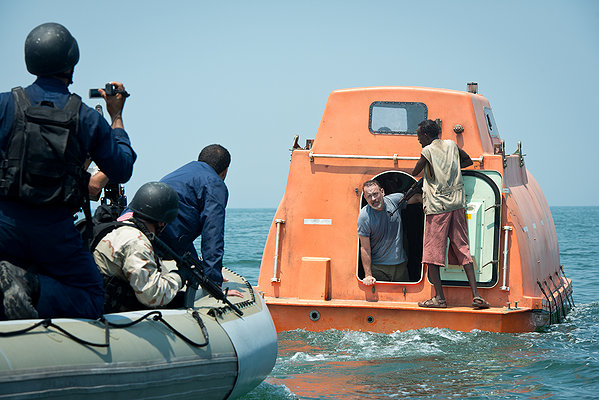
Director Paul Greengrass has an intimate, documentary style that keeps even those who remember the details of the real story on edge.  The pirates search the ship, looking for the crew like a nightmare game of sardines.  Phillips leads them around, genial and cooperative on the surface, but always thinking about how to impede them without making them angry.  When their boat is destroyed, they take one of the lifeboats, more like a capsule than a ship, and they take Phillips as hostage.  For four grueling days, Phillips has to try to keep calm and do what he can to help the US Navy, which is assembling its response.  Hanks goes deeper than he ever has before, ultimately reaching a place of wrenching vulnerability.

After a shaky start, Greengrass and his talented cast make this into more than a story of courage and resilience.  While he clearly has a point of view and never pretends that the pirates are justified, he allows us to understand their desperate circumstances.

Parents should know that this is the true story of a pirate attack on a US ship, featuring intense and disturbing scenes of threats, torture, and violence with some graphic images and dramatic emotional breakdown.

Family discussion:  What was Captain Phillips’ most difficult decision?  What was the most difficult decision for the US military in responding to the pirates? Do you disagree with any of their actions?

If you like this, try: “United 93,” another true story from the same director and Captain Phillips’ book, A Captain’s Duty: Somali Pirates, Navy SEALS, and Dangerous Days at Sea

Related Tags:


Based on a true story Drama DVD/Blu-Ray Pick of the Week Thriller

Rush

Posted on September 26, 2013 at 6:00 pm

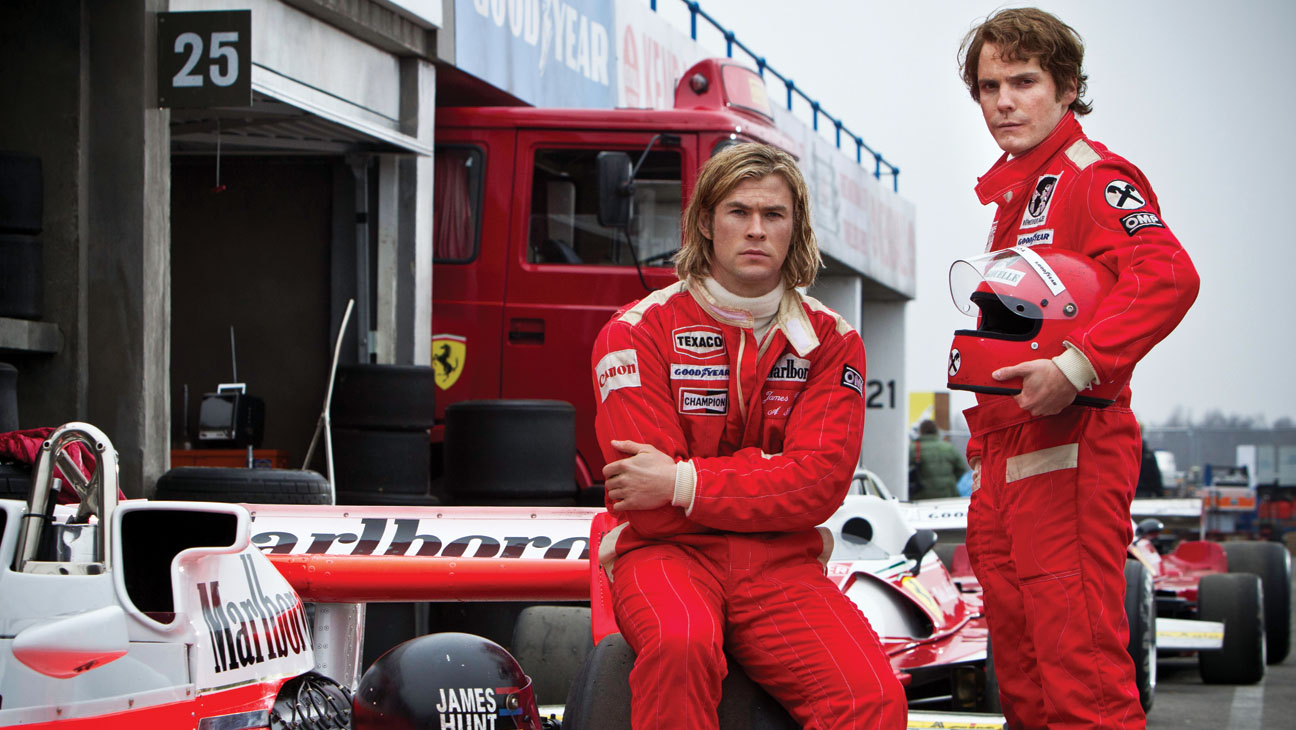
RUSHThe immensely gifted screenwriter Peter Morgan reunites with his “Frost/Nixon” director Ron Howard and returns to his favorite theme, a real-life drama about the clash between two brilliantly talented but flawed figures. This time it is the bitter rivalry between Formula One race car drivers James Hunt (“Thor’s” Chris Hemsworth) and Niki Lauda (“Inglourious Basterds'” Daniel Brühl).  The British Hunt is Maverick to the Austrian Lauda’s Iceman, the Michael to his Sonny, the id to Lauda’s superego.

Both were the rebellious sons of wealthy fathers.  Hunt is handsome, careless, and catnip to the ladies.  “He will have you pulling your hair out nine days out of ten,” a character says, but on the tenth day, when you need him, he will deliver.  Lauda is methodical and analytical.  He calculates the odds.  But they both know that they are among the very few who know what it feels like to get into a car that is essentially a bomb on wheels and speed it around a racetrack.  They both do it not because they like driving in circles but because they like to test themselves.  They both like to win, even need to win.  And, as they remind us perhaps one or two times too many in this film, they both know that the best way to do that is to compete against one another.  “The only people  I can get along with are those who can drive fast,” Hunt says.  He does not really get along with them, either.

Hemsworth, 30 pounds lighter than his Thor/Avengers muscled-up Norse god look, is able to make Hunt magnetic even in 70’s hair.  We meet him as he walks into an emergency room with a bashed nose, not from a racing accident, from a jealous husband.  The pretty nurse (Natalie Dormer) asks what he did to anger the husband and he rakishly offers to show her.  The curtain rings squeal against the rod as it is quickly swung around and soon he is introducing her to his pit crew as “Nursie.”  No time to learn her name, and no need.

Hunt was the James Bond of race car drivers, sexy, sophisticated, and fearless.  But I don’t think James Bond ever threw up before a confrontation.  “Rebels, lunatics, dreamers,” he tells us about race car drivers. “People who are desperate to make a mark and willing to die for it.”  Formula One averaged two deaths a year.  But, he adds, “The closer you are to death, the more alive you feel.”

Lauda says his brain is not that strong but his ass is very smart.  He can tell from a car’s vibrations under the seat that a fan belt will be in trouble and which tire needs air.  He negotiates his driving deals the way he drives, calmly but ruthlessly.   He gets up early to walk the track.  He calculates risk constantly and accurately.  When he explains that one race should be called off because the heavy rainstorm has made conditions unsafe, Hunt, behind on points, persuades the other drivers to vote to continue.  Lauda is very badly injured, including burns on his face and severe lung damage.  In one of the most extraordinary comebacks in the history of sports, Lauda was back on the track 42 days later, against doctor’s orders but able to compete.  In what passed for cheerfulness from the dour Austrian, he told the press that there was one advantage to the skin grafts on his forehead.  They don’t sweat, so he would no longer be bothered by sweat dripping in his eyes.  And, has his wife told him, you drive with your foot, not your face.

Howard conveys the pressure and the thrill of Formula One racing, giving us the view from inside the helmet, and showing us that Hunt’s air of casual mastery is accompanied by a nervous habit of playing with the cap on his cigarette lighter.   He shows us how Hunt and Lauda are always racing, whether it is Hunt visualizing the track or Lauda walking it, competing for the best cars and sponsors, or exchanging barbed comments about whether it is more important to be feared than loved.  The action is electrifying, on and off the track.

Parents should know that this movie includes some disturbing images of crashes and injuries, very strong language, sexual references and situations with nudity, drinking, smoking, and drug use, as well as a great deal of reckless behavior.

Family discussion: What were the most important ways in which Hunt and Lauda were alike?  If you were a sponsor, which would you hire and why?

If you like this, try: “Winning” with Paul Newman, “Grand Prix” with James Garner, and “Le Mans” with Steve McQueen, and Peter Morgan’s “The Damned United” about another real-life sports rivalry.

Related Tags:


Based on a true story Drama Sports

New on DVD: The Life of Muhammad

Posted on August 24, 2013 at 8:00 am

PBS distribution this week released “THE LIFE OF MUHAMMAD” on DVD, Blu-ray and digital download. It is a three-part program, presented by acclaimed journalist and author Rageh Omaar, charting the extraordinary story of a man who, in little more than 20 years, included humble beginnings in Mecca, to his struggles with accepting his prophetic role, his flight to Medina, the founding of the first Islamic constitution and his subsequent military and political successes and failures.  It also explores his legacy as a religious and historic leader, with chapters called: “The Seeker,” “Holy Wars,” and “Holy Peace.”

Filmed on location in Saudi Arabia, Jerusalem, Turkey, Syria, the U.S., the United Kingdom and Jordan, the series also draws on the expertise of some of the world’s leading academics and commentators on Islam, including Tariq Ramadan (academic and fellow of St. Anthony’s College, Oxford), Ziauddin Sardar (London-based scholar and writer specializing in Muslim thought), Tom Holland (British novelist and historian), HRH Princess Badiya El Hassan of the Jordanian Royal Family, Dr. Amira K Bennison (senior lecturer in Middle Eastern and Islamic Studies, Cambridge University), Sajjad Rizvi (associate professor of Islamic Intellectual History, Exeter University), Bishop Nazir-Ali (author of “Islam: A Christian Perspective”) and John L Esposito (professor of Religion and International Affairs and Islamic Studies, Georgetown University).

Any documentary about a religious figure is guaranteed to be controversial.  Some people will object that the series is biased; others will object that it strives too hard for objectivity.  It is a work of history and anthropology, not a hymn. Along with the historical narrative, the film addresses Islam’s role in the world today and explores interpretations of Islamic attitudes toward money, charity, women, social equality, religious tolerance, war and conflict, well worth watching by anyone who wants to learn more about one of history’s most influential and inspirational leaders and the followers who continue to practice his faith and spread his word.


Related Tags:


Based on a true story Biography Spiritual films
THE MOVIE MOM® is a registered trademark of Nell Minow. Use of the mark without express consent from Nell Minow constitutes trademark infringement and unfair competition in violation of federal and state laws. All material © Nell Minow 1995-2026, all rights reserved, and no use or republication is permitted without explicit permission. This site hosts Nell Minow’s Movie Mom® archive, with material that originally appeared on Yahoo! Movies, Beliefnet, and other sources. Much of her new material can be found at Rogerebert.com, Huffington Post, and WheretoWatch. Her books include The Movie Mom’s Guide to Family Movies and 101 Must-See Movie Moments, and she can be heard each week on radio stations across the country.

Website Designed by Max LaZebnik