Lee Daniels’ The Butler

Posted on August 15, 2013 at 6:00 pm

B+
Lowest Recommended Age: Middle School
MPAA Rating: Rated PG-13 for some violence and disturbing images, language, sexual material, thematic elements and smoking
Profanity: Some strong language, n-word and other racist epithets
Alcohol/ Drugs: Drinking and alcohol abuse, smoking
Violence/ Scariness: Peril and violence including police brutality, lynching, murder, rape (off-camera), sad deaths
Diversity Issues: A theme of the movie
Date Released to Theaters: August 16, 2013
Date Released to DVD: January 13, 2014
Amazon.com ASIN: B00EV4EUT8

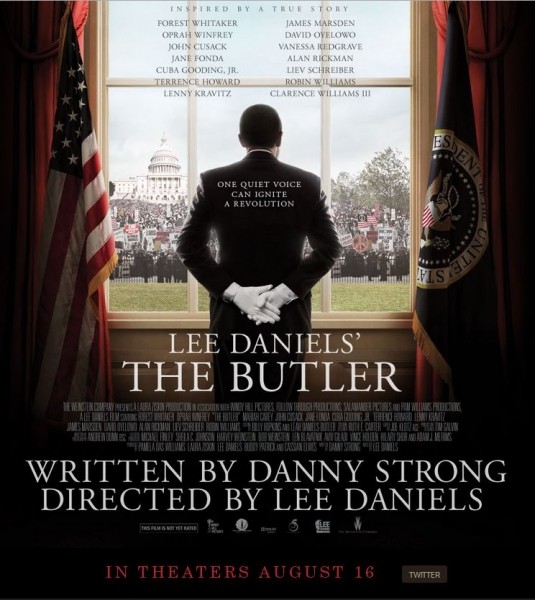
the-butler-poster

Washington Post reporter Wil Haygood was covering the 2008 Obama campaign when some young black women told him that they were going to vote for America’s first major party Presidential candidate who was African-American, even though their fathers told them not to.  The generational chasm that separated the fathers who were not ready to see one of their heritage in the White House and the daughters who were inspired him to check to see whether there might be someone in the White House itself who was of that older generation.  He found one, Eugene Allen, who had been a butler in the White House from the Truman administration to the Reagan administration, and who was planning to vote for Barack Obama, and Haygood  wrote an article telling his story.

That story inspired this film, with Forest Whitaker as Cecil Gaines, born on a plantation in the Jim Crow south and serving eight Presidents while raising two sons.  Like the young women Haygood met, the next generation had very different ideas and aspirations.  The conflict between a man whose job was to serve by being “invisible in the room” had sons who wanted to be anything but invisible. As Sidney Poitier said to Roy Glenn in “Guess Who’s Coming to Dinner” in 1967, “Dad, you think of yourself as a colored man.  I think of myself as a man.”

There are some awkward moments in trying to get through so much material so quickly, with just brief glimpses of some of the Presidents and some of the events.  By the time we figure out that it is Robin Williams playing President Eisenhower, painting a landscape as Cecil serves him from a silver tray, his appearance is over. John Cusack has two juicy scenes as Richard Nixon.  As the eager, if socially clumsy Vice President, he visits the kitchen to hand out buttons and ask the staff what issues are important to them.  “As members of the Negro race,” he intones, as though they do not know who they are, “what are your biggest concerns?”

Later, Cecil sees the President unraveling under the impeachment proceedings.  James Marsden has some of President Kennedy’s charisma, and Minka Kelly is lovely and utterly heartbreaking as Jackie, sobbing in the pink suit covered with blood that she could not bring herself to remove.  Liev Schreiber shows us President Johnson’s swagger, leaving the bathroom door open so he can talk to his aides while he is on the toilet.  Presidents Carter and Ford are seen only in brief archival footage, but Alan Rickman and Jane Fonda are both excellent as the Reagans, shown with more warmth and humanity than the caricatures we might expect.

This cavalcade of star power is just the frame.  Director Lee Daniels and screenwriter Danny Strong (Danny Siegel on “Mad Men”) put the human story at the center of the tumultuous historic changes from the late 1950’s to the first decade of the 21st century.  That gets a little didactic and clumsy.  Cecil Gaines is given two sons, Louis (David Oyelowo of “Red Tails”) and  Charlie (Elijah Kelley of “Hairspray”), so that Louis can become involved in the Civil Rights movement, from sit-ins to freedom rides, and then the Black Panthers and anti-apartheid, while Charlie goes to fight in Vietnam.   But sensitive and heartfelt performances and the ultimate recognition by the characters that despite their estrangement, the connection between Cecil and Louis is powerful and unbreakable makes their reconciliation hit home.  There is a distracting and unnecessary detour into the relationship between Cecil’s wife, Gloria (Oprah Winfrey) and a neighbor (Terrence Howard).  And the cameos by big stars as the Presidents are distracting — and a grim reminder that even powerhouses like Winfrey, Whitaker, and Daniels and a relatively modest budget were not enough to get a Hollywood greenlight without some white stars.  Some of the best scenes are when we see the African-American characters away from the “other face” they have to show whites, relaxed and joking in the White House locker room (Cuba Gooding, Jr. Lenny Kravitz) and  or at neighborhood parties.

Ultimately, this is Cecil’s story.  When he was a child, service was a chance to get out of the cotton field.  In his first job away from the plantation, he learns to present a pleasant, respectful, and helpful face to the customers, to “make them feel not threatened,” to look at them only to “see what they need.”  And he learns to stop using the n-word about himself or anyone else.  When he comes to the White House, he is told,  “You hear nothing.  You see nothing.  You only serve.”  As for the issues, when it comes to the staff, “We have no tolerance for politics at the White House.”

While Louis and his friends are staging a sit-in at a segregated lunch counter, his father is serving dignitaries, wearing white gloves and a tuxedo.  But all the courage and determination Louis shows in his passionate commitment to equality don’t reach the power of the moments when Cecil challenges the long-standing tradition of paying the African-American staff of the White House 40 percent less than the white staff, and not allowing them the opportunity for promotion.

“Darkness cannot drive out darkness,” the movie’s opening epigraph from the Reverend Dr. Martin Luther King tells us.  “Only light can do that.”

Parents should know that this film includes strong language, drinking, drunkenness, and alcohol abuse, sad deaths, peril and violence including police brutality, rape, murder, lynching, racial epithets, sexual references and non-explicit situations.

Family discussion: Talk to members of your family about their own experiences before and during the Civil Rights era and read about some of the people and incidents mentioned in this movie, including Emmett Till, Pablo Casals, and James Lawson.

If you like this, try:  The Autobiography of Miss Jane Pittman, “Eyes on the Prize,” and “The Remains of the Day” and the books The Butler: A Witness to History and White House Butlers: A History of White House Chief Ushers and Butlers

Related Tags:


Based on a book Based on a true story Biography Drama DVD/Blu-Ray Pick of the Week Epic/Historical Family Issues

Jobs

Posted on August 15, 2013 at 6:00 pm

Lowest Recommended Age: High School
MPAA Rating: Rated PG-13 for some drug content and brief strong language
Profanity: Some strong language
Alcohol/ Drugs: Drinking, smoking, drug use including hallucinogens
Violence/ Scariness: Tense and angry confrontations
Diversity Issues: None
Date Released to Theaters: August 16, 2013
Date Released to DVD: November 26, 2013
Amazon.com ASIN: B00BEIYLAW

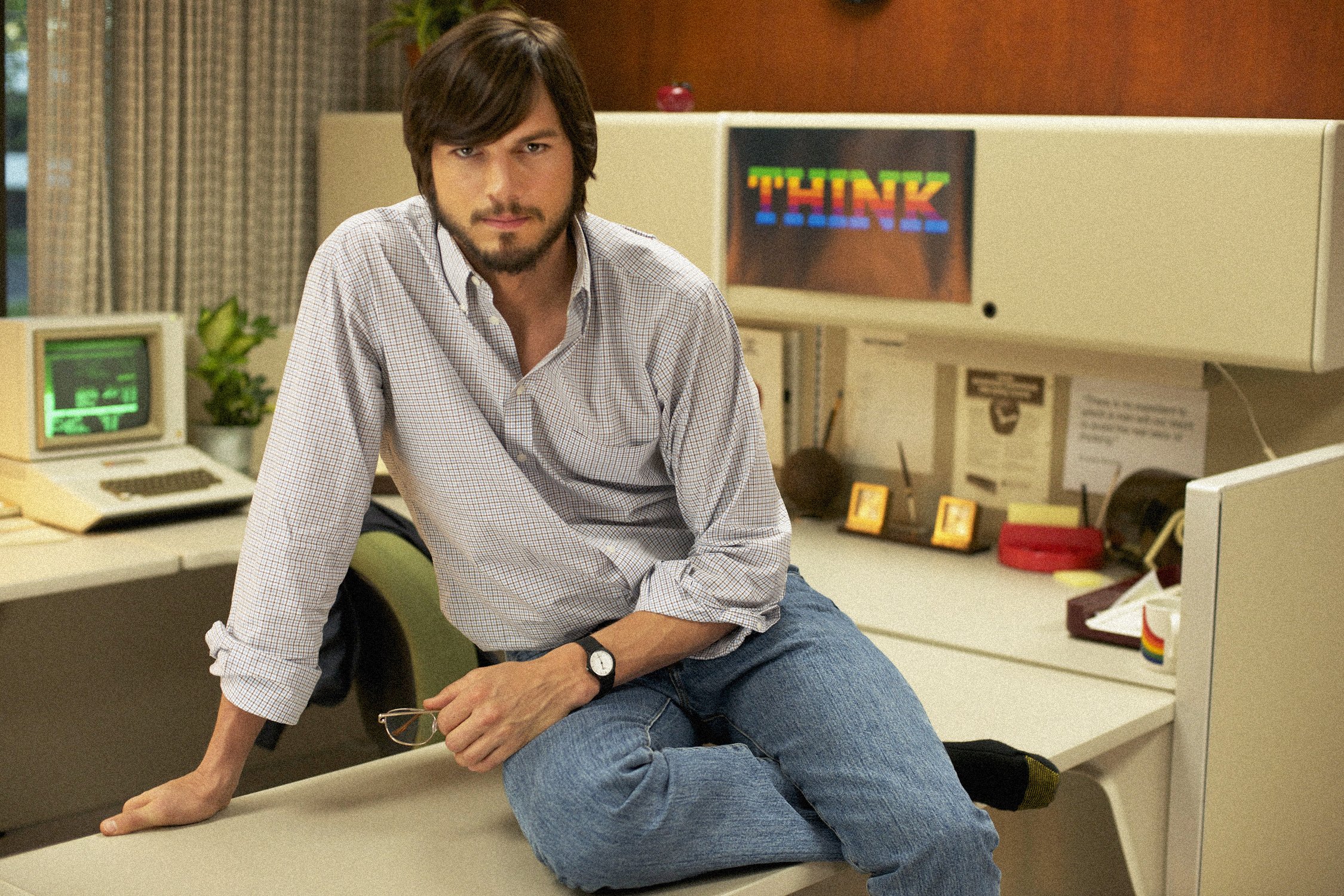
ashton-kutcher-as-steve-jobs

Even the most fascinating character, a true visionary with a transformative impact on the world and a story with one of the most wallopingly vindicating comebacks in business history, cannot always translate into a great movie.  A straight-on biopic cannot help but feel formulaic and clichéd, with the inevitable cinematic ports of call: our hero meets his then-unknown, now-legendary posse, there is a start-up montage of hard work with no resources, and when things get going our hero is accused by the people around him of neglecting them and/or abandoning the principles he once stood for. Everyone will tell him he is wrong.  He will be proven to be right.  Everyone will tell him he is arrogant.  He is, but he is also right.  There are setbacks.  There is triumph.  There are “Stars: They’re Just Like Us”-style peeks into his messy private life.  There is hero worship.  As we learned from “The Social Network,” these stories work better when they do not try to show us why someone was great or how he or she became great but instead tell us a story about a limited set of incidents that illuminate not only the life of this real person but tell us something about our own.

The good news is that just that movie about Steve Jobs is in the works, from “The Social Network’s” Aaron Sorkin. It will show us just three different moments in Jobs’ life, as three products are about to be launched.  And it will have lots of very smart dialog.  I can’t wait to see it.  In the meantime, we have this version, with Ashton Kutcher giving a very respectable performance as Steve Jobs, from his days as a college dropout still attending courses at Reed, in between sleeping around and dropping acid, to his triumphant return to Apple, eleven years after he was thrown out by the board of directors and the CEO he hired. Is it ironic or at least inconsistent that a movie about a man who insisted on “insanely great” innovation and joyfully disruptive, even seismic product development would be the subject of such an old-fashioned, traditionally structured storytelling?  Sure.  It’s like the problem of the computers and other equipment in the movie.  Though it is crucial to the storyline that we see how innovative they are; a couple of decades later they all look as old-fashioned as the rotary phones.  It is not a great or even a very good movie.  It is reporting rather than illuminating.  But it is watchable and modestly entertaining.

We learn very quickly, if clumsily, that (1) Jobs is so brilliant that a benign professor played by James Woods says he is welcome to keep going to class even though he has dropped out, (2) he is something of a user (he picks up a girl, sleeps with her, and then, when she offers him a tab of acid, tells her he is taking a second one for his girlfriend), (3) he is sad and rootless (as he and his friend and girlfriend are tripping as they lie on a blanket in the Oregon countryside, a tear slips out of his eye when he talks about being abandoned by his birth parents).  And while we’re on the subject of tears, there are a lot of damp eyes in this movie.  There may be no crying in baseball, but apparently there are a lot of tears in computers.  And (4) he does not play well with others.  He goes to work as a programmer for Atari, where he alienates everyone by being arrogant and smelling bad.

And then one day his pal Steve Wozniak (Josh Gad, in full nerd mode but with heart) shows him something cool.  He has hooked up his processor to a TV screen so that he can see the code.  Big time light bulb moment for the other Steve.  After an awkward and unimpressive demo for the Home Brew computer club, which led to his first business opportunity.  Jobs realized that there was a market for personal computers beyond the hobbyists and gearheads.  The fact that this seems stunningly obvious now is a tribute in part to his vision.  The clunkiness of the landline phones throughout the movie is another one.  Soon he created Apple with Wozniak and some friends.  Jobs set up a production facility in his parents’ garage and everyone got out their soldering irons and whatever the 1980’s equivalent of Red Bull was and went to work.

We see him rise and fall and rise again, with boardroom battles as vicious and bloodlessly violent as any scene to hit theaters this year.  Jobs is portrayed as a callous but visionary leader who tells his staff that “when you can touch the human heart, it’s limitless,” but parks in the handicapped space and tells his pregnant girlfriend, “I’m sorry you have a problem, but it’s not happening to me.”  He ferociously insists on loyalty from those around him but shows them none in return.

All of the performances are solid, despite the considerable handicap of 70’s hair.  As one of the early Apple employees he cuts out of the IPO gains, Lukas Haas is still making good use of those puppy dog eyes that go way back to “Witness.” Matthew Modine and J.K. Simmons are nicely slick as corporate bad guys.  But so much of both the personal and business story is left out that it feels empty.  The Jobs we see seems more focused on the details of the financing than the details of the product.  The man who felt abandoned by his birth parents (and later refused to see his birth father, even as Jobs was dying) disputed paternity and refused to see his daughter Lisa, but nevertheless named his biggest project after her?  He ran up huge development costs but refused to raise the price of the products to cover them and this made the shareholders the bad guy?  Why was he so ruthless in refusing stock options for the guys who were there at the beginning?  And why doesn’t the movie show that Wozniak gave them a piece of his own share?  Most important, why doesn’t the movie give us more than platitudes in showing us how Jobs got to “insanely great?”

Parents should know that this film includes smoking, drinking, marijuana and hallucinogens, strong language, a paternity dispute, and many tense confrontations.

Family discussion: What were Steve Jobs’ greatest strengths and faults? How can you work toward something that is “insanely great?”  What does it mean to say that “the system can only produce the system” and how can we transcend that?

If you like this, try: Steve Jobs by Walter Isaacson and Steve Wozniak’s iWoz: Computer Geek to Cult Icon: How I Invented the Personal Computer, Co-Founded Apple, and Had Fun Doing It

Related Tags:


Based on a true story Biography Drama DVD/Blu-Ray Pick of the Week

Robin Hood

Posted on August 6, 2013 at 4:00 am

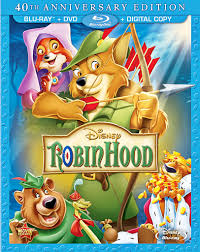
robin hood disneyDisney is celebrating the 40th anniversary of one of its most beloved animated musicals with a gorgeous new Blu-Ray. It is based on the classic Robin Hood story of the man who robbed from the rich to give to the poor in 12th century England.  It has cute cartoon animals playing all of the roles, a talented voice cast, and singable songs from down home country singer Roger Miller.

The story is narrated by Moore as Merry Men minstrel Alan-a-Dale, a rooster.  Wicked but immature Prince John is trying to steal the crown from his brother, brave King Richard (both lions voiced by Peter Ustinov).  He is backed by Sir Hiss (Terry-Thomas as a gap-toothed snake).  In this version of the story, Sir Hiss hypnotizes the king to get him to leave England and fight in the Crusades.  With Richard gone, John abuses the populace, imposing harsh taxes.  Robin (Brian Bedford as a fox) is a nobleman who fights to protect the community, stealing back the money that has been stolen from them by Prince John.  Kids will especially enjoy the antics of Prince John, who reverts to babyhood and sucks his thumb when he is under pressure.

The rest of the cast includes the distinctive voices of Phil Harris (Baloo from “The Jungle Book”) as Little John, a bear, Monica Evans as Maid Marion (a vixen), John Fiedler (voice of Pooh) as a mouse innkeeper, and Andy Devine as Friar Tuck (a badger), and in addition to Miller’s songs “Ooo De Lally,” “Whistle Stop,” and “Not in Notingham,” there is a Johnny Mercer tune, “The Phony King of England.”

I have one copy to give away!  Send me an email at moviemom@moviemom.com with “Robin” in the subject line and tell me your favorite version of this story.  Don’t forget your address!  (US addresses only)  I will pick a winner at random on August 12.  Good luck!

Parents should know that there is some mild peril and slapstick in this film.

Family discussion: Why were brothers John and Richard so different?  Why is Robin Hood remembered as a hero?  Who is most like Robin Hood today?

If you like this, try: “The Adventures of Robin Hood” with Errol Flynn and Disney animation classics like “Pinocchio” and “Peter Pan”

Related Tags:


Animation Based on a book Based on a true story Classic Comedy Contests and Giveaways For the Whole Family Remake Romance Talking animals

The Sword in the Stone

Posted on August 5, 2013 at 4:00 am

A-
Lowest Recommended Age: All Ages
MPAA Rating: G
Profanity: None
Alcohol/ Drugs: None
Violence/ Scariness: Cartoon violence and peril
Diversity Issues: Class issues
Date Released to Theaters: 1963
Date Released to DVD: August 5, 2013
Amazon.com ASIN: B00CUDD0XO

SwordInTheStone50thAnnB_lurayComboDisney is celebrating the 50th anniversary of one of its animated classics with a beautiful new Blu-Ray edition.  Based on The Once and Future King by T.H. White that also inspired the musical “Camelot,” “The Sword in the Stone” is the story of the early years of King Arthur.

Nicknamed “Wart,” the future King Arthur is squire to a knight when he meets Merlin the magician, who promises to take on his education. Merlin turns the boy into a fish, a bird, and a squirrel to teach him lessons like the importance of brains over brawn. He gets to see this in action when Madame Mim, Merlin’s enemy, challenges Merlin to a duel by magic, and, though she cheats, Merlin is able to defeat her.

Wart still has his duties as a squire, and, having forgotten the sword for a jousting match, he runs to get it. He sees a sword stuck in a stone and pulls it out, not knowing the legend that whoever will pull the sword out of the stone will be the rightful king. He becomes King Arthur, and listens when Merlin reminds him that knowledge is the real power.

The Arthur legend has fascinated people for centuries, and this story about Arthur’s childhood as special appeal for children. Aside from the fun of seeing what it is like to be a bird, a squirrel, or a fish, and from having your very own wizard as a teacher, there is the highly satisfying aspect of having one’s worth, unappreciated by everyone, affirmed so unequivocally.

Parents should know that this film has some mild peril and family issues.

Family discussion: What made Arthur the one who could pull the sword out of the stone?  What did he learn from his adventures with Merlin?  How will what he learned help him to be a good king?  How did Madame Mim cheat?  How did Merlin fight back when she did?

If you like this, try: Older kids may like to see “Camelot,” the musical by Lerner and Lowe (of “My Fair Lady”), to find out some of what happened to Arthur later (note that the focus of that movie is on Guinevere’s infidelity with Lancelot). Mature teenagers might like the rather gory “Excalibur,” which has some stunning images.

Related Tags:


Animation Based on a book Based on a true story Classic Comedy Coming of age DVD/Blu-Ray Pick of the Week Epic/Historical Fantasy For the Whole Family Stories About Kids

Still Mine

Posted on July 18, 2013 at 6:00 pm

B+
Lowest Recommended Age: Middle School
MPAA Rating: Rated PG-13 for some thematic elements and brief sensuality/partial nudity
Profanity: Mild language
Alcohol/ Drugs: None
Violence/ Scariness: Sad themes of aging and loss
Diversity Issues: A theme of the movie
Date Released to Theaters: July 19, 2013

StillMineWhy do we spend so much time in movies watching young people fall in love? Why is the wedding so often the happy ending? “Still Mine” is a beautifully performed true-life tale of a couple who have been deeply in love for 70 years. That is a love story.

James Cromwell (“Babe”) plays Craig Morrison, a flinty, taciturn, stubbornly independent man in his 90’s who is committed to caring for his wife, Irene (the exquisitely lovely Geneviève Bujold), as she is struggling with becoming forgetful.  Their seven grown children are concerned, but Irene wants to stay at home and Craig is resolute.  He has land and he knows how to build.  When she falls down the stairs in their home, he decides he will build a new house for them on their land, something small, simple, and one-story, where he can keep her safe.

The local building authorities tell him that he is in violation of their rules.  They have no reason to believe that the structure is unsafe.  But they have regulations about the certification of lumber and various other check-list requirements that his home does not meet.  As the movie opens, he is in court, with the judge to decide whether he will go to jail for contempt, or go home to his wife.

We then go back two years to see what has led to this court appearance, in a series of sensitively understated scenes brimming with privileged moments.  It is clear that the depth tenderness between Craig and Irene is earned over a period of decades.  And it is so sweetly portrayed it will make you eager to get old.

Parents should know that this movie’s themes include aging and loss.  There is a sad death.

Family discussion:  How should families talk about end of life issues?  Do you agree with the way the Morrison’s children and grandson respond to them?  What is the best way for government authorities like the building inspectors to ensure the safety of the community but give people like Craig the freedom they need?

If you like this, try: “The Straight Story” and some of the earlier films with the immensely talented Cromwell and Bujold like “Babe,” “W,” “King of Hearts,” and “Anne of the Thousand Days”

Related Tags:


Based on a true story Drama Family Issues Movies -- format Romance The Real Story
THE MOVIE MOM® is a registered trademark of Nell Minow. Use of the mark without express consent from Nell Minow constitutes trademark infringement and unfair competition in violation of federal and state laws. All material © Nell Minow 1995-2026, all rights reserved, and no use or republication is permitted without explicit permission. This site hosts Nell Minow’s Movie Mom® archive, with material that originally appeared on Yahoo! Movies, Beliefnet, and other sources. Much of her new material can be found at Rogerebert.com, Huffington Post, and WheretoWatch. Her books include The Movie Mom’s Guide to Family Movies and 101 Must-See Movie Moments, and she can be heard each week on radio stations across the country.

Website Designed by Max LaZebnik