Saving Mr. Banks

Posted on December 13, 2013 at 5:17 pm

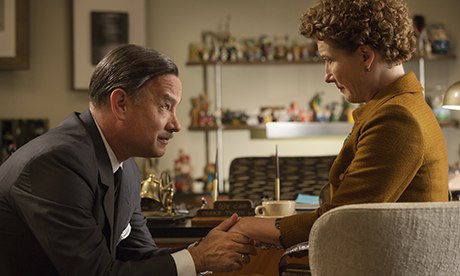
Saving Mr BanksFor most of this story, Walt Disney (Tom Hanks) and P.L. Travers (Emma Thompson) are on opposite sides.  He has been trying for twenty years to persuade her to let him make a movie based on her books about the magical nanny, Mary Poppins.  She needs money, as her agent reminds her, which is why she has very reluctantly agreed to leave home and fly to Los Angeles to talk to him about it.  But she cannot bear the idea of losing control of the characters who mean so much to her and she abhors everything about Disney and California, including sunshine, cheerfulness, twinkling, music, and calling people by their first names.

But there is one moment when, in the midst of some obvious culture clash jokes, there is a quiet moment that shows they are both on the same side.  Disney tells Travers that he was in her position when someone wanted to pay him for Mickey Mouse and he simply could not bear the agony of allowing anyone else to make decisions about a character he had created.  Travers says that Mary Poppins and the Bankses are her family.  But in a very real way, the character these artist created are their own very souls.  “We restore order with imagination,” Disney tells her.  And, engagingly, throughout the film we see the process, the inspiration, the despair, the triumph, the necessity of creating art, from a father soothing his little girl with a story to songwriters puzzling out a way to show Mary Poppins’ upside down world by having the tune go up as she sings the word “down.”

We all know how it turned out.  Disney’s “Mary Poppins,” celebrating its 50th anniversary next year, is one of the beloved and honored family films of all time, with five Oscars (Best Actress, Song, Special Effects, Score, and Editing) and eight more nominations.  But anyone who has read the books knows that there are some major departures from the Travers version, and that the fears she expressed — as documented in tape recordings of her sessions with the screenwriter and songwriting team — were more than justified.

Some people have criticized this film as Disney’s burnishing of its own brand, with its founder portrayed as a decent man who is just trying to keep a two-decade old promise to his daughters to make a movie from one of their favorite books.  Amy Nicholson writes in LA Weekly that “Saving Mr. Banks” is “a corporate, borderline-sexist spoonful of lies.”  She says that Thompson’s “Travers is as unpleasant as a pine needle pillow, and she’s as far away from the actual woman as ‘supercalifragilisticexpialidocious’ is from being a real word” when in fact she was a “a feisty, stereotype-breaking bisexual.”  I think this is a misreading of the film’s attitude toward Disney, Travers, “Mary Poppins” (the movie), and what it means to be a creative person in a world that is very imperfect when it comes to assigning monetary value to art (see also: “Inside Llewyn Davis”).  To come to Nicholson’s conclusion, one has to assume that the movie wants us to believe that Disney somehow outsmarted Travers by improving her work.  On the contrary, the movie makes it clear that the movie Mary Poppins was very different from Travers’ idea of the characters, moving them several decades earlier, for a start, and, crucially, as indicated in the title of this film, transforming an episodic storyline about children’s adventures with a magical nanny into a story about parents discovering the importance of being close to their children.  It is Nicholson who underestimates Travers by suggesting she was somehow snookered.  She made a decision that it was worth it to her to let that happen to get the money she needed to be as financially independent as she wished.  As is shown in the very first scene, she could have made money another way — by writing more books about Mary Poppins, for a start — but she chose to consent to the movie, and then to make absolutely sure that no American would ever touch her characters again.

colin-farrell-saving-mr-banks-gintyWhile the cute culture clashes and Travers’ resistance to Disney’s brand of pixie dust are featured in the movie’s trailers, the film itself devotes a substantial amount of time to Travers’ childhood, clearly taking her very seriously as a woman and an artist.  We see her as a child dearly loved by the father she adored (a superb Colin Farrell), a man of great imagination and charm, but, perhaps in part due to those same qualities, not able to manage life as a banker in the far reaches of Australia. As we see him sink from manager at a bank to manager at a smaller bank to teller, fans of the Poppins books will remember her description of what Mr. Banks did at the office (it is not coincidental that he shares a name with his profession).  He “made money.”  Meaning that, at least in his children’s minds, he sat at his desk cutting out coins each day.  Some days he was able to cut out many, and the family was quite comfortable.  But other days he was not as productive, and there were fewer coins to go around.

We can see the origins of this idea and many other Mary Poppins book details in Travers’ past, a seemingly bottomless carpet bag, a crisp “spit spot” from an imposingly organized woman who arrives to put the household in order.  But the most telling detail from the past is the key to the invention of Travers’ most important character: herself.  Her name is not P.L. Travers at all.  Nor is she Mrs. Travers, despite her insistence that Mrs. Travers is what she prefers to be called.  The Australian girl who would grow up to be the ultra-English P.L. Travers is named Helen Lyndon Goff, called “Ginty” by her dad.  His name was Travers Robert Goff.  She took his first name as her last name and put a “Mrs.” in front of it to create the character she chose to be.  This revelation, and Thompson’s brilliant portrayal of Travers show us a woman whose most important creation was the character she pretended to be — or became.

And of course Disney, too, played a character, the folksy host who was going to entertain you no matter how hard you tried to resist, and very well aware that these qualities were his best assets as a businessman.  He insists on taking Travers to Disneyland (beautifully recreated as it was in 1961).  Disney is persuasive enough to get Travers onto the carousel and canny enough to tell her the truth — that getting her on a ride won him a $20 bet.  And he tells her a story about his childhood, showing that just because he promotes an idealized vision of the world does not mean that he is unfamiliar with its harshness and disappointments.

Thompson gives one of the best performances of the year, showing us the insecurity and humanity and wit of a woman who is far more complex than she wishes to appear.  Jason Schwartzman and B.J. Novak as the song-writing Sherman Brothers and Paul Giamatti as the limo driver are all excellent as characters who underscore the theme of art as a path to meaning.  The glimpses of the “Mary Poppins” movie are so entrancing (okay, I had to come home and watch it again and am still humming “Step in Time”) that it is easy to be temporarily distracted from the bittersweetness of the story.  Hmmm, where have I heard that idea before?

Parents should know that this film includes the very sad death of a parent, substance abuse, a suicide attempt, tense confrontations, and some disturbing images.

Family discussion:  What did Walt Disney and P.L.Travers have in common?  What do you learn about her from her relationship with the driver?  How can you take details around you and make them into a story?

If you like this, try: the Mary Poppins books by P.L. Travers and the Disney musical film and the documentary “The Boys,” about the Sherman Brothers

Related Tags:


Based on a true story Behind the Scenes Drama Family Issues

Ten Lessons from Schindler’s List

Posted on December 8, 2013 at 8:00 am

schindlersListSteven Spielberg’s film about Oskar Schindler and the 1200 Jews he saved from being killed by the Nazis came out twenty years ago, based on the novel by Thomas Keneally (originally titled Schindler’s Ark).  Keneally happened on the story when he stopped in a Beverly Hills luggage shop and chatted with the owner, who turned out to be one of the people saved by Schindler. Keneally later wrote Searching for Schindler: A Memoir, about his research, writing the book, and his dream of “an Oscar for Oskar” that came true when the movie was made in 1993.
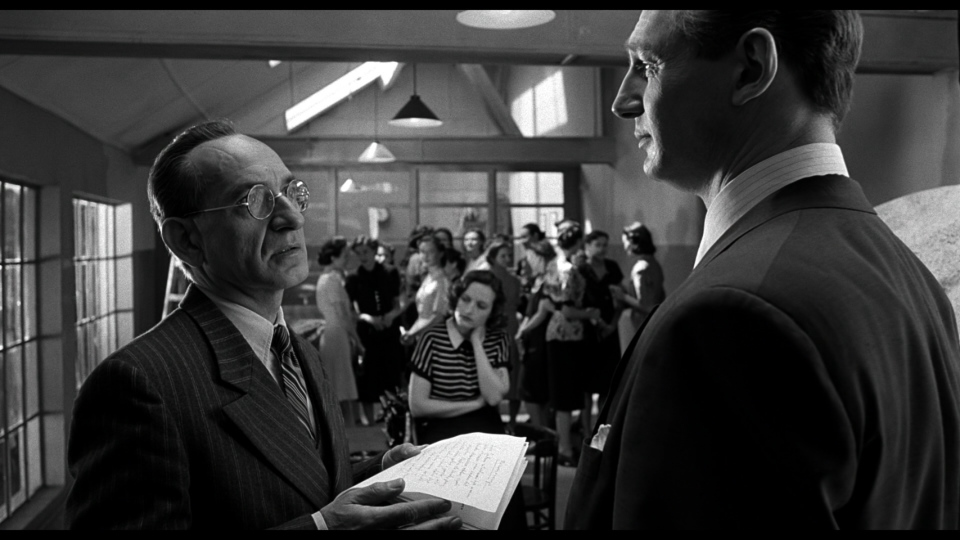
The anniversary is just one of many good reasons to remember Schindler and ten of the lessons from the film.

1.  Even if you cannot stop a great wrong, you can do something that will be very meaningful.

2. Heroes are not always exemplars of integrity and sacrifice.  Oskar Schindler worked for the Nazis and was for much of his life an opportunist and self-promoter.  Keneally once said that what interested him about Schindler was “the fact that you couldn’t say where opportunism ended and altruism began. And I like the subversive fact that the spirit breatheth where it will. That is, that good will emerged from the most unlikely places.”  No one is perfect.

3. And a related lesson — sometimes a person’s faults are assets when it is time to rebel against authority.

4. Schindler was able to save 1200 people by insisting that they were essential employees in his business and contributing to Germany’s wartime efforts.  This shows that people in business can — and must — make as much or an even greater contribution to the public good as government and non-profits.

5.  The Nazi camp commander played by Ralph Feinnes shows us how a soul is destroyed by evil.  The more corrupt he becomes, the more he must wall himself off from any sense of compassion or decency.

6. This movie was made half a century after the events it depicted and nearly 20 years after Schindler’s death.  Sometimes it takes a while for us to be able to begin to understand historical events.

7. Some historical events are so enormous and so tragic they can never be fully understood.  The best we can do is tell as many different pieces of the story as possible.  The story of a small group who were saved must help us better understand the reality of those who did not survive.

8.  As we reach the end of the time when living witnesses will be able to share their stories directly, it is even more important that we make sure that these stories are remembered.  Making this film inspired director Steven Spielberg to create the Shoah Foundation and an archive of interviews.

9.  Even a child can save a life with quick thinking and courage. schindlers_list_neeson kingsley

10.  To quote the line from the Talmud in ring given to Schindler by the Jews he saved: “Whoever saves one life saves the world entire.”

Related Tags:


Based on a true story Classic Epic/Historical

Philomena

Posted on November 24, 2013 at 8:40 pm

B+
Lowest Recommended Age: High School
MPAA Rating: Rated PG-13 on appeal for some strong language, thematic elements and sexual references
Profanity: Very strong, frank, and explicit language for a PG-13
Alcohol/ Drugs: Drinking
Violence/ Scariness: Sad deaths and abuse
Diversity Issues: Diverse characters, issue of anti-gay bigotry is discussed
Date Released to Theaters: November 22, 2013
Date Released to DVD: April 14, 2014
Amazon.com ASIN: B00GSBMNOQ

Philomena-dench-movieDame Judi Dench has played many strong-minded, determined characters, from Queens (Victoria and Elizabeth I) to the even more imperious head of the MI6 who can take on James Bond with an air of crisp authority.  As the title character in “Philomena,” she shows us the radiance and inner core of strength in a woman we might otherwise find easy to overlook.

Martin Sixsmith (co-screenwriter Steve Coogan) underestimates her at first, too.  Sixsmith is a journalist-turned politician smarting from a public humiliation after he was fired for something he did not do.  He gets little sympathy from those around him and it seems clear that being aggrieved has only fed his sense of superiority, isolation, and entitlement.  He mutters something about writing a book on Russian history, though he realizes no one is very interested in reading it.  When he meets a young Irish woman who offers him her mother’s story of a half-century search for the son she was forced to give up for adoption, his first reaction is a haughty, “I don’t do human interest stories.”  The truth is, he is not really interested in humans, in part because they have not done a very good job of being interested in him.

Sixsmith did eventually write some books about Russia.  But first he decided to give human interest a try.  The result was Philomena: A Mother, Her Son, and a Fifty-Year Search.

When she was a teenager, Philomena (Dench) became pregnant and her parents sent her to the now-notorious Magdalene Sisters workhouse.  The girls were forced to work for years to pay (financially and spiritually) for their sins.  The abused and underage girls also signed away all of their rights to their babies, including access to information about where they were placed.  Philomena (Sophie Kennedy Clark as a young woman) was working in the laundry when her son was taken from her and adopted by an American family.  For half a century, as she became a nurse, married, and had more children, she missed him and worried about him.  Sixsmith found an editor to pay him to write the story, covering expenses for a trip to America to see if they could track him down.  She hopes the story will have some lurid details.  “Evil is good — story-wise, I mean….It’s got to be really happy or really sad.”

Coogan knows he is at his best playing slightly high-strung, slightly self-involved guys who are too smart for the room and usually end up outsmarting themselves (see “The Trip”).   It is especially satisfying to watch his character go from irritation to respect and then affection.  There’s a reason the movie is named for her.  Philomena is a surprise.  If she has awful taste in books and movies, it is because she has the gift of being able to be pleased.  When it comes to the big things, she is refreshingly clear-eyed and open-minded.  And  she understands what it takes to not let anyone make you a victim.

More improbable than any fictional story would dare to be, the journey taken by Philomena and Sixsmith is bittersweet and ultimately transcendent.  Performances by Dench and Coogan of great sensitivity illuminate this story of a quiet heroine and the man who was lucky enough to learn from her.

Parents should know that this movie was initially rated R and then given a PG-13 on appeal.  It concerns young teenagers put in a home for out-of-wedlock pregnancies and forced to give up their babies for adoption and there is frank discussion of sex and a childbirth scene, the abuse of the young women by the nuns who ran the home, and the life of a character as a closeted gay man.  Characters use very strong and explicit language and there is some drinking.

Family discussion: Why did Martin and Philomena feel differently about forgiveness?  Did she find what she was looking for?

If you like this, try: “The Magdalene Sisters” and “The Trip”

Related Tags:


Based on a book Based on a true story Drama DVD/Blu-Ray Pick of the Week Family Issues

12 Years a Slave

Posted on October 17, 2013 at 6:15 pm

A-
Lowest Recommended Age: Mature High Schooler
MPAA Rating: Rated R for violence/cruelty, some nudity and brief sexuality
Profanity: Constant use of racial epithets, sexual references
Alcohol/ Drugs: Drinking and drunkenness
Violence/ Scariness: Intense and disturbing violence including rape, murder, whipping, and abuse, disturbing and graphic images
Diversity Issues: A theme of the movie
Date Released to Theaters: October 18, 2013
Date Released to DVD: March 3, 2014
Amazon.com ASIN: B00G4Q3NDA

12-years-a-slave-2Watching “12 Years a Slave” is a shattering experience. It shatters any remaining illusions of gracious, chivalrous, Southern plantation life in the pre-Civil War era.  They were based on the late 19th century myth-making from the children of slave-owners in a toxic effort to disguise the reality that the South was fighting to preserve a system of virulent racism fueled by the economics of plantation life. It shatters cherished notions of the first principles underlying the founding of this country.  The man who wrote the revolutionary words that “all men are created equal” was a part of this atrocity. It shatters all previous depictions of slavery.  By comparison they seem cartoonish and fraudulent, from “Gone With the Wind” to “Django Unchained,” more about the time they were made than the time they depicted. And, like all great films, it shatters our previous notions of what was possible on screen, with performances so vivid and compelling they seem to break through every boundary, between us and them, between then and now, between actor and audience. In one audacious moment, Solomon Northrup (Chiwetel Ejiofor), a free man sold into slavery, looks into the distance, eyes filled with ineffable suffering and loss, and then turns to face us, looking into the eyes of those who are looking at him, bringing us further into his world.

This is different because it is a rare story of pre-Civil War South told from a black person’s point of view. It is based on Northrup’s book, written after he returned to his family.  It is the story of slavery from a man who experienced it, and who knew what it was like to live as a black man who was not just free but better educated and more successful than most people of any race in his community. In that sense, it is a story told from inside the system of our country’s greatest shame.  In another sense, it is presented by outsiders, director Steve McQueen (British) and stars Ejiofor (the British son of Nigerian immigrants) and Lupita Nyong’o (born in Mexico, raised in Kenya, educated in the US).  They tell us Northrup’s story — and ours — without being tied to the way we prefer to tell ourselves what our history is and means.

Northrup is a successful musician, happily married with two adored children and respected by both white and black members of his community in New York State.  He accepts a job playing with some circus performers (Scoot McNairy and “SNL’s” Taran Killem) in Washington, D.C., where slavery is legal.  They drug him and sell him to a slave dealer (Paul Giamatti).  Without his papers, he cannot prove he is a free man.  Soon he is renamed Pratt and transported to Louisiana, where he is sold first to a comparatively benevolent man (Benedict Cumberbatch), but then, when he gets into a fight with the overseer (an oily Paul Dano), he is re-sold to a brutal man who prides himself on being an n-word-breaker (Michael Fassbender).  Northrup loses more than his family, his liberty, his name, and his freedom.  He loses his very self; he is told early on that if the white people know he can read and write, it will create more trouble for him.  Indeed, when he tries to be helpful by suggesting a better system for transporting the crop, he earns the gratitude of his master but incurs the jealousy of the white boss.  The only way to survive is to pretend to be the sub-human the owners need them to be to continue to hold onto their bigotry.

This movie makes clear the poisonous, psychotic twisted mind that can accept or even justify the idea that one person can buy and sell another.  Over and over, we see the slaveholders at the same time acknowledging and denying the humanity of the people they think they own.  A female slave sobs because her children have been sold and she will never see them again.  The woman of the plantation, briefly sympathetic, says, “Poor woman.”  But then, immediately after, “Your children will soon be forgotten.”  Slaves are included in family worship services (though not seated with the family).  But their souls are never acknowledged; they are categorized as livestock.

There are terrible beatings.  There is torture and rape.  Slave children run and play, laughing, ignoring the man who is almost choking to death as punishment. There are property identification chains slaves must wear if they go off the property, like something between a hall pass and a dog tag.  There is a slave who has made her peace with what she has done to get better treatment — and with what she now does to other slaves.

Instead of the lush orchestral score usually underlying period films or the melancholy flute and drum usually heard in Civil War films, Hans Zimmer has created spare, edgy music that is bleak without being maudlin.  McQueen’s approach is sure and direct and the script by John Ridley is ably structured and thoughtful.  Nyong’o’s gives performance of exquisite grace and heart-wrenching dignity.  But the center of the story is Northrup.  Ejiofor is sure to get an Oscar nomination for a performance of unparalleled depth and eloquence.

Parents should know that this film includes very graphic and disturbing images of slavery, with rape, murder, and abuse, brutal whipping and atrocities, nudity, sexual references and situations, constant racial epithets, drinking and drunkenness.

Family discussion: What was the significance of the early scene in Mr. Parker’s store?  How does this story differ from other movie depictions of the pre-Civil War South?  Why did Northrup join in the singing of “Roll, Jordan, Roll?”

If you like this, try: book by Solomon Northrup, “Amistad,” American Experience: The Abolitionists, and Roots

Related Tags:


Based on a book Based on a true story Drama DVD/Blu-Ray Pick of the Week Epic/Historical
THE MOVIE MOM® is a registered trademark of Nell Minow. Use of the mark without express consent from Nell Minow constitutes trademark infringement and unfair competition in violation of federal and state laws. All material © Nell Minow 1995-2026, all rights reserved, and no use or republication is permitted without explicit permission. This site hosts Nell Minow’s Movie Mom® archive, with material that originally appeared on Yahoo! Movies, Beliefnet, and other sources. Much of her new material can be found at Rogerebert.com, Huffington Post, and WheretoWatch. Her books include The Movie Mom’s Guide to Family Movies and 101 Must-See Movie Moments, and she can be heard each week on radio stations across the country.

Website Designed by Max LaZebnik