The Big Sick

The Big Sick

Posted on June 22, 2017 at 5:53 pm

B +
Lowest Recommended Age: Mature High Schooler
MPAA Rating: Rated R for language including some sexual references
Profanity: Strong and explicit language
Alcohol/ Drugs: Alcohol
Violence/ Scariness: Very serious illness
Diversity Issues: A theme of the movie
Date Released to Theaters: June 24, 2017
Date Released to DVD: September 25, 2017
Copyright Amazon 2017

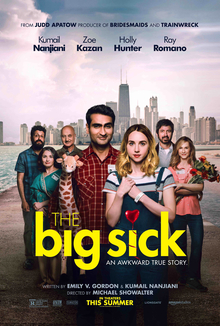
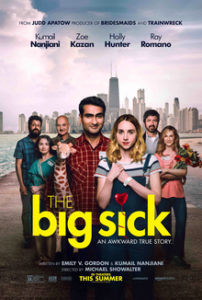
The more specific the story, the more universal. This is a very specific story. Indeed, you are unlikely ever again to see a romantic comedy with one of the pair spending half of the film in a coma. And that is not the couple’s biggest obstacle. Kumail Nanjiani (“Silicon Valley”), plays a character named Kumail Nanjiani in a story based on his relationship to Emily V. Gordon (played by Zoe Kazan and called Emily Gardiner in the film), who is now his wife and the co-screenwriter of the smart, touching, heartfelt and very funny film. It is beautifully directed by Michael Showalter, as always unsurpassed in meticulous casting of even the smallest roles.

Real-life Nanjiani and his movie alter ego are Pakistani immigrants from traditional families. Every time he visits his parents for dinner, an unmarried Pakistani woman “happens to drop in.” They have made it very clear that they expect him to marry a woman who is Pakistani and Muslim. Gordon is neither; she is white and from North Carolina. Just after they break up because he could not say that they could have a future together, she suddenly becomes critically ill and is placed in a medically induced coma.  He gets the call when she is hospitalized and has to be the one to call her parents. He meets them for the first time in the hospital waiting room, where they are understandably frosty (he broke their daughter’s heart) and preoccupied (she’s in a coma).

They would rather that he not be there. And his parents find out that he has not been honest with them and they tell him they cannot accept his feelings for Emily. So, in the second half of the movie there is another kind of love story, about the love between parents and their children and the partners their children choose.

It is also a story about a man learning to be honest with himself about who he is and what he wants. What lifts this out of the recent glut of arrested development movies is its compassion for all parties (the film nicely acknowledges that Nanjiani’s brother has a very successful and satisfying marriage arranged the traditional way and presents as one of the candidates a woman so seemingly perfect for him that we almost root for her) and Nanjiani’s thoughtful, self-deprecating but confident performance. The best stand-up comics mine their own lives for material, with observations that make us see our own lives, and especially our follies and irrationalities, in sharper relief — that’s relief in both senses of the word.

Best of all, the movie itself is proof that they lived happily ever after.

Parents should know that this movie includes strong language, sexual references and non-explicit situations, family conflict, and very serious illness.

Family discussion: Why didn’t Kumail tell Emily about his family’s concerns? How should you decide what traditions to keep and which ones to leave behind?

If you like this, try: “Ruby Sparks” (also with Kazan, who wrote the screenplay) and “50-50” with Joseph Gordon-Levitt and Seth Rogen, also based on a true story

Related Tags:


Based on a true story Comedy Comedy Date movie Drama DVD/Blu-Ray Pick of the Week Family Issues Illness, Medicine, and Health Care movie review Movies -- Reviews Romance
White Chicks

White Chicks

Posted on June 23, 2004 at 4:58 am

C
Lowest Recommended Age: High School
MPAA Rating: Rated PG-13 for crude and sexual humor, language and some drug content
Profanity: Very strong language for a PG-13
Alcohol/ Drugs: Drug humor, drinking, smoking
Violence/ Scariness: Comic violence including guns, characters shot but no one badly hurt
Diversity Issues: A theme of the movie
Date Released to Theaters: June 23, 2004
Date Released to DVD: October 26, 2004

Appealing performers and a couple of very funny moments don’t make up for a lazy and generic script in this predictable farce about two black male FBI agents who go undercover as spoiled rich white girls. I knew we were in trouble when there was a “Hammer Time” joke in the first few minutes, a reference way past its sell-by date. And a Bjork swan-dress joke? In white chick terms, that’s so yesterday.

Copyright Columbia Pictures 2004

In rap music terms, this movie samples characters and plots from many other movies, including the already vastly over-used (attractive and principled but do-things-their-own-creative-way law enforcement types always getting chewed out by choleric superiors until one of their wacky schemes pays off and they get to be heroes) and the already done so brilliantly and distinctively that no one should ever try them again (whoever thought of appropriating the “Junior” plot twist from Some Like it Hot should be sent to the screenwriter equivalent of solitary confinement).

Even the movie doesn’t even appear to paying attention to its plot. Movies don’t have to be logical; they don’t even have to make sense. But sloppy inconsistencies like the ones here become a distraction that interferes with the ability of the audience to enjoy even the jokes that work.

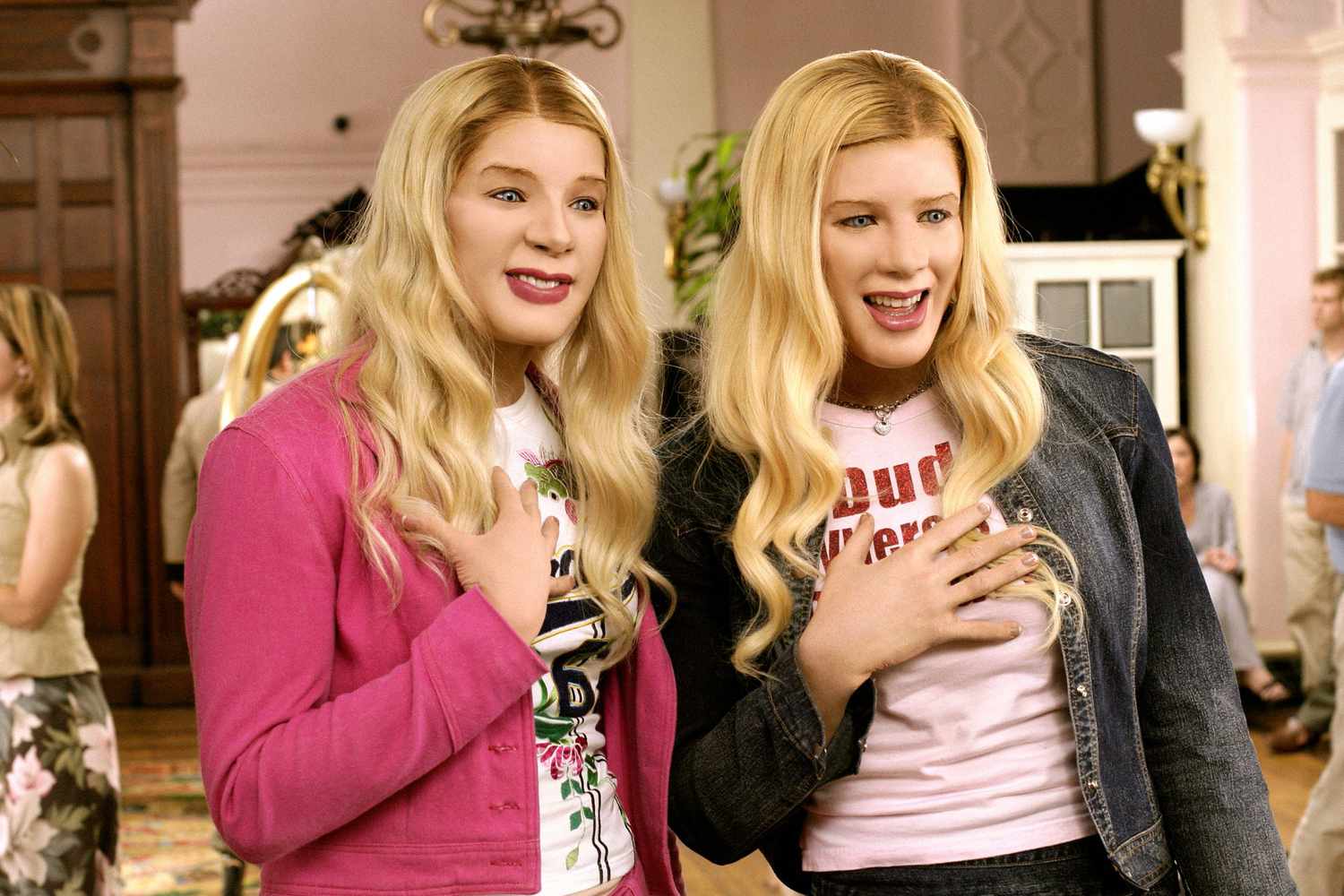
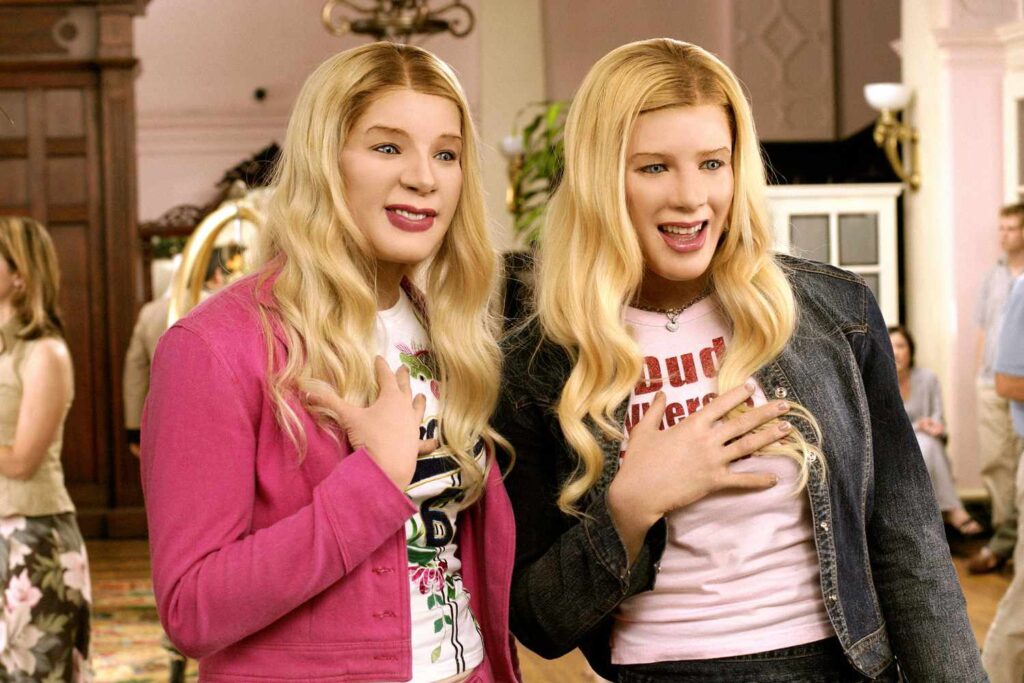
Shawn and Marlon Wayans, apparently both the Zeppo Marxes of the talented Wayans family, play FBI agents Kevin and Marcus Copeland. It is typical of this movie’s problems that no one had the energy to give these characters anything resembling a personality. They are almost indistinguishable from each other except that one has a hysterically jealous wife and the other has a goatee and is single.

After they bungle a drug bust, they are assigned to escort the Wilson sisters (think Paris and Nicky Hilton), who may be targets for a kidnapper. They are on their way to a weekend at the Hamptons where they hope to be photographed for the cover of a magazine. A minor car accident on the way there leaves them with scratches on their faces and they refuse to be seen that way. So, the Copelands call in the FBI’s crackerjack undercover make-up team to transform them into the Wilsons. Conveniently, they both already have earrings.

Despite the fact that they are taller than the girls and the latex masks applied to their faces make them look like victims of Botox overkill, no one in the Hamptons seems to notice anything significantly different about “the girls” (one friend guesses that they’ve had collegen treatments to turn their lips from “Cameron Diaz to Jay-Z”). The Copelands squeal and giggle, shop with the girls, go all mean girls on the snooty rich snobs, and participate in a fashion show and a dance-off (okay, that dance-off is pretty funny). They also go out on dates, Marcus in drag with a smitten athlete (the very funny Terry Crews) and Kevin as a man but pretending to be someone else to impress a pretty reporter.

Gender and race-switching are inherently funny but the situations and jokes in this script do very little to build on that energy and sometimes actually get in the way. There are predictable culture clashes, as when the society girls sing along to Vanessa Carleton’s “1000 Miles” and the Copelands have to pretend to know the words. Then, when the rap song comes on…well, you know where this is going. (A twist on this scene later on provides the movie’s most sustained laugh.) There is a lot of gross-out humor involving various body parts and functions, and some leering double entendres. There are also predictable life lessons as the Copelands develop more empathy for women and encourage the society girls to have more self-respect, to insist on the best for and from themselves. Too bad the Wayans forgot to learn that lesson themselves; the insights are delivered with no more enthusiasm, sincerity, or imagination than the comedy.

Parents should know that the movie has very crude and vulgar material for a PG-13, with comedy based on sexual references (including a game where players have to choose between two unappealing sexual encounters), drug jokes, insult humor, and a lot of graphic potty humor. Characters use strong language, not just the usual “almost-R” words but also terms that may concern parents like “yeast infection,” “coke whore,” “bitch fit,” and the n-word. Racial insults and stereotyping are intended to be comic. The movie has some comic and action violence, meaning that a lot of punches are thrown and a few shots are fired but no one is seriously hurt.

Families who see this movie should talk about what Kevin and Marcus learn from pretending to be white women. Why was it so hard for Karen, Lisa, and Gina to feel good about themselves and their relationships?

Families who enjoy this movie will also enjoy the better movies it borrows from, like Some Like it Hot, which was first on the American Film Institute’s funniest movies of all time, and Tootsie, which was second. They may also enjoy Martin Lawrence in drag as an undercover cop in Big Momma’s House. The freshest and funniest Wayans film is still I’m Gonna Git You Sucka.

Related Tags:


Comedy movie review Movies -- format Movies -- Reviews
THE MOVIE MOM® is a registered trademark of Nell Minow. Use of the mark without express consent from Nell Minow constitutes trademark infringement and unfair competition in violation of federal and state laws. All material © Nell Minow 1995-2025, all rights reserved, and no use or republication is permitted without explicit permission. This site hosts Nell Minow’s Movie Mom® archive, with material that originally appeared on Yahoo! Movies, Beliefnet, and other sources. Much of her new material can be found at Rogerebert.com, Huffington Post, and WheretoWatch. Her books include The Movie Mom’s Guide to Family Movies and 101 Must-See Movie Moments, and she can be heard each week on radio stations across the country.

Website Designed by Max LaZebnik