
Muppets Most Wanted

Posted on March 20, 2014 at 6:00 pm

A-
Lowest Recommended Age: All Ages
MPAA Rating: Rated PG for some mild action
Profanity: None
Alcohol/ Drugs: None
Violence/ Scariness: Some peril and action, no one hurt
Diversity Issues: Diverse characters
Date Released to Theaters: March 21, 2014
Date Released to DVD: August 11, 2014
Amazon.com ASIN: B00H4RL2H2
Poster courtesy Walt Disney Pictures

The Muppets live up to the title in this adorable follow-up that is even truer to the essence of Muppetry than the Jason Segal predecessor because it puts the Muppets themselves at the heart of the story, not the humans. And that’s very good news. No one is better than the Muppets at creating a giddy mixture of sharp wit, delirious silliness, pop culture references (here they range from Ingmar Bergman’s scythe-bearing Death chess match to a “Producers”-inspired prison gang kick-line) and random guest stars (Lady Gaga! Tony Bennett! Together!), and a self-deprecating but irrepressibly sunny sensibility. There is always grand spectacle, romance, and heart, even a brief but telling lesson in manners. Plus, there’s another tuneful and hilarious collection of songs from Oscar-winner Bret McKenzie. The result is pure joy.

It starts about one minute after the last movie ends.  The human couple is clearly on the road to happily ever after, but what about the Muppets?  Time for a sequel! “While they wait for Tom Hanks to Make ‘Toy Story 4,'” they sing, even though “everybody knows that the sequel’s never quite as good.”  They also blithely explain that we can expect “a family-style adventure during which we should bond and learn heartwarming lessons like sharing and taking your turn and the Number 3.”

The Muppets hire Dominic Badguy (“pronounced Bad-GEE”) (Ricky Gervais) as their new tour manager and go to Europe to perform.  He actually is a bad GUY, however, and the tour is just a cover for an elaborate series of heists, conveniently located next door to the venues selected by Dominic.  Meanwhile, Constantine, the most dangerous frog in the world, escapes from the Siberian gulag where he has been in prison.  And he looks almost exactly like Kermit, except for a distinctive beauty mark on his cheek.  Constantine slaps a fake birthmark onto Kermit’s cheek, covers his own with green make-up, and soon Kermit is captured (vainly trying to explain that he’s an “Amphibian-American”) and sent to the gulag.

And Constantine is running the Muppet Show.  Even though he speaks with a thick accent and has a completely different personality, none of the Muppets notices the switch, especially when he tells them they can do whatever they want.  Miss Piggy does not realize that her beloved frog has been replaced.

Meanwhile, the hard core prisoners in the gulag (including Ray Liotta and a mystery guest star in solitary) figure out immediately that Kermit is not Constantine because he says “thank you.”  Even Nadya (Tina Fey), who runs the prison, knows it is not Constantine.  But her fondest dream is a first-class gulag musical show.  She won’t let Kermit leave because she needs him to direct it.  And she knows every possible trick the prisoners might try to sneak out.  She explains, “I have a Netflix account with the search words ‘prison escape.'”  Also, she likes him.  So, soon Kermit is overseeing a prison kick-line to a song from “A Chorus Line” (the guy in solitary has a great set of pipes).  And Constantine is getting ready for the biggest heist of all: the British royal family’s crown jewels, though — wait for it — “It’s not easy being mean.”

On the path of the master thieves are a pair of non-master detectives, Jean Pierre Napoleon from Interpol (Ty Burell, through no fault of his own the movie’s only weak point) and Sam the Eagle from the FBI.  Their competition over the size of their badges is rather fun, but then their appearances descend into repeated and increasingly flat jokes about Napoleon’s tiny car and constant breaks for meals and vacations.  But then we have the classic shots of newspapers to bring us up to date: “Slow News Week; Muppets Dominate Headlines” and we’re back in Muppet heaven.

Note: Be sure to get to the theater in time.  There’s an adorable “Monsters University” short before the feature starts.

Parents should know that there is some bad behavior, a very brief scary skeleton and mild peril.  Scenes in the gulag play dire prison conditions and treatment for comedy.

Family discussion: How could Nadya, Fozzie, and Walter tell the difference between Kermit and Constantine? Why didn’t anyone else figure out what was going on?  Why did Constantine let the Muppets do whatever they wanted?

If you like this, try: The Muppet Show and their feature films
Related Tags:


Based on a television show Comedy DVD/Blu-Ray Pick of the Week Fantasy For the Whole Family Musical Scene After the Credits Series/Sequel

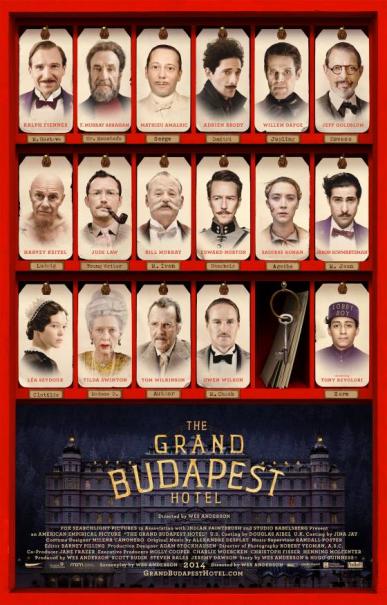
The Grand Budapest Hotel

Posted on March 13, 2014 at 6:08 pm

B+
Lowest Recommended Age: Mature High Schooler
MPAA Rating: Rated R for language, some sexual content, and violence
Profanity: Strong and crude language
Alcohol/ Drugs: Drinking, drugs
Violence/ Scariness: Murder, wartime violence
Diversity Issues: Diverse characters
Date Released to Theaters: March 8, 2014
Date Released to DVD: June 16, 2014
Amazon.com ASIN: B00JAQJNN0

The_Grand_Budapest_Hotel_3Writer/director Wes Anderson loves precious little worlds and his movies are not just created, they are curated. There’s a reason that this film is named for its location, not its characters or plot. Anderson is the master of “saudade,” the nostalgia for something you never had or that never existed. The Grand Budapest Hotel is as romantically imagined as its name, more vividly realized than any of the human characters in the movie, and we instantly feel the pang of its loss.

We enter through a Sheherezade-ian series of nesting narratives.  A girl visits the grave of a writer, and we go back in time to see that writer (Tom Wilkinson) as an older man, talking about where writers get their stories (from real life), and then back again further as a younger man (Jude Law), actually getting the story in a bleak, bordering on seedy distressed version of the hotel, from an old man named Zero Mustafa (F. Murray Abraham).  And then we go further back in time to see Zero as a young man, a proud lobby boy in the titular edifice, a gorgeously splendid, elegant, and luxurious resort in the mountains of a fictitious European country called Zubrowka, somewhere in the midst of Switzerland, Luxembourg, Austria-Hungary, and the Balkans.  Anderson invites us into the artificiality of the memory within a memory within a story told by a stranger. He does not bother with cinematic tricks to make the hotel look real.  We see it made out of paper, with a paper finicula pulled by a string to bring the guests up the mountain, as though it is part of a puppet show, which, in a way it is.  At times it feels as though it is being put on with the marionettes from the “Lonely Goatherd” number in “The Sound of Music.”  There is no effort to make the actors playing the younger and older versions of characters look alike.  But the detail work is as meticulous as ever, so that must be intentional, and meaningful.

In the era of the Jude Law storyline, the hotel’s inept concierge is M. Jean (Jason Schwartzman).  But, as Zero tells the story, in the heyday of the hotel, the concierge was the legendary M. Gustave (Ralph Fiennes).  A concierge is there to be the all-purpose fixer, finder, and minder, like the entire staff of Downton Abbey in one.  M. Gustave is infinitely attuned to the needs of the hotel’s wealthy, important, often noble (as in duchesses, not heroes), and always demanding clientele.  There is a reason they are always referred to as guests.  And if they require a particularly specialized and personal form of service, he is willing to oblige, even if the guest in question is a titled termagant in her 80’s (an hilariously unrecognizable Tilda Swinton as Madame D.)  Fiennes gives a performance as perfectly precise as his character, whose flawless demeanor evokes exquisite deference, competence, and discretion.  Like Anderson and Anderson’s autobiographical stand-in played by Schwartzman in “Rushmore,” M. Gustave is a showman, and one with an extravagantly grand and very ambitious sense of mise-en-scene.  Early on, we see M. Gustave striding through the hotel lobby, a gracious farewell to a guest on one side, sharp but not unkind directions to staff who are not up to standard on the other. Later, in two intrusions by this story’s version of the Nazis and later, as a prisoner, he responds as though he is in a drawing room comedy.  Fiennes pulls off the tricky balance between farce and drama as the story takes him through murder, art theft, love, war, and delectable pastries.  And he is matched by newcomer Tony Revolori as the young Zero, a refugee who aspires to M. Gustave’s savoir faire, and who becomes first his protege and then his friend. 

As always in a Wes Anderson film, starting with the very first scene of his first movie, “Bottle Rocket,” there is an escape.  M. Gustave is imprisoned, but still strives to maintain an aura of gracious living.  After a rough encounter with another prisoner, he is bruised but airily assures the visiting Zero that they are now dear friends.  He confronts the direst of situations — or tries to — as though they are at the level of an errant lobby boy.  But when he is deprived of his beloved fragrance, L’Air de Panache, he begins to crumble.

The details of the various time periods are, as expected, exquisitely chosen, well worth a second viewing.  Ant it is a bit warmer than Anderson’s previous films, less arch, less removed, softer toward its characters, even tender.  Anderson often makes objects more important than people but in this one, with the painting and the pastry almost character themselves on one side and Zero and his true love Agatha (Saoirse Ronan) still stylized but still heartfelt on the other, they’re getting closer.

Parents should know that this film includes wartime violence, with characters injured and killed, some graphic and disturbing images, strong language, sexual references and an explicit sexual situation.

Family discussion: Did M. Gustave and Zero have the same priorities? What is added to the story by seeing the author and Zero later in their lives?

If you like this, try: “Moonrise Kingdom” and “Rushmore”


Related Tags:


Comedy Crime Drama DVD/Blu-Ray Pick of the Week Epic/Historical Romance Satire War

About Last Night

Posted on February 13, 2014 at 6:00 pm

B
Lowest Recommended Age: Adult
MPAA Rating: Rated R for for sexual content, language and brief drug use
Profanity: Very strong, crude, and explicit language
Alcohol/ Drugs: Drinking, drunkenness, scenes bars, marijuana
Violence/ Scariness: Comic peril
Diversity Issues: Diverse characters
Date Released to Theaters: February 14, 2014

about-last-night03Kevin Hart, who starred in the surprisingly successful “Ride Along” just last month, is back with a much sharper, funnier comedy that is ideal for making the best use of his brash, motormouth persona. Even more important, for the first time Hart appears opposite someone who is every bit his match, the fabulously talented and knock-out gorgeous Regina Hall. It’s one of the best on-screen romantic pairings since Mae West and W.C. Fields.  As a funny post-credit scene shows, she not only kept up with him every step of the way, she challenged him to do better.  It is clear he is not only upping his game but having a blast.

David Mamet’s play “Sexual Perversity in Chicago” was softened a bit for its 1986 movie version, also called “About Last Night,” a romantic comedy starring Rob Lowe, Demi Moore, Jim Belushi, and Elizabeth Perkins. But it was still, for its time, provocatively frank in its portrayal of two couples who were navigating a world that was post Mr. Goodbar but pre-AIDS, pre-Tinder, and pre use of the term “booty call.”

Like the original, there is a serious couple and a comic couple. As the movie begins, Bernie (Hart) and Joan (Hall) are each giving their best friends all the details (and I mean all) of the wild, drunken sex within moments of meeting at a bar the night before. Their friends are Danny (Michael Ealy, with a lot of leading man sizzle) and Debbie (Joy Bryant, with one of the best smiles in Hollywood), both serious, stable, and gunshy about relationships following some bad experiences. Bernie and Joan bring their friends along to their second meeting, otherwise known as the “this isn’t a date date.”  Bernie and Joan introduce them to each other as “boring,” and that, more than any other reason, prompts them to try to interact and prove that it isn’t true.  “I’m not really boring,” Debbie explains.  “I just pretend to be so she can be the crazy one.”  Debbie and Danny have sex within hours after meeting, uncharacteristic impulsivity for both of them, and then they worry about what it all means.

Danny and Debbie end up moving in together but poor communication, struggles with intimacy, and Danny’s insecurity over losing his job while Debbie is professionally accomplished. No one seems to know what it means to have sex, to live with someone, to say “I love you” first, to decide to get a puppy. And no one is clear about what it should mean — Danny and Debbie want to have a relationship (most of the time) but sometimes it scares them. And when one of them gets scared, the other’s feelings get hurt.

What keeps this part of the story from bogging things down is the energy and oh-no-you-didn’t outrageousness of the bicker/banter, which starts out down and dirty and then gets even down and dirtier.  From the opening blast of “Sex Machine” through a series of hilariously explicit conversations swinging back and forth between confident assertions about the most intimate specifics and panicked cluelessness about the basics of any form of interaction out of bed.  So, there’s a lot of theories about how to behave and a lot of failure to carry it off.  Danny’s problems at work and with an ex are under-written distractions that don’t work as well as the silly fun of a costume party that has Danny and Debbie dressed as Ike and Tina Turner.  The energy and chemistry of the four leads keeps things moving so briskly that it diminishes the familiarity of the material.  And, more important, it keeps us hoping for a happy ending.

Parents should know that this is a very raunchy comedy. It features extremely explicit sexual references and situations, sexual humor including many jokes about casual sex and various sexual acts and body parts, drinking and drunkenness, drinking games, and marijuana.

Family discussion: Why did Danny keep asking Debbie if they were fighting? Why did Bertie and Joan enjoy making each other angry?

If you like this, try: the original version, starring Rob Lowe and Demi Moore (briefly glimpsed in this remake), “He’s Just Not That Into You,” and “Think Like a Man”

Related Tags:


Based on a play Comedy Movies -- format Remake Romance

Original Version: About Last Night…

Posted on February 9, 2014 at 7:42 am

First there was a play about what was not then yet called “hookup culture” or “booty calls” by pre-“Glengarry Glen Ross”/”The Verdict” David Mamet.  The title was “Sexual Perversity in Chicago.”  Both the title and the script were softened for a 1986 movie starring Demi Moore, Rob Lowe, Jim Belushi, and Elizabeth Perkins.  The remake opening this week stars Kevin Hart, Regina Hall, Michael Ealy, and Joy Bryant.

http://www.youtube.com/watch?v=-f_8ixgO7M8
Related Tags:


Comedy For Your Netflix Queue Original Version Romance
THE MOVIE MOM® is a registered trademark of Nell Minow. Use of the mark without express consent from Nell Minow constitutes trademark infringement and unfair competition in violation of federal and state laws. All material © Nell Minow 1995-2026, all rights reserved, and no use or republication is permitted without explicit permission. This site hosts Nell Minow’s Movie Mom® archive, with material that originally appeared on Yahoo! Movies, Beliefnet, and other sources. Much of her new material can be found at Rogerebert.com, Huffington Post, and WheretoWatch. Her books include The Movie Mom’s Guide to Family Movies and 101 Must-See Movie Moments, and she can be heard each week on radio stations across the country.

Website Designed by Max LaZebnik