Rated R for language, some sexuality/nudity and violence
Profanity:
Strong language
Alcohol/ Drugs:
Some alcohol, drug references
Violence/ Scariness:
Peril and violence, murder
Date Released to Theaters:
September 1, 2017
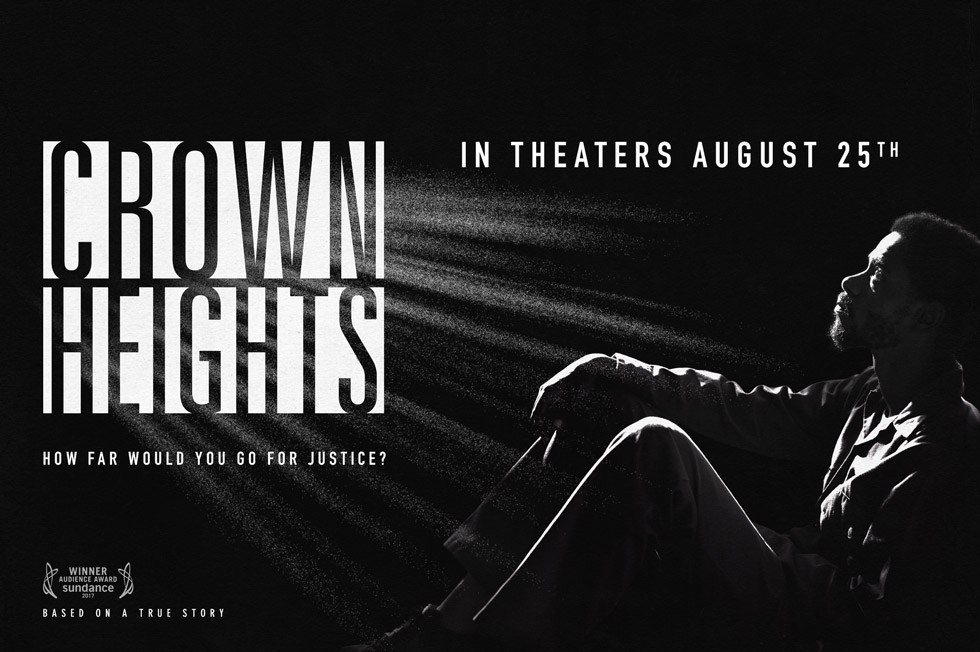
Copyright Amazon 2017The story of Damon and Pythias has exemplified friendship and loyalty since the time of the ancient Greeks. The story of Colin Warner and Carl King should stand beside it. King spent 21 years working to get Warner released from prison after he was unjustly sentenced for murder. A reporter for “This American Life” told their story, and now it has been adapted for the screen by former NFL player Nnamdi Asomugha, who plays King opposite the extraordinarily gifted LaKeith Stanfield (“Get Out,” “Short Term 12″) as Warner.
The friends met growing up in Trinidad and then reconnected when both emigrated to the Crown Heights neighborhood of Brooklyn. Writer/director Matt Ruskin and Director of Photography Ben Kutchins evoke the lively but volatile and gritty atmosphere of 1980 Brooklyn. Warner is not even in the wrong place at the wrong time. He is nowhere near the spot where an apparent revenge execution-style murder is committed. But the cops are overwhelmed and under a lot of pressure to produce arrests and close cases. Archival footage of Presidents Reagan, Clinton, and George W. Bush promising crackdowns on crime provide context.
It is possible that determination to be fair to as many people as possible costs the film some dramatic momentum, especially as it stretches over decades, with setback after setback and complication after complication, plus the various family stresses, particularly with King as his wife understandably gets frustrated with the time and money he is devoting to Warner instead of their children. But the dignity and sensitivity of the performances by Stanfield and Asomugha hold the story together. But the time King takes a job as a process server in order to better understand what kind of legal help they need, things begin to pick up. A tender romance and a touching expression of forgiveness give the film a quiet power that I hope will not always feel as timely as it does right now.
Parents should knot that this story concerns a wrongful murder conviction and includes peril, violence, abuse, strong language, some sexual references and situations, and some nudity.
Family discussion: Why does this film title refer to the neighborhood, not the people involved? Why didn’t Carl give up? Listen to the story that inspired this film on “This American Life.”
If you like this, try: “Conviction” and “Hurricane”
Copyright 2016 Bleeker Street You can refuse. You can disagree. You can object. You can argue. But none of those words is as charged as “denial,” with its multiple uses all implying injustice, unfairness, even bullying. The title of this film establishes immediately that the courtroom and media battle it depicts is not one of popularity, reputation, or consensus. It is about the core issue of proof — how we know what we know, and, in this case, what that means as we approach the time when everyone with a memory of the experience in question is gone.
The experience in question, in the most literal sense of the term, is the Holocaust. David Irving (Timothy Spall, all oily charm), a British self-described historian, wrote and lectured widely about his view that Hitler never ordered the killing of Jews in concentration camp and that in fact there were no gas chambers used for mass executions of Jewish prisoners. He was intentionally offensive — in both sense of the word. He said:
Ridicule alone isn’t enough, you’ve got to be tasteless about it. You’ve got to say things like ‘More women died on the back seat of Edward Kennedy’s car at Chappaquiddick than in the gas chambers at Auschwitz.’ Now you think that’s tasteless, what about this? I’m forming an association especially dedicated to all these liars, the ones who try and kid people that they were in these concentration camps, it’s called the Auschwitz Survivors, Survivors of the Holocaust and Other Liars, ‘ASSHOLs’. Can’t get more tasteless than that, but you’ve got to be tasteless because these people deserve our contempt.
And he took his case to the classroom of a professor who specialized in the Holocaust, Emory’s Deborah Lipstadt (Rachel Weisz, feisty but thoughtful, with a red perm, bright scarves, and a Queens accent), to confront her in person, without notice but with a video camera. She refused to debate him, saying that it would legitimize his arguments. And she described him in her book, Denying the Holocaust: The Growing Assault on Truth and Memory, as:
one of the most dangerous spokespersons for Holocaust denial. Familiar with historical evidence, he bends it until it conforms with his ideological leanings and political agenda. A man who is convinced that Britain’s great decline was accelerated by its decision to go to war with Germany, he is most facile at taking accurate information and shaping it to confirm his conclusions.
He wanted more than a classroom confrontation after that. He filed a lawsuit against Lipstadt and her publisher, and he filed it in England, where the laws are more favorable for plaintiffs in libel cases. In the US, the person filing the suit has to prove his or her case. In the UK, it is up to the defendant to prove the truth of the statements made. In cinematic terms, the legal and physical setting heightens the inherent courtroom drama — all the wigs and posh accents and strangeness of the rules boost the theatricality of the presentation, especially after Lipstadt learns that neither she nor the Holocaust survivors who are vitally concerned with the trial will be allowed to testify. For Lipstadt, not being permitted to use her voice was a whole separate category of denial.
This is a compelling courtroom drama that goes to the deepest questions not just of Holocaust history or any history but of how we know what we know and who we believe. It is always tempting to say “let’s listen to both sides.” But as the late Daniel Patrick Moynihan used to say, “Everyone is entitled to his own opinion, but no one is entitled to his own facts.” The meticulous combing of Irving’s work to check footnotes and translate original documents (funded by Steven Spielberg and other donors) proved that Irving’s “conclusions” were based on misrepresentation. The meticulous combing of his shelves and shelves of diaries proved his bias. This is a compelling drama and an urgent reminder of the importance of rigorous challenges to unsubstantiated, malicious “history.”
Parents should know that this film deals with the Holocaust, with references to genocide and ethnic bigotry. It includes social drinking and some strong language.
Family discussion: What evidence would you want to see if you were the judge in this case? Should Professor Lipstadt have testified?
The American Bar Association’s Six Types of Movie Lawyers
Posted on August 18, 2016 at 3:19 pm
The American Bar Association’s ABA Journal magazine has an article about movie lawyers that is not the usual top 50 list. Thane Rosenbaum writes about the six types of movie lawyers: crusading, heroic, obtuse, disillusioned, vengeful, and buffoons. Of course, some of the best movies have lawyer characters who fall into more than one of these categories. “To Kill a Mockingbird” has the greatest of all movie lawyers, Atticus Finch, who is heroic and crusading. “Anatomy of a Murder,” based on a novel by a lawyer/judge and starring a real-life judge as the movie’s jurist, had a lawyer who was disillusioned and heroic, and so did “The Verdict” and “Michael Clayton.” “My Cousin Vinny’s” title character was a buffoon and sometimes obtuse, but a hero, too.
I’m a lawyer from a family of lawyers, and I love movies about the law, including the ones listed above (I have to point out that “The Verdict” is completely inaccurate and even “Anatomy of a Murder” has one huge mistake). I especially like movies about real-life lawyers like “Gideon’s Trumpet,” “Amistad,” “Erin Brockovich,” and the upcoming “Loving.”