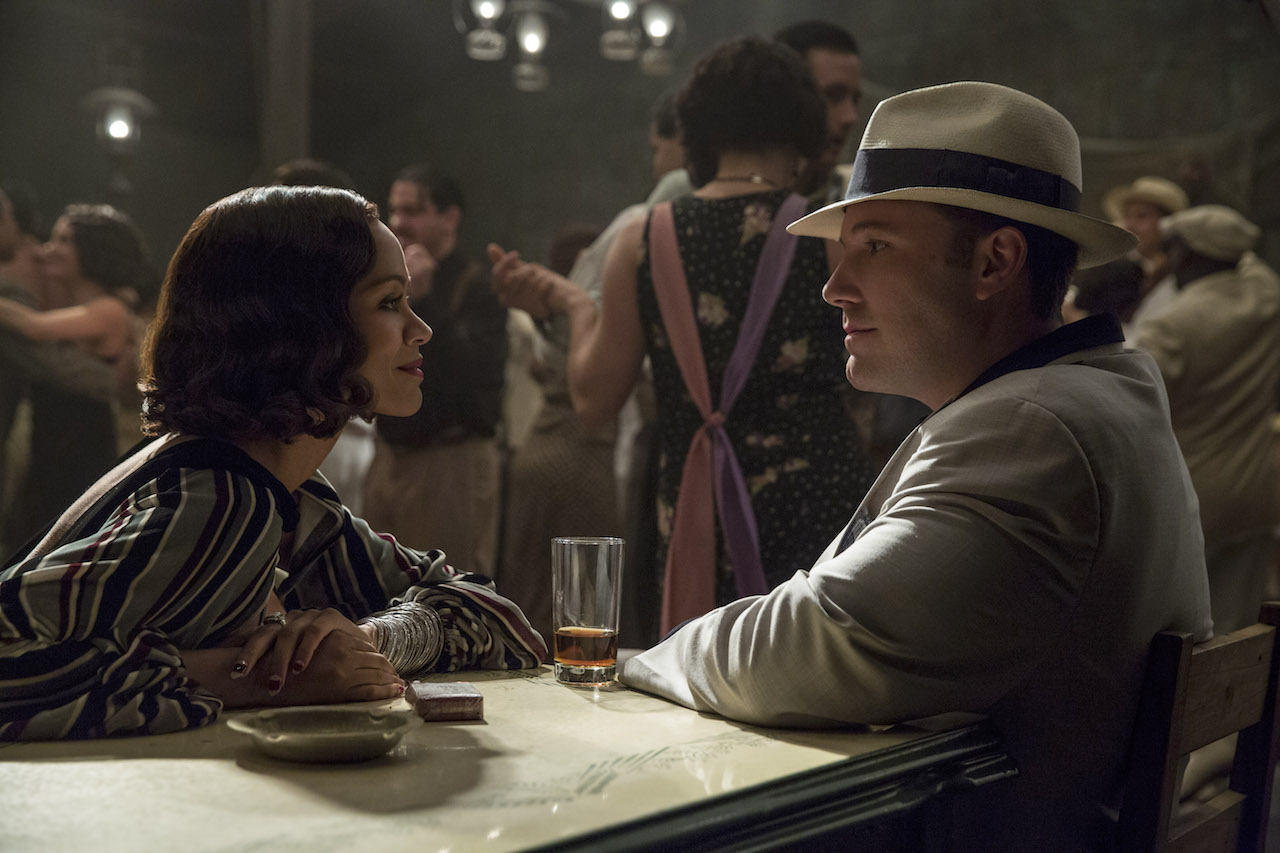
Live By Night

Live By Night

Posted on January 12, 2017 at 5:45 pm

Copyright 2016 Warner Brothers
Ben Affleck the director picked the wrong screenwriter and the wrong star for “Live By Night,” based, like his far better “Gone Baby Gone” on a book by Dennis Lehane.

Unfortunately, this time Ben Affleck the director picked Ben Affleck the screenwriter and Ben Affleck the actor for this crime drama set in post WWI, prohibition-era Boston and Florida. Affleck the director has a good eye for detail. He understands the pacing of individual scenes, selects a great cast (other than himself), cinematographer (Robert Richardson), and composer (Harry Gregson-Williams) and has a good sense for visual storytelling. But in this case he was let down by Affleck the screenwriter, who allows the storyline to become so episodic it loses energy. And Affleck the actor gives the weakest performance in the film. He wants to be strong and stoic but comes across as blank and unfocused. It is disappointing to see Warner Brothers, the studio behind gangster classics, produce a film that has nothing of their grit or vitality.

Affleck plays Joe Coughlin, son of an Irish-American cop (Brendan Gleeson) who returns from fighting in WWI determined not to answer to anyone again. He wants to make his own rules. So he becomes involved in crime. Even criminals have rules, and Joe breaks those, too, having a passionate affair with Emma (Sienna Miller), who is supposed to be the girlfriend of the boss of the Irish mob. She betrays him (revealed early in the film, unlike the book), and is reported killed in a chase that ends with her car going into the water. He is badly beaten and then sent to prison.

When he gets out, he goes to Tampa, where he and his friend Dion Bartolo (Chris Messina) muscle their way into the crime scene there. Joe becomes involved with Graciela (Zoe Saldana) and she encourages him to take over the rum distribution. Immediately after telling him she will not sleep with him, she sleeps with him, discomfiting even in a retro story. More thuggery. More killing.

A local cop named Figgis (Chris Cooper) explains that he associates with crooks but is not one himself. His compartmentalization is geographic as well as moral, and he outlines for Joe with a map where he can operate. Later, when Joe needs leverage, he shows Figgis photos of his adored daughter Loretta (willowy Elle Fanning), hooked on drugs and prostituting herself. Joe will tell Figgis where she is in exchange for redrawing those moral boundaries. We later see Figgis punishing her by whipping her bare behind. And she becomes an Aimee Semple McPherson-style evangelist, showing the needle scars on her arms to the crowd as proof of her redemption, and calling on her followers to stay away from the demon rum that Joe is selling.

Joe’s run-ins with cruder thugs, including the KKK, are intended to show that he, too compartmentalizes and perhaps to raise the question of how each of us draws lines, and then redraws them, as we make choices about how far we will go. The excellence in production design and cinematography only show by contrast the superficiality of the story which like the other recent period film from an actor-turned-director, Warren Beatty’s “Rules Don’t Apply,” puts form above substance, or, worse, thinks they are the same thing.

Parents should know that this is a gangster film with extensive violence, including many graphic and disturbing images and characters who are injured and killed. The film also has strong language including racist epithets and sexual references and situations.

Family discussion: Why did Joe want to talk to Emma? How was Joe different from some of the other gangsters? How did his experience in the army influence him?

If you like this, try: “The Godfather,” parts 1 and 2

Related Tags:


Based on a book Crime Drama
Jack Reacher: Never Go Back

Jack Reacher: Never Go Back

Posted on October 20, 2016 at 5:12 pm

Copyright Paramount 2016
Tom Cruise is back in a second “Jack Reacher” movie, based on the hard-boiled series by Lee Child. Jack Reacher is a quintessential and perfectly named fantasy action hero — former military but resistant to authority, capable of instant assessment of threats and options, crackerjack fighting skills, and no strings of any kind. He has no home, no family, no ID other than an expired military card, no car, no bank account, no possessions, just a passion for justice and a knack for getting into and out of trouble. And the equally perfectly named Cruise, capable of challenging himself as an actor but apparently not at the moment very interested in it, except maybe physically, is just right for Reacher, a bit world-weary but ever-righteous. He still runs very fast and looks good with his shirt off.

We first see Reacher in a diner with his hands cuffed behind his back, a bit scuffed up but characteristically steely. A sheriff informs him he is about to be arrested and charged with felony assault of the men lying injured on the ground. He coolly informs the officers that the pay phone is about to ring and that it is the sheriff who will soon be wearing the cuffs. The officer’s derisive snort is barely over before the phone rings, and sure enough, Reacher is right again.

He has solved a problem for the military (we won’t worry about the various laws — and bones — he broke on the way), and thanking him is his successor as overseer of an investigative unit, Major Susan Turner (Cobie Smulders of “How I Met Your Mother” and “Avengers”). They do a little phone flirting, and he decides to go see her in DC, only to find she has just been arrested for espionage. So, now Reacher has what he loves best, an injustice that only he can make right, of such an order of magnitude that it is certain to provide many opportunities for mayhem. But there is one problem that is, for a change, entirely outside of his ability to shoot, punch, or evade. Turner’s military attorney conveniently agrees to meet with Reacher (in an officer’s club, surrounded by pretty much everyone who might be interested), and he conveniently happens to have Reacher’s file with him as well, and helpfully shows Reacher the paperwork showing that a woman had filed a child support request with the military because she said the father of her teenage daughter was Jack Reacher. The same bad guys who are after Maj. Turner are after the girl, so Reacher ends up on the run with both Turner and his possible daughter Sam (Danika Yarosh).

Pairing up again with Edward Zwick (“The Last Samurai”) and with a script by Zwick and his “thirtysomething” partner Marshall Herskovitz (with Richard Wenk), Cruise stays right in his “Mission Impossible” action hero sweet spot. The interplay with Sam gives a little balance and emotional weight to the various fight scenes and shoot-outs, without diminishing the appeal of the ever-able hero with no strings.

Parents should know that the violence in this film is borderline R with very intense action and fight scenes, chases, fights, shoot-outs and explosions, torture, hired killers, corruption, many characters injured and killed, threat of rape, some strong language.

Family discussion: How was military training and experience reflected in the choices made by both the good and bad guys in this movie? What did Jack want the answer to be about Sam?

If you like this, try: the earlier “Jack Reacher” film and the “Bourne” series

Related Tags:


Action/Adventure Based on a book Crime Series/Sequel
Hell or High Water

Hell or High Water

Posted on August 11, 2016 at 5:40 pm

Copyright Film 44 2016
“Hell or High Water” is a modern western that reminds us why spare, dry landscapes have so often been the settings for grand American epics. Like frontier stories of ranchers, farmers, cowboys, Indians, masculinity, and bank robbers, this film has a gripping story that touches on the most profound American struggles — from guns to real estate, race, and income inequality — specific in detail but universal in scope.

One of the film’s wisest choices is in keeping important information from us until just the right moment, so I will be especially scrupulous about spoilers and keep the description of the plot to a minimum. There are four main characters, two bank robbers and two Texas Rangers. The bank robbers are Tanner (Ben Foster) and Toby (Chris Pine), and we can tell immediately that they seem less experienced than the staff at the small Texas Midland bank branch they are robbing, just before it opens on a dusty morning. Both bad news and good manners are so deeply ingrained in the bank manager that he courteously wishes them a good morning before turning over the small unmarked bills.

The Texas Rangers are about-to-retire Marcus (Jeff Bridges) and Alberto (Gil Birmingham), who is of both Native American and Mexican heritage, as Marcus constantly reminds him with a stream of amiably delivered insults. As Tanner and Toby continue to rob banks, always Texas Midland branches, Marcus begins to discover a pattern that begins to reveal a plan.

The characters are skillfully drawn and performed with a deep and understanding humanity, not just by the four lead actors but by everyone in the cast. Every performance in even the smallest role conveys an arid and dusty world, physically, financially, and emotionally. Standouts include Katy Mixon as a waitress, Richard Christie as a bank loan officer, and Dale Dickey as the woman who opens the bank in the morning.

The outstanding screenplay is written by Texan Taylor Sheridan (“Sicario,” “Guns of Anarchy”), who knows these people and these places. He has a gift for finding the poetry in dialog as dry and spare as the setting. And he has the confidence in himself, his characters, and his audience to let the story unfold without telling us too much at first, and to present complex issues without feeling that he has to provide simple answers. Sheridan also has a gift for the small, telling details, the bank manager who courteously wishes the bank robbers good morning, the Indian casino, the ex-wife, the way some men say more in the pauses than the words. His deep appreciation for people overlooked by just about everyone makes this cops and robbers story into something real and meaningful.

Parents should know that this film has extended crime and law enforcement-related violence, with characters injured and killed, themes of moral and legal crimes, drinking, smoking, sexual references, prostitute, and a brief explicit sexual situation.

Family discussion: Why does the movie keep some of the details of the plan secret for so long? Why does Marcus insult Alberto? Why does Tanner say he is a Comanche?

If you like this, try: “99 Homes” and “The Newton Boys”

Related Tags:


Crime Drama Western
The Infiltrator

The Infiltrator

Posted on July 12, 2016 at 5:25 pm

B
Lowest Recommended Age: Mature High Schooler
MPAA Rating: Rated R for strong violence, language throughout, some sexual content and drug material
Profanity: Very strong language, homophobic slurs
Alcohol/ Drugs: Drugs and drug dealing, alcohol, smoking
Violence/ Scariness: Extensive and graphic violence, guns, car crash, mob executions, disturbing images
Diversity Issues: Diverse characters
Date Released to Theaters: July 12, 2016
Copyright 2016 Broad Green

“We’ve been following the drugs to get to the bad guys. What if we follow the money?” That simple suggestion from FBI undercover agent Bob Mazur (Bryan Cranston) led to an unprecedented massive series of arrests that brought down key members of Pablo Escobar’s cocaine operations — and the world’s 11th biggest bank. Based on Bob Mazur’s book, and with Mazur as a producer, it is set in 1980’s Florida, where Excobar was smuggling in literally tons of cocaine. Getting it into the country was easy. Selling it was easy. Paying off, threatening, and torturing anyone who tried to stop them was easy. The biggest challenge they faced was moving the money between countries.

Mazur, trained as an accountant, went undercover and offered money laundering services to Escobar’s lieutenants, funnelling their stacks of cash through “legitimate” companies and criminal-friendly jurisdictions like Panama, then led by Manuel Noriega. He was able to gain the trust of the drug dealers. It was even easier to get the cooperation of bankers, including the prestigious international financial institution BCCI.

This movie, directed by “The Lincoln Lawyer’s” Brad Furman is sincere, diligent, a little corny, and for better and worse exactly what you expect from a fact-based story of an FBI undercover operative. There is the anxious and at times impatient wife. “Promise me this is the last one.” “I’m just wondering where my little Bobby the accountant went?” She has the thankless task of sighing, getting upset when their anniversary celebration is ruined when he has to go into character because they run into one of his criminal buddies, being jealous of his relationship with a beautiful female agent posing as his fiancee (Diane Kruger) and telling him he should have taken the chance for early retirement.

For a tense crime drama, it is surprisingly inert. We learn very little about what is involved in laundering money to prove himself to the bad guys or how the investigation proceeded or what goes into a long-term undercover operation. Mazur shows up in a Rolls Royce and has access to a mansion. Both were confiscated from drug dealers, but we do not learn that from the movie. What we do see is Mazur going home at night to his modest suburban house and his wife and children and jogging through his neighborhood. Presumably Escobar, one of the most ruthless criminals in history, would not turn over hundreds of millions of dollars to someone without making sure he was who he said he was. Mazur comes across as near-saintly, so even Cranston cannot give the character much by way of depth. The conflicts he feels about betraying a man who trusts him are confusing. Even when he is played by the elegant Benjamin Bratt, he is still a barbaric thug. The “Red Wedding”-style climax is synthetic, which, come to think of it, is the problem throughout. This is a movie about a faker that never feels real.

Parents should know that this film has very intense peril and violence, very disturbing and graphic images, guns, car crash, mob executions, characters injured and killed, very strong and crude language throughout with some homophobic slurs, some nudity, sexual references, drinking, smoking, and drugs and drug dealing.

Family discussion: Do you agree with the sentences received by the people who went to jail in this film? What makes someone good at undercover work?

If you like this, try: “Donnie Brasco,” “American Hustle,” and “Kill the Messenger”

Related Tags:


Based on a book Based on a true story Crime Drama Movies -- format

Clip: Bryan Cranston in “The Infiltrator”

Posted on June 24, 2016 at 11:11 am

Bryan Cranston plays federal agent Bob Mazur in this fact-based story. He goes deep undercover in 1986 to infiltrate Pablo Escobar’s drug trafficking operation. John Leguizamo plays his impulsive colleague and Diane Kruger plays a rookie agent posing as his fiancée. The movie will be in theaters next month.

Related Tags:


Based on a true story Crime Trailers, Previews, and Clips
THE MOVIE MOM® is a registered trademark of Nell Minow. Use of the mark without express consent from Nell Minow constitutes trademark infringement and unfair competition in violation of federal and state laws. All material © Nell Minow 1995-2026, all rights reserved, and no use or republication is permitted without explicit permission. This site hosts Nell Minow’s Movie Mom® archive, with material that originally appeared on Yahoo! Movies, Beliefnet, and other sources. Much of her new material can be found at Rogerebert.com, Huffington Post, and WheretoWatch. Her books include The Movie Mom’s Guide to Family Movies and 101 Must-See Movie Moments, and she can be heard each week on radio stations across the country.

Website Designed by Max LaZebnik