CCA Documentary Awards 2025: Perfect Neighbor, Orwell; 2+2=5 and More
Posted on November 10, 2025 at 2:21 pm
It is an honor to serve on the Critics Choice Association Documentary Committee and I am delighted to announce this year’s awardees.
WINNERS OF THE TENTH ANNUAL CRITICS CHOICE DOCUMENTARY AWARDS
BEST DOCUMENTARY FEATURE The Perfect Neighbor (Netflix)
BEST DIRECTOR Geeta Gandbhir – The Perfect Neighbor (Netflix)
BEST FIRST DOCUMENTARY FEATURE My Mom Jayne: A Film by Mariska Hargitay (HBO Max)
BEST CINEMATOGRAPHY Toby Strong, Doug Anderson (Underwater Photography) – Ocean with David Attenborough (National Geographic)
BEST EDITING Viridiana Lieberman – The Perfect Neighbor (Netflix)
BEST SCORE Alexei Aigui – Orwell: 2+2=5 (Neon)
BEST NARRATION Orwell: 2+2=5 (Neon) Written by George Orwell, Adapted by Raoul Peck Performed by Damian Lewis
BEST ARCHIVAL DOCUMENTARY The Perfect Neighbor (Netflix)
BEST HISTORICAL DOCUMENTARY (TIE) The American Revolution (PBS) Hurricane Katrina: Race Against Time (National Geographic)
BEST BIOGRAPHICAL DOCUMENTARY Mr. Scorsese (Apple TV)
BEST MUSIC DOCUMENTARY (TIE) Becoming Led Zeppelin (Sony Pictures Classics) Sly Lives! (aka The Burden of Black Genius) (Hulu, Onyx Collective)
BEST POLITICAL DOCUMENTARY The Alabama Solution (HBO Max)
BEST SCIENCE/NATURE DOCUMENTARY Ocean with David Attenborough (National Geographic)
BEST SPORTS DOCUMENTARY America’s Sweethearts: Dallas Cowboys Cheerleaders (Netflix)
BEST TRUE CRIME DOCUMENTARY The Perfect Neighbor (Netflix)
BEST SHORT DOCUMENTARY Saving Superman (Switchboard)
BEST LIMITED DOCUMENTARY SERIES Mr. Scorsese (Apple TV)
BEST ONGOING DOCUMENTARY SERIES 30 for 30 (ESPN Films)
About the Critics Choice Association (CCA)
The Critics Choice Association is the largest critics organization in the United States and Canada, representing more than 500 media critics and entertainment journalists. It was established in 2019 with the formal merger of the Broadcast Film Critics Association and the Broadcast Television Journalists Association, recognizing the intersection between film, television, and streaming content.
To stream the ceremony and learn more about the Critics Choice Documentary Awards, visit CriticsChoice.com. The list of nominees and winners will also be available on the site.
All artwork (including nominee and winner laurels) can be found HERE.
Discussion of miscarriages and fertility issues, scenes in hospital
Diversity Issues:
A theme of the movie
Date Released to DVD:
November 4, 2025
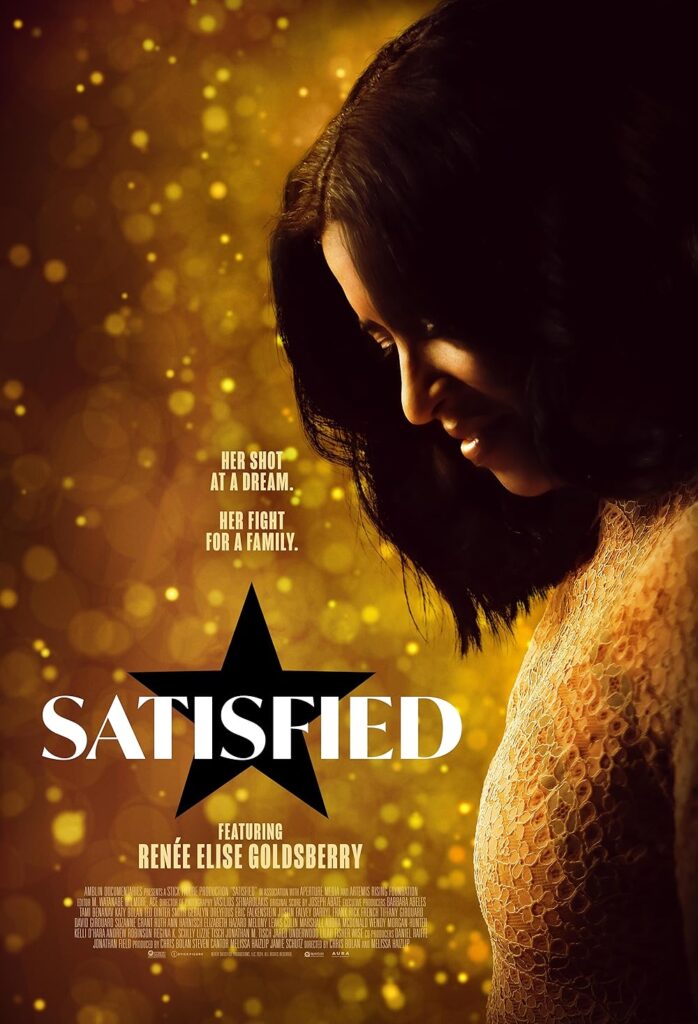
The “Hamilton” song “Satisfied” is sung by a character who is not at all satisfied. The sister she loves is marrying a man she loves, a man who himself, in the words of the song, is never satisfied. She sings,
A toast to the groom, to the bride From your sister who is always by your side To your union and the hope that you provide May you always be satisfied And I know she’ll be happy as his bride And I know he will never be satisfied I will never be satisfied.
The character who sings that song is Anjelica Schuyler, originated in the workshop as the show was developed, its off-Broadway premiere, and then when it was transferred to Broadway, by Renée Elise Goldsberry. This documentary is her story, about the two transcendent goals of her life: to be a mother, and to have a career as a performer, and the way they collided.
Copyright 2025 Aura Entertainment
The history of documentaries, going back to the earliest days, is of a filmmaker on one side of the camera and the story on the other, whether it includes archival clips, fly-on-the-wall footage as the story develops, or talking head experts or witnesses. This film presents a different approach that reflects the evolution in storytelling as individuals bypass intermediaries and tell their own stories in the most unfiltered and direct way possible (and usually in vertical mode, filmed on a phone).
“Satisfied” is raw, intimate, and immediate because much of what we see is moments when Goldsberry filmed herself, not necessarily intended to show anyone else but just as a way to process what she is experiencing.
We see her heartbreaking difficulties in trying to have a child, including five miscarriages. We see the overwhelming joy of delivering a healthy baby boy, Benjamin, and then adopting a baby girl, Brielle. Their scenes together are everything we hope for a family. She and her husband adore each other and adore their children and the children love each other and their parents. One of the film’s sweetest moments is a brief home movie when Brielle, still a toddler, wants to go to school like her big brother, even though she is not quite sure what that means. So he puts a backpack on her and one on himself and tells her they are going to school even though it’s just the front door of their apartment. She is so proud and happy and he is so loving.
Goldsberry also provides narration for archival footage, telling us how she met her husband (in church) and did not tell him at first that she was a perfumer. She explains that a performer is two people; the aspiring one who is constantly anxious about getting cast and the successful one who is constantly pulled in a million directions, leaving her husband to hold her purse. That husband, Alexis Johnson, is completely on board with both elements. In another of the film’s highlights, he stands in their kitchen, tearing up as he tells us about how moved he is by her performances.
It was just after they brought Brielle home, when Goldsberry was planning to take some time off, that she was asked to audition for the workshop of “Hamilton.” Initially, she was going to say no, in part because workshop performers often help develop the material and then are passed over for bigger names when the production is launched. But she heard the songs and could not resist. We hear her worry about whether she will get cast when the show opens off-Broadway, and then we see what happens when it moves to Broadway and becomes a phenomenon. Every dream come true has some additional stress. She is nominated for a Tony award but that just means even more time away from her family as part of that process is bringing her story to the attention of the public.
The archival footage of her high school performances is endearing — and impressive. And there’s a lovely scene where she visits the high school drama teacher who cast her as Nellie in “South Pacific,” a play about a white woman dealing her her “carefully taught” prejudice.
She is a star. And yet, as she shows us, that doesn’t mean a cab driver won’t bypass her to pick up the white theater-goers who just gave her a standing ovation. And, as she also shows us, she has the same wrenching conflicts between work and family faced by every parent.
We hear from colleagues including Lin-Manuel Miranda and Oscar-winner Ariana DeBose and we see and hear some of Goldsberry’s thrilling performances. But what makes this film special is its private moments. This kind of honesty’s a gift, especially in a world of augmented reality. We should be grateful to Goldsberry for sharing her struggle as well as her talent and triumphs.
Parents should know that this movie deals with fertility challenges, including miscarriages, family stress, mental health, and racism.
Family discussion: How did Goldsberry decide what to prioritize? What was the most difficult decision? What made her decide to film herself and then to share those very personal moments?
If you like this, try: Goldsberry’s performances in “Hamilton,” “Girls 5Eva” and “The House with a Clock in Its Walls” — and watch the Tony Awards! It’s the best awards show on TV.
Marc Maron is not going to live happily ever after. As we saw recently in the documentary “Anxiety Club,” about the connection between stand-up comedy and anxiety, Maron would not feel like himself if he was happy. He is not quite sure why other people are happy, or want to be. Not being happy has worked out well for him. In its own way, that may be his kind of happiness. What he says is, “I’m clearly dealing with grief and sadness by overcompensating with anger and funny.” And that gives him some sense of satisfaction.
Copyright 2025 Radiant Media Studios
“Are We Good?” is a documentary about Maron as he is in a transitional moment. He is still mourning the loss of the person he loved most, the one who made him feel the most seen and safe. That was writer/director Lynn Shelton, and the archival footage of them together is heart-wrenchingly moving, her radiant pleasure in his presence, and a glimpse of him as, yes, happy, somewhere under the defaults of the perpetual dissatisfactions that underly observational humor. If you have not seen Shelton’s “Sword of Trust” movie seek it out. The storyline gets loopy, but Maron is superb and so, in a brief appearance as Maron’s character’s ex, is Shelton.
Maron tells us he always wanted to do comedy, and we see clips from him in the early years. with long hair, a period where he tells us he was smoking, drinking, and doing drugs. David Cross says he was one of the few who liked Maron in those days.
He “didn’t draw” back then, meaning that he could get on TV talk shows but it did not translate to success in clubs. And so, with no particular goal in mind, he set up a recording “studio” in his garage and began the podcast that if he had any hopes of making commercially successful he would probably not have called WTF.
His timing may have been accidental, but it was perfect. And the kind of close observation that underlay his comedy made him an attentive, perceptive, insightful, and empathetic interviewer. Everyone anyone might want to hear came to his garage, comedians like Robin Williams, writers and directors and producers like Lorne Michaels, Quentin Tarrantino, Mel Brooks, and Mike Judge, musicians and singers like Keith Richards, Bruce Springsteen, and Mavis Staples, actors like Brad Pitt and Leonardo DiCaprio, and national figures like Barack Obama. And, of course, Lynn Shelton, before they were a couple, and you can feel the spark between them as they discover it in each other.
In the documentary, Maron appears before an audience with a pad of paper on his lap. They and we can see him creating on the spot, not just jokes, not just his set, but as he admits, even his persona. He is still grieving the loss of Lynn Shelton, and he is also, in the movie’s most touching scenes, dealing with his father’s dementia. He is also coping with the end of WTF. He has spent more time as an actor (recently in the AppleTV+ series “Stick”), though says he is always inclined to turn down offers.
The film will be of most interest to Maron fans, though even fans may prefer his comedy specials and acting appearances. But seeing someone whose inclination is to maintain distance between his thoughts and feelings grapple with loss shows us what even comedy cannot.
Parents should know that this film includes very strong language and references to drinking, smoking, drug use, a parent with dementia, and a sad death.
Family discussion: How can comedy help to process grief? How does what Marc Maron observes around him show up in his act?
If you like this, try: “Anxiety Club,” “Stick,” “WTF,” and Maron’s comedy specials
The Thunderbirds of the Air Force are the elite display team pilots who give demonstrations around the country to inspire Americans with a show of extraordinary courage and skill. This documentary, with producers that include Barack and Michelle Obama, is like Glenn Powell’s “The Blue Angels,” about the Navy’s elite flying group. It takes us inside the training that leads up to the annual tour of 62 shows across the country, with “flying acrobatics” and are “meant to look nearly impossible.” The signs on the doors they walk through to the airstrip say “Fly Like Champions” and “Blind Trust,” the first a goal, the second the foundational principle of the team, because they fly in such tight formation that the slightest error from one of them puts all of them at risk. As we see in the film, there have been a number of crashes and many Thunderbirds pilots have died.
Copyright 2025 Netflix
The pilots serve for two years, and each year half are new. So we begin with the arrival of three pilots joining the team. They are there because of their outstanding skills, but they have to unlearn as well as learn. The experience of the Tom Cruise in “Top Gun” types trained for combat or those “Right Stuff” types trained for testing new equipment are not exactly transferable and some are completely opposite. Combat pilots have two goals, to hit the target and stay alive. Thunderbirds literally are told to “divorce yourself from your usual survival instincts” because the maneuvers they perform are designed to keep them “micro-seconds from a life-threatening situation.” We see the impact of G-force acrobatics that make a 200-pound pilot into a 2000-pounder, making it impossible for oxygen to reach the head, so they pass out.
And we see that these pilots find all of that “frickin’ awesome.” One points to the number 5 painted on the side of the plane. It is upside down, because that way it will appear right-side up during the demonstration.
We spend much of the time with the boss, number one, called Astro (like the Blue Angels and the Top Guns, they have call signs — my favorite was the flight surgeon, who goes by Angry). His dream from his earliest childhood was to be an astronaut, and his parents proudly show us his grade school drawings. But when the Thunderbirds were in need, after a 2018 crash, they needed someone to make some changes, and his unique skills as a graduate of both combat and test flight training made him the ideal candidate. His wife says that she checked the mortality numbers for the Thunderbirds; ten percent. But the commitment to “service over self” meant they both understood that was where he needed to be.
We see one pilot struggle with his position and the way the others support him. And we see that the unquestioned dedication to “service over self” is as important to them as their constant training and striving for perfection.
We also see the support they get from the maintenance crews, every bit as devoted to excellence as the pilots. Their first demonstration at the Daytona races, is not perfect. They are supposed to appear on “brave,” the last word of the National Anthem. They’re off by seconds, but to them it feels like months. Astro’s reaction: “We have something to work on.”
The better we understand what goes into the maneuvers, the more we appreciate the skills that make it possible for them to fly in such tight formations, wings almost touching, each relying on the others to stay stable.
Copyright 2025 Netflix
The cinematography is stunning, with special thanks to Arial Coordinator (and stunt pilot) Kevin LaRossa II, also the genius behind the air footage of “Top Gun: Maverick,” “The Blue Angels,” “The Avengers,” any many more. The air maneuvers are dazzling. But it is the hearts, integrity, and courage of the Thunderbirds that are unforgettable.
Parents should know that this film includes references to airplane fatalities.
Family discussion: What made Astro decide to withdraw from the astronaut program? Do you agree with his decision? Go to one of the air shows and stay after to talk to the pilots.
If you like this, try: “The Blue Angels” and the “Top Gun” movies
Swamp Dogg is not the typical musician and this is not the typical documentary about a musician. The movie, directed by three people: Isaac Gale, Ryan Olson, and David McMurry, and written by four: Andrew Broder, Isaac Gale, Paul Lovelace, and Ryan Olson. The mosaic quality of film, messy, imaginative, zig-zaggy, fits the subject. The off-beat title — note the passive voice as well as the reference to an activity that we drop in on now and then as we meander through Swamp Dogg’s life and his past, which meanders now and then, too.
A pause for some non-meandering, linear background. Swamp Dogg is the stage name for a musician, songwriter, and producer named Jerry Williams. AllMusic writes: “Raunchy, satirical, political, and profane, Swamp Dogg is one of the great cult figures of American music.” His career spanned Southern soul, “eccentric” electronics, acoustic roots music, and rap (he was an early producer for Dr. Dre). His music was often provocative, with commentary on sensitive social and political issues. He now lives in the San Fernando Valley, sharing a house that has a pool with musicians Guitar Shorty and Moogstar and hanging out with performers and artists like Johnny Knoxville, SpongeBob’s Tom Kenny, and Mike Judge.
Copyright 2024 Magnolia Pictures
Swamp Dogg and his housemates and friends spent a lot of time sitting by the pool, casually chatting. These moments are surrounded by archival footage, including what looks like a bare-bones public access show hosted by a fan and some home movies made on one of the earliest videocameras. Those unfamiliar with Swamp Dogg will begin to understand his influence when we see him wander through a hallway in his home, passing a dozen or more gold records framed on the wall.
Those who then wonder why we are unfamiliar will get a sense of it when we see some of his work, like the album cover with him riding a giant rat. (One of the film’s highlights is when his friend, apparently not understanding how editing photography works or even that it exists, asks him where he found that giant rat.)
This movie is a pleasure on several levels, first as the discovery of a fascinating musician and his role in a remarkable variety of hit songs, second as a emblematically American version of a resolute original with a wildly generative and generous life, and third as a near idyllic story of a life of creation and support of others who want to create. It is also a story of loving family; Swamp Dogg’s neurologist daughter Jeri Williams’ love for her father is wonderfully touching.
And yes, that pool does get painted, and the final image is chef’s kiss.
Parents should know that this movie includes strong language and references to sex, drugs, and alcohol. There are references to sad deaths and family dysfunction.
Family discussion: Which of Swamp Dogg’s productions do you like the best and why? Would you like to live in a house of musicians?
If you like this, try: “Dolemite Is My Name” and “Muscle Shoals”