
The King’s Speech

The King’s Speech

Posted on April 18, 2011 at 8:00 am

A-
Lowest Recommended Age: Middle School
MPAA Rating: Rated R for language
Profanity: One brief scene with profanity used as a vocal exercise
Alcohol/ Drugs: Social drinking, smoking
Violence/ Scariness: None
Diversity Issues: Class difference
Date Released to Theaters: December 17, 2010

One of the best movies of the year makes a king look like an underdog in the true story of a man who had to literally and metaphorically find his voice, with in a very real sense the fate of the world depending on it.
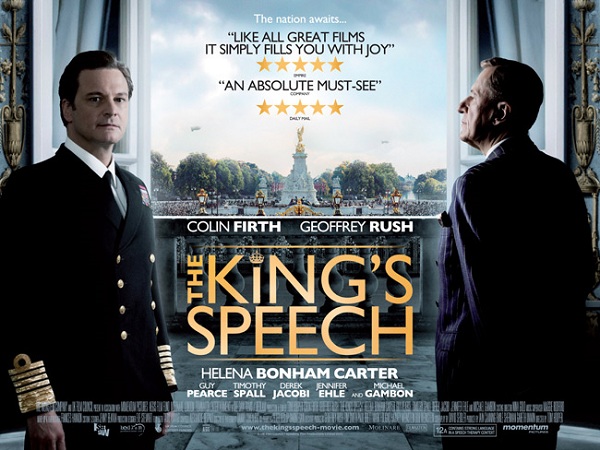
kings-speech-34.jpgIt wasn’t because she didn’t love him, she explains, when she turned down his proposal of marriage twice. It was because he was a prince, a member of the British royal family, and she did not want to live a public life. And then she remembered that she did love him. And that he had a stammer, so she concluded that would keep him on the sidelines. And then she married him, and they had two children. And then he became king.
The Duke of York (Colin Firth), known as Bertie to his family, was an almost-ideal second son in the royal family. He served honorably in the military and took his public duties seriously. He had no interest his brother David’s position as the heir to the throne. But then three things happened. First, radio was invented, and all of a sudden a dignified wave was not enough. For the first time, all of Great Britain (encompassing, at that time, one quarter of the developed world) could hear the voice of their leaders. Second, Hitler’s aggression was making war inevitable.
And third, Bertie’s brother David, by then King Edward VIII, would shatter precedent and become the first ruler in British history to resign, in royal terms, to abdicate, so that he would be free to marry an American divorcee named Wallis Simpson. Just at the moment when the British people most needed to hear their king, they had a king who could not TIFF-Kings-Speech-colin_firth_helena_bonham_carter_kings_speech4.jpgspeak.
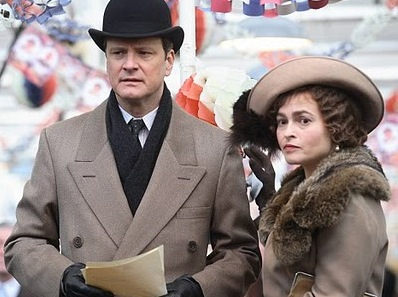
The best doctors had been consulted, and Bertie had been subjected to treatment that literally went back to Demosthenes. And then the Duchess brought him to Lionel Logue (Geoffrey Rush), an Australian actor who had worked with the shell-shocked veterans of WWI. As an actor, he knew breathing techniques and other exercises to help make the spoken word smooth and compelling. And his work with the veterans showed him that the relationship between the therapist and the stutterer — and sometimes the opportunity to talk about the stutterer’s experiences and fears — could be very important.
And so Bertie has, for the first time ever, conversations with someone outside his family. He desperately wants to maintain his dignity, but he even more desperately wants to be able to play this increasingly more crucial role.
The movie may be sepia tones and British accents but it is not at all stuffy thanks to Firth, Rush and Helena Bonham Carter as his wife. Firth shows us Bertie’s struggles to locate his voice and define his role. In one scene, when he tells his little girls (including the current Queen Elizabeth) a bedtime story, it is almost unbearably touching because it means so much to him and the story is so self-deprecatory and loving. People who have trouble speaking spend a lot of time listening and observing. Bertie watches his father and brother with deference, a need for approval, and also a thoughtful evaluation of their strengths and weaknesses as though he is measuring them as a way of creating himself.
The heart of the film is Bertie’s meetings with Lionel, and they are a marvel. Screenwriter David Seidler, himself a one-time stutterer whose uncle was treated by Lionel, worked on the screenplay for decades (the Queen Mother asked that it not be produced until after her death), and it is a masterwork that merits all that went into it. At age 72, Seidler knows what it is to find one’s voice.

(more…)

Related Tags:


Based on a true story Biography Drama DVD/Blu-Ray Pick of the Week

Country Strong

Posted on April 12, 2011 at 8:00 am

The husband manager of the beloved country singer just out of rehab says to her, “Do I tell you how to sing, darlin’? Hmm? Have I ever told you how to sing a song?” “That ain’t the point,” she weakly responds, and he keeps going. “Don’t tell me how to run your life. I been doin’ pretty good with it.”

That brief exchange 36 years ago in the classic Robert Altman film, “Nashville,” summarizes the new Gwyneth Paltrow film, “Country Strong.” She plays Kelly Canter, always introduced as a six-time Grammy winner, whose husband-manager James (played by real-life country superstar Tim McGraw) takes her out of rehab a month early for a series of concerts, on the theory that her brand needs more rehabilitation than her substance abuse problem.

But the incomplete rehab is not the only unfinished business. In a performance in Dallas, Kelly, then five months pregnant, was so drunk she fell off the stage. She has to regain the trust of her fans, concert promoters, her husband, and — toughest of all — herself.

To make things even more complicated and difficult, the opening acts for her new tour are Beau (“Tron: Legacy’s” Garrett Hedlund) and Chiles (“Gossip Girl’s” Leighton Meester). Kelly likes Beau. James likes Chiles. Beau and Chiles like each other. Not even a country song, much less a movie, can manage all that drama.

The music is the best part. Hedlund has a surprisingly rich singing voice, the mahogany tones giving depth and stature to an under-written character, and Meester handles her songs like the beauty pageant contestant with Taylor Swift ambitions she is asked to play. But all of Paltrow’s considerable acting chops are not up to the challenge of playing either a country singer or a substance abuser. Her toned, willowy body and elegant, urban posture are out of place and her singing voice, while pleasant and tuneful is far better suited to the saucy songs she performed on “Glee.”

As in her first film, The Greatest, writer-director Shana Feste shows a great deal of promise, but like many excited beginners, she still has not figured out how to remove the clutter from her story. Individual scenes work well enough and the songs are very good but she juggles too many relationships with too many ups and downs and the conclusion feels unearned and tacked on. Part of the power of a country song is its simplicity in telling its story, a lesson Feste still needs to learn.

(more…)

Related Tags:


Drama Musical

Harry Potter and the Deathly Hallows: Part 1

Posted on April 11, 2011 at 8:00 am

B+
Lowest Recommended Age: Middle School
MPAA Rating: Rated PG-13 for some sequences of intense action violence, frightening images and brief sexuality
Profanity: Some British swear words
Alcohol/ Drugs: None
Violence/ Scariness: Constant intense fantasy peril and violence, some graphic injuries, major characters injured and killed
Diversity Issues: A theme of the movie
Date Released to Theaters: November 18, 2010
Date Released to DVD: April 12, 2011
Amazon.com ASIN: B001UV4XHY

Harry, Hermione, and Ron have to grow up quite literally in the gripping second-to-last installment of the “Harry Potter” movie series, based on the first half of the seventh and final book.  Harry (Daniel Radcliffe), Hermione (Emma Watson), and Ron (Rupert Grint) take a swig of polyjuice potion to impersonate three nondescript middle-aged people so they can infiltrate the Ministry.  Afterward, they shed the older personas like giant overcoats. But they know they must stay in the adult world in this powerful story that sets up the final confrontation between the boy who did not die and he who must not be named.

No more Hogwarts school for young wizards and witches. No more Quidditch, no more short-term Defense Against the Dark Arts professors or visits to Hagrid’s creatures or OWL exams or excursions to Hogsmeade for a cozy chat over butterbear at The Three Broomsticks. Hogwarts headmaster Albus Dumbledore (Michael Gambon) is dead. Hermione has had to erase her parents memories so that not even a photograph remains as evidence that they once had a child.  The dreadful Dursleys have fled 4 Privet Drive.  Voldemort (Ralph Fiennes) is stronger.  The Ministry is under the control of his Death Eaters, who despise muggles (humans) and want to eradicate any witches or wizards with muggle blood.

Everything is on the line. Within the first 15 minutes of the film, an important character is seriously wounded and another is killed. Deeper, direr losses are ahead. Harry, Hermione, and Ron are out in the cold as they race from one remote, chilly location to another and try to figure out how to locate the seven places where Voldemort has hidden pieces of his soul.

Director David Yates and writer Steve Kloves return, again showing a deep appreciation for the material, especially in the way the vast, bleak settings reflect the overwhelming task facing the three friends. The book is not an easy one to adapt and like its source material the movie sometimes seems to lack direction as its heroic trio often has no idea what to do next. But its young stars have grown into able performers who hold up well next to what sometimes seems like a battalion of classically trained British actors. The scene of Hermione erasing her parents memory is very brief, but Watson makes it sharply poignant. Radcliffe’s quiet dignity shows us how Harry has matured. And Grint, too often relegated to comic relief, gets a chance to show us his pain as a piece of Voldemort’s soul begins to infect him with jealousy and mistrust. A tender moment between Harry and Hermione lends a sweet gravity that does as much to add urgency to our anticipation for the next chapter as the prospect of the final battle. (more…)

Related Tags:


Action/Adventure Based on a book Drama DVD/Blu-Ray Pick of the Week Fantasy Series/Sequel

Upstairs, Downstairs — Old and New

Posted on April 10, 2011 at 12:58 pm

I loved the old PBS series “Upstairs, Downstairs,” which ran from 1971-75 on the BBC.  It was revolutionary because it gave almost-equal time to the stories of the servants (downstairs) and the wealthy Edwardian-era family they worked for (upstairs).  Jean Marsh, who played a housemaid, was the series co-creator with her friend Eileen Atkins.  A new 40th anniversary DVD set has been released by Acorn Media with more than 25 hours of new bonus material.

Marsh returns for three new episodes, this time with Atkins, as the sequel to “Upstairs, Downstairs” begins tonight on PBS.

When the master of 165 Eaton Place, Sir Hallam Holland, carries his wife across the threshold of their new home, Lady Agnes exclaims with pleasure, “What a ghastly old mausoleum!” Neglect has strewn cobwebs everywhere and furred the surfaces with dust. But with a sumptuous renovation and the help of the indomitable housekeeper Rose Buck (Jean Marsh), the iconic address so beloved in the original series Upstairs Downstairs is soon restored to its former glory.

It’s 1936, a tumultuous time in Britain, and within the walls of 165 Eaton Place, characters from an orphanage, a damp Welsh castle, the heart of the British Raj and elsewhere together will face a changing world, not just upstairs and downstairs, but side by side.


Related Tags:


Drama Television

Soul Surfer

Posted on April 7, 2011 at 6:01 pm

Bethany Hamilton (AnnaSophia Robb) tells us that as a child she spent more time wet than dry. She is the daughter of competitive surfers, home-schooled so that nothing would interfere with her training or her opportunity to go out into the water when the waves were good. And then one morning, when she was 13, a shark bit off her arm up to the shoulder. Determined that nothing could stop her from doing what she loved, she was back on her board a month later.

Two powerful forces kept her going, Bethany’s passion for surfing and her faith in God. This movie does a better job with the first than the second. The surfing scenes both before and after her injury are gorgeously portrayed, taking us inside the waves so that you will almost feel the spray on your face as the surfers rip around the swells. Writer-director Sean McNamara and the talented surfers on screen convey not just the experience of harnessing the power of the ocean but the thrilling rush of it as well. But he does not bring the same energy to the faith-based part of the film, which feels flat and more dutiful than heartfelt, like a youth group curriculum pulled off the Internet.

One problem is Carrie Underwood, a lovely performer who just does not have the acting skill she needs for Sarah Hill, the youth counselor who guides Bethany both before and after the attack. Perhaps because the film-makers are trying to please both faith and secular audiences, the faith-based elements of the story are thin and vague, reduced to a parable about not being able to see the big picture when you are too close and a trip to a very tidy settlement area in Thailand after the tsunami. The mention of Jeremiah 29:11 is not as significant as her doctor’s reassurance that “the things you are going to have to learn to do differently is extensive but the things you won’t be able to do is small.”

The real turning point is the scene where Bethany receives a prosthetic arm that does not give her the functionality she expected. That is a far greater blow than the original injury because it is only then that she must acknowledge that her loss is permanent. It is only then that she is able to have an honest re-evaluation of her faith, her priorities, and her options. In another sober moment, Bethany’s father (Dennis Quaid) silently matches the bite mark on Bethany’s surfboard with the enormous jaws of a captured shark, confirming that this was the beast that attacked his daughter.

Robb conveys Bethany’s resilience and athleticism. McNamara has a good sense for the rhythms of teen girl friendships (I still think that Bratz is underrated) and the scenes with Bethany and her friends capture the warmth and excitement of young girls on the brink of mastery of skills and the beginning of independence.  But like its main character, it really comes alive when it catches the waves.

(more…)

Related Tags:


Based on a book Based on a true story Drama Sports Stories About Kids
THE MOVIE MOM® is a registered trademark of Nell Minow. Use of the mark without express consent from Nell Minow constitutes trademark infringement and unfair competition in violation of federal and state laws. All material © Nell Minow 1995-2026, all rights reserved, and no use or republication is permitted without explicit permission. This site hosts Nell Minow’s Movie Mom® archive, with material that originally appeared on Yahoo! Movies, Beliefnet, and other sources. Much of her new material can be found at Rogerebert.com, Huffington Post, and WheretoWatch. Her books include The Movie Mom’s Guide to Family Movies and 101 Must-See Movie Moments, and she can be heard each week on radio stations across the country.

Website Designed by Max LaZebnik