The Highwaymen

The Highwaymen

Posted on March 21, 2019 at 5:12 pm

B
Lowest Recommended Age: Mature High Schooler
MPAA Rating: Rated R for some strong violence and bloody images
Profanity: Some mild language
Alcohol/ Drugs: Drinking and alcohol abuse
Violence/ Scariness: Extended bloody violence, characters injured and killed
Diversity Issues: None
Date Released to Theaters: March 22, 2019

Copyright Netflix 2019
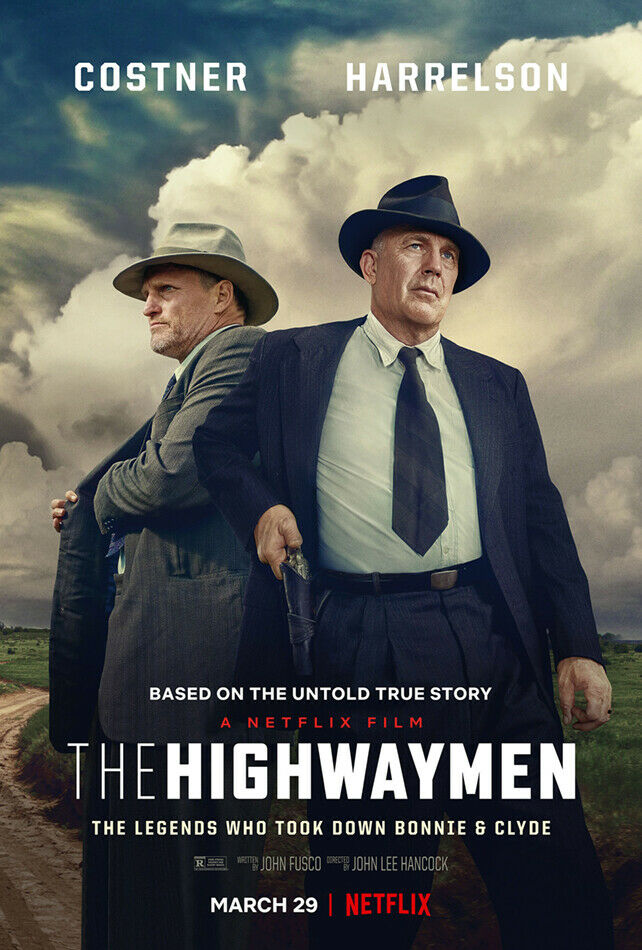
The titles say it all. Bonnie Parker and Clyde Barrow, robbed banks, stores, and gas stations, masterminded a prison escape, killed police officers and civilians, all while they were still in their 20’s, until they were gunned down by law enforcement. They were populist celebrities of their time and have been glamorized in movies, most notably the Arthur Penn film “Bonnie and Clyde,” starring Faye Dunaway and Warren Beatty. They get their names in the title, but for the story of the men in law enforcement who tracked them down, a generic term will do.

“The Highwaymen” is the un-glamorous story of former Texas Rangers called back into service who persevere despite unreliable politicians, incompetent federal agents, and a population, including criminals and Depression-era fan who were on the side of anyone who was not on the side of the banks. The story of the lovers who defied the rules created by the rich and powerful and shared cheeky photos of themselves holding guns was much more appealing than the idea of bringing them to justice.

Director John Lee Hancock “The Blind Side” and writer John Fusco (“Young Guns,” “The Shack”), are, like the story’s lead characters, disgusted with those who think that Bonnie and Clyde are more appealing than the men who caught and killed them, though that does not prevent them from altering some of the facts themselves.

The focus here is on the two old pros, Frank Hamer (Kevin Costner) and Maney Gault (Woody Harrelson). In the Penn film, the Hamer character was portrayed as hapless in comparison to the people he was tracking, initially captured by them (which never really happened). In this version, we only catch brief glimpses of the notorious duo. It is clear who we are supposed to respect and root for.

Texas governor Ma Ferguson (a deliciously bellicose Kathy Bates) has shut down the Texas Rangers in favor of a more modern form of law enforcement. But when it comes to the crime spree of Bonnie and Clyde, she recognizes that she doesn’t need modern and she doesn’t want law enforcement. She wants them dead. And so she has someone contact Hamer, now a successful private investigator living comfortably with his wife (Kim Dickens). And Hamer contacts Gault, living in near-poverty with his daughter trying to stay off the booze.

The pace of the film is slow and deliberate because what these men are doing is slow and deliberate. The filmmaking is straightforward but thoughtful. A scene where Hamer and Gault search what turns out to be an empty house is especially skillful, with the lawmen framed in a dresser-top mirror. The images of Depression-era life, the campout of what in those days were called hoboes, the saucy red shoe that is all we see of Bonnie in her first appearance, the stop to buy guns and the boys who help Hamer with some secret target practice, the face of Hamer’s wife (an excellent Kim Dickens) as she says goodbye — all reward the patient viewer.

Costner and Harrelson have the kind of easy chemistry that suits their characters, men who have seen too much and done too much. They know they have done wrong in the cause of right, but they also know that their wrongs kept people safe. They know that they will not be appreciated by the politicians who will claim credit for their successes and blame them for mistakes made by others, or by the people who thought of Bonnie and Clyde as a romantic fantasy of living fast, dying young, and leaving a good-looking corpse, if you don’t count the bullet holes. But that knowledge will not, as anything else can not, turn them away from what they see is their duty. This movie does what they were too proud to do themselves, tell their story and let us learn from it.

Parents should know that this is a crime and law enforcement story with extended peril and violence. Characters are injured and killed and there are some graphic and disturbing images. The film also has some sexual references, some potty humor, alcohol and alcoholism, and some strong language.

Family discussion: Why did Hamer and Gault take the job? Why did Clyde’s father want to talk to Hammer? Why did so many people root for Bonnie and Clyde?

If you like this, try: “The Untouchables” and “Bonnie and Clyde”

Related Tags:


Based on a true story Crime Drama movie review Movies -- format Movies -- Reviews
The Upside

The Upside

Posted on January 10, 2019 at 5:49 pm

B-
Lowest Recommended Age: High School
MPAA Rating: Rated PG-13 for suggestive content and drug use
Profanity: Some strong and crude language
Alcohol/ Drugs: Marijuana, some alcohol
Violence/ Scariness: Severe medical issues, some peril, reference to serious accident
Diversity Issues: A theme of the movie
Date Released to Theaters: January 11, 2019
Date Released to DVD: May 20, 2019

Copyright 2019 The Weinstein Company
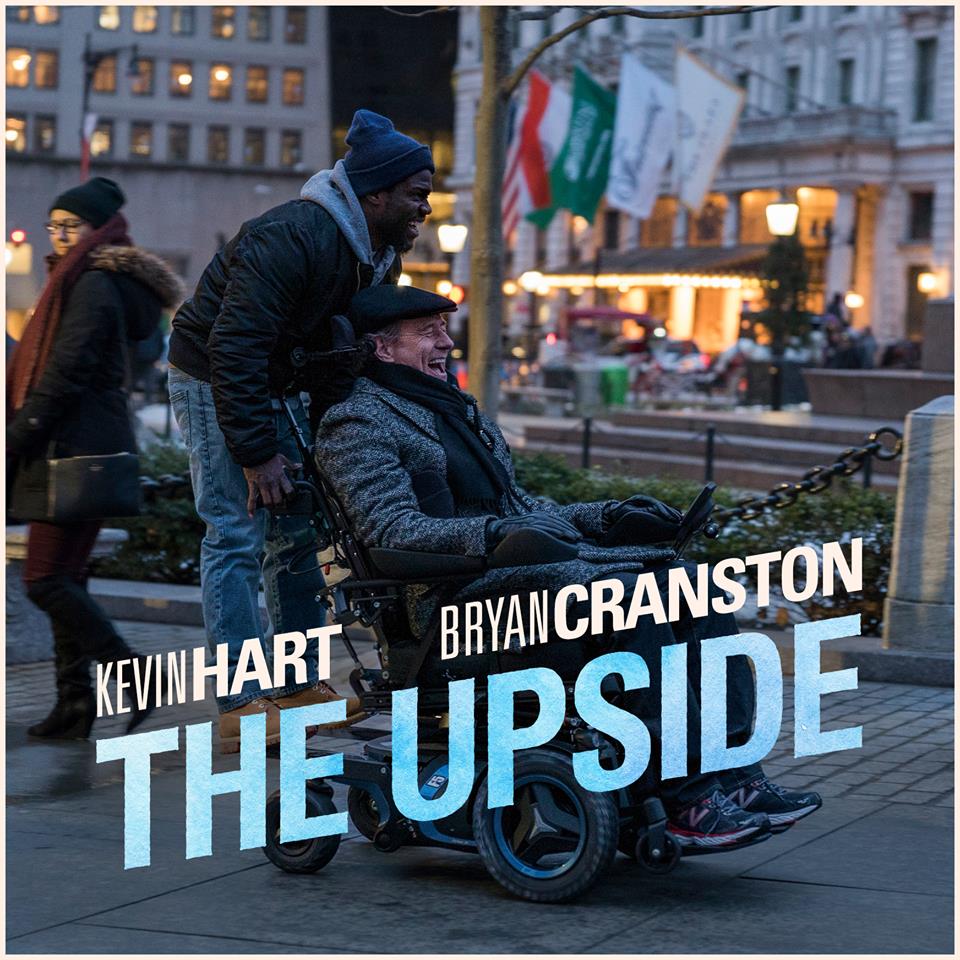
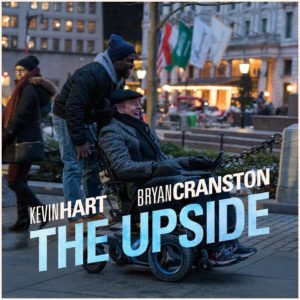
First, it really happened. A wealthy French aristocrat named Philippe Pozzo di Borgo was paralyzed in a paragliding accident and hired an ex-con to be his aide. Their friendship and their adventures together inspired a French box office record-breaker called “The Intouchables.” And now there is an American remake called “The Upside,” set in New York City, starring Bryan Cranston as the man in the wheelchair and Kevin Hart as Del, the “life auxiliary.”

Del did not want the job. He did not even know what job he was applying for. But his parole officer warned him that he would have to go back to prison if he could not show that he had been turned down by three potential employers. So, he takes the elevator to the penthouse thinking he is applying for a custodial position and barged into another candidate’s interview because he just wants to be turned down and get out of there and pick up his son from school. Instead, he ends up getting hired. Philip (Cranston) likes Del because he is so inappropriate. While the other applicants for the position spoke in low, soothing, deferential tones, Del was at home with saying whatever he was thinking.

Being at home with whatever the job required was another thing, however. Del is fine with lifting Philip into the chair and driving him around in his fancy cars. He is more than fine with his room in the penthouse, though the shower is very complicated and probably bigger than his prison cell. He is fine with Philip’s DNR orders. He is not fine with some of the more intimate aspects of the job.

It is about 15 minutes too long, and very much a studio product, burnished and focus-grouped. Philip teaches Del to appreciate opera and Del teaches Philip to appreciate Aretha Franklin. They each push the other out of their comfort zones. Del forces Philip to call his “epistolary” friend, a woman he has been corresponding with through old-school letters. Philip makes it possible for Del to resolve some of the issues of his past, including beginning to develop a relationship with his estranged son.

The three performers bring a lot of luster to a formulaic screenplay (opera/Aretha, TWO scenes high on weed, a breaking-everything-will-be-cathartic moment), especially Cranston, who brings warmth and depth to a character who is extremely patient and understanding (until he isn’t). Kidman is marvelous as Philip’s quiet and very proper executive assistant. And Hart has his best moments when he is slightly toned down, unsure, and disheveled from his usual high-energy, peppery persona, making us look forward to seeing him explore a wider variety of roles, maybe even something dramatic. If he listens to the advice Del gets from Philip, maybe that will happen.

Parents should know that this film features some strong and crude language, sexual references and graphic sexual humor and a mild situation, drug use and drug humor, and a severe medical condition.

Family discussion: What need can you find a way to fill? Who can you encourage? Why did Philip like Del?

If you like this, try: the original French version, “The Intouchables” and “Me Without You”

Related Tags:


Comedy Drama DVD/Blu-Ray Illness, Medicine, and Health Care Inspired by a true story movie review Movies -- format
If Beale Street Could Talk

If Beale Street Could Talk

Posted on December 27, 2018 at 12:08 pm

A
Lowest Recommended Age: Middle School
MPAA Rating: Rated R for language and some sexual content
Profanity: Strong language
Alcohol/ Drugs: Acohol
Violence/ Scariness: Some peril and violence, references to rape
Diversity Issues: A theme of the movie
Date Released to Theaters: December 25, 2018
Date Released to DVD: March 26, 2019
Copyright Annapurna 2018

When I interviewed writer/director Barry Jenkins about “Moonlight,” we talked about the movie’s haunting score, composed by Nicholas Britell. “Many directors would use songs of the era to place the audience in the film’s three time periods,” I said. “Two things,” he replied. “First, we could not afford the rights to those songs. But more important, I believe these characters deserve a full orchestral score.”

I thought of those words as I watched Jenkins’ latest film, “If Beale Street Could Talk,” based on the 1974 novel by James Baldwinmy #1 film of 2018, and winner of the Best Director, Best Supporting Actress and Best Film Spirit Awards. There were moments when it did not feel like I was watching the film. It was more like I was immersed in it, as though I could feel it pulsing through my veins. The entire theme of the movie could be, “These characters deserve a full orchestral score” along with the highest level of every other creative and aesthetic element available to a filmmaker, from Baldwin’s lyrical words to the luscious cinematography of “Moonlight’s” James Laxton, another gorgeous score by Britell, costumes that carry the narrative and illuminate the characters, and performances of infinite sensitivity and humanity.

“If Beale Street Could Talk” succeeds brilliantly at one of cinema’s most central functions: a love story with sizzling chemistry between two impossibly beautiful people. Stephen James (“Race”) and newcomer Kiki Layne are 2018’s most compelling romantic couple, pure pleasure to watch. Their relationship is in every way the heart of this story, the reason we feel so sharply the injustice and, in some ways harder to accept, the resignation that is the most undeniable signifier of generations of institutional racism. We see that most powerfully when Oscar-winner Regina King, as the girl’s mother, looks in the mirror as she prepares like a matador entering the bullring for a meeting that could make all the difference for the couple. She cannot expect much, but she has to try. Throughout the movie, there is resignation and diminished hopes but there is also resilience. And “Beale Street” reminds us that undiminished and imperishable love abide: romantic love, the love of parents and siblings, even an unexpected encounter with a warmhearted landlord. There is the love Baldwin and Jenkins have for these characters. And, most of all, it reminds us that this is a story that deserves to be told with the best of what movies have to offer, including a full orchestral score.

James and Layne play Fonny and Tish, childhood sweethearts who are young and deeply in love. He is wrongfully arrested for rape by a bigoted cop with a grudge and is in jail when Tish tells him that she is going to have a baby. We see what happened before and what happens after in a jazzy, non-linear form, luscious images and exquisite performances. This film is a masterpiece, like its characters of a time nearly half a century ago, “ready,” and exactly right on time.

Parents should know that this film includes explicit sexual references and situations, references to rape, unjust charges and abuse of the justice system, racism, and some peril and violence.

Family discussion: Why does Sharon take off her wig? Why do the mothers respond so differently to the news of the baby?

If you like this, try: “Moonlight” from the same writer/director and the books of author James Baldwin

Related Tags:


Based on a book Drama DVD/Blu-Ray Family Issues movie review Movies -- format Race and Diversity Romance
Ben is Back

Ben is Back

Posted on December 6, 2018 at 5:40 pm

B +
Lowest Recommended Age: Mature High Schooler
MPAA Rating: Rated R for language throughout and some drug use
Profanity: Very strong language
Alcohol/ Drugs: A theme of the movie, drug dealing, drug use, overdoses
Violence/ Scariness: Peril and threats of violence
Diversity Issues: None
Date Released to Theaters: December 7, 2018
Date Released to DVD: March 4, 2019

Copyright Lionsgate 2018
Movies about families struggling with substance abuse, like real life struggles, generally follow the same pattern. A family member gets involved with drugs (or alcohol or some other addiction) and then there is the horrified realization of how serious the problem is, hope, betrayal, hope, back-sliding, incalculable damage to other family members, anger, recriminations, tears, hope, more back-sliding, maybe some more hope. We saw that most recently in “Beautiful Boy,” based on the joint memoirs of a father and son. But writer-director Peter Hedges (“Pieces of April,””What’s Eating Gilbert Grape?”) wisely takes a different approach in “Ben is Back,” starring his son, Lucas Hedges (“Manchester By the Sea,” “Boy Erased”).

As he explained to me in an interview, Hedges has always been fascinated by the story of Orpheus, who followed the woman he loved into Hades to try to save her. As the title tells us, this movie begins when Ben (Hedges) unexpectedly shows up at home just before Christmas. We learn everything that the typical substance abuse movie takes two hours to cover in the first few minutes, from the very different reactions of his mother, Holly (Julia Roberts), who is overjoyed to see him and his sister, Ivy (Kathryn Newton), who is furious and horrified. (Nice Christmas-y names, there, Holly and Ivy). And then we see that Holly may be happy to have Ben home, but she has not forgotten who he is — she immediately empties out the medicine cabinet and hides her jewelry.

He says he got permission from the residential rehab program. It is probably not true, but what can a mother do? She wants it to be true so badly. She wants him to be home and to want to be home. And it is Christmas. Holly’s husband, Neal (Courtney B. Vance), the father of her two younger children, does not want Ben to be there. Holly persuades him to give Ben (another) chance.

And then, she must follow him into Hades. An incursion from Ben’s old life in the underworld of drug abuse means that Ben must visit many of his former contacts, and Holly insists on going with him. She may have thought she knew and had experienced the worst, that she knows how far she can go, how far she is willing to go, but she will learn that none of that is true.

Hedges, as always, approaches his characters with a deep, tenderhearted humanity. He is clear-eyed about the genuine villains in this story, including those who make and sell legal opiates, and he recognizes the mistakes even well-meaning, attentive, caring people make. He also understands how family dynamics curb and enable abuse, and how abuse distorts and damages everyone in the substance abuser’s orbit. But he has sympathy for addicts and their families, acknowledging their mistakes and their struggles but always wanting the best for them.

We go backwards through Ben’s life (and Holly’s), meeting people who used with him and people who used him. We see how he first got hooked, one of the movie’s most powerful moments as Holly confronts the now-pathetic culprit in a shopping mall food court. We see the collateral damage, the grieving mother, the near-destroyed friend. And, paraphrasing the words of the old public service ad, we know what it did to Ben, but does Holly know what it is doing to her?

Roberts, who has always been one of the most expressive of actors, gives one of her all-time best performances here. From the film’s very first moment, as she persuades her younger children to do something with a small, seemingly harmless bribe, we see how much of her energy and focus is on managing the world for the people she loves. As she and Ben are driving through their own version of Hades, she keeps assuring her family that everything is fine and that she and Ben will be home soon. It is as though she thinks that if she can only persuade everyone, she can will it into being. The skill of this movie is that while it is clear she cannot, we wish she could.

Parents should know that this movie includes themes of drug abuse, overdoses, rehab, drug dealing, sexual references, sad offscreen death, and very strong language.

Family discussion: How is this different from other stories of substance abuse? What do we learn from the scene in the food court? Why can’t Holly tell her family the truth?

If you like this, try: “Beautiful Boy” and “Flight”

Related Tags:


Crime Drama DVD/Blu-Ray Family Issues Illness, Medicine, and Health Care movie review Movies -- format
Creed II

Creed II

Posted on November 20, 2018 at 10:37 pm

B +
Lowest Recommended Age: Middle School
MPAA Rating: Rated PG-13 for sports action violence, language, and a scene of sensuality
Profanity: Brief strong language
Alcohol/ Drugs: None
Violence/ Scariness: Intense and graphic fight scenes, serious injury, fighter killed
Diversity Issues: None
Date Released to Theaters: November 20, 2018
Date Released to DVD: March 4, 2019
Copyright 2018 Warner Brothers

Like a Timex watch and like Rocky himself, the Rocky franchise takes a licking and keeps on ticking. Here we are, four decades later, and Rocky Balboa is still going. “Creed,” written and directed by Ryan Coogler in between “Fruitvale Station” and “Black Panther,” was an unexpected upgrade, as Adonis Creed, the son of Rocky’s opponent in the original Oscar-winning film took over, angry, with a chip on his shoulder, and itching for a fight. Michael B. Jordan is a brilliant actor with sizzling screen charisma, and it was, well, a knockout. He was on his way to becoming a champ and to making a life with a beautiful hearing-impaired singer (Tessa Thompson).

Coogler produced this next chapter, Creed 2, written by the original Rocky, Sylvester Stallone, who returns as Creed’s coach and mentor, the guy you always want in your corner. And one thing Stallone knows how to do is step up the stakes. Entertainment Weekly once wrote that “It’s hard to find anything more 80’s than Rocky IV.” Just before the Cold War would draw to a close, “Rocky IV” had Stallone battling a Soviet fighting machine named Drago (Dolph Lundgren) with an ice queen of a wife (Brigitte Nielsen, who would be Mrs. Stallone briefly).  After Drago kills Apollo Creed in the ring, Rocky fights him on behalf of Apollo and of course on behalf of America and freedom, and Rocky-ism.

And now, in the eighth film in the series, Drago’s son, trained by his bitter, brutal father (Lundgren again), challenges Adonis, newly crowned heavyweight champion, to a fight on behalf of Apollo, America, freedom, and Rocky-ism.  One fighter is bigger and tougher, but he has been trained with hate. The other has been trained with heart . Time for the classic Bill Conti score again.

Michael B. Jordan is mesmerizing on screen and so completely authentic that he makes even the soapiest moments real and engrossing.  Is Rocky going to refuse to train Adonis to fight Drago’s son (Florian Munteanu) just to create an opportunity for extra drama? Will there be ten-counts? Will there be a proposal, a baby, a reconciliation? Maybe two? Cornerman pep talks about “this is your house” and commentary on the business side of boxing (“The belt ain’t enough — you need a narrative, something that sticks to the ribs”)?  Decadent Russian oligarchs in a dining room that looks like it belongs to Count Dracula?  A camera shot that makes us feel like one of Drago, Jr.’s fists is coming right at us?  Callbacks to “Rocky IV?”  (In that film, Lundgren said only 46 words. In this one, he says a few more but some of them are the same words. Nielsen, on the other hand, is in the film but her ex-husband did not give her more than a few words to say.)  Dramatic moments in the audience, as women watch the fights — or don’t?  All of that, plus, in case we miss anything, a lot of expository narration from the sports announcers. 

Oh sure, it’s cheese.  But it’s Rocky, and it still works.

Parents should know that this film includes extended and graphic scenes of boxing with severe injuries, references to a boxer who died following a fight, brief strong language, and a non-explicit sexual situation.

Family discussion: How did the different goals Adonis and Viktor had for the fight affect them? What made Ivan Drago change his mind? What do we learn from Adonis’ night with the baby?

If you like this, try: the “Rocky” movies and “Warrior”

Related Tags:


Drama DVD/Blu-Ray movie review Movies -- format Series/Sequel Sports
THE MOVIE MOM® is a registered trademark of Nell Minow. Use of the mark without express consent from Nell Minow constitutes trademark infringement and unfair competition in violation of federal and state laws. All material © Nell Minow 1995-2026, all rights reserved, and no use or republication is permitted without explicit permission. This site hosts Nell Minow’s Movie Mom® archive, with material that originally appeared on Yahoo! Movies, Beliefnet, and other sources. Much of her new material can be found at Rogerebert.com, Huffington Post, and WheretoWatch. Her books include The Movie Mom’s Guide to Family Movies and 101 Must-See Movie Moments, and she can be heard each week on radio stations across the country.

Website Designed by Max LaZebnik