Almost Christmas

Almost Christmas

Posted on November 10, 2016 at 5:24 pm

Copyright Universal 2016

In “Almost Christmas,” Danny Glover plays Walter, a recent widower who spends a lot of time in the kitchen, trying over and over again to replicate his late wife’s legendary sweet potato pie. What he wants to replicate, of course, is the time when his family was all together, as shown in a heart-tugging, gracefully edited opening credit sequence, with the years melting into each other from 1971 to 2015. A young couple embraces on a mattress on the floor and, as it happens in life, an eye blink later they have three children, and then, as a bit of a late surprise, a fourth. The children are all adults now, coming home for the first Christmas since their mother died, and Walter wants it to be a time of reconnection. For that, he needs the sweet potato pie and it has to be just like hers.

Writer/director David Talbert (“Baggage Claim”) is trying for his own version of a sweet potato pie with this film, mixing in the standard ingredients for a Christmas family gathering comedy/drama movie. So, there are adult siblings with ongoing conflicts, a dad who is spending too much time on work, precocious kids (in this case, happily uploading every element of family dysfunction on social media), church, a guest star (though why you would put Gladys Knight in a film and not let her sing is beyond me), family traditions, a kitchen disaster, secrets to be revealed, a rekindled romance, a busted marriage, high maintenance in-laws, and, of course Christmas meaning and reconciliation magic and a lot of food. In other words, other than running into Gladys Knight, it is pretty much what goes on around the world at Christmas.

Talbert’s sweet potato pie of a movie has the right ingredients, and if they are not always combined just right, it still makes for a treat, with an exceptional cast and enough laughs to keep us going until the exact right moment for some tears.

Walter’s older son is Christian (Romany Malco), a husband and father of two who is running for Congress (none of this storyline makes any sense as Christmas is at least 11 months before the next election and the issue he gets caught up in is municipal, not federal, but okay). Malco is terrific in an unusually understated role. The look on his face as Walter asks him to speak at the homeless shelter his mother was devoted to shows endless tenderness and loss. His wife (an underused Nicole Ari Parker) is mostly there to remind him that he should not take time away from the family for his campaign. The youngest of Walter’s children is Evan (Jessie T. Usher), a college football player being scouted for the NFL draft, hiding an addiction to painkillers.

Their two sisters are Rachel (co-producer Gabrielle Union), a fiercely independent single mom and law student, and Cheryl (Kimberly Elise), a dentist married to a know-it-all former basketball player (J.B. Smoove), who is still a player, if you know what I mean.

Walter’s outspoken sister-in-law, a backup singer named May (Mo’Nique) arrives to wear a wild assortment of wigs and prepare an even wilder assortment of exotic foods that no one will touch. Rachel’s high school friend (Omar Epps) would like to renew their acquaintance. And Jasmine (Keri Hilson), Christian’s campaign manager (John Michael Higgins) and Evan’s friend (D.C. Young Fly) show up for various complications.

Like Walter’s pie, it’s not quite as good as the real thing. It would fit it well with Hallmark’s line-up of non-stop Christmas movies from Halloween through New Year’s Day. But there’s a reason those movies are so popular. They remind us of our own chaotic but still memorable holidays and our own difficult but still wonderful families.

Parents should know that this film includes some sexual references and a non-explicit situation, prescription drug abuse, sad offscreen death of a parent, offscreen car crash with injuries, gun, and some strong and explicit language.

Family discussion: What is your family’s favorite recipe? Why was it hard for the sisters to get along?

If you like this, try: “This Christmas”

Related Tags:


Comedy Drama Family Issues Holidays
Loving

Loving

Posted on November 10, 2016 at 5:21 pm

A-
Lowest Recommended Age: Middle School
MPAA Rating: Rated PG-13 for thematic elements
Profanity: Racist epithets
Alcohol/ Drugs: Some alchohol
Violence/ Scariness: Racism, some shoving, child hurt in accident
Diversity Issues: A theme of the movie
Date Released to Theaters: November 11, 2016
Date Released to DVD: February 6, 2017
Amazon.com ASIN: B01LTHZK2U

Copyright 2016  Focus
Copyright 2016 Focus
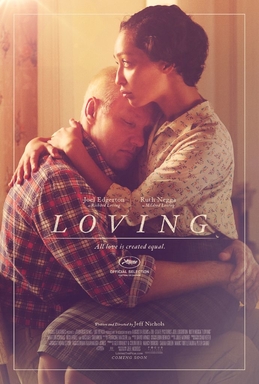
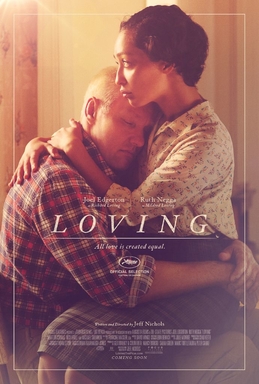
We don’t have to see how they met. We don’t have to see how he worked up the courage to ask her out or their first misunderstanding, or watch her try on different outfits before their big date. “Loving,” written and directed by Jeff Nichols (“Midnight Special,” “Mud”) brings us into the story of Richard and Mildred Loving (Joel Edgerton and Oscar nominee Ruth Negga) as they have a very short, very simple, but very meaningful conversation. She pauses, and we can see on her face that she does not know how he will react and is perhaps afraid to hope. Finally, she says it: “I’m pregnant.”

There is a pause, only a few seconds but it feels much longer. Finally he says only, “That’s great.” But it is clear that he is overjoyed that their love has created a child and he is fully committed to her. And it is clear, too, that they are not fully aware of the ramifications of having a child when the mother is black, the father is white, and the Commonwealth of Virginia, which shut down its entire school system just four years earlier in response to the Supreme Court’s Brown v. Board of Education decision, prohibits marriage or cohabitation between people of different races specifically because it does not want mixed-race children to be born.

Washington D.C. allows inter-racial marriage, so they are married there in 1958, and return home.  One night the sheriff crashes into their home as they are sleeping in their bed, their marriage license on the wall, and arrests them.  The judge suspends their sentence only if they will agree to leave the state and never return together.

They live with family in Washington, and raise three children.  But Mildred wants to go home. Nichols conveys the Edenic quality of the countryside they love. The Civil Rights movement has begun, so she writes to Attorney General Robert Kennedy to ask for his help.  He puts her in touch with the American Civil Liberties Union, a nonprofit that protects Constitutional rights. Two idealistic, if inexperienced, young lawyers (Nick Kroll and Jon Bass) want to take their case to the Supreme Court, which can invalidate all 16 state miscegenation laws.

Nichols keeps the legal stuff at the edges of the story. His focus is on the Lovings and their community, and the film is brimming with small, beautifully realized, evocative details. A dinner scene shows how completely Richard is accepted as a part of Mildred’s family. But we also see a frank conversation where a black man tells Richard that they may be alike, but Richard can “fix” his problem with the bigoted law by leaving Mildred while there is nothing they can do to “fix” theirs.

Richard’s mother, a midwife, only needs a few words to let Richard know that she did not give the police any information about where the Lovings were (and to let him know she was not entirely happy about the marriage, though she treats Mildred with kindness). We see a baleful glance from a defeated white competitor in a car race that could indicate the source of the complaint to the sheriff.

We see Richard’s careful, capable hands stirring mortar and laying concrete blocks and Mildred caring for the children and sitting at the kitchen table to write to the Attorney General. And, in a re-creation of the famous photo in LIFE Magazine by Grey Villet (a nice cameo by Nichols regular Michael Shannon), we see their quiet pleasure in each other as they laugh at the “Andy Griffith Show” episode about Aunt Bee’s pickles. He may need a lawyer to tell the nine old men on the Supreme Court he loves his wife. We see it in every frame.

Parents should know that this film depicts historic racism with some offensive epithets. The movie also includes a childbirth scene and an (off-screen) accident involving a child.

Family discussion: If you could take a case to the Supreme Court, what would it be?  What do we learn about the Lovings from seeing them with their families?

If you like this, try: the documentary “The Loving Story

Related Tags:


Based on a true story Drama DVD/Blu-Ray Pick of the Week Features & Top 10s Race and Diversity Romance
Moonlight

Moonlight

Posted on October 27, 2016 at 5:33 pm

A-
Lowest Recommended Age: Mature High Schooler
MPAA Rating: NR (some sexuality, drug use, brief violence, and language throughout)
Profanity: Very strong language
Alcohol/ Drugs: Drugs and drug dealing, alcohol, smoking
Violence/ Scariness: Bullies, beating, disturbing images, sad offscreen death
Diversity Issues: A theme of the movie, homophobia
Date Released to Theaters: October 28, 2016
Date Released to DVD: February 27, 2017
Amazon.com ASIN: B01LTHZVM4
Copyright 2016 Plan B Entertainment

In the 2017 Oscar winner for Best Picture, a man tells a young boy a story, and, as with many stories adults tell children, especially in movies, it is a story with a purpose. Juan (Mahershala Ali) tells the boy derisively known as “Little” (Alex Hibbert) that when he was young, a woman saw him at night and told him that the silvery moonlight made his dark skin looked blue. She said he should be called Blue from then on. But, he tells Little, he wasn’t. “At some point you gotta decide for yourself who you gonna be. Can’t let nobody make that decision for you.”

In “Moonlight,” a film of a delicate, shimmering beauty that measures up to the title, the boy will struggle to make that decision for himself. Three chapters, as a child, a teenager and a young man, played by three different actors, are labeled with three different names that he is called: the taunting nickname Little, his birth certificate name Chiron (played by Ashton Sanders), and the nickname given to him by someone who had a profound impact on him, Black (played by Trevante Rhodes). Who will he decide to be?

The story begins in the Liberty City neighborhood of Miami. Little runs from bullies and hides out in a crack house, where he is discovered by Juan, a kind-hearted drug dealer. Little won’t talk, so Juan takes him home, where his warmhearted significant other, Teresa (singer Janelle Monae) gives little some food and lets him stay the night. The next day, Juan brings Little back to his mother, Paula (Naomie Harris), a nurse who loves Little but leaves him alone much of the time. “He can take care of hisself. He good like that.”

In the second section, he is a skinny teenager all but abandoned by his mother, who has become addicted to drugs, and bullied at school. He still does not talk much, but he has one friend, Kevin (Jharrel Jerome), who calls him Black. Chiron cannot even acknowledge to himself that he wants more from Kevin, but one night on the beach, they share a piercingly sweet moment of tenderness that will indirectly lead to an act of violence.

When we see him again, he is a man, with an armor of muscle and gold teeth grillz, still almost silent, still almost isolated. But a call from Kevin inspires a journey.

The film is based on a play called “In Moonlight Black Boys Look Blue” by McArthur awardee Tarell Alvin McCraney, who worked with director Barry Jenkins (the lovely romance “Medicine for Melancholy”) on adapting it for the screen. Both McCraney and Jenkins, like Little, had mothers who struggled with addiction, and Jenkins grew up on the Liberty City setting of the film.

The small miracle of the movie is the way it subverts the expectations the audience has based on news reports and many, many other movies. Every character is authentically complex. The graceful, poetic score by composer Nicholas Britell gives the story epic scope and heartbreaking intimacy.

We see Juan’s kindness and wisdom as he holds Little gently in the ocean, teaching him to swim and, more important, giving him an idea of what a man can be. We hear his thoughtful answer when Little asks him what “faggot” means. And yet, when Paula wants drugs, Juan supplies them, even knowing what it will do to Little. The confident, capable Kevin casually mentions time in prison as though it was an inevitable rite of passage. Little/Chiron/Black is physically transformed from chapter to chapter. We are continually challenged and confounded, yet held close to the heart of the story by its romantic lyricism and, most of all, the spacious humanity of its love for its characters.

Parents should know that this film includes very mature material: bullying, brutality, drug dealing and drug abuse, very strong language including homophobic slurs, sexual references and explicit sexual situations.

Family discussion: Why does the main character have a different name in each chapter? What do you think happened to Juan?

If you like this, try: “Medicine for Melancholy”

Related Tags:


Based on a play Drama DVD/Blu-Ray Pick of the Week GLBTQ and Diversity Race and Diversity
American Pastoral

American Pastoral

Posted on October 20, 2016 at 5:47 pm

C
Lowest Recommended Age: Mature High Schooler
MPAA Rating: Rated R for some strong sexual material, language and brief violent images
Profanity: Very explicit and strong language
Alcohol/ Drugs: Alcohol, drugs
Violence/ Scariness: Mostly offscreen violence including riots, domestic terrorism, characters injured and killed
Diversity Issues: Reflects the biases of its era
Date Released to Theaters: October 21, 2016

Copyright 2016 Lakeshore
Ewan McGregor’s first film as a director is “American Pastoral,” based on Philip Roth’s Pulitzer Prize-winning novel about a man whose good and lucky life is torn apart by the upheavals of the 1960’s. It is a thoughtful and diligent effort, but the film cannot overcome two insurmountable problems of adaptation.

The first is the timing. The book was published in 1997, the first of Roth’s American trilogy, and it described the contemporary experience of people who had raised children in post WWII era of peace and prosperity, believing that they had given their children everything they were denied growing up during the Depression and war years, only to find that they raised a generation of angry teenagers who rejected the gifts they had been so proud to present. The dismay they felt is presented in the book as evidence of nobility of spirit; today, in the midst of another era of political polarization and resentment of the first generation as powerful a demographic as the baby boomers, it is difficult to see it as anything other than representing white male privilege.

The second is the inherent challenge of any adaptation of a work of fiction. It is impossible to replicate the experience of a novel, and this one, which depends so entirely on its voice, loses a great deal of its power in the translation to a visual medium. The framing story, with Roth representative Nathan Zuckerman (David Strathairn) attending a reunion and hearing the story that will become the movie from an old friend, is entirely superfluous, missing the essential focus of the book on the limits to our ability to understand the lives of others, even those we think we understand. Zuckerman helpfully sums it up for us: “It’s getting them wrong that is living, getting them wrong and wrong and wrong and then, on careful consideration, getting them wrong again. That’s how we know we’re alive: we’re wrong.”

Zuckerman hears the story of “Swede” Luvov, the kind of golden boy that every high school has to have, the one who is effortlessly good at everything and so nice that you can’t even hate him for it. Swede was a superb athlete and young enough that he was drafted into the army near the end of WWII and just missed action. He returned to a hero’s welcome and married a beauty queen named Dawn (Jennifer Connelly), with the grudging approval of his parents because she was not Jewish.

And then he has the perfect life that his personal grace and talent and respect should earn. He and Dawn move to a house in the country and have cows. He takes over his father’s business, a glove factory, where they produce fine leather goods and treat their workers — mostly African Americans — well. He and Dawn have a beautiful blonde daughter named Merry and she loves them and their bucolic, pastoral life. Everything makes sense.

And then nothing makes sense. Merry (now played by Dakota Fanning) becomes an angry teenager and is enthralled by the protesters against the Vietnam War (and the patriarchy, and pretty much everything else her parents represent). She bitterly accuses: “You’re just contented middle class people.” He helplessly replies, “Some people would be happy to have contented middle class parents.”

She disappears after a post office is bombed. Swede and Dawn are devastated. He cannot stop looking for her. Dawn has a breakdown.

They all try their best, but the result is static and off-key. We are supposed to admire Swede’s decency, but the movie is slanted so precipitously in his favor that even McGregor’s palpable sincerity cannot obscure the film’s smug misogyny. The men are decent, sympathetic, patient, and virtuous. Most of the women are needy, unstable, and sexually provocative. As a child Merry asks for a kiss on the lips and then confesses that she always goes too far. These women should be happy with whatever the men want to give them. They mostly exist merely to disappoint or betray the men in their lives, and sometimes the other women, too.

Or, they are one-dimensional saints. Samantha Mathis (good to see her as always) has a brief scene as a member of the community who is philosophical after a devastating loss. Vicky (“Orange is the New Black’s” Uzo Aduba) is Swede’s top manager in the glove factory. Though Aduba is excellent, the role is limited to a bland loyal subordinate.

When there are riots outside the factory following the murder of Martin Luther King, Vicky helps Swede hang a banner out of the window that reads: Negroes Work Here. Instead of Zuckerman’s meditation on how the people who spend so much of your life envying end up having less enviable lives than your superficial, incurious assessment contemplated, it would have been much more telling to explore the world of a man who thinks that employing African Americans in a glove factory should protect him from the consequences of the system that has for so long tilted in his favor.

Parents should know that this movie includes very explicit sexual references and situations, very strong language, domestic terrorism and murder, riots, alcohol, and drugs.

Family discussion: What do we learn from the framing story at the reunion? What should Merry’s parents have done differently, either before or after the bombing?

If you like this, try: “Goodbye Columbus,” “The Human Stain,” and “Indignation,” also based on books by Philip Roth

Related Tags:


Based on a book Drama Movies -- format
The Accountant

The Accountant

Posted on October 12, 2016 at 5:50 pm

Copyright Warner Brothers 2016
Ben Affleck plays the title character in “The Accountant,” a man on the autism spectrum who has what clinicians call a “flat affect” and some obsessive-compulsive tendencies, but also the math skills of a 93 petaflop computer and the martial arts skills of a Navy Seal who competes on weekends as an American Ninja Warrior.

Director Gavin O’Connor (the underseen gem “Warrior“) and screenwriter Bill Dubuque (the underseen “The Judge“) have concocted a twisty thriller with surprises up to the last minute. The crafty back-and-forth structure keeps the information just out of our reach until it is exactly the right moment for it to fall into place.

After a brief opening shoot-out, we go back in time to see the Wolff family. The parents are meeting with a specialist, who is explaining what it means to be gifted but not neuro-typical. The boy they are discussing is Christian (Seth Lee), who is speed-solving a jigsaw puzzle as his younger brother Brax (Jake Presley) watches. We are given three important pieces of information in this scene. First, Christian cannot handle not being able to finish the puzzle. Second, when the piece that fell off the table is located, we see it fit into place from underneath — he has been working on upside-down puzzle pieces, the blank underside rather than the picture.

Third, his parents do not agree on how to help him. His mother accepts the advice of the specialist, who says that Christian’s hyper-sensitivity to stimulation means that he should be protected from light and noise. But his father (Robert C. Treveiler), who is in the military, insists on the opposite. If light and noise bother Christian, “he needs more.”

We will learn more about the consequences of that disagreement later.

Christian grows up to be an accountant, operating out of a tiny office in a strip mall. (Is the name of his firm, ZZZZ, a reference to one of the most notorious accounting frauds of the 1980’s?). He advises a couple on how to use home office deductions to reduce their tax bill and shows no interest when the receptionist tries to fix him up with her daughter. He then takes on a big case, tracking down a missing $61 million at a company about to go public, where he meets Dana, the very bright young CPA who discovered the discrepancy in the financial reports (Anna Kendrick, lighting up the screen as always). But there is more to him, including a treasure trove that includes originals by Pollack and Renoir and a #1 Action Comic (first appearance of Superman, worth about $3 million), a torturous nightly ritual, a Siri-like virtual assistant who seems to know everything and some very serious guys with guns who are determined to kill Christian and Dana.

Meanwhile, a government official (JK Simmons) is trying to track down a mysterious figure who shows up in photos of some of the most dangerous people in the world, a guy who appears to be their…accountant. He blackmails a savvy young woman on his staff (Cynthia Addai-Robinson) into tracking him down. And a paid assassin (Jon Bernthal) efficiently deals with people he has been assigned to take care of, who may or may not be connected to all of this.

As he did with “Warrior,” O’Connor plays with the borders of genre. There are unexpected moments of humor (“We should go” turns out to be very funny when the tone and timing are right). And he knows how to make us feel for the characters, giving some heft to the puzzle and action. By the end of the film, we get the same satisfaction Christian does in seeing that last piece fit into place.

Parents should know that this film includes intense, sustained action-style violence involving adults and children with martial arts and guns, characters are paid assassins and criminals, fraud, very strong language, and parental abandonment.

Family discussion: What does it mean to be neuro-typical? Who was right about Chris, his father or his mother? What was the purpose of his nightly ritual?

If you like this, try: “Warrior” from the same director

Related Tags:


Drama Thriller
THE MOVIE MOM® is a registered trademark of Nell Minow. Use of the mark without express consent from Nell Minow constitutes trademark infringement and unfair competition in violation of federal and state laws. All material © Nell Minow 1995-2026, all rights reserved, and no use or republication is permitted without explicit permission. This site hosts Nell Minow’s Movie Mom® archive, with material that originally appeared on Yahoo! Movies, Beliefnet, and other sources. Much of her new material can be found at Rogerebert.com, Huffington Post, and WheretoWatch. Her books include The Movie Mom’s Guide to Family Movies and 101 Must-See Movie Moments, and she can be heard each week on radio stations across the country.

Website Designed by Max LaZebnik