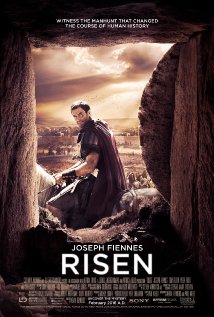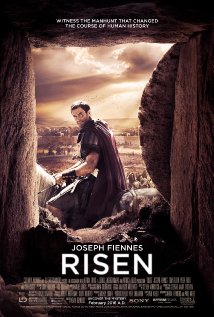
Risen

Risen

Posted on February 18, 2016 at 5:38 pm

B
Lowest Recommended Age: Middle School
MPAA Rating: Rated PG-13 for Biblical violence including some disturbing images
Profanity: None
Alcohol/ Drugs: Alcohol
Violence/ Scariness: Battle, swords, crucifixion, characters injured and killed, some graphic and disturbing images
Diversity Issues: A theme of the movie
Date Released to Theaters: February 19, 2016
Date Released to DVD: May 23, 2016
Amazon.com ASIN: B01BZ4DOGQ

Copyright 2016 Sony Pictures
“Risen” is a sober, reverent story of Clavius (Joseph Fiennes), a Roman soldier ordered to witness the crucifixion of Jesus and prevent his body from being stolen. When the rock placed in front of the tomb and sealed by Clavius is moved and the tomb is empty, Pilate (Peter Firth) is worried that the Jesus’ followers will use this disappearance as proof of His divinity, so he sends Clavius to investigate. His journey will take him to Galilee, and what he sees there will transform everything he thinks he knows.

Fiennes brings Clavius to life with a vivid, thoughtful, sensitive performance, showing us the depth of his loyalty and sense of honor. The way he walks, stands, and rides communicates a lifetime of battles fought and won. He is a man confident in his strength and very aware of the brutality on both sides. At first, he is governed by duty, which we see in the opening battle scenes, in his prompt appearance before Pilate following the battle, not even taking time to clean up, in his acquiescence to taking on a new aide (“Harry Potter’s” Tom Felton, excellent as Lucius) who has not come up through the ranks because his father is Pilate’s friend.

We see that he might have made a different decision about how to respond to the Sanhedrin’s concerns about Jesus, but he follows the orders and makes sure that Jesus is dead and that the tomb is sealed. And we see him speak to his own gods placing a tribute on the shrine to ensure that his prayers are heard.

One of the film’s most powerful sections is an almost “Law & Order” scene with Clavius interrogating witnesses to try to figure out what happened to the body in the tomb. Each encounter tells us something different about Clavius and, indirectly, about the impact that Jesus (called Yeshuah) has had on his followers.

The cinematography by Lorenzo Senatore is beautiful, lending dignity to the story, and Cliff Curtis, a superbly talented performer of Maori heritage who is famously able to play a remarkably wide range of ethnicitys makes a warm, appealing Jesus, kind, compassionate, and a little mysterious. But the focus of the story is wisely on the (fictional) Roman, who is the stand-in for the audience as a witness to the resurrection.

Parents should know that this film includes Biblical-era violence including battle scenes, torture, and crucifixions, with characters injured and killed and disturbing and briefly graphic images.

Family discussion: When did Clavius first begin to believe and why?

If you like this, try: “The Robe,” “Spartacus,” and “Ben-Hur”

Related Tags:


Drama Epic/Historical Movies -- format Spiritual films

Touched With Fire

Posted on February 11, 2016 at 5:12 pm

B
Lowest Recommended Age: High School
MPAA Rating: Not rated
Profanity: Strong language
Alcohol/ Drugs: Drinking and drugs
Violence/ Scariness: Mental illness, suicide attempt, risky behavior
Diversity Issues: A theme of the movie
Date Released to Theaters: February 12, 2016

Movies are fascinated with mentally ill people but they usually do not do a very good job of portraying them accurately or compassionately. Too often they are serial killers (“Silence of the Lambs”). Even worse, many times they are adorable wise fools (“Benny & Joon,” “King of Hearts”), somehow tuned in to a finer way of thinking. We very seldom get to see them as people. But “Touched With Fire,” named for the book on bi-polar disorder by a doctor who herself is bi-polar and written and directed by Paul Dalio, who is bi-polar, has a sense of deep understanding of the characters that makes it very compelling.

Dalio takes us inside, literally shifting the color scheme and the walls of the sets so that we not only see the characters experiencing a manic high but get a sense of how thrilling, liberating, and exhilarating it feels. He is also deeply compassionate to the family members. Christine Lahti and Griffin Dunne show us the endless and sometimes exhausting love, fear, and pain for their children.

Dalio and his characters, Marco (Luke Kirby) and Carla (Katie Holmes) feel kinship to the many artists who were bi-polar, from Van Gogh to Hemingway (we see a list in the film’s closing credits). The manic cycles of bi-polar disorder can spark a kaleidoscopic geyser of artistic energy. Marco and Carla are both poets with wild, vivid word choices. They meet in a mental hospital and are immediately drawn to one another, triggering a manic episode that catapults them into ecstatic happiness. But the down cycle and the consequences of their behavior create complications.

Dalio is very good at conveying the subjective experience of mania and the family dynamics and the poetry and speech of the two main characters limns the uncertain line between art and madness. Holmes and Kirby both give performances of enormous sensitivity and insight. But Dalio’s very diligence about fairness to everyone and some didactic discursiveness are better for therapeutic purposes than narrative purposes. In its best moments, it is a thoughtful, compassionate film that shows how art can help to both heal and express thoughts that are otherwise dangerously uncontainable.

Parents should know that this movie includes themes of mental illness and medication, with attempted suicide and risky behavior, strong language, sexual references, and abortion.

Family discussion: What was the best way for Marco’s and Carla’s parents to respond to their news? Why did Carla and Marco make different choices?

If you like this, try: the book by Kay Redfield Jamison and Mark Ruffalo’s performance in “Infinitely Polar Bear”

Related Tags:


Drama Illness, Medicine, and Health Care Inspired by a true story Movies -- format Romance
The Finest Hours

The Finest Hours

Posted on January 28, 2016 at 5:53 pm

B
Lowest Recommended Age: Middle School
MPAA Rating: Rated PG-13 for intense sequences of peril
Profanity: Some mild language
Alcohol/ Drugs: Social drinking
Violence/ Scariness: Intense scenes of peril, characters injured and killed
Diversity Issues: None
Date Released to Theaters: January 29, 2016
Date Released to DVD: May 23, 2016
Amazon.com ASIN: B019PQ0NZG
Copyright Disney 2016

“In the Coast Guard they say you gotta go out. They don’t say you gotta come back in.” It was a big nor’easter storm off the coast of Massachusetts. It was February 1952, so communications technology was limited. And not one but two tankers split in half. The most experienced Coast Guard crew went off to rescue the first one. When word came in that a second one was sinking, four young men, all under 25 and two who had never been on a rescue operation, took a small boat out into the storm.

That second ship was the Pendleton. Knowing that they had no more than two to three hours before their half of the tanker would sink into the icy storm-tossed waves, they had to decide who would be in charge. “No officers, no rules, every man for himself,” a crew member says. But they realize they must choose between the man who wanted to take the lifeboats or the engineer they did not know as well who said he had a plan (Casey Affleck, understated and compelling). “They may not like you, but they know to listen to you,” one member of the crew admits.

Based on the true story as told in the book by Michael J. Tougias and Casey Sherman, screenwriters Scott Silver, Paul Tamasy and Eric Johnson efficiently introduce us to the characters and the challenges they are facing. Chris Pine plays Bernie Webber, a departure from his usual cocky, confident roles. Bernie is a little shy, but very sincere, and he believes in the rules, not in a rigid way but in a careful way. When we first see him, he is about to see the girl he has been talking to on the phone for the first time and he does not want to get out of the car because he is afraid she will not like him.

And of course she does like him. Her name is Miriam (British actress Holliday Grainger, last seen as an evil stepsister in “Cinderella”). Director Craig Gillespie (of the wonderful “Lars and the Real Girl”) gives them just enough time to get invested in their relationship — and to get us invested in it — before the storm comes in.

Gillespie really gets going when the storm does, though, and those scenes are powerful and exciting. We are in the small boat with Webber as the window shatters and the compass is wiped out. The boat is tossed around like a cork, at one point completely on its side, with monster waves crashing down. And we are in the Pendleton’s engine room as seams burst and beams come down. And then we are back on land, as Miriam tries to find out what is going on, tries to get the commanding officer to bring the rescue team back, and then learns what it is to love a man who risks his life as a part of his job.

In a film like this, the most important job of the director is to make sure we understand how daunting, even impossible, the task is, and then to make sure we get to see what goes into surmounting the obstacles. Some of that is missing here, as when we are told that there are too many men on the Pendleton for the small boat to carry, and then somehow it carries them. The compass is out, there’s no communication, and yet somehow Webber’s crew finds the Pendleton. It may be that no one knows how it worked, but it undercuts the drama to skip over some of those details.

The quiet heroism of these characters is movingly portrayed, and these days, when heroes are hard to come by, this is a touching story of selflessness, courage, and dedication, and exactly the kind of story that Disney tells best.

Parents should know that this story concerns a real-life catastrophic storm with many lives lost. There are scenes of very intense peril, some mild language, and social drinking.

Family discussion: How did the men on the tanker decide who should be in charge? How did Bernie decide when to follow the rules and when not to? What did Miriam learn from her visit to the widow’s house?

If you like this, try: “The Perfect Storm” and “The Hunt for Red October”

Related Tags:


3D Action/Adventure Based on a book Based on a true story Drama DVD/Blu-Ray Pick of the Week
The Lady in the Van

The Lady in the Van

Posted on January 21, 2016 at 5:55 pm

Copyright 2015 Sony Pictures

What connects us to each other? What creates a sense of obligation? Why is it that we somehow find ourselves alone when we don’t want to be and with others when we don’t want to be? Are there secrets that completely change the way we think about people we thought we knew?

And is it possible to be fair to the other people in our lives when we tell stories about them?

Writer Alan Bennett (“The History Boys,” “The Madness of King George”) got an urgent appeal from a disheveled woman in a kerchief. You know the kind of person I am talking about, the ones we ignore or pretend to ignore. She is not exactly homeless. She has a dilapidated, broken-down van parked on the street near his new home. His neighbors are not unkind. One even tries to bring her food. But for some reason, Miss Shepherd (Maggie Smith) likes Bennett. And for some equally inexplicable reason, he kind of doesn’t dislike her. And for another equally inexplicable reason, as frustrating and annoying and inconvenient and often infuriating as Miss Shepherd (as he always calls her) is, he finds it easier to deal with her than with his own mother, who is beset with her own cognitive challenges.

“A writer is doubled,” Bennett tells us, “the one who writes, the one who lives.” He is clearly most comfortable as the one who writes. And we get to see them both. Alex Jennings plays two slightly different variations on Bennett, the subtle variations of clothing and attitude showing us the tension as he wavers between being involved and observing. Part of him recoils from Miss Shepherd’s “multi-flavored aroma” with a thin layer of talcum powder. Part of him knows that she could lead to exactly what we are watching — a book, a radio play, a theatrical production, a movie with an Oscar-winning Dame in the title role. Yes, she asks if she can park temporarily in his driveway and stays for 15 years. But given the money he made from the story, who was sponging on who?

A writer will inevitably be drawn to the peculiar mix of sense and nonsense, sometimes called a word salad, coming from someone like Miss Shepherd. There’s something about the way she ends her mildly preposterous statements with equivocation. “I’m in an incognito position, possibly,” she tells Bennett. He will learn more about her past, but Bennett has enough respect for us and for Miss Shepherd that there is no attempt to try to explain her. It is just to help us do what he did instinctively, though perhaps reluctantly — to see the person inside the weirdness.

“A proper writer might welcome such an encounter.” Yes, he might. Yet, he thinks, “You won’t catch Harold Pinter pushing a van down the street.” Shouldn’t a writer get to pick his subject? “I don’t want to write about her,” he says. “I want to write about spies.” He knows that “you don’t put yourself into what you write; you find yourself.” And his two selves seem to come closer together as Miss Shepherd disintegrates further. If, as Arthur Miller wrote in “Death of a Salesman,” attention must be paid to people we would prefer to overlook, Bennett has done that for Miss Shepherd, with grace and humanity.

Parents should know that this film includes themes of mental and physical illness, fatal car accident, blackmail, and non-explicit sexual situations and bodily functions.

Family discussion: Why did Alan treat his mother and Miss Shepherd differently? Why does he let her stay? Why are there two Alans and what can we tell from the way they dress and speak?

If you like this, try: “The Madness of King George” by the same author and his early work in “Beyond the Fringe”

Related Tags:


Based on a book Based on a play Based on a true story Drama Family Issues
Son of Saul

Son of Saul

Posted on January 14, 2016 at 5:56 pm

A-
Lowest Recommended Age: Mature High Schooler
MPAA Rating: Rated R for disturbing violent content, and some graphic nudity
Profanity: Racist language
Alcohol/ Drugs: None
Violence/ Scariness: Intense and deeply disturbing Holocaust atrocities including shooting, gas chambers, graphic images
Diversity Issues: A theme of the movie
Date Released to Theaters: January 15, 2016
Date Released to DVD: April 25, 2016
Amazon.com ASIN: B01BZBOA30
son of saul
Copyright 2015 Sony Pictures Classics

As we move past the time when there are living witnesses to the Holocaust who can tell us their stories, we need more than ever voices like first-time writer/director László Nemes to tell the stories. I know there are those who will shrug sheepishly and say that they just can’t handle another one.  But each story is about a singular individual who had a singular experience.  And this Oscar-winning drama is distinctively different in subject matter and in the form of storytelling. It deserves careful attention.

The Nazis took more than lives in the concentration camps. They took identities and they took souls. Saul (Géza Röhrig), the title character, is a Hungarian Jew in an unnamed extermination camp near the end of the war. Because Hungarian dictator Miklos Horthy cooperated with the Nazis but did not allow them to take the 800,000 Hungarian Jews until he could no longer prevent it in 1944 (see Walking with the Enemy), Saul has only been there a short time. Throughout the movie, the camera is close to his face or at his shoulder as he numbly tries to hold on to his life and to some sense of himself amidst the horrific slaughter and nightmarish chaos all around him. We get only glimpses.

In the very first moments, we see him standing silently as a reassuring German voice tells the new arrivals that there will be jobs and food for them, as soon as they clean off in a shower. They leave everything they brought with them, clothes, jewels, money, photos, in the outer room and then, naked, walk into the gas chamber, where they are killed.

What happens to Saul is worse than death. He is a Sonder-kommando, a prisoner forced to assist in this process, from making the new arrivals feel a little less hopeless to ransacking their belongings and removing the remains, which the Nazis will not dignify with the term “bodies.” They are called “pieces.” And he is forced to be a part of it.

Somehow, a boy, perhaps 10 or 11 years old, survives the gas chamber. He is still breathing. So he is sent to the doctor (another prisoner) to be killed and autopsied, to help make the killing process more efficient.

And that is Saul’s breaking point. He becomes convinced that the boy is his son, though it appears likely he never had a child. This may be manifestation of trauma-induced delusion, or it may be an adaptive mechanism to restore his shattered sense of the world. He knows he cannot save this both in life. But perhaps in death he can do one kindness and provide the boy with a religious burial, away from the discarded “pieces.” Increasingly desperate, contrary to his previous flat affect, Saul seeks a rabbi who can say the mourner’s prayer over the boy. Throughout the film, we see quick glimpses of the ways other prisoners hold on to some tiny element of control. For some, it may be keeping a record. For Saul, who seems to see very little of what is going on around him, it is giving a boy a better death.

This insistence on a sacred burial at any cost is a direct link to Sophocles’ 442 BC play Antigone, the final chapter in the Oedipus trilogy. Three thousand years of human history later, and someone is still finding meaning by refusing to make one final compromise.

Parents should know that this is a Holocaust movie with scenes of Nazi brutality and disturbing themes and images including gas chambers, shooting, suffocation, and dead bodies, some nude.

Family discussion: How does the style of this film help to convey the experience of the concentration camp? Why was this boy so important to Saul? What were the special issues faced by the Sonder-kommandos and the doctor?

If you like this, try: “Conspiracy,” “Schindler’s List,” and “Labyrinth of Lies”

Related Tags:


Drama DVD/Blu-Ray Pick of the Week Tragedy War
THE MOVIE MOM® is a registered trademark of Nell Minow. Use of the mark without express consent from Nell Minow constitutes trademark infringement and unfair competition in violation of federal and state laws. All material © Nell Minow 1995-2026, all rights reserved, and no use or republication is permitted without explicit permission. This site hosts Nell Minow’s Movie Mom® archive, with material that originally appeared on Yahoo! Movies, Beliefnet, and other sources. Much of her new material can be found at Rogerebert.com, Huffington Post, and WheretoWatch. Her books include The Movie Mom’s Guide to Family Movies and 101 Must-See Movie Moments, and she can be heard each week on radio stations across the country.

Website Designed by Max LaZebnik