Thanks for Sharing

Posted on September 19, 2013 at 6:00 pm

B+
Lowest Recommended Age: Mature High Schooler
MPAA Rating: Rated R for language and strong sexual content
Profanity: Very strong and explicit language
Alcohol/ Drugs: Drinking and references to substance abuse
Violence/ Scariness: Tense confrontations, some mild peril
Diversity Issues: Diverse characters
Date Released to Theaters: September 20, 2013
Date Released to DVD: January 7, 2014
Amazon.com ASIN: B00FXWAZX2

thanksforsharing

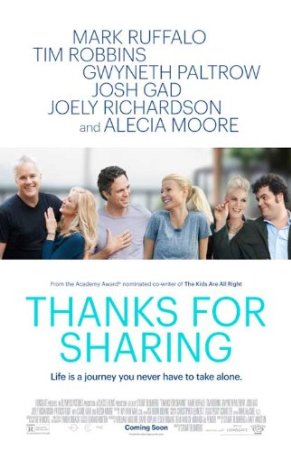
Imagine that the one thing you cannot trust yourself to be near is around you all the time, wherever you go.  As difficult as it is to recover from addiction to drugs or gambling or alcohol, at least those in recovery can wall themselves off from the places and activities that act as their most dangerous triggers.  But sex addicts are surrounded by stimuli all the time.  “Is all of Manhattan just one big catwalk?” asks one character in this sympathetic portrayal of people who try to find a way out of what one of them calls his very dark places.  “It’s like trying to quit crack while the pipe is attached to your body.”

Sex addicts have to endure the ignorance of those who snicker or ask “Isn’t that just something men say when they get caught cheating?”  They have to ride in cabs with titillating videos playing in the back seat.  Adam (Mark Ruffalo) avoids temptation by not allowing himself to have a television, home access to internet, or a smartphone.  And he has walled himself off from another kind of temptation but not having a romantic relationship.

His sponsor, Mike (Tim Robbins), encourages him to try to date.  And when he meets Phoebe (Gwyneth Paltrow), he wants very much to get close to her.  She is a breast cancer survivor, which may be one reason he feels that she can understand his struggles.  But at first he does not tell her the truth about himself.  Mike has a son, Danny (Patrick Fugit of “Almost Famous”), who has a history of substance abuse, and who returns home promising that this time is different.

Adam is a sponsor, too.  His “sponsee” is Neil, a doctor whose passion for saving others has been a way for him to avoid being honest with himself about his own behavior, which includes inappropriate touching of women he does not know and elaborate mechanisms for “upskirt” photography.  Being court-ordered will not be enough to get him to tell the truth; being fired could be a start.  As so often happens in 12-step programs, the key for Neil may be the chance to help someone else, someone he understands and who understands and helps him.  An outspoken hairdresser named Dede (rock star Alecia “Pink” Moore) who is in both the sexual addiction and “beverage” (alcohol abuse) programs calls him for emergency help and helping her is the first step in helping himself.

Mike, Tom, and Adam are all at different stages of their recovery, and each faces different challenges and hard truths.  Sometimes these are framed in the kind of “But that’s okay” support group-speak that Al Franken used to mock on “Saturday Night Live.”  “Why did I pick such a tough sponsor?” Adam asks wryly.  “I don’t know, maybe you wanted to recover,” Mike answers with a smile.  “United we stand, divided we stagger.”  “Thanks for bookending this for me.”  And you know someone will have to break down and say, “I’m out of control.  I’m scared.  And I need help.”  But, you know what?  That’s okay.

Co-writer/director Stuart Blumberg wisely spares us the easy explanations that allow us to feel smugly separate from those who struggle to achieve a sense of control, and he is frank about the dynamic, positive and negative, between those who struggle with addiction and those who maintain relationships with them.  The all-star cast delivers with performances of aching sensitivity and heart.  And if a brief moment in the film that has People Magazine’s most beautiful person alive Gwyneth Paltrow in sexy lingerie is the image that is being unironically widely used to promote the movie, well, that helps make its point.

Parents should know that this film concerns sexual addiction and there are frank discussions and portrayals of people who struggle with various kinds of obsessive and destructive sexual behavior. It includes very strong and explicit language, some drinking and references to substance abuse, and some mild peril and violence.

Family discussion: How does sexual addiction differ from other kinds of obsessive and compulsive behavior? Why was it easier for these characters to support and understand each other than to their families and romantic partners?

If you like this, try: “Don Jon” and “28 Days”

Related Tags:


Date movie Drama DVD/Blu-Ray Pick of the Week Romance

World War Z

Posted on September 16, 2013 at 6:00 pm

B+
Lowest Recommended Age: Mature High Schooler
MPAA Rating: Rated PG-13 for intense frightening zombie sequences, violence and disturbing images
Profanity: Mild language
Alcohol/ Drugs: Drinking
Violence/ Scariness: Constant peril and violence with many characters injured and killed, children in peril, scary zombies, many disturbing images including graphic wounds and attacks, dead bodies, tension and scary surprises
Diversity Issues: Diverse characters
Date Released to Theaters: June 21, 2013
Date Released to DVD: September 17, 2013
Amazon.com ASIN: B005LAIIMG

There are going to be a lot of superheroes on screen this summer, but none of them are as super as Gerry Lane a former investigator for the UN called back into action to fight the zombie apocalypse. No superhero outfit or origin story — he doesn’t need one. He’s just an ordinary good guy who happens to be super-smart, super-kind, super-honorable, and super-able to withstand all kinds of physical challenges, perform emergency surgery, and be an awwww-inspiring dad and husband. To put it another way, he’s played by Brad Pitt.world_war_z_37736  Based on the book by Max Brooks (son of Oscar-winners Anne Bancroft and Mel Brooks), the story takes Lane all over the world to find “patient zero,” the original source of the plague that has turned millions of people into zombies, so they can figure out how to fight them.

A brief opening scene shows us Lane interacting endearingly with his adorable family: wife Karin (Jessica Chastian-ish Mirielle Enos), and two daughters, one with a stuffed animal and one with asthma.  We have just enough time to fall in love with them on what seems like an ordinary day, until all hell breaks loose while they are driving to work and school.  At first, all is confusion and chaos, and then the zombies arrive.  They are fast and aggressive and it takes just 12 seconds after a person is attacked for them to become fast and aggressive zombies themselves.  Zombies are, as we have come to know from many other movies, extremely focused and therefore extremely effective.  They have just one purpose: to create more zombies.  They will do whatever it takes to whomever it takes.  And the humans who must try to survive will be faced with terrible choices.

After a harrowing escape, the Lanes and a young boy who helped them are rescued by a helicopter and taken to Gerry’s former boss at the UN, working from an aircraft carrier.  At first, Gerry refuses to leave his family to investigate the source of the zombies.  But the Naval Commander (David Andrews) makes it clear that they only have room for “essential personel” on their ship — and that Gerry’s family will only be considered essential as long as Gerry takes on the mission of escorting a young professor and expert in virology to Korea to track down the first reported case.  They set off with some Navy Seals for protection, but soon Gerry is on his own, globe-trotting from Korea to Israel to Wales in search of answers.

Director Marc Forster, not known for thrillers, keeps things taut and involving, holding back information to keep us just a little strung out and then allowing us some release at just the right moment.  The zombies are fast and relentless.  Even at a PG-13 level, with muted gore, they are very disturbing.  One just clicks his teeth with what could hardly be described as a knowing look — maybe just focused — and it is really creepy.  From the heartbeat sound behind the opening logo to the seemingly innocent moments that turn ominous, the pacing is tight and absorbing and the the characters and the puzzle weighty.  But it is Pitt who makes it all work.  He is so good at everything that we almost wonder why he needs a plane — surely he can just fly to the next city on his own — but his un-angsty goodness and sheer star power is itself the most powerful reminder of why it is that we want the humans to win.

Parents should know that this film has graphic and disturbing images, extended very intense sequences of peril with many characters injured and killed, scary and disgusting zombies, emergency amputation, guns, explosions, and chases.

Family discussion: Do you agree with the “tenth man” rule? How did Gerry use what he learned from the doctor? From his observations?

If you like this, try: “28 Days Later,” “I Am Legend,” and “The Andromeda Strain” and the book by Max Brooks


Related Tags:


Action/Adventure Based on a book Drama DVD/Blu-Ray Pick of the Week Fantasy Science-Fiction Thriller

Closed Circuit

Posted on August 27, 2013 at 8:00 am

closed circuitTerrorism has killed thousands of people, destroyed buildings and property, and caused seismic rifts in our notions of who constitutes “us” and “them.”   What is even more terrifying is the damage it has inflicted on our most fundamental notions of privacy and justice.  “Closed Circuit” is an up-to-the-minute thriller in which the chases and explosions are less scary than what it reveals about how ineffective our legal system is for responding to terrorism.  The damage to democracy may be more devastating than the damage to life and property.

The story begins with a shocking terrorist attack at a London market.  Two suspects died in the bombing and one died “resisting arrest.”  Farroukh Erdogan (Denis Moschitto), described as “the last man standing,” is quickly captured and accused.  The traditional judicial system cannot provide him with the rights that are accorded all defendants under UK law, including the right to examine and respond to all evidence against him and to be given any evidence the government has that might cast doubt on his guilt.  So he is given two different trial attorneys (called barristers in Great Britain), one for an open hearing, one for a separate closed hearing.  The judge soberly advises them that “you must not meet or communicate or share information in any way.”

Martin (Eric Bana) will represent Erdogan in the open hearing to the best of his ability without any access to information deemed sensitive by the government.  Claudia (Rebecca Hall) is appointed to have access to those files the government has selected as confidential.  In a complicated set of procedures, if she discovers something in those files that is relevant to the case, she can show it to the judge but not to Martin or the defendant.  This procedure is intended to provide some some fairness in an inherently unfair process we continue to refer to as the justice system.  “There is no right way out of this,” a character will say.

Claudia initially tries to withdraw.  She does not explain much but we learn that she and Martin have a history.  Even though the process prohibits them from having any contact, that past relationship makes things more complicated.

Separately, Martin and Claudia begin to believe that they are being manipulated, even threatened.  But by which side?  Is it possible to sustain a democracy, or any kind of accountability, when an official explains, “You want the freedom to attack me, but without me you wouldn’t have much freedom at all?”  It is eerily reminiscent of Jack Nicholson’s famous speech in “A Few Good Men” and Jose Ferrar’s in “The Caine Mutiny.”  Both accuse us of feeling superior to the decisions we delegate to those who guard our freedom, and our willingness to overlook the infringements of freedom that result.

As an audience, we can distance ourselves from the chases and explosions.  Our most terrifying realization is the same one Pogo made famous: “We have met the enemy and he is us.”

Parents should know that this film has very strong language, references to adultery a terrorist attack, chases and fights, suicide, some disturbing images of murder victims, drinking, and smoking.

Family discussion: Read up on the US FISA court and the controversy about NSA access to personal information.  How do we balance the need for national security with the fundamental guarantees of individual justice like the presumption of innocence, the right to examine evidence, and the protection against self-incrimination?

If you like this, try: “Four Lions” and “The Ghostwriter”

Related Tags:


Courtroom Drama Politics Thriller

Short Term 12

Posted on August 23, 2013 at 9:37 pm

B+
Lowest Recommended Age: Mature High Schooler
MPAA Rating: Rated R for language and brief sexuality
Profanity: Very strong language
Alcohol/ Drugs: Drinking, drug references
Violence/ Scariness: Tense confrontations, references to abuse, suicide attempt
Diversity Issues: Diverse characters
Date Released to Theaters: August 23, 2013
Date Released to DVD: January 17, 2014
Amazon.com ASIN: B00EOAHDT8

There is a look in the eyes of those who have seen the very worst that can happen.  Those who no longer have the blessing of living in denial.  Those who know, not just in their heads but in their souls, that the innocent can be hurt by those they trust, that their bodies, their hearts, and even their minds can be damaged in ways that leave them shattered, convinced that they will always be alone and outside the magic circle everyone else seems to know how to stay inside.  Then there are those rare souls who have traveled all the way to the end of the road of no expectations but hold on to their sense of humanity by using what they have experienced to help others.  The look in their eyes is tired, but not entirely closed off from the world.  As T.S. Eliot said in “Ash Wednesday,” the goal must be “to care and not to care.”  short term 12

The gifted actor Brie Larson captures that look in “Short Term 12,” a wise and heartfelt new film about the staff at a facility for abused, neglected, and damaged teenagers.  It has the intimacy of a documentary so that the solid, assured narrative structure sneaks up on you.  This assured feature from writer/director Destin Cretton shows that kind of understanding behind the camera as well.

Larson plays the aptly named Grace.  She is not a therapist or a doctor.  She has a more important credential, as we will learn.  Her job is to help create a space that makes the kids who have no reason to trust anyone can feel safe, despite the drab institutional setting, the almost non-existent budget, the overworked professionals, and the rules that restrict them.  How can you make someone feel safe when the state will throw them out with no support after 12 months or when they turn 18?  How do you not give up when you see this kind of damage every day?  Can you find yourself in helping others?  Can you hide from yourself there?

Grace lives with her co-worker, Mason (“Newsroom’s” John Gallagher Jr., authentically disheveled), who loves her deeply but is troubled that she cannot truly open up to him.  Remi Malek has the thankless role of the newbie who gives the other characters the chance to provide some exposition and show us that good intentions are not enough.  But Cretton handles even this character with sympathy and humanity.  Then there are the residents, including Marcus (Keith Stanfield), who is about to turn 18 and leave the only home he knows, and a new arrival, Jayden (Kaitlyn Dever), who is furious and hostile.

Beautifully observed scenes open these characters up to us, with moments of small-g grace that are more heart-wrenching than the traumatic revelations.  They seem to bloom on screen thanks to sensitive writing and gorgeously heartfelt performances.  Birthday cards.  An anniversary tribute.  A look of resignation, recognition, and exhilaration as an emergency, but a relatively and reassuringly solvable one, comes up.  A broken teenager begins to heal.  And a broken adult begins to acknowledge that helping others cannot be enough unless she does what she asks from them, and what Cretton does before our eyes: to tell the truth.

Parents should know that this film includes very strong language, sexual references and situations, discussion of very severe parental abuse including sexual molestation, and frank discussion of family dysfunction and abuse

Family discussion: What do you learn about Mason from his family party?  Why is the character named Grace?

If you like this, try: “Manic” and “The United States of Leland”

Related Tags:


Drama DVD/Blu-Ray Pick of the Week Stories about Teens

Lee Daniels’ The Butler

Posted on August 15, 2013 at 6:00 pm

B+
Lowest Recommended Age: Middle School
MPAA Rating: Rated PG-13 for some violence and disturbing images, language, sexual material, thematic elements and smoking
Profanity: Some strong language, n-word and other racist epithets
Alcohol/ Drugs: Drinking and alcohol abuse, smoking
Violence/ Scariness: Peril and violence including police brutality, lynching, murder, rape (off-camera), sad deaths
Diversity Issues: A theme of the movie
Date Released to Theaters: August 16, 2013
Date Released to DVD: January 13, 2014
Amazon.com ASIN: B00EV4EUT8

the-butler-poster

Washington Post reporter Wil Haygood was covering the 2008 Obama campaign when some young black women told him that they were going to vote for America’s first major party Presidential candidate who was African-American, even though their fathers told them not to.  The generational chasm that separated the fathers who were not ready to see one of their heritage in the White House and the daughters who were inspired him to check to see whether there might be someone in the White House itself who was of that older generation.  He found one, Eugene Allen, who had been a butler in the White House from the Truman administration to the Reagan administration, and who was planning to vote for Barack Obama, and Haygood  wrote an article telling his story.

That story inspired this film, with Forest Whitaker as Cecil Gaines, born on a plantation in the Jim Crow south and serving eight Presidents while raising two sons.  Like the young women Haygood met, the next generation had very different ideas and aspirations.  The conflict between a man whose job was to serve by being “invisible in the room” had sons who wanted to be anything but invisible. As Sidney Poitier said to Roy Glenn in “Guess Who’s Coming to Dinner” in 1967, “Dad, you think of yourself as a colored man.  I think of myself as a man.”

There are some awkward moments in trying to get through so much material so quickly, with just brief glimpses of some of the Presidents and some of the events.  By the time we figure out that it is Robin Williams playing President Eisenhower, painting a landscape as Cecil serves him from a silver tray, his appearance is over. John Cusack has two juicy scenes as Richard Nixon.  As the eager, if socially clumsy Vice President, he visits the kitchen to hand out buttons and ask the staff what issues are important to them.  “As members of the Negro race,” he intones, as though they do not know who they are, “what are your biggest concerns?”

Later, Cecil sees the President unraveling under the impeachment proceedings.  James Marsden has some of President Kennedy’s charisma, and Minka Kelly is lovely and utterly heartbreaking as Jackie, sobbing in the pink suit covered with blood that she could not bring herself to remove.  Liev Schreiber shows us President Johnson’s swagger, leaving the bathroom door open so he can talk to his aides while he is on the toilet.  Presidents Carter and Ford are seen only in brief archival footage, but Alan Rickman and Jane Fonda are both excellent as the Reagans, shown with more warmth and humanity than the caricatures we might expect.

This cavalcade of star power is just the frame.  Director Lee Daniels and screenwriter Danny Strong (Danny Siegel on “Mad Men”) put the human story at the center of the tumultuous historic changes from the late 1950’s to the first decade of the 21st century.  That gets a little didactic and clumsy.  Cecil Gaines is given two sons, Louis (David Oyelowo of “Red Tails”) and  Charlie (Elijah Kelley of “Hairspray”), so that Louis can become involved in the Civil Rights movement, from sit-ins to freedom rides, and then the Black Panthers and anti-apartheid, while Charlie goes to fight in Vietnam.   But sensitive and heartfelt performances and the ultimate recognition by the characters that despite their estrangement, the connection between Cecil and Louis is powerful and unbreakable makes their reconciliation hit home.  There is a distracting and unnecessary detour into the relationship between Cecil’s wife, Gloria (Oprah Winfrey) and a neighbor (Terrence Howard).  And the cameos by big stars as the Presidents are distracting — and a grim reminder that even powerhouses like Winfrey, Whitaker, and Daniels and a relatively modest budget were not enough to get a Hollywood greenlight without some white stars.  Some of the best scenes are when we see the African-American characters away from the “other face” they have to show whites, relaxed and joking in the White House locker room (Cuba Gooding, Jr. Lenny Kravitz) and  or at neighborhood parties.

Ultimately, this is Cecil’s story.  When he was a child, service was a chance to get out of the cotton field.  In his first job away from the plantation, he learns to present a pleasant, respectful, and helpful face to the customers, to “make them feel not threatened,” to look at them only to “see what they need.”  And he learns to stop using the n-word about himself or anyone else.  When he comes to the White House, he is told,  “You hear nothing.  You see nothing.  You only serve.”  As for the issues, when it comes to the staff, “We have no tolerance for politics at the White House.”

While Louis and his friends are staging a sit-in at a segregated lunch counter, his father is serving dignitaries, wearing white gloves and a tuxedo.  But all the courage and determination Louis shows in his passionate commitment to equality don’t reach the power of the moments when Cecil challenges the long-standing tradition of paying the African-American staff of the White House 40 percent less than the white staff, and not allowing them the opportunity for promotion.

“Darkness cannot drive out darkness,” the movie’s opening epigraph from the Reverend Dr. Martin Luther King tells us.  “Only light can do that.”

Parents should know that this film includes strong language, drinking, drunkenness, and alcohol abuse, sad deaths, peril and violence including police brutality, rape, murder, lynching, racial epithets, sexual references and non-explicit situations.

Family discussion: Talk to members of your family about their own experiences before and during the Civil Rights era and read about some of the people and incidents mentioned in this movie, including Emmett Till, Pablo Casals, and James Lawson.

If you like this, try:  The Autobiography of Miss Jane Pittman, “Eyes on the Prize,” and “The Remains of the Day” and the books The Butler: A Witness to History and White House Butlers: A History of White House Chief Ushers and Butlers

Related Tags:


Based on a book Based on a true story Biography Drama DVD/Blu-Ray Pick of the Week Epic/Historical Family Issues
THE MOVIE MOM® is a registered trademark of Nell Minow. Use of the mark without express consent from Nell Minow constitutes trademark infringement and unfair competition in violation of federal and state laws. All material © Nell Minow 1995-2026, all rights reserved, and no use or republication is permitted without explicit permission. This site hosts Nell Minow’s Movie Mom® archive, with material that originally appeared on Yahoo! Movies, Beliefnet, and other sources. Much of her new material can be found at Rogerebert.com, Huffington Post, and WheretoWatch. Her books include The Movie Mom’s Guide to Family Movies and 101 Must-See Movie Moments, and she can be heard each week on radio stations across the country.

Website Designed by Max LaZebnik