Coming to Netflix: The Queen Elizabeth II Story “The Crown”
Posted on May 3, 2016 at 3:54 pm
As Great Britain’s longest-reigning monarch turns 90, “The Crown” focuses on Queen Elizabeth II as a 25-year-old newlywed faced with the daunting prospect of leading the world’s most famous monarchy while forging a relationship with legendary Prime Minister, Sir Winston Churchill. The British Empire is in decline, the political world is in disarray, and a young woman takes the throne….a new era is dawning. Peter Morgan’s masterfully researched scripts reveal the Queen’s private journey behind the public facade with daring frankness. Prepare to be welcomed into the coveted world of power and privilege and behind locked doors in Westminster and Buckingham Palace….the leaders of an empire await.
Morgan Freeman and Jack Huston star in this remake of the Charlton Heston classic, “Ben-Hur,” the story of a falsely accused Jewish nobleman in the time of Jesus (Rodrigo Santoro).
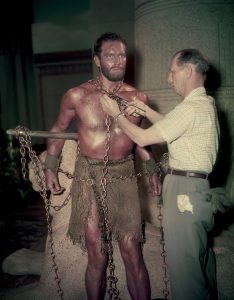
Behind the Scenes With Charlton Heston and “The Ten Commandments”
Posted on March 16, 2016 at 6:26 pm
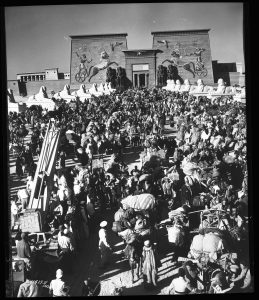
The scale of the epic “Ten Commandments” meant a record-breaking budget.
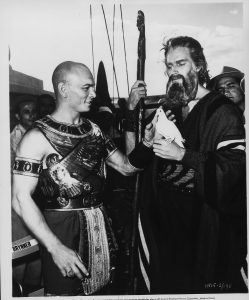
Yul Brynner and Charlton Heston
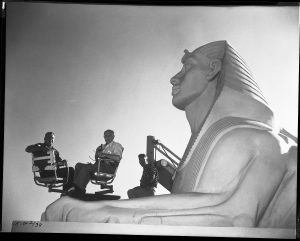
Cecil B. DeMille on the set of “The Ten Commandments”
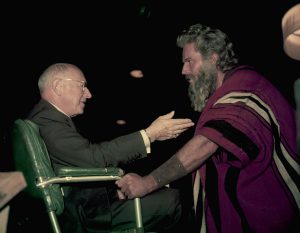
Charlton Heston as Moses confers with director Cecil B. DeMille
All images Copyright Paramount 1956
“The Ten Commandments” is coming back to theaters for two days only, March 20 and 23, 2016, in more than 650 cinemas nationwide. Truly, this is a film that must be seen on the big screen to experience the epic scope and grand vision of director Cecil B. DeMille and the towering performance of Charlton Heston as Moses. It was selected by movie fans as the greatest Biblical movie of all time in a survey by MovieTickets.com.
We are honored to be able to present these rare behind-the-scenes photos from the making of the film.
Copyright 2016 FocusWe have a very clear picture of Jesus’s birth, and it is endlessly re-enacted and depicted each year at Christmas time. But we know almost nothing about His childhood, other than his astonishing the elders with his depth of knowledge.
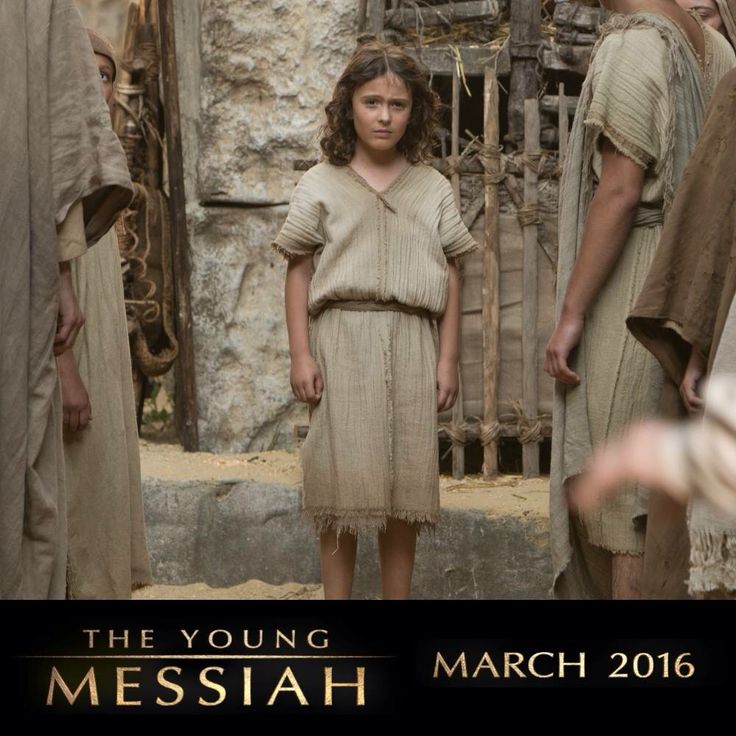
“The Young Messiah,” “inspired by scripture and rooted in history,” shows us His early years. It is a reverential, respectful portrayal of Jesus at age 7, as the Romans were trying to find and kill Him, and as He was just beginning to understand His power and purpose. It is based on the book by Anne Rice.
Jesus is played by sweet-faced Adam Greaves-Neal. We first see Him listening to a young girl who is teaching him to draw a camel. When a bully gives her a hard time, Jesus steps in to defend her and the bully starts attacking Him. A mysterious hooded figure tosses an apple core to trip up the bully, who falls, hits his head on a rock, and dies. No one else could see the man in the hood, and Jesus is blamed for the boy’s death.
The young Messiah insists on visiting the body, and it is there He performs His first miracle, bringing the boy back to life. This is an extraordinary moment because no one, even Jesus himself, knew such a thing was possible or that He was capable of it. And yet Jesus is so young, and his compassion so deep, that it seems completely natural for him. It confirms the greatest hopes but also the greatest fears of Mary and Joseph as it makes him a target for the Romans. And, like all parents, they have to find a way to protect their child and to answer His questions, though both are difficult and both at the same time seem impossible. “How do we explain God to His own son?” Even more difficult, how can they explain to Him a world in which the road is lined with crucified Jews and babies were murdered because the Romans were so afraid of Him? And how should they guide Him in using a power no one really understands? Mary can only say, “Keep your power inside you until your Father in Heaven shows you the time to use it.”
As Jesus and his family travel from Egypt to Jerusalem, Herod sends a soldier named Severus (Sean Bean) to find the boy and kill Him. Severus is not worried about reports that the boy can perform miracles. “There’s only one miracle,” he says, brandishing his sword. “Roman steel.”
Greaves-Neal is not really an actor, but his performance has an appealing dignity and tenderness. “Am I dangerous?” he asks, not “Am I in danger?”
It is especially good to see the young Jesus portrayed as compassionate but also intensely curious about the world. That thirst for knowledge and understanding is as inspiring to those around Him as His miracles.
Parents should know that this film include Biblical violence including crucifixion, bullying, and characters are injured and killed.
Family discussion: What do we learn about Jesus from his reaction to the bully? How did his curiosity about the world and scripture help him understand his purpose?
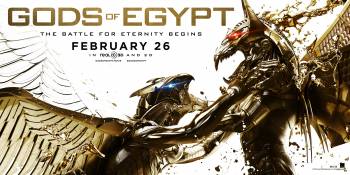
“Gods of Egypt” has more gods than IQ points. There are some grand and striking visuals and some well-staged fight scenes, but there are also effects that look like they were created for a 64-bit computer game and lines of dialogue that make cheesy sword and sandal epics of the Steve Reeves era look like Noel Coward. It may be pretty to look at, but this is a big budget wheel of cheddar.
The producer and director have both apologized, too little and too late, for making a film based on Egyptian mythology without a single Egyptian actor. The gods are played by Australian Geoffrey Rush (Ra, the sun god and father and grandfather to the other gods), Danish Nikolaj Coster-Waldau (Horus, god of air and libertine turned hero), Scotsman Gerard Butler (Set, angry and ambitious god of the desert), American Chadwick Boseman (Thoth, smug god of wisdom), and French Elodie Yung (Hathor, goddess of love). And then there are a few humans, Australian Brenton Thwaites as an Aladdin-style street thief called Bek, and imperious as always British Rufus Sewell as Urshu, Set’s obsequious architect. Given the results, I imagine the Egyptians are relieved not to be a part of it.
The ponderous opening narration informs us that ancient Egypt is the cradle of civilization and so the gods decided to live there among the humans, though they are much taller and have gold for blood. As the story begins, Horus wakes up bleary following an orgy as he is about to take over as king from his wise and progressive father (Australian Bryan Brown). But his uncle Set arrives, kills the king, and plucks out Horus’ super-special eyes. Horus, humiliated and blind, retreats to his temple to sulk and drink. And Set enslaves the entire population to build structures for his glory and decrees that only the rich will obtain eternal life.
Zaya (Australian Courtney Eaton, very appealing) is the servant of Urshu, and the beloved of Bek. With access to Urshu’s architectural drawings, she shows Bek where Horus’ eyes are hidden. She believes that if Horus’ sight was restored, he would be able to defeat Set. Bek gets through an Indiana Jones-style series of traps to retrieve one eye, delivers it to Horus, and persuades him to fight Set and get back his kingdom.
There is visual splendor on a scale Cecil B. DeMille could only dream of, with sumptuous production design by Ian Gracie and costumes by Liz Keogh. But some of the CGI effects are less persuasive than Ray Harryhausen‘s stop-motion miniatures, and a few of them, like Ra’s flames and a sort of sand-based version of Skype, look like they came from a 64-bit video game. The mis-matched sizing of the gods and humans is more silly than impressive. The dialogue is a mish-mash of pretentious claptrap about the Journey and comments like “death is not the end” and “never doubt a man fighting for the one thing as powerful as any god — love.” Occasionally there are painful attempts at humor, as when Bek tells Horus to run from danger: “Mortals do it all the time!” or when Hathor brags that she is “the goddess of too much.” The mythology of ancient Egypt is fascinating and meaningful. This movie is not. It cannot decide whether it wants to be campy or thrilling, but it really does not matter because it fails at both.
Parents should know that this film includes extended sword and sorcery peril and violence with many characters injured and killed, monsters, disturbing images, sexual references and situations, and brief strong language.
Family discussion: Why did Ra treat his sons differently? Why does he say he wants human destiny to be uncertain?