Noah

Posted on March 27, 2014 at 8:00 pm

B+
Lowest Recommended Age: Middle School
MPAA Rating: Rated PG-13 for violence, disturbing images and brief suggestive content
Profanity: None
Alcohol/ Drugs: Drinking and drunkenness
Violence/ Scariness: Disturbing images, peril, chaos, characters injured and killed, dead bodies, violence, attacks, sexual assaults, girls sold into slavery
Diversity Issues: None
Date Released to Theaters: March 28, 2014
Date Released to DVD: July 28, 2014
Amazon.com ASIN: B00JBGWP3Y

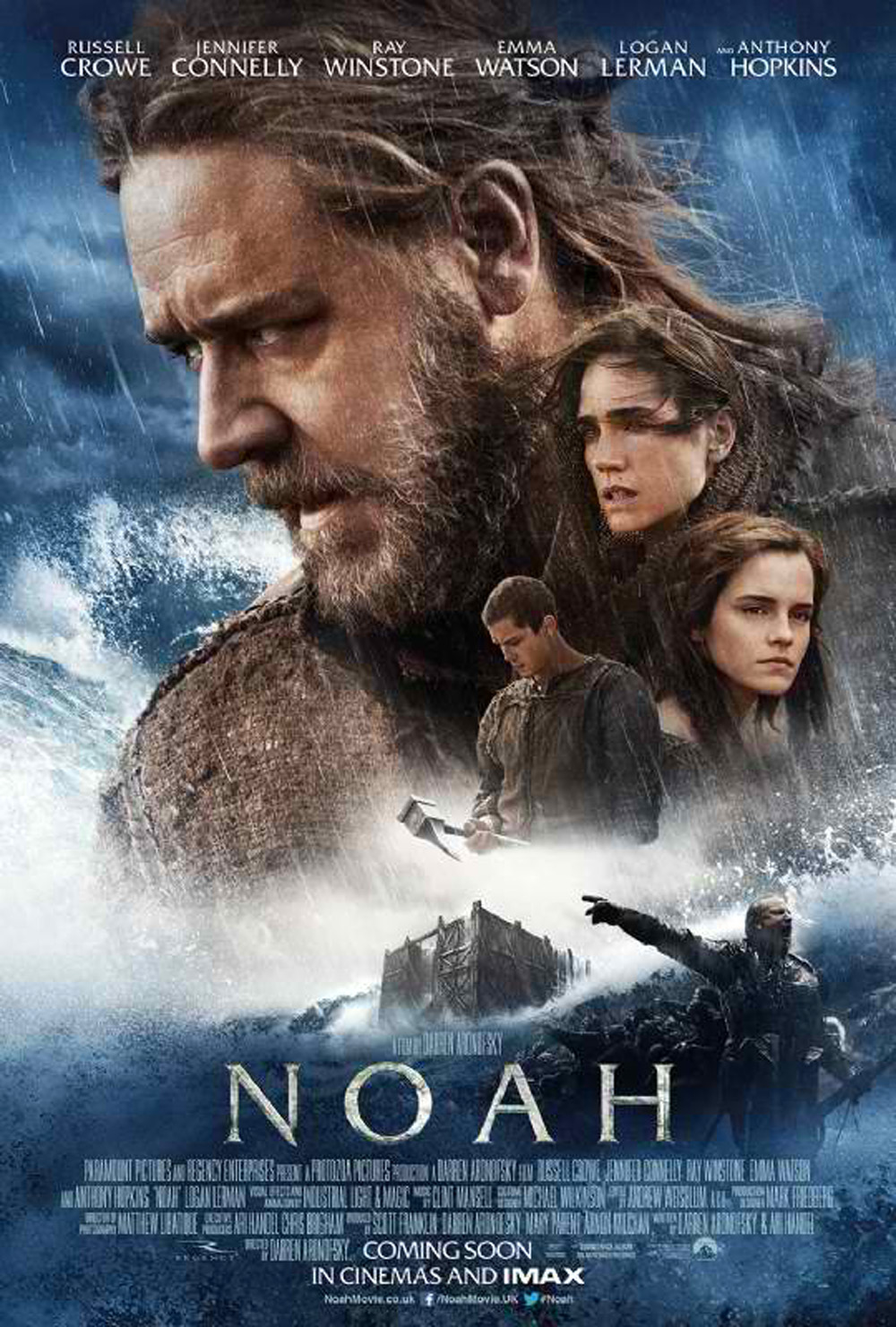
Noah_poster“Noah” is a serious, thoughtful, reverent movie that, like its title character, wrestles with the big issues of morality, survivor guilt, and strengthening a connection to the divine.  It is also a big, grand adventure with drama and special effects.  It should satisfy believers, seekers, and those who just want an exciting story, well told.

Writer/director Darren Aronofsky (“Black Swan”) shows us a Noah (Russell Crowe) who struggles to be a good man and do as God wants. Only ten generations from Adam and Eve, he is haunted by the stories of the Fall and Cain’s murder of his brother. When he was a boy, he witnessed the murder of his own father at the hand of the brutal leader of the descendants of Cain (Ray Winstone as Tubal-Cain). Now, he tries to protect his wife, Naameh (Jennifer Connelly), and three sons from the marauders.

Noah lives lightly on the earth, gently chiding his son for picking a flower because that interfere with its work of spreading seeds. He and his family do not eat animals; they respect the innocence of all creatures, unlike Tubal-Cain who defines himself as someone who takes without regard for anything but his own urges and lust for power.

Noah is filled with an ominous sense that he is receiving omens and seeks the advice of his mystic of a grandfather, Methuselah (Sir Anthony Hopkins).   He begins to understand that he is commanded by The Creator to build an ark and collect the animals of the earth and to preserve them in the coming storm that will wipe out all of life on Earth.  He will be helped in this by The Watchers, fallen angels who were once pure light but are now punished for their mistakes by being imprisoned in enormous bodies of mud and rock.

As Auden reminds us, the grand, sweeping events of the world do not happen purely.  They occur in the midst of human lives that are messy and imperfect.  While Noah struggles to follow the will of The Creator, he has to deal with problems at home.  Ila (Emma Watson), a girl Noah and his family rescued after her entire community was slaughtered by Tubal-Cain, is loved by Noah’s son, Shem (“Romeo & Juliet’s” Douglas Booth), who loves her, too.  But due to her injuries, she cannot have children, and she does not want to keep him from being a father and creating a new generation.  Ham (Logan Lerman of “Percy Jackson”) is furious that there is no prospect of a wife and family for him.

And then there is Tubal-Cain, used to taking whatever he wants.  He will do anything to stay alive through the flood and become king of whatever the world will be afterward.   And he senses that Ham may be susceptible to joining him.

We rarely see Bible stories told with such artistry and power.  The acting is superb and the special effects are well done.  The big moments, the flood, the omens, the Watchers, the thousands of animals moving inexorably toward the ark, are all handled with meaning and import.  When Noah tells his family one of the few stories that they have in this still-new human world, the story of creation, we feel the nothingness that was before.  Story-telling itself becomes a way to shape the world and form an understanding of patterns, purpose, and meaning.

Men wind a snakeskin around their arms in the earliest of rituals and prayers and we see the flicker of what would become a daily observance for Orthodox Jews over the millennia through the present, the phylactery leather strips that men use in their morning prayers.  We are reminded that this is a time before Jesus and before Abraham, when there was no organized religion and no established set of beliefs and practices.  There is not even the word “God.”  It is just “Creator.”

The innocence and the impulse to reach out toward the heavens are very moving.  So is the way that Noah grapples with what today we might call survivor guilt or PTSD.  And he struggles to find his better angels.  Tubal-Cain is not just a man who wants to fight him; he is that part of Noah himself that is all lower urges toward flesh and power, the impulse to trap and smash and to break laws even in a world where laws have not been established.

While some viewers and some who have not even seen the film have objected to this portrayal (or, in the case of strictly Muslim groups, any portrayal of a religious figure), most should see this film as an eternal story well told in a manner that is itself a form of worship in prompting us to think more profoundly about our own choices and connections.

Parents should know that this film includes epic/Biblical violence including murder, battles, flood, some disturbing images, parent killed in front of child, character trampled to death, discussion of infanticide, some disturbing images, non-explicit sexual situation, and childbirth.

Family discussion: Why did the two groups of humans develop so differently? What should Noah have done about Na’el? Why did he separate from the family after the flood?

If you like this, try: “The Fountain” and “Pi” by the same director and Biblical-era classics like “Ben-Hur” and “The Ten Commandments”
Related Tags:


Action/Adventure Based on a book DVD/Blu-Ray Pick of the Week Epic/Historical

The Grand Budapest Hotel

Posted on March 13, 2014 at 6:08 pm

B+
Lowest Recommended Age: Mature High Schooler
MPAA Rating: Rated R for language, some sexual content, and violence
Profanity: Strong and crude language
Alcohol/ Drugs: Drinking, drugs
Violence/ Scariness: Murder, wartime violence
Diversity Issues: Diverse characters
Date Released to Theaters: March 8, 2014
Date Released to DVD: June 16, 2014
Amazon.com ASIN: B00JAQJNN0

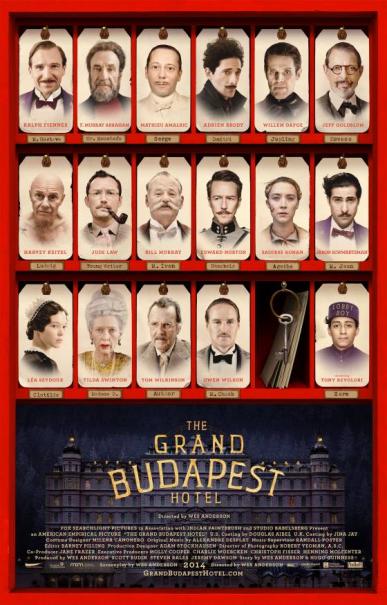
The_Grand_Budapest_Hotel_3Writer/director Wes Anderson loves precious little worlds and his movies are not just created, they are curated. There’s a reason that this film is named for its location, not its characters or plot. Anderson is the master of “saudade,” the nostalgia for something you never had or that never existed. The Grand Budapest Hotel is as romantically imagined as its name, more vividly realized than any of the human characters in the movie, and we instantly feel the pang of its loss.

We enter through a Sheherezade-ian series of nesting narratives.  A girl visits the grave of a writer, and we go back in time to see that writer (Tom Wilkinson) as an older man, talking about where writers get their stories (from real life), and then back again further as a younger man (Jude Law), actually getting the story in a bleak, bordering on seedy distressed version of the hotel, from an old man named Zero Mustafa (F. Murray Abraham).  And then we go further back in time to see Zero as a young man, a proud lobby boy in the titular edifice, a gorgeously splendid, elegant, and luxurious resort in the mountains of a fictitious European country called Zubrowka, somewhere in the midst of Switzerland, Luxembourg, Austria-Hungary, and the Balkans.  Anderson invites us into the artificiality of the memory within a memory within a story told by a stranger. He does not bother with cinematic tricks to make the hotel look real.  We see it made out of paper, with a paper finicula pulled by a string to bring the guests up the mountain, as though it is part of a puppet show, which, in a way it is.  At times it feels as though it is being put on with the marionettes from the “Lonely Goatherd” number in “The Sound of Music.”  There is no effort to make the actors playing the younger and older versions of characters look alike.  But the detail work is as meticulous as ever, so that must be intentional, and meaningful.

In the era of the Jude Law storyline, the hotel’s inept concierge is M. Jean (Jason Schwartzman).  But, as Zero tells the story, in the heyday of the hotel, the concierge was the legendary M. Gustave (Ralph Fiennes).  A concierge is there to be the all-purpose fixer, finder, and minder, like the entire staff of Downton Abbey in one.  M. Gustave is infinitely attuned to the needs of the hotel’s wealthy, important, often noble (as in duchesses, not heroes), and always demanding clientele.  There is a reason they are always referred to as guests.  And if they require a particularly specialized and personal form of service, he is willing to oblige, even if the guest in question is a titled termagant in her 80’s (an hilariously unrecognizable Tilda Swinton as Madame D.)  Fiennes gives a performance as perfectly precise as his character, whose flawless demeanor evokes exquisite deference, competence, and discretion.  Like Anderson and Anderson’s autobiographical stand-in played by Schwartzman in “Rushmore,” M. Gustave is a showman, and one with an extravagantly grand and very ambitious sense of mise-en-scene.  Early on, we see M. Gustave striding through the hotel lobby, a gracious farewell to a guest on one side, sharp but not unkind directions to staff who are not up to standard on the other. Later, in two intrusions by this story’s version of the Nazis and later, as a prisoner, he responds as though he is in a drawing room comedy.  Fiennes pulls off the tricky balance between farce and drama as the story takes him through murder, art theft, love, war, and delectable pastries.  And he is matched by newcomer Tony Revolori as the young Zero, a refugee who aspires to M. Gustave’s savoir faire, and who becomes first his protege and then his friend. 

As always in a Wes Anderson film, starting with the very first scene of his first movie, “Bottle Rocket,” there is an escape.  M. Gustave is imprisoned, but still strives to maintain an aura of gracious living.  After a rough encounter with another prisoner, he is bruised but airily assures the visiting Zero that they are now dear friends.  He confronts the direst of situations — or tries to — as though they are at the level of an errant lobby boy.  But when he is deprived of his beloved fragrance, L’Air de Panache, he begins to crumble.

The details of the various time periods are, as expected, exquisitely chosen, well worth a second viewing.  Ant it is a bit warmer than Anderson’s previous films, less arch, less removed, softer toward its characters, even tender.  Anderson often makes objects more important than people but in this one, with the painting and the pastry almost character themselves on one side and Zero and his true love Agatha (Saoirse Ronan) still stylized but still heartfelt on the other, they’re getting closer.

Parents should know that this film includes wartime violence, with characters injured and killed, some graphic and disturbing images, strong language, sexual references and an explicit sexual situation.

Family discussion: Did M. Gustave and Zero have the same priorities? What is added to the story by seeing the author and Zero later in their lives?

If you like this, try: “Moonrise Kingdom” and “Rushmore”


Related Tags:


Comedy Crime Drama DVD/Blu-Ray Pick of the Week Epic/Historical Romance Satire War

300: Rise of an Empire

Posted on March 5, 2014 at 10:52 pm

B-
Lowest Recommended Age: Mature High Schooler
MPAA Rating: Rated R for strong sustained sequences of stylized bloody violence throughout, a sex scene, nudity and some language
Profanity: Some strong language
Alcohol/ Drugs: Wine
Violence/ Scariness: Constant very graphic peril and war-time violence with many graphic and disturbing images and sad deaths
Diversity Issues: Diverse characters
Date Released to Theaters: March 7, 2014
Amazon.com ASIN: B00BEJL6Q8
eva-green-as-artemisia-in-300-rise-of-an-empire
Copyright Warner Brothers 2014

Here’s a new term: this movie is neither a sequel nor a prequel to 300, the story of the 300 Spartans who died battling the vastly greater army of the Persians. This is a “side-quel,” a “meanwhile” story about what was going on in a sea battle led by Spartan’s rivals, the Athenians.  While “300” was based on a graphic novel by Frank Miller, itself based on historic events in ancient Greece, this side-quel was written at the same time as Miller’s still-uncompleted follow-up, to be called “Xerxes.”

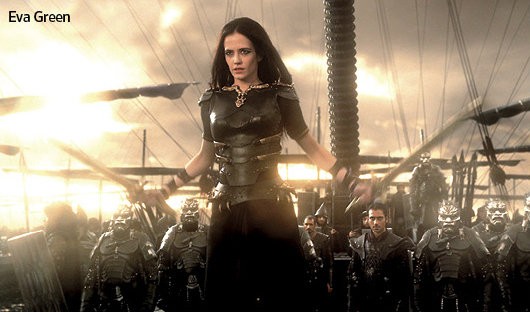
We get a bit more backstory this time, too.  In a previous battle, Athens’ great warrior Themistokles (hunky Sullivan Stapleton) killed the Persian king.  His furious son, Xerxes (returning Rodrigo Santoro) traded his humanity for godlike powers to get his revenge by invading Greece.  The leader of the Persian forces is the even-more-furious Artemisia (Eva Green), who can kiss the lips on the head she has just severed, enjoying the kiss just slightly less than the kill.  She is tougher than any of her generals, more lethal than any of her soldiers, and even hungrier for inflicting desolation on Greece than her king.  And she has the kind of fearlessness only found in those who have nothing left to lose and who will never win enough to feel that they have succeeded.

Themistokles needs to get the support of the resolutely independent city-states if they are to hold off the far greater Persian forces.  He knows that his men have heart and dedication, but they are not trained warriors like the Spartans.  I could say more about the story, but let’s face it — like the first film, this is about abs, swords, and lots of blood spurting in artistic slo-mo, drenching the screen.

The primary differences are the absence of Gerard Butler and the shift from battles on land to battles on water.  We feel Butler’s loss, as he brought a bit more to the original in terms of acting and managed to give his character some depth and personality in the midst of the carnage.  But that works for the story, as the death of his character Leonidas is felt deeply in Sparta.   The only thing that stands out from the carnage, though, is Green, whose Artemisia cranks up the cray-cray as one of the most evil-relishing villainesses since Cruella De Vil.  There’s a sizzling sex-and-fight scene (hmmm, Green did something very similar in “Dark Shadows“) that is way over the top of whatever point over the top used to be.  Green has a blast striding around casting laser beams of hatred at everyone, and wipes everyone else in the cast off the screen more thoroughly than her character does to to the “farmers, sculptors, and poets”-turned soldiers of Athens.

Parents should know that this film has constant very intense, graphic, and bloody violence with many battles, swords, fire, drowning, executions, rapes, disturbing images, nudity, sexual references and situations, and some strong language.

Family discussion: What are the biggest differences between the Greeks and the Persians? Do we think about war differently today?

If you like this, try: “300” and “Gladiator”

Related Tags:


3D Action/Adventure Based on a book Based on a true story Comic book/Comic Strip/Graphic Novel Epic/Historical Movies -- format Series/Sequel War

Son of God

Posted on February 27, 2014 at 6:00 pm

B
Lowest Recommended Age: Middle School
MPAA Rating: Rated PG-13 for intense and bloody depiction of The Crucifixion, and for some sequences of violence
Profanity: None
Alcohol/ Drugs: Wine
Violence/ Scariness: Intense and graphic torture and abuse and disturbing images in depiction of crucifixion, swords
Diversity Issues: Religious diversity issues
Date Released to Theaters: February 28, 2014
Date Released to DVD: June 2, 2014
Amazon.com ASIN: 1455585831

son-of-god“Son of God,” re-cut and expanded from the popular miniseries produced by Roma Downey and Mark Burnett, “The Bible,” tells the story of Jesus from birth to crucifixion and resurrection in a thoughtful, reverent, and dignified manner. This is a movie made by believers for believers. It expects viewers to be familiar enough with the story to fill in some of the gaps and devout enough to assume the significance of each moment. It tells the story in a westernized, conventional manner that can seem superficial at times, more a cinematic Sunday School lesson than a movie.  It is unlikely to persuade anyone, but it is undeniably moving and many believers will find it inspiring.

The production values are high, with Morocco providing the Biblical landscapes, elaborate sets and costumes, and a stirring Hans Zimmer score.  Portuguese actor Diogo Morgado plays Jesus with dignity.  He is very handsome, though his western features seem out of place.  The portrayal of the Jews is always a sensitive issue in the depiction of the New Testament story.  This version is more sympathetic than some, showing the political pressure that gave the Jewish community in Rome-occupied Jerusalem little choice.  But it seems odd that Jesus and his followers, who considered themselves Jews, show no evidence of Jewish practice other than the Hebrew prayer for he dead following the crucifixion.  Even the Last Supper, which has no elements of a Passover seder, though the Gospel of Mark says that Jesus prepared for the Last Supper on the “first day of Unleavened Bread, when they sacrificed the Passover lamb.”

The movie also reflects its source with some odd re-cuts and deletions.  Those who are not familiar with the details of the Gospels may have trouble understanding who some of the characters are and how they fit in.  The death of John the Baptist is mentioned briefly without making it clear what his contribution was and how he died.  Roma Downey has explained that they chose to literally cut the devil out of the story, in part as a result of some claims that the actor cast in the role for the television version bore a resemblance to President Obama.  But that means eliminating a key element of the story, the Garden of Gethsemane, which is an important part of understanding the way Jesus saw his role and his sacrifice. This is an accessible version of the story, but it is also a simplified one.

Parents should know that the New Testament storyline includes illness, bigotry, and graphic and disturbing images of torture, abuse, and crucifixion.

Family discussion: How does this differ from other versions of the story?  What was Jesus’ most important statement and why?

If you like this, try: the rest of “The Bible” miniseries and other depictions of the life of Jesus including “The Gospel of John” and “King of Kings”


Related Tags:


Based on a book Drama DVD/Blu-Ray Pick of the Week Epic/Historical Spiritual films

Pompeii

Posted on February 20, 2014 at 6:00 pm

pompeii posterIn 79 AD Mount Vesuvius erupted, wiping out the city of Pompeii. Director Paul W.S. Anderson, who gave us movie versions of “Resident Evil” and “Mortal Kombat,” presents the story as a video game. If what you are looking for is special effects and well-staged action, or even buff bodies, you’re all set.  But those who are looking for history, meaningful drama, character development, or good dialog — well, they weren’t paying attention a moment ago when I mentioned the director of game console-to-movie theater movies and Paul W.S. Anderson.  It is basically “The Legend of Hercules” with a volcano.

“Game of Thrones'” Kit Harington plays Milo, who as a child saw his entire community brutally slaughtered by the vicious and corrupt Roman soldier Corvus (an imperious Kiefer Sutherland).  Milo escaped by hiding in a pile of dead bodies.  He is later captured and sold into slavery, where his outstanding fighting skills bring him to the attention of a purveyor of gladiator battle-to-the-death entertainment.  He travels to the big city of Pompeii to compete in the arena there.  Along the way, he sees a beautiful young woman named Cassia (Emily Browning) and he impresses her by putting her injured horse out of its misery.  Cassia is returning to her parents (Jared Harris and Carrie-Ann Moss) after a visit to Rome, where she attracted the attention of Corvus, now a high-ranking Senator.  But Milo has attracted her attention.  In an example of dialog that could have come out of a middle school slam book, a character says, “I never saw you look at any man the way you looked at that slave.”

Milo is set to fight the enormous and powerful Atticus (“Thor’s” Adewale Akinnuoye-Agbaje), who can earn not just his life but his freedom with one more win in the arena.  They end up forming an alliance like that of Kirk Douglas and Woody Strode in the classic “Spartacus.”  Meanwhile Corvus is attempting to extort Cassia’s hand in marriage from her father, who needs the support of Rome for his building project.

And all of this is about to be trumped by a nearby mountain and some seismic movement of the earth.  There are huge sinkholes and then there is an ocean of burning lava and chokingly thick ash.  Every element of the lives of the Pompeiians is turned upside down as all societal restrictions are removed and all anyone wants to do is stay alive.  Well, you’d think that, but unfortunately the storylines that have already more than overstayed their welcome drag on, interfering with what we really want to see — the special effects — and jettisoning any possible remaining legitimacy of the plot.

Harington is very good as Milo and he and the excellent Akinnuoye-Agbaje make the fight scenes exciting and compelling.  Sutherland has a nice sneer (I could not help remembering his bully in “Stand By Me.”)  The special effects, especially in 3D, are impressive.  But the movie is dragged down by its cheesy storyline.

This is not the first movie version of the story of Pompeii and it will not be the last.  Pliny the Younger’s eyewitness description of what happened when the volcano erupted excerpted in the opening moments of the film, is still more vivid and powerful than any version yet put on screen.

You might hear the Shrieks of Women, the Cries of Children, the Noise of Men: Some called aloud for their Parents, some for their Husbands, and knew them only by their Voices; some bewailed their own Share in the Calamity; and others that of their Neighbours; some wished for Death from the Fear of Dying; many lifted up their Hands to Heaven; a Multitude disbelieved all the Gods, and looked upon the Time to be the last eternal Night, that has been prophesied. Some improved the real Dangers by feigned and imaginary Fears; others gave it out, that this House at Misenum was fallen, that was burnt; both falsely, but they met with Believers. A Glimpse of Light appeared, that did not show us the Return of Day, but the Approach of the Fire that threatened us: The Fire indeed, stood at a Distance; then the Darkness revived, and after that, a plentiful Shower of Ashes and Cinders: We rose up now and then and shook them off, otherwise we should have been covered and oppressed with the Weight of them. I could boast, that neither a Sigh, nor a complaining Expression dropped from me in the midst of these Alarms; but I was supported by this Consolation, not very Reasonable indeed, but natural enough, to think that all the World perished with me. 

Parents should know that this film has extensive sword and sandal-era violence including the slaughter of a village, a child seeing his parents get killed, a horse put down, and many gladiator fighting scenes with many characters injured and killed. Also, natural disaster violence destroys an entire city with some disturbing images and there is a brief sexual situation (slaves as prostitutes) and reference to a brothel.

Family discussion: Why didn’t Milo want to say his name? What kind of culture finds gladiator fighting entertaining?

If you like this, try: read up on the real history of Pompeii and watch classics like “Gladiator,” “Ben Hur” and “Spartacus”

Related Tags:


3D Action/Adventure Drama Epic/Historical Inspired by a true story Tragedy
THE MOVIE MOM® is a registered trademark of Nell Minow. Use of the mark without express consent from Nell Minow constitutes trademark infringement and unfair competition in violation of federal and state laws. All material © Nell Minow 1995-2026, all rights reserved, and no use or republication is permitted without explicit permission. This site hosts Nell Minow’s Movie Mom® archive, with material that originally appeared on Yahoo! Movies, Beliefnet, and other sources. Much of her new material can be found at Rogerebert.com, Huffington Post, and WheretoWatch. Her books include The Movie Mom’s Guide to Family Movies and 101 Must-See Movie Moments, and she can be heard each week on radio stations across the country.

Website Designed by Max LaZebnik