
The Curious Case of Benjamin Button

Posted on May 12, 2009 at 8:00 am

Brad Pitt is a very fine actor (see “Twelve Monkeys” and “True Romance”) but in this epic fantasy his diligent and thoughtful performance contributes less to the film than his appearance, about two-thirds of the way through. I mean appearance in the broadest sense. It is not until that point that we feel that the Pitt we have been waiting for shows up on screen. And it is at that moment that Pitt’s appearance, meaning his golden movie star beauty, provides the essential jolt that propels the story forward into its final, heart-wrenching conclusion.

It takes its title from a story by F. Scott Fitzgerald about a man who lives his life backwards, born as an old man and getting younger every day. The movie begins with both of its main characters very, very old. One is Daisy (Cate Blanchett), dying in a hospital, with her daughter standing vigil. Daisy asks her daughter to read aloud from an old diary and we go back to the Armistice, the end of World War I. A baby is born and his mother dies in childbirth. The father is horrified by the child and leaves him on the doorstep of a home for the elderly where he is adopted by Queenie (the marvelous Taraji P. Henson), who works at the home. At first he seems like an exceptionally ugly baby. And then as he gets older he seems to be disabled. A nursing home is a perfect environment for young Benjamin Button. He’s just another person who needs help. He is raised in an atmosphere of unconditional love and acceptance and grows up to have a gentle and observant nature.

One day a little girl comes to visit her grandmother. It is Daisy. Benjamin looks like a very old man but he is really a little boy and he wants to play with her. As she grows up, he gets younger, but there are still decades between them. Benjamin leaves the nursing home to work on a ship and writes to Daisy from around the world.

The digital effects are very well done and by this time Pitt starts to become more recognizable, so almost-familiar that we almost believe that this is the way he looks now, that he’s getting a little older like the rest of us. And then, all of a sudden, there he is, the wind brushing his hair, a burnished glow on, around, and coming from him, the very personification of youth and promise and every possible kind of yes. Our hearts ache with the bittersweet longing for what he has that no one ever will, the look and energy of youth with the wisdom and experience of age. And then they ache again with what he shares with us and every human, the awareness of how brief it all really is and the need for connection to transcend life’s limits.

This is a film with the scope and reach of almost a century but its power comes from the smallest gestures and the simplest moments. And its ultimate conclusion is one of the most powerful and moving of the year.

Related Tags:


Based on a book Date movie Drama Epic/Historical Fantasy Romance

Australia

Posted on March 3, 2009 at 7:00 am

Writer/director Baz Luhrmann is known for his surprises. In Strictly Ballroom, William Shakespeare’s Romeo & Juliet , and Moulin Rouge! he created visual and musical mash-ups of classic and pop that achieved, sometimes apparently accidentally, some transcendence and that were just about always a lot of fun.
But this big epic is told absolutely straight and is all the duller for it. The moment we see the tight little walk of Lady Sarah Ashley (could there be a more snore-ific character name) in her immaculate little suit with the veiled hat, we know it is her destiny to meet a dusty cowpoke and Learn a Few Things, probably involving some earthy cattle, some frolicking in water with said cowpoke, some enlightening experiences involving earthy native peoples, an look of growing appreciation and approval from the earth-smeared cowpoke as he discovers that she has some spunk, a test of her mettle, and a new appreciation for, well, earthiness.

It all unfolds like a script that could have starred John Wayne and Maureen O’Hara and probably did at some point. Three Aussies (one playing a Brit) have made a movie that gives us no special feel for the country’s landscapes, culture, and history. The one attempt to engage us with something meaningful, the authorized abduction of mixed-race children for government-run camps, has little of the power of the fact-based “Rabbit-Proof Fence.” Re-cuts are evident in a last half-hour that seems to end three or four times with two too many reversals. The setting, timing, and accents may be new but there isn’t one line, one plot development, one bad guy, or one adorable urchin that we have not seen before, anything that feels new, or real, or arresting. It’s always nice to see pretty people in grand vistas doing great things and falling in love as the music swells, but in telling the story that should have been most his own, Luhrmann has ceded his vision to someone else.

Related Tags:


Drama Epic/Historical War Western

The Chronicles of Narnia: Prince Caspian

Posted on December 1, 2008 at 8:00 am

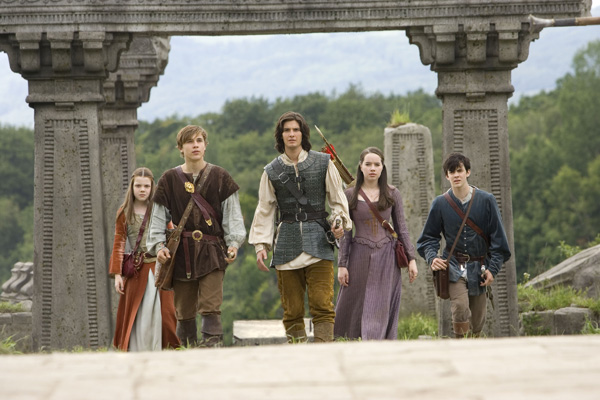
prince%20caspian.jpgThe Pevensie children are back in London and contemporary life seems pale and uninvolving compared to their adventures in the magical land of Narnia. As they wait for the Tube, a wall opens up and just as happened when they went through the wardrobe, they stand before the entryway to Narnia again. This time, they know immediately where they are. What they don’t know is when they are. Everything is different. “I don’t remember any ruins in Narnia,” one says. Lucy (Georgie Henley) confidently approaches a bear, introducing herself as though she was inviting him to tea. But he growls and charges. “I don’t think he could talk at all,” she says with surprise. “If treated like a wild animal long enough, that’s what you become,” explains Trumpkin (Peter Dinklage in heavy gnomish make-up). “You may find Narnia a more savage place than you remember.”
“Everything you know is about to change,” says one character and that serves as a warning and a prediction that applies to all of the great adventures before the Pevensies — the battle for Narnia, the challenges of growing up, and the struggles of leadership, faith, and principle.
As the Pevensies explore, they find that 1300 years have passed in Narnia since they helped Aslan the lion (voice of Liam Neeson) defeat the White Witch (Tilda Swinton) and end the tyranny of Narnia’s perpetual winter. It is summer, but there is no peace and prosperity in Narnia. The nearby Telmarines have done their best to wipe out all of Narnia. Those creatures who are left are in hiding, without a leader. Aslan, who seemed the answer to all questions in their first visit may have been glimpsed by Lucy, but the others are not willing to believe her. And they meet up with Prince Caspian (Ben Barnes), the rightful heir to the throne of the Telemarines, usurped by his evil uncle. Wary of each other at first, Caspian and the Pevensies join forces to battle for the freedom of the Narnians.
Like the first film, this is a grand and visually stunning epic with thrilling battle scenes and powerful themes. This one has more violence but also more humor, especially from the most welcome new character, a mouse with the heart of a lion and the voice of Eddie Izzard. Like the book, one of the less compelling of the seven-volume series, it is not as involving as the first. Barnes has a nice screen presence (though his accent sounds like he is trying out for a road show version of “West Side Story” as one of the Sharks). The pacing is strong, the effects are superb, and the battles are exciting. The themes are presented with a subtlety that encourages thoughtful consideration, with a range of possible interpretations.
Don’t let the PG rating fool you. This is a long, intense, violent epic with the deaths of both good guys and bad guys, and it is not suitable for young children. The earlier film had some difficult and troubling material, including the shearing and apparent death of Aslan and the emotional corruption of one of the Pevensie children by the White Witch. But this one has a childbirth scene (with the mother in evident distress) and a retreat from battle that involves the loss of Narnians that is the fault of one of the Pevensies. The disturbing material may be darker than the first for some viewers.

(more…)

Related Tags:


Action/Adventure Based on a book Epic/Historical Family Issues Fantasy Series/Sequel

Kit Kittredge: An American Girl

Posted on October 26, 2008 at 8:00 am

“Kit Kittredge” is remarkable for what it is and just as remarkable for what it is not. It is wholesome but it is not sugary. It is family-friendly but it does not gloss over economic realities and family stress. It is true to the spirit of the 1930’s but respectful of all we have learned since that era about respect and tolerance for differences of race and gender. And it is a good movie with important lessons but it is not one bit dull or preachy. Three cheers for Kit and for producer Julia Roberts for making this movie everything the devoted fans of the American Girls series hope for.

Abigail Breslin (of Little Miss Sunshine) plays Kit, a 1930’s heroine very much in the spirit of spunky 1930’s and 40’s female journalists like Dorothy Thomson and those portrayed in films by Rosalind Russell (His Girl Friday) and Jean Arthur (Mr. Smith Goes to Washington). In a nod to those classic movies, this one begins with Kit striding into a Cincinnati newspaper office to ask the editor to print her story. And the editor (Wallace Shawn) is every bit as choleric as newspaper editors in 1930’s movies always are.

But Kit will soon have bigger challenges than being underestimated by a grumpy newspaper editor. All around her, families are struggling because of the economic problems. Fathers are losing their jobs and her friends are losing their homes. Kit’s own beloved daddy (Chris O’Donnell) has to leave to try to find work in Chicago. And she and her mother (Julia Ormond) have to open up their home to boarders to make ends meet.

Some of the people around her become fearful and suspicious but Kit and her mother maintain their sense of optimism and generosity, sharing what little they have. A courageous pair of young hobos insist on working for the food they get from Kit’s mother and they introduce Kit to a community of homeless people who help each other any way they can.

Kit enjoys the boarders, especially a lively dancer (“30 Rock’s” Jane Krakowski), and a friendly magician (Stanley Tucci). She takes comfort in some small distinctions — unlike her friends, she has not lost her house or had to sell eggs or wear dresses made from a flour sack. And her father has promised to keep writing. But then things get tougher. And they get toughest of all when every penny her family has is stolen and it looks like the thief is her friend.

Related Tags:


Based on a book Epic/Historical For all ages

The Duchess

Posted on September 25, 2008 at 6:00 pm

B
Lowest Recommended Age: High School
MPAA Rating: Rated PG-13 for sexual content, brief nudity, and thematic material
Profanity: Some strong language
Alcohol/ Drugs: Drinking, including getting drunk to deal with stress
Violence/ Scariness: Rape
Diversity Issues: A theme of the movie
Date Released to Theaters: September 26, 2008

Kiera Knightley plays 18th century aristocrat Georgiana, Duchess of Devonshire in this muddled but eye-filling saga of an ancestor of Diana, Princess of Wales, who shared her status as a fashion icon, heartbroken wife of a man in love with someone else, and object of intense public fascination.

Georgiana was still a teenager when she was told that one of the most sought-after catches in England wanted to marry her. Silly girl, she thought it meant he loved her. But the Duke thought of marriage as something between a political alliance and animal husbandry. All he cared about was her ability to produce a male heir. The property law of the time depended on continuing the male line (as readers of Pride and Prejudice well know). And, as an affecting scene near the end shows, the Duke (Ralph Fiennes) is as constricted by the conventions of the era as she is.

This creates the opportunity for a soap opera in period clothes, with mutual adulteries and children born to other partners. Georgiana (known as “G”) also struggles with the betrayal of her closest friend (“Brideshead Revisted’s” Hayley Atwell) and the agonizing choice between her great love, a politician (“Mamma Mia’s” Dominic Cooper), or her children with the Duke.

It never quite comes together because G’s life was too big and varied to fit on screen. She was a fashion icon and an influential figure in politics. She was a devoted mother and an “all for love and the world well lost” libertine. She was strong and weak, intelligent and foolish, loyal and disloyal, practical and a dreamer. Though Knightley is game, the film falters in pomp and loses her under the feathers and jewels.

Related Tags:


Based on a book Based on a true story Drama Epic/Historical Movies -- format
THE MOVIE MOM® is a registered trademark of Nell Minow. Use of the mark without express consent from Nell Minow constitutes trademark infringement and unfair competition in violation of federal and state laws. All material © Nell Minow 1995-2025, all rights reserved, and no use or republication is permitted without explicit permission. This site hosts Nell Minow’s Movie Mom® archive, with material that originally appeared on Yahoo! Movies, Beliefnet, and other sources. Much of her new material can be found at Rogerebert.com, Huffington Post, and WheretoWatch. Her books include The Movie Mom’s Guide to Family Movies and 101 Must-See Movie Moments, and she can be heard each week on radio stations across the country.

Website Designed by Max LaZebnik