
Defiance
Posted on June 2, 2009 at 8:00 am
Cowriter-director Edward Zwick, who also made “Glory,” the story of an all-black Union regiment in the Civil War, spoke to me about why it was important to tell the story of the Bielski brothers, who kept 1200 Jews hidden from the Russians and the Nazis during WWII.
There is a perverse irony in commemoration of the dead in the Holocaust with little attention to the survivors and the resistance, especially the Jewish resistance. Its immensity can’t be underestimated and it is a story that needs to be told. We all know these iconic images of Jews in the Holocaust and those are important but we have come to accept them as the only images and that needs revision.
This is not the story of Jews trying to stay alive in concentration camps. This is the story of Jews who were lucky enough to have the chance to fight back. Tuvia Bielski does not just have a gun — he is played by James Bond himself, Daniel Craig.
When the Bielski parents are killed by the Nazis, the three brothers hide out in the woods. In addition to Tuvia there is Zus (Liev Schreiber) and the youngest, Asael (Jamie Bell of “Billy Elliot”). Over time, other escapees ask for their protection and they are faced with the wrenching choice between turning away those who are old or ill or putting the entire group at risk by taking on people who were not strong enough to help them or quick enough to keep out of sight. They have to make other choices, too. The Russian army will give them some minimal protection but only if they will join forces and devote their energy to fighting the Nazis, just just hiding from them. Zus joins them but Tuvia stays on to take care of the people who are not capable of fighting.
The natural world of the forest is for the escapees a sort of Arden where many things are turned upside down. Back in the village, social status depended on class, profession, education, devotion to religious study and ritual. The Bielskis had none of these. In the forest, status depends on the ability to survive in the forest, including the ability to find a balance between asking and telling everyone what to do. Tuvia falls somewhere between achieving greatness and having it thrust upon him. He never wanted to be a leader; he certainly never wanted everyone to depend on him. And most of all, he never wanted to make the tragic choices he must make, to have to find out that he is a person capable of killing and of moral compromise.
 ,
,  , and
, and  he created visual and musical mash-ups of classic and pop that achieved, sometimes apparently accidentally, some transcendence and that were just about always a lot of fun.
 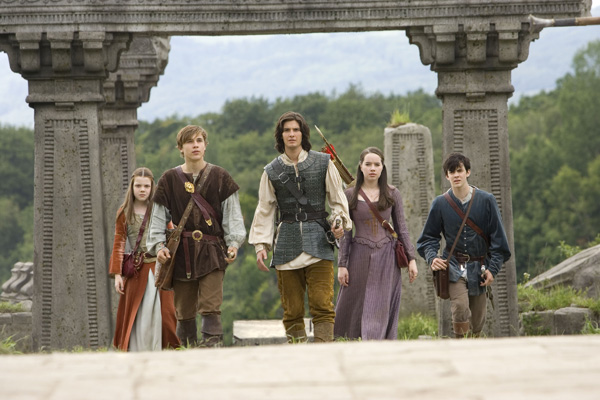 The Pevensie children are back in London and contemporary life seems pale and uninvolving compared to their adventures in the magical land of Narnia. As they wait for the Tube, a wall opens up and just as happened when they went through the wardrobe, they stand before the entryway to Narnia again. This time, they know immediately where they are. What they don’t know is when they are. Everything is different. “I don’t remember any ruins in Narnia,” one says. Lucy (Georgie Henley) confidently approaches a bear, introducing herself as though she was inviting him to tea. But he growls and charges. “I don’t think he could talk at all,” she says with surprise. “If treated like a wild animal long enough, that’s what you become,” explains Trumpkin (Peter Dinklage in heavy gnomish make-up). “You may find Narnia a more savage place than you remember.”
 ) plays Kit, a 1930’s heroine very much in the spirit of spunky 1930’s and 40’s female journalists like
  ) and Jean Arthur (
 ). In a nod to those classic movies, this one begins with Kit striding into a Cincinnati newspaper office to ask the editor to print her story. And the editor (Wallace Shawn) is every bit as choleric as newspaper editors in 1930’s movies always are.