Escape from Planet Earth

Posted on February 15, 2013 at 11:15 pm
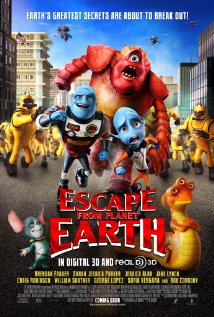
A new animation studio called Rainmaker has produced its first film, “Escape from Planet Earth,” a story of sibling rivalry and aliens.  It almost works as an amiable, if derivative time-waster for kids with a few jokes for the grown-ups, but too much is unsettlingly off-base.

On the planet Baab, where the inhabitants are blue and nearly bald, Scorch Supernova (Brendan Fraser) is a big, brash, brave, impulsive hero.  His Buzz-Lightyear knock-off spacesuit is festooned with NASCAR-style sponsor patches.  In between missions, he promotes his cereal brand, Scorchies.

His brother Gary Supernova (Rob Corddry) is the brilliant but careful, brilliant mission control specialist who makes sure Scorch knows what he has to do, where he has to be, and how to get back home.  His coffee mug says, “I (HEART) Safety.”  Gary tells Scorch to proceed with extreme caution and Scorch responds that he will proceed with style.

Scorch always calls Gary his “little brother” and Gary irritably reminds Scorch that he may be smaller but he is actually older.  Each feels unappreciated by the other.  And each secretly thinks his contribution is the more important one.

They complete a successful mission rescuing kidnapped Baab-ian babies from a planet inhabited by creatures with big teeth who thought of the babies as a delicacy.  But it put such a strain on their working relationship that they split up, just as Scorch is about to undertake his most dangerous mission of all — a trip to “the dark planet” of earth, “the only world in which evolution goes in reverse.”  More than 100 aliens have landed there and none has made it home.  Scorch, insisting he can do it on his own, arrives on earth and is immediately captured.  Gary goes after him, and he gets captured, too.  And of course they are taken to Area 51.

They are held there by General Shanker (William Shatner), where they are forced to give up their inventions — like social networking, cell phones, computer animation, and search engines — so that the general can finance some big contraption he says is to help preserve peace.  The brothers will have to learn to work together and to appreciate each other if they are to get back home.  And they will need the help of Gary’s wife Kira (Sarah Jessica Parker) and son.

There are a couple of good jokes and some of the characters are well-designed and voiced, especially Jane Lynch as a one-eyed alien who appears to be made out of lobster shells.  The prison-like setting where Scorch, Gary, and the other aliens are kept and much of the humor is reminiscent of films like “Paul,” “Monsters, Inc.” and “Monsters vs. Aliens.”  But the movie slides from the unimaginative to the weirdly creepy when the aliens are told that if they work they will be set free in a chillingly insensitive echo of the infamous Auschwitz gate.  When Gary’s boss (Jessica Alba) repeatedly insults Kira for being a stay-at-home mother, it falls flat.  So do the jokes about Gary’s being a nerd, making fun of him for being smart.  It’s one thing to have all the aliens breathe air and speak English, but having them travel back and forth between planets in less time than it takes to fly from New York to Chicago and have characters show up on Baab when they were left behind on earth three days earlier feels less like sci-fi than laziness.

Parents should know that this movie includes extended peril and action and some scary-looking aliens, some potty humor, and a parent getting crushed by a UFO.  There are some oddly insensitive jokes about nerds not having any friends and stay-at-home mothers not being capable.

Family discussion: Why was it so hard for Gary And Scorch to be nice to each other?

If you like this, try: “Monsters vs. Aliens” and “Monsters, Inc.”

Related Tags:


3D Action/Adventure Animation Comedy Family Issues

A Good Day to Die Hard

Posted on February 13, 2013 at 6:00 pm

Chases.  Explosions.  Guns.  Crashes.  Wisecracks. Punches.  Repeat.  Repeat again.  Yes, it’s the fifth “Die Hard” movie.

Bruce Willis returns as cop John McClane and this time the setting is Moscow.  Though he repeatedly says throughout the film’s zippy 90 minutes that he is on vacation, McClane is in Russia to help his estranged son Jack (Australian actor Jai Courtney of “Spartacus”), who has been arrested for attempted murder.  It turns out that Jack, who uses his mother’s last name and has not spoken to John in years, is actually under cover for the CIA.  Both the Russians and the Americans want a “file” that has been hidden away by a man named Komorov (Sebastian Koch), who is about to go on trial.  It contains incriminating information about a high-ranking Russian official.  He wants it destroyed.  The Americans want to use it to discredit him.  The stakes are very high.  The chases are very fast.  The explosions are very big.  The repartee is….not great, but thankfully minimal.

Unlike his “Expendables” colleagues Arnold Schwarzenegger and Sylvester Stallone, whose 2013 action film releases managed to be both lackluster and overheated, with so much work done on their faces they looked like bad copies of Madame Tussaud’s replicas of themselves, Willis is every bit as good and better than he was in the first “Die Hard” film a quarter century ago.  Regrettably, we get only a glimpse of the fabulous Mary Elizabeth Winstead, briefly returning as John’s daughter, Lucy, to drop him at the airport and admonish him to behave (as if!).  But Courtney is well-matched to Willis, with their bullet heads, truculent glares, and cocky pleasure in their own outrageous badassery.  John may pause for a brief “Cat’s in the Cradle” reverie with Komorov in between dodging bullets, as they ruefully reflect on their failures as fathers, but shortly afterward, as John and Jack awkwardly observe a tender parent-child reunion, they agree that nothing like that would work for them.  “We’re not a hugging family,” Jack says.  “Damn straight,” agrees his father.

The locations are exotic, and the chase scene through the streets of Moscow is wilder than any since the last “Die Hard.”  The titles may be getting increasingly labored but Willis and the stunts make it work.

Parents should know that this film has constant peril and violence.  Many characters are injured and killed, and there is a lot of shooting, punching, chases and explosions, some graphic and disturbing images, and strong language.

Family discussion:  How are John and Jack alike?  Why was Jack so angry with John?  What changed his mind?

If you like this, try: the other “Die Hard” movies, especially the first and third

Related Tags:


Action/Adventure Crime Family Issues Series/Sequel Spies

Parental Guidance

Posted on December 24, 2012 at 6:00 pm

D
Lowest Recommended Age: Kindergarten - 3rd Grade
MPAA Rating: Rated PG for some rude humor
Profanity: Some schoolyard language
Alcohol/ Drugs: Some alcohol
Violence/ Scariness: Comic peril and violence
Diversity Issues: None
Date Released to Theaters: December 25, 2012

This shtick-y, utterly synthetic sit-com of a movie telegraphs its every joke and then pounds the audience over the head to make sure we get them.  Oh, we get them.  We just wish we didn’t.

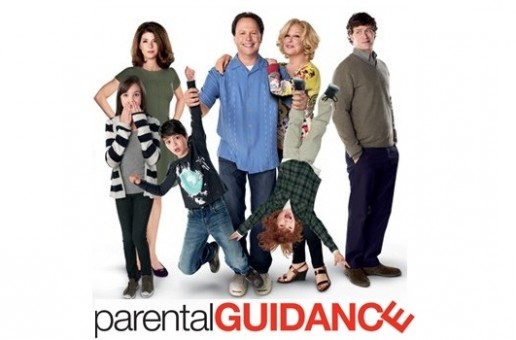
Artie (Billy Crystal) is a minor league baseball announcer who always dreamed of announcing for the Giants.  He is fired at the end of the season because he is too old-school.  Insert “What’s Twitter?” and “What’s an Angry Bird?” jokes.  His wife, Diane (Bette Midler), teaches pole dancing in their living room for no reason except that it must be funny to see middle-aged ladies try to pole dance.  Their daughter, Alice (Marisa Tomei) is happily married to Phil (“That Thing You Do'” Tom Everett Scott), newly settled in Atlanta with their three children.

Phil’s new project is a super-duper high-tech home system that welcomes every family member when they come into the house, bids them farewell when they leave and talks to and spies on them in between.  When Artie and Diane arrive to babysit while Alice and Phil go to a business conference, we can expect to be treated to the conflict between Artie, whose ability with technology ended with the dial phone (until the script calls for him to pull up a track on an iPod) and the high-tech house.  And when Alice explains that their parenting philosophy is to say “remember the consequences” instead of “no” and insist on three “put-ups” to counter any “put-downs,” we can expect that, well, there will be consequences.  Everyone tries hard, but the talented cast is utterly wasted in a series of mind-numbingly obvious and heart-numbingly phony set-ups.

http://www.youtube.com/watch?v=_9nmIzCAMJQ

The oldest grandchild is Harper (Bailee Madison, giving the film’s best performance), a middle-schooler who is something of a perfectionist.  She has a big violin audition coming up, a teacher who thinks anyone who isn’t up to her standards should be shunned, and an increasing sense that she is missing out on some of the fun of the pre-teen years.  The youngest is Barker (Kyle Harrison Breitkopf), a high-spirited five-year-old perpetual flight risk who insists on calling his grandfather “Fartie,” which is even less hilarious than you might hope.  No good asking him to consider the consequences; there aren’t any.

Then there’s the middle child, Turner (Joshua Rush), a stressed-out, shy kid with a bad stutter.  The cynical sloppiness of this film is revealed in Turner’s miraculous transformation into a completely fluent speaker as the result of hearing the famous Russ Hodges “Giants win the pennant” broadcast, disrespectful in the extreme to those who struggle with speech impediments and to those who work with them.

It is filled with poorly staged slapstick and potty humor.  Artie gets hit in the crotch and throws up on the face of the kid who hit him.  Barker pees onto a half-pipe, causing Tony Hawk(!) to crash. There’s an extended nose-picking sequence.  The consequences of these moments — this movie is awful.

Parents should know that this film has extended and graphic potty and other bodily function humor, schoolyard language, comic peril, drinking, unrealistic portrayal of a “cure” for stuttering, and mild sexual references.

Family discussion: What are the biggest differences in the styles of parenting in this movie?  Which one do you agree with?  What did the three kids learn from their time with their grandparents?

If you like this, try: the “Wimpy Kid” movies

Related Tags:


Comedy Family Issues Movies -- format

This is 40

Posted on December 20, 2012 at 6:00 pm

Writer-director Judd Apatow has made the mistake of believing that the audience will find his wife and children and mid-life crisis as relatable and endearing as he does. And there is nothing more fatal to a movie than a gross miscalculation about the appeal of its characters. It’s fine to make a movie about unpleasant people as long as the movie knows they are unpleasant. But this movie asks us to care about the concerns of people who care very little for anything but the most superficial and selfish problems, with no sense at all of how shallow and unappealing they are.

Apatow’s mega-successful “Knocked Up” was the story of a successful professional woman who became pregnant after a one-night stand with a man who was neither successful nor professional.  The pregnant woman’s sister Debbie (Apatow’s real-life spouse Leslie Mann) and her husband Pete (Paul Rudd) provided a comedic counterpoint, coping with marital stress, including two children, played by Apatow and Mann’s real-life children.  In one scene, Debbie and her sister are not permitted into a club because Debbie is too old and her sister is pregnant.  Debbie is devastated by the loss of this important validation.  Debbie is shrill and demanding, constantly blaming her husband.  In one big plot twist, it turns out that the secret he had been hiding from her was not an affair but a fantasy sports group he liked to escape to.

“This is 40” continues the story of Pete and Debbie.  She is still shrill and demanding, still constantly blaming her husband, and still pretty much on board with the idea that her self-worth depends on being attractive to strangers in hot clubs.  In the opening scene, the week of both Pete’s and Debbie’s 40th birthdays, they are having very enthusiastic sex in the shower when he reveals that his performance has been enhanced with medication.  Instead of expressing concern or sympathy or support, she interprets this as evidence that she is no longer as attractive as she was when she was younger.  She whines to her personal trainer (Apatow regular Jason Segal) that she is failing to arouse men and he consoles her by saying that she arouses him.

Debbie insists that she and Pete embark on a course of self-improvement that involves graphic depictions of a mammogram and a colonoscopy, and a lot of resolutions about eating better and unplugging the kids from the internet.  It does not, however, involve any expressions of generosity, humility, compassion, responsibility, or maturity.  Pete and Debbie are aggrieved by the remoteness (her) and dependence (his) of their fathers, but they are not doing much better as parents.  I have a sinking feeling that there will a a future sequel for the girls to work out their issues with their parents.

The movie is overlong and saggy, swooping almost randomly from set-piece scene to set-piece scene, and yet it is all supposed to take place in about one week.  This continually undercuts any sense of forward momentum and Apatow stuffs his films with so many of his friends that we keep having to be reminded of who all the characters are.  And then when we are reminded, we are disappointed all over again.  Segal, Chris O’Dowd (“Bridesmaids”), Lena Dunham (“Girls”), Charlene Yi and Melissa McCarthy (“Bridesmaids”) are all trotted out for short bits and some are quite funny (be sure to stay for McCarthy’s outtakes during the credits).  And Megan Fox is a standout as an impossibly hot and possibly larcenous employee in Debbie’s boutique.  This is Fox’s second top-notch performance this year, following “Friends With Kids” — take that, Michael Bay.  There is even an occasional flash of understanding of the challenges of marriage and getting older, as when Pete and Debbie try (but not very hard) to use obviously therapy-inspired tactics for expressing their complaints and disappointments.

But that is not enough to make up for the  inert plotline and unappealing characters.  For a guy who seems to think about nothing more than the travails of self-absorbed people suffering from arrested development, Apatow has failed to learn that the issue is not growing old — it is growing up.

Parents should know that this film includes extremely graphic and explicit sexual references and situations including fertility issues and an “escort,” constant very strong language, drinking, marijuana, some mild violence (no one badly hurt), family stress, and stealing.

Family discussion:  What do we learn about Pete and Debbie from their relationships with their fathers?  Why was staying young so important to Debbie?
If you like this, try: “Knocked Up” (featuring the same characters) and “The 40 Year Old Virgin”
Related Tags:


Comedy Drama Family Issues Series/Sequel

Silver Linings Playbook

Posted on November 15, 2012 at 6:01 pm

B+
Lowest Recommended Age: Mature High Schooler
MPAA Rating: Rated R for language and some sexual content/nudity
Profanity: Constant very strong language
Alcohol/ Drugs: Drinking
Violence/ Scariness: Assaults and fighting
Diversity Issues: Respectful treatment of mental illness
Date Released to Theaters: November 16, 2012
Date Released to DVD: April 29, 2013
Amazon.com ASIN: B00A81NFAS

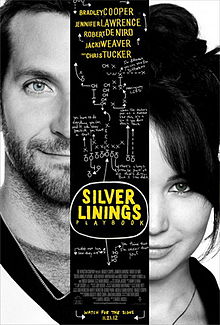
When Bradley Cooper appeared on “Inside the Actors Studio,” the first graduate of the program to be featured, they showed a clip from Robert DeNiro’s appearance on the show, with then-student Cooper asking him a question about his performance in “Awakenings.”  DeNiro was clearly impressed with the perception and sincerity of his young questioner.  It was only a few years later that Cooper was acting opposite DeNiro in “Limitless.” Now they are together again as father and son, Pat Sr. and Pat Jr., in “Silver Linings Playbook,” based on the novel by Matthew Quick.

Pat Jr. has been in a mental hospital being treated for bipolar disorder, the result of a plea bargain following “the incident,” we will only learn the details of later.  His mother brings him home though it is not at all clear that he is or will ever be ready.  Pat has impulse control problems, especially when he hears a particular Stevie Wonder song or does not like the ending of a Hemingway novel.  But he is absolutely determined to get his life back.  And his wife back.  This involves a lot of physical conditioning and finding away around the restraining order that forbids him from contacting her.

He meets a troubled young widow named Tiffany (Jennifer Lawrence of “Hunger Games”), the sister-in-law of his best friend.  Pat is fighting so hard to be “normal” again that he is disturbed, annoyed, and a little scared by her outspoken, socially inappropriate behavior.  But she offers the same directness and shared experience he had with his fellow patients.  He struggles with the competing impulses to reject and accept her overtures of friendship.  Their exchange about the effects of various mood and anti-psychotic meds is a gem, the mental illness equivalent of Romeo and Juliet speaking to each other in alternate lines of a sonnet on their first meeting.  And Lawrence is sublime in her summation-to-the-court-style argument with Pat Sr. about the factors that go into an Eagles win.

They agree to help each other, and this gives Pat purpose, discipline, and direction.  And we learn more about “the incident” and about Pat’s relationship with Pat Sr., a professional gambler and bookie whose passion for the Eagles provides some context for his influence on his son.

Director David O. Russell, who adapted the novel, and his cast fill the story with engaging, believable characters, especially Jackie Weaver as Pat’s mother, John Ortiz as his stressed-out best friend, and Anupam Kuhr as his therapist.  It is a great pleasure to see Chris Tucker, who is outstanding as a mental patient, though I wish they had found him more to do than the usual “black it up” (that’s a direct quote) pep talk.  Pat is so upset by the end of Farewell to Arms (on his wife’s assigned reading list for the high school class she teaches) that he has to wake his parents in the middle of the night to tell them why stories need happy endings.  The ending here is abrupt and a bit cheesy.  But these damaged and vulnerable and anxious characters love and want to be loved and we want it for them.

Parents should know that this film includes a lot of very strong and profane language, sexual references (some explicit), family dysfunction and mental illness, drinking

Family discussion: How are Pat and his father alike? How do Tiffany, Ronnie, and Cliff help him? What makes Pat change his mind?

If you like this, try: “Inside Moves” and “Garden State”

Related Tags:


Based on a book Drama DVD/Blu-Ray Pick of the Week Family Issues Romance
THE MOVIE MOM® is a registered trademark of Nell Minow. Use of the mark without express consent from Nell Minow constitutes trademark infringement and unfair competition in violation of federal and state laws. All material © Nell Minow 1995-2026, all rights reserved, and no use or republication is permitted without explicit permission. This site hosts Nell Minow’s Movie Mom® archive, with material that originally appeared on Yahoo! Movies, Beliefnet, and other sources. Much of her new material can be found at Rogerebert.com, Huffington Post, and WheretoWatch. Her books include The Movie Mom’s Guide to Family Movies and 101 Must-See Movie Moments, and she can be heard each week on radio stations across the country.

Website Designed by Max LaZebnik