Dr. Seuss’ The Cat in the Hat

Posted on November 18, 2003 at 6:10 pm

The great thing about the irrepressibly anarchic Cat in the Hat is that even Hollywood can’t contain him. They can stretch out the story with filler that ranges from the superfluous to the distracting and once in a while reaches the level of oh-no-not-that-again. They can put in some inexcusably vulgar humor. But when Cat takes over, it is still entertaining.

Mike Meyers, as irrepressibly mischevious as the Cat himself, is a great choice for the role. His Cat seems to be a master of vaudvillian schtick with a few of the voices from The Wizard of Oz and a sort of demented Mary Poppins thrown in for what turns out to be very good measure. His energy and audacity — and his astonishingly animated expressions under all that fur — do as much as possible to keep the movie on track.

But very little of what is added to the story is worth the effort. Dr. Seuss was much too smart to try to insert any kind of a moral into his stories or to give us too much detail about the lives of the children the Cat comes to visit. This left his story universal and subject to interpretation.

But it would not fill even the short 73 minute running time of this feature film. So, this version makes the Cat into an “I’m here to teach you a lesson,” sort of guy. Conrad (Spencer Breslin) has to learn to follow the rules and Sally (Dakota Fanning) has to learn to loosen up and not be so bossy. And they have to learn to appreciate one another. Awwwwww. We also get a completely gratuitous menace in Alec Baldwin, a neighbor with a corset and an upper plate who schemes to marry the kids’ mother and have Conrad sent to a military boarding school. None of this is very original or interesting, and it all takes much too much time away from the real story, which is the absolute chaos created by the Cat and the reaction of the kids — a mixture of horror and delight, with delight winning out. And why not? Who among us does not thrill to see that “don’t you touch anything” living room covered in splotches of purple goo?

This undeniable pleasure is almost enough to keep the movie working. Those jellybean-colored sets (and Mom’s just-drycleaned dress) are cheerfully destroyed along with, Mom’s rules, some of the kids’ ideas about themselves, and, apparently, the laws of physics. We get both the fun of imagining all of that and the satisfaction of a happy ending. Meyers is simply a hoot to watch, with able support from the kids (especially Fanning) and the fish (voice of Sean Hayes).

But parents should know that this movie has some surprisingly rude and crude humor for a PG, including double entendres and almost-swearing, potty humor, and other bodily function jokes. The Cat picks up a muddy garden implement and refers to it as “a dirty hoe” and spells out the s-word. The Cat is hit in the crotch. He has a fake bare behind. It is almost unfathomable that the people behind this movie put material like that in a movie based on a beloved book for children. There is also a lot of comic peril that may be too intense for younger children. An adult character drinks beer.

Families who see this movie should talk about why Sally had a hard time with her friends and why Conrad had a hard time following rules. They might also like to pretend they are Thing One and Thing Two (or Chocolate Thun-da) and do the opposite of what they are told.

Families who enjoy this movie should read the book and its sequel and some of the other Seuss classics like Horton Hears a Who and The Sneetches.

Related Tags:


Based on a book Comedy Fantasy

Bruce Almighty

Posted on May 21, 2003 at 5:28 am

You could not ask for a better showcase for what Jim Carrey does best than this comedy about a man who is given all of God’s powers and has no compunction about using them for cheap thrills and petty payback. Director Tom Shadyac, who worked with Carrey on his biggest hits, “Ace Ventura” and “Liar, Liar,” once again gives us Carrey in a role designed to get the most out of his talent for wildly elastic physical comedy.

There’s a strong sense of art imitating life here, at least the life of Carrey the performer, if not Carrey the person. Carrey the performer has not had the success he hoped for in more serious roles, particularly in “The Majestic” and “The Man in the Moon.” So when his character is told throughout this movie that there is nothing wrong with being funny (and when God, played by Morgan Freeman, says “All-righty then!” Ace Ventura’s favorite catch phrase), and when he plays a character with God’s powers (which must feel pretty close to the omnipotent power our society gives to celebrities) and yet he ends up being satisfied with what makes people laugh, it is hard not to think that there is something more than resonance here for Carrey. It is almost as though he is saying “All-righty then! If this is what you want to see, here it is!” to the audience.

Carrey plays Bruce Nolan, a television news reporter who resents being assigned to silly stories like the world’s biggest cookie and the anniversary of the Niagara Falls boat tour. He wants to do serious stories and he thinks he should be the anchor. He lives with his girlfriend, Grace (Jennifer Aniston), whose name is an indication of the script’s idea of a theological reference.

Despite his love for Grace, Bruce is shallow and self-centered. When he loses the anchor job to a rival (Comedy Central “Daily Report’s” Steve Carell), he furiously explodes on the air and is fired. He tries to help a homeless man, and is beat up by thugs. Bruce thinks that life is very unfair, so he complains to God. God challenges him to try out His powers, as long as he does not tell anyone or interfere with free will.

Bruce spends the first week using the powers for cheap thrills. He parts the red soup instead of the Red Sea and makes the cars blocking him in a traffic jam move out of the way. And he enjoys petty payback. This part of the movie is fun — who would not like to be able to do anything without any guilt or accountability — and it is very funny, especially when Bruce makes his rival mess up on camera. The best physical comedians, like Carrey, perfectly enact the id out of control, the mean little imp that lives in each of our hot little hearts. That is ideal for embodying Bruce’s juvenile uses of his new power.

But then Bruce has to realize that power and responsibility go together and that he cannot be happy until he understands that other people’s happiness has to come first. That part of the movie does not work because it is pretty clear that Bruce never cares about anyone but himself. There is a hollow, hypocritical, and faintly creepy sense that the people behind the movie don’t really understand the message themselves.

Bruce’s carelessness in lassoing the moon (a reference to “It’s a Wonderful Life” that is hammered home later on when we get a glimpse of that scene on television), unleashing an asteroid, and making hundreds of lottery winners, is portrayed as humorous. Even though we get glimpses of the disasters he causes, Bruce never does and never has to clean up the mess.

When Bruce tells God that he wants to solve the problems of world hunger and peace, God tells him that is a “Miss America answer” and His goal seems to be to get Bruce to think about what would make him happy with no regard for anyone but himself and the woman he loves. And life and art come together as it becomes clear that Carrey the performer is no more generous than Bruce the anchorman; Bruce’s failure to appreciate the sweet and ever-forgiving Grace is less of a, well, sin, than Carrey’s failure to make use of the considerable comic talents of the woman who plays her. It’s a shame to see Aniston in essentially an arm candy role. The result is a movie that, despite some very funny moments, makes the same mistake as its main character without learning any lessons about maturity or responsibility. It teeters between deranged comedy and sentimental fable, and is unsatisfying in both categories. What Bruce should have used his powers for was a better script.

Parents should know that the movie has very mature material for a PG-13, including very strong language and crude humor after a thug makes a rhetorical reference to a monkey coming out of his butt. Bruce gives “pleasure” to Grace as they prepare for a sexual encounter. There is an extended joke about a dog who is not house-trained. Characters drink alcohol and Bruce uses his powers to plant bags of marijuana on rival broadcasters.

Families who see this movie should talk about what they would do if they had God’s powers. How would they decide the best way to respond to prayers? Most of the prayers in this movie are “petitionary,” meaning that they are asking for something, usually love, money, or status-related. What other kinds of prayers are there? Some families will want to discuss their own ideas about God and prayer.

Families who enjoy this movie will also enjoy “Oh God,” with George Burns and John Denver. They might like to see a different portrayal of God that also discusses the importance of free will in the wonderfully imaginative “Time Bandits.” And every family should watch and discuss “It’s a Wonderful Life” with Jimmy Stewart and Donna Reed.

Related Tags:


Comedy Fantasy Romance

James and the Giant Peach

Posted on January 20, 2003 at 4:01 pm

This movie may be too scary for kids under six, but older children and their families, particularly fans of the Roald Dahl book, will love this spectacular musical fantasy from Tim Burton and Henry Selick (“The Nightmare Before Christmas”).
James has a blissful life with loving parents until they are both killed by a rhinoceros. He then goes to live with his horribly mean aunts, until a mysterious stranger brings him a bag of magical crocodile tongues.
James trips and spills them on the ground, near a tree that then grows a giant peach. When James climbs inside, he meets a collection of human-sized insects, including the lovely Polish-accented spider (voice of Susan Sarandon) and violin-playing grasshopper (voice of Simon Callow). The peach takes off, and, tethered to 300 seagulls and flies to New York.
Exquisite stop-motion claymation, computer animation, and special effects combine to create real movie magic and an instant classic.
Kids who love Dahl will also enjoy the films of his other books, “Willie Wonka and the Chocolate Factory” and “The Witches” and Children will also enjoy Dahl’s “Matilda,” another story of a child overcoming cruel adults.

Related Tags:


Action/Adventure Animation Based on a book Fantasy For the Whole Family Talking animals

Mary Poppins

Posted on December 13, 2002 at 5:18 am

A+
Lowest Recommended Age: Kindergarten - 3rd Grade
MPAA Rating: G
Profanity: None
Alcohol/ Drugs: None
Violence/ Scariness: None
Diversity Issues: The cause of votes for women is presented as unimportant, even daffy; subtext that parents should spend time with their children in
Date Released to Theaters: 1964
Date Released to DVD: December 09, 2013
Amazon.com ASIN: B00E9ZAT4Y

marypoppins5In honor of the upcoming “Saving Mr. Banks” and the 50th anniversary of the original film, Disney is releasing a superclifragilisticexplialidocious new edition of Mary Poppins.

Based on books by P.L. Travers (whose reluctance to allow a film to be made is the subject of “Saving Mr. Banks,” the film switches the 1930’s-era setting to the more picturesque London of 1910, where the Banks family has a loving, if rather chaotic, household. A nanny has just stormed out, fed up with the “incorrigible” children, Jane and Michael. Mr. Banks (David Tomlinson) writes an ad for a new nanny and the children compose their own, which he tears up and throws into the fireplace. The pieces fly up the chimney, where they reassemble for Mary Poppins (Julie Andrews), who is sitting on a cloud. The next day, a great wind blows away all of the nannies waiting to be interviewed, as Mary floats down.

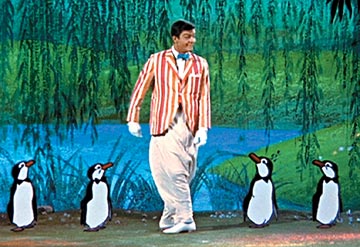
Somehow, she has a mended copy of the qualifications written by the children that Mr. Banks tore up and threw into the fireplace.  To the children’s astonishment, she slides up the banister.Out of her magically capacious carpetbag she takes out a tape measure to determine the measure of the children (“stubborn and suspicious” and “prone to giggling and not tidying up”) and her own (“practically perfect in every way”).  She directs them to clean up the nursery, and shows them how to make it into a game (“A Spoonful of Sugar Helps the Medicine Go Down”). Once it is clean, they go out for a walk, and they meet Mary Poppins’ friend Bert (Dick Van Dyke) drawing chalk pictures on the sidewalk. They hop into the picture and have a lovely time, or, rather, a “Jolly Holiday” in a mixture of live-action and animation that has Bert dancing with carousel horses and penguins.

Mary-Poppins-RooftopMary takes the children ato see her Uncle Arthur (Ed Wynn), who floats up to the ceiling when he laughs, and they find this delightfully buoyant condition is catching. Later, Mr. Banks takes the children to the bank where he works, and Michael embarasses him by refusing to deposit his tuppence because he wants to use it to buy crumbs to feed the birds. There is a misunderstanding, and this starts a run on the bank, with everyone taking out their money. Mr. Banks is fired.

Mr. Banks realizes that he has been too rigid and demanding. He invites the children to fly a kite with him. Mrs. Banks realizes that in working for the vote for women, she had neglected the children. Her work done, Mary Poppins says goodbye, and floats away.

This sumptuous production deserved its many awards (including Oscars for Andrews and for “Chim Chimeree” as best song) and its enormous box office. It is fresh and imaginative, and the performances are outstanding. (Watch the credits carefully to see that Van Dyke also plays the rubber-limbed Mr. Dawes.) The “jolly holiday” sequence, featuring the live-action characters interacting with animated ones, is superb, especially Van Dyke’s dance with the penguin waiters.

The resolution may grate a bit for today’s families with two working parents, but the real lesson is that parents should take time to enjoy their children, not that they should forego all other interests and responsibilities to spend all of their time with them.

Family discussion:  If you were writing a job notice for a nanny, what would it include?  Which of the children’s adventures did you most enjoy and why?

If you like this, try: books by P.L. Travers and the documentary about this film’s Oscar-winning song-writers, The Boys: The Sherman Brothers’ Story. And go fly a kite!

Related Tags:


Based on a book Classic Comedy DVD/Blu-Ray Pick of the Week Family Issues Fantasy For the Whole Family Musical Stories About Kids

Aladdin

Posted on December 13, 2002 at 5:17 am

A+
Lowest Recommended Age: Kindergarten - 3rd Grade
MPAA Rating: G
Profanity: None
Alcohol/ Drugs: None
Violence/ Scariness: Characters in peril
Diversity Issues: Class issues
Date Released to Theaters: 1992
Date Released to DVD: October 5, 2015
Amazon.com ASIN: B00WR534TK

One of the best of the contemporary Disney releases, this classic tale of the magic lamp benefits tremendously from the energy and humor of Robin Williams as the genie. Only the Disney animators could find a way to keep up with Williams’ pop culture torrent of a brain, and the big blue genie is a marvel of rapid-fire images and associations, deliciously irreverent, a nice surprise in a Disney film.  This 2015 Diamond edition

Aladdin, a “street rat,” meets the beautiful Princess Jasmine, when she sneaks out to wander through the city. Jasmine refuses all of the men who want to marry her to get the throne and wants to find out more about the world outside the castle walls. Evil Jafar, the trusted advisor to the Caliph, sends Aladdin to get the magic lamp. The genie appears and offers Aladdin three wishes. Aladdin promises he will use the third wish to free the genie, and then wishes to be a prince, so he can court Jasmine.

But Jafar, too, wants Jasmine, and the kingdom she will inherit. Aladdin has to find a way to free the King from Jafar’s control using his own powers. And he has to find a way to feel comfortable enough about himself to allow Jasmine to know who he really is.

The songs by Alan Menken and Howard Ashman are tuneful, sparkling, and exceptionally clever, one of Disney’s all-time best scores. After Ashman’s death, lyrics for three songs were written by Tim Rice of “The Lion King” and “Jesus Christ, Superstar,” including those for the Oscar-winning song, “A Whole New World.”

Families who see this movie should discuss these questions: Why didn’t Aladdin want to tell Jasmine the truth? Why did Jasmine’s father trust Jafar? If you had three wishes, what would they be?

Disney issued two made-for-video sequels, “The Return of Jafar” and “Aladdin and the King of Thieves” (only the second one featuring Williams), both very entertaining. Parents may have concerns about some aspects of the story in the second. Aladdin behaves in an honorable and accountable fashion, there is a fairly happy resolution of the relationship between Aladdin and his father, Kaseem, and Kaseem acknowledges that the relationship with his son is “the ultimate treasure.” However, Kaseem’s original desertion of Aladdin and his mother and his failure to care for Aladdin after his mother’s death are never really justified or apologized for; nor does he ever address or repent for his his lifelong career as a thief. Kaseem seems unconcerned when the outlaws insist that Aladdin pass the test for becoming one of them, a fight to the death, and almost casually approves. He leaves the outlaws to drown when their ship sinks. And at the end, he rides off with Iago the parrot (again voiced by the wickedly funny Gilbert Gottfried), apparently to return to a life of crime. Parents should be prepared for questions, and may want to initiate discussion of how Aladdin might feel about his father and why he has decided to make different choices in his own life.

Related Tags:


Animation Based on a book Classic DVD/Blu-Ray Pick of the Week Fantasy For all ages For the Whole Family Musical Romance
THE MOVIE MOM® is a registered trademark of Nell Minow. Use of the mark without express consent from Nell Minow constitutes trademark infringement and unfair competition in violation of federal and state laws. All material © Nell Minow 1995-2026, all rights reserved, and no use or republication is permitted without explicit permission. This site hosts Nell Minow’s Movie Mom® archive, with material that originally appeared on Yahoo! Movies, Beliefnet, and other sources. Much of her new material can be found at Rogerebert.com, Huffington Post, and WheretoWatch. Her books include The Movie Mom’s Guide to Family Movies and 101 Must-See Movie Moments, and she can be heard each week on radio stations across the country.

Website Designed by Max LaZebnik