The Giver

Posted on August 12, 2014 at 7:00 am

B
Lowest Recommended Age: Middle School
MPAA Rating: Rated PG-13 for a mature thematic image and some sci-fi action/violence
Profanity: Some strong languge
Alcohol/ Drugs: Citizens are required to take drugs to make them submissive
Violence/ Scariness: Sci-fi-style apocalyptic violence, murder, peril, characters injured and killed
Diversity Issues: A theme of the movie
Date Released to Theaters: August 15, 2014
Date Released to DVD: November 24, 2014
Amazon.com ASIN: B00MU2P0HO
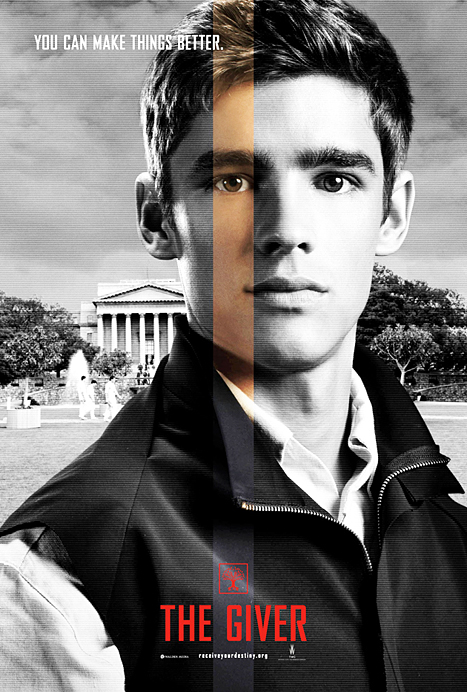
the giver poster
Copyright 2014 The Weinstein Company

“Thank you for your childhood.” Are there any more fearsome words in literature than these?

Lois Lowry’s The Giver is a Newbery Award-winning novel, a staple of middle school reading lists and book reports. It tells a dystopian story of a post-apocalypse society that is pleasantly courteous on its surface, but rigidly regimented and ruthlessly enforced. As children come of age and are assigned to their future careers by the all-powerful elders (who will later assign their mates and children as well), they are thanked for their childhood, words that sound grateful and polite, but which imply that all lives belong to the community, which demands that childhood be somehow contributed.  And, it clearly communicates that whatever freedoms or pleasures of childhood exist in this society, they are now in the past.

“From the ashes of the ruin,” we are told, “the communities were built” and “true equality” was achieved.  Whoever designed these new communities made the decision that human life could only continue if all memories of the past were erased, so that the sources of catastrophic conflicts — individual and cultural differences, were wiped out, along with the freedom to chose that inevitably leads to jealousy, anger, and struggles for power.  Fear, pain, envy, hatred, are all gone.  So are colors.  We see their world through their eyes, muted greys, no color, no music, no art.  There is constant discussion of “precision of language,” but it is just a way to eliminate words that describe strong emotions or complicated concepts, while genuinely imprecise words like “elsewhere” and “release” are euphemisms for dire and tragic consequences.  People “apologize” all the time but there are no real regrets and the “I accept your apology” responses are just as perfunctory.

Three friends, the serious Jonas (Brenton Thwaites), fun-loving Asher (Cameron Monaghan), and kind-hearted Fiona (Odeya Rush) are about to receive the thanks for their childhoods and be assigned their jobs.  Jonas is worried but his “parents” (a couple assigned to each other and handed babies from a collective nursery) reassure him that the Elders will make a good assignment, whether it is as a laborer, a nurturer (caretaker of infants and elderly), a lawyer (like his mother), or one of the other jobs that keep the community going.

But at the assignment ceremony announcements, Jonas is skipped over.  Only when everyone else has been assigned does the Elder (Meryl Streep in Very Serious Hair) tells the group that Jonas has been selected for a very important job.  The founders of this post-Ruin society erased all memories of the past but recognized that there might be some circumstances when mistakes could be prevented by reminders of past failures.  And so, it turns out, one isolated member of society is designated to be the repository of memories.  Jonas has been selected to be his successor.  He tells Jonas that because he is transferring the memories, he is The Giver (Jeff Bridges).  There is a lot of pressure on The Giver and Jonas because a previous effort to find a new keeper of memories (a small role for Taylor Swift, unglammed and made under) failed.

The story retains its power, despite an uneven translation to screen, in part because the book has been so influential that its ideas are no longer as innovative.  There is now an entire literary genre about repressive dystopian societies where it is up to an exceptionally attractive and very brave and talented teenager to save the day: Divergent, The Hunger Games, and the upcoming “The Maze Runner.”  Those stories have some similarities — the imposition of sometimes-fatal assignments by all-powerful adults, the rigidity and corruption of the society.  But the other stories are more inherently cinematic than The Giver, with a lot of the interaction here limited to conversations.  The muted emotions and colors are better imagined by a reader than watched as a viewer.  Streep and Bridges give uncharacteristically one-note performances in one-note roles.  Only Alexander Skarsgård as Jonas’ “father,” a nurturer in the facility where all the newborns are kept for the first year, gives his character some nuance and complexity, particularly in one very difficult scene that shows Jonas just how ruthless the seemingly placid and egalitarian community really is.

Indeed, that is one of the few scenes that seems to come alive.  On film, the book falters, more weighted by ideas than by story or character.   Despite the gifted work of production designer Ed Verreaux, whose setting convey placid exterior and deeper menace and director Philip Noyce, who uses music and color to deepen the emotional resonance, the film still feels thinly conceived.  The Giver can transmit tumultuous events and powerful emotions with a touch.  But the audience never achieves that visceral connection.

Parents should know that there is disturbing dystopic material in this story including peril and attacks, murder of people deemed unwanted or superfluous and mandatory drugging of the entire population,  some graphic images, reference to adolescent “stirrings,” and a kiss.

Family discussion:  If you were The Giver, what memories would you share and why?  What are the reasons someone might think this was a better way for societies to function?

If you like this, try: “Pleasantville,” “The Hunger Games” and “Divergent” and the three sequels to this book by Lois Lowry.
Related Tags:


Based on a book Drama DVD/Blu-Ray Pick of the Week Fantasy Stories about Teens

Teenage Mutant Ninja Turtles

Posted on August 7, 2014 at 5:59 pm

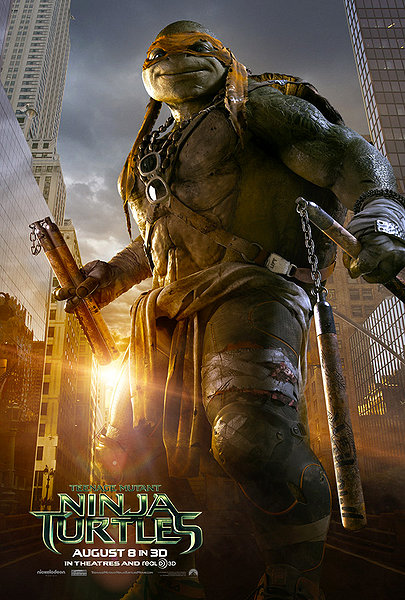
Copyright 2014 Paramount StudiosDear Michael Bay,
Just because you were able to turn one Saturday cartoon series for children into a PG-13 blockbuster, based on nostalgia on the part of its now-teen and 20-something audience and some world class special effects, does not mean that you can do the same with the Teenage Mutant Ninja Turtles. This is less “Transformer” and more “Yogi Bear” or “Scooby-Doo.” In other words, step away from “Shirt Tales” and “The Wuzzles.” Please, just stop. Sincerely, The Movie Mom

Before it wore or, or, more accurately, wore down its welcome, the original “Transformers” was a refreshing surprise that kept the spirit of the original series.  But even as a cartoon show, the Teenage Mutant Ninja Turtles were meta and self-referential and cutesy.  I mean, just look at the concept: they’re turtles.  And ninjas.  And teenagers.  You can blow them up into CGI behemoths, but they still can’t make a movie work, even by bringing back the original star of the first “Transformers” movie, Megan Fox.

Fox plays April O’Neil, a would-be investigative reporter relegated by her condescending colleagues to cutesy stories like exercising on mini-trampolines in Times Square.  She would much rather be reporting on a powerful and merciless gang of criminals known as the Foot Clan.  No one believes her when she says she saw a super-strong vigilante in the shadows, fighting the Foot Clan, including her editor (a “what is she doing in this movie?” Whoopi Goldberg).  It turns out she has a connection to this mysterious crime-fighter.  Her father was a scientist who died in a tragic lab accident as he was working on a special strength-giving serum by injecting it into four young turtles.  The night the lab burned down, April rescued the turtles and a rat by letting them escape into the sewer.

A handy martial arts manual found in the sewer gives the rat, known as Splinter (voice of “Monk’s” Tony Shaloub) the chance to train the young turtles, and the effects of the injections make them grow up to be large, muscular, and able to stand upright.  Each of the four has a different color mask and a Smurf-like individual personality quirk.  But they all love pizza.

The action scenes are well-staged, especially a snowy chase scene, though I have no idea where the snow came from as we only see snow outside the city.  But the script is lame and the violence is too intense for anyone old enough to be interested.  A slumming William Fitchner plays an industrialist who is not as philanthropic as he seems. And the scenes with an even-more slumming Will Arnett (what happened to his career?), whose two functions are to drive April around and be generally skeezy about his interest in her, are just painful.  April strives to be taken seriously as a journalist.  Fox, sadly, fails to be taken seriously as an actress (which she really is — see “This is 40”).

And the title characters are under-used as well.  For a movie about the TMNTs, they just don’t have enough to do beyond loving pizza and kicking bad guys. Whatever charm existed in the original cartoons is trampled by this over-blown bore.

Parents should know that this film includes cartoon-style action, peril, and violence, sad off-screen death of a parent, some brief disturbing images, some crude humor and a brief potty joke.

Family discussion: Why didn’t anyone take April seriously? Which turtle is your favorite and why?

If you like this, try: the TMNT cartoon series and the earlier films

Related Tags:


3D Action/Adventure Based on a television show Comic book/Comic Strip/Graphic Novel Fantasy Superhero Talking animals

Guardians of the Galaxy

Posted on July 31, 2014 at 5:59 pm

A-
Lowest Recommended Age: Middle School
MPAA Rating: Rated PG-13 for intense sequences of sci-fi violence and action, and for some language
Profanity: Some strong and crude language
Alcohol/ Drugs: Drinking
Violence/ Scariness: Extended comic book/action-style peril and violence with weapons and fights, many characters injured and killed, brief disturbing images
Diversity Issues: Diverse characters
Date Released to Theaters: August 1, 2014
Date Released to DVD: December 8, 2014
Amazon.com ASIN: B00N1JQ452

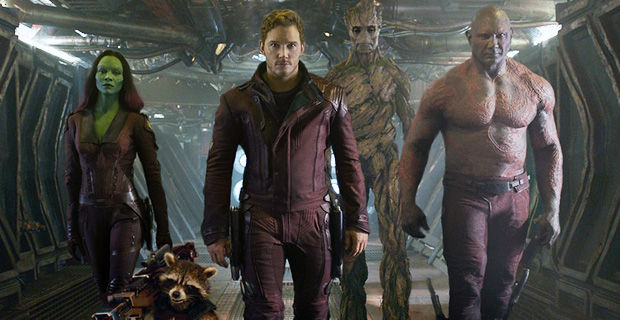
Guardians of the GalaxyThis is the most purely entertaining film of the year, a joyous space romp that all but explodes off the screen with lots of action and even more charm.

Our recent superheros have been complex, often anguished, even downright tortured. It has been a while since we’ve had a charming rogue with a bad attitude but a hero’s heart. Enter Peter Quill (Chris Pratt), who keeps trying to get people to call him Star Lord and who carries with him on his interplanetary space travels the “awesome mixtape” he was listening to as a young boy on Earth back in the 1980’s, when his mother died and a spaceship came to suck him up from the ground and take him far, far away.  One of the purest pleasures of the film is the soundtrack of 70’s gems like “Ooh Child,” “Come and Get Your Love,” and “Hooked on a Feeling” (the ooga-chacka Blue Swede version) and some others too delicious to give away, wittily juxtaposed with spaceships and aliens.

In a scene that pays homage to the classic opening of “Raiders of the Lost Ark” and with a personality that owes a lot to Harrison Ford’s irresistible space rogue Han Solo, Quill enters a chamber and steals a precious orb from a pedestal, only to be stopped by Korath (Djimon Hounsou) and some other scary-looking guys with sci-fi gun-looking things.  A lot of people want the orb and are willing to take extreme measures.  Evil wants-to-control-the-galaxy guy  Ronan (Lee Pace) sends the beautiful but deadly green assassin Gamora (Zoe Saldana, who seems to specialize in colorful space characters) to get it.  Also interested are superthief Rocket Racoon, a genetically modified procyonid (voiced by Bradley Cooper) and his sidekick Groot, an enormous, self re-generating talking tree (voice of Vin Diesel).  Groot can only say one existential sentence, but it is remarkably expressive.  Then there’s Drax (Dave Bautista), who just wants to destroy pretty much everyone, but especially Ronan, who killed his family.  He is completely literal, with no capacity to process metaphor (except when the script calls for him not to be, but no need to get overly focused on consistency here).

This motley crew ends up in prison together, where they form a bond through an elaborate escape plan and a lot of quippy dialogue.  The  low-key, unpretentious “Bad News Bears”/”Dirty Dozen” vibe is refreshing after so much sincerity and angst in the superhero genre. It hits the sweet spot, irreverent without being snarky. And because it is set away from earth we are spared the usual scenes of destroying iconic skylines and monuments.  Instead we get a range of richly imagined exotic settings and wild characters, though Lee Pace is under too much make-up and is stuck with a one-note character as Ronan.  It is a shame that the bad guy is not as delightfully off-kilter as the good guys, but with five of them, there is plenty to keep us entertained.  I don’t want to get too picky (see consistency note above), but the orb’s purpose and powers don’t seem to be thought through too well, either.  I don’t ask for much from a McGuffin, just that it (1) propel the storyline and (2) not interfere with the storyline.  This one doesn’t quite meet #2.

But deliciously entertaining it still is, with a long-overdue star-making role for Pratt, who has been the best thing in too many second-tier movies and outstanding but under-noticed in top-level films like “Moneyball” and “Zero Dark Thirty.”  Director James Gunn, who also co-scripted with first-timer Nicole Perlman, has made the summer popcorn movie of 2014, tremendous fun, and with more heart that we have any reason to expect.  Can’t wait for the just-announced part 2.

Parents should know that this film has extended (and quite cool) science fiction/comic book/action-style peril, violence, and action with fighting and various weapons, some characters injured and killed, some disturbing images, some sexual references, and some strong language (two f-words).

Family discussion: What makes this group especially suitable for taking on Ronan? How does this movie differ from other superhero/comic book films?

If you like this, try: “Men in Black” and “The Avengers”

Related Tags:


3D Action/Adventure Comic book/Comic Strip/Graphic Novel DVD/Blu-Ray Pick of the Week Fantasy Scene After the Credits Science-Fiction Superhero Talking animals

Lucy

Posted on July 24, 2014 at 6:00 pm

Copyright 2014 Universal Pictures

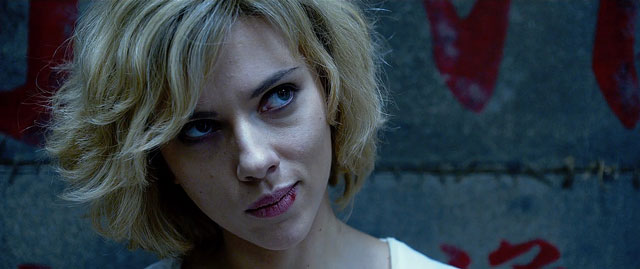
I always enjoy Luc Besson’s stylish car chases and shootouts. I like his use of locations, his strong female characters, and unexpected flashes of sentiment in the midst of mayhem.  While I found much to like in this story about a young woman who gains superpowers through a new drug, it was a mistake to have her show less emotion as she becomes physically and emotionally stronger.  Instead of sentiment, this time Besson inserts some preachy ruminations on the meaning of life.  I’m not opposed to existential ponderings in the middle of a crashes and explosions film.  But they need to be a little less silly and a lot less intrusive.

For a moment, I thought we were back on the Planet of the Apes or perhaps picking up some deleted scenes from “Tree of Life” as we returned to the dawn of time with the earliest hominids.  But no, this is just some sort of context for what is to come.  Our heroine, you see, shares a name with the skeleton of the oldest human remains, thought of as the first woman.

We then meet our present-day Lucy, standing on the sidewalk, arguing with her boyfriend of a week, who is trying to persuade her to deliver a briefcase for him.  She may not be very focused, but she is sharp enough to know that he and the deal he is proposing are both very sketchy.  But she is not smart enough to walk away before he can handcuff her to the case and shove her toward the door.  She has no choice.  She walks into the building.  The boyfriend gets shot.  And she is hustled upstairs but a lot of very scary-looking guys in black suits.

She is soon knocked out, and awakens to find that a pouch of a powerful new drug has been sewn into her abdomen.  She is one of four mules to be sent to cities across Europe to deliver the drug.  But before she leaves, a thug kicks her in the belly, the pouch opens, and the drug, a synthetic version of a chemical essential in fetal development, goes into her bloodstream and she is suddenly super-smart, super-powerful, and super-mad.  Also, she can time-travel, sweeping eras to the side like Tinder rejects.

Meanwhile, all of that brain power has not led her to the obvious conclusion that wiping out all of the bad guys who are in charge of distribution of the new drug is not going to solve very much if there are still people out there manufacturing it.

For a while it is fun to see her think, kick, punch, stab, and, yes, levitate the bad guys.  But there are too many returns to Morgan Freeman lecturing a group of students about what would happen if we used more than ten percent of our brains (by the way, that old myth has no more basis in reality than this movie does) and the decision to make Lucy increasingly robotic in demeanor as she gets more cerebrally enhanced lessens the narrative propulsion and emotional heft to the storyline. She also loses a lot of our sympathy when she engages in needless murders of innocent parties. I like Luc Besson. But I think he was using less than ten percent of his brain when he wrote this one.

Parents should know that this film includes extensive action-style violence with many characters injured and killed, lots of guns, knives, surgery, car chases and crashes, fights, threat of sexual assault with some grabbing, explicit scenes of animal and brief human sex and childbirth, sexual references, brief strong language, theme of drug dealing and effects of illegal drugs

Family discussion: If you could access more of your brain capacity, what would you use it for? Why did Lucy become less emotional as she got smarter?

If you like this, try: “The Transporter” and “Limitless”

Related Tags:


Action/Adventure Fantasy

Planes: Fire & Rescue

Posted on July 17, 2014 at 5:59 pm

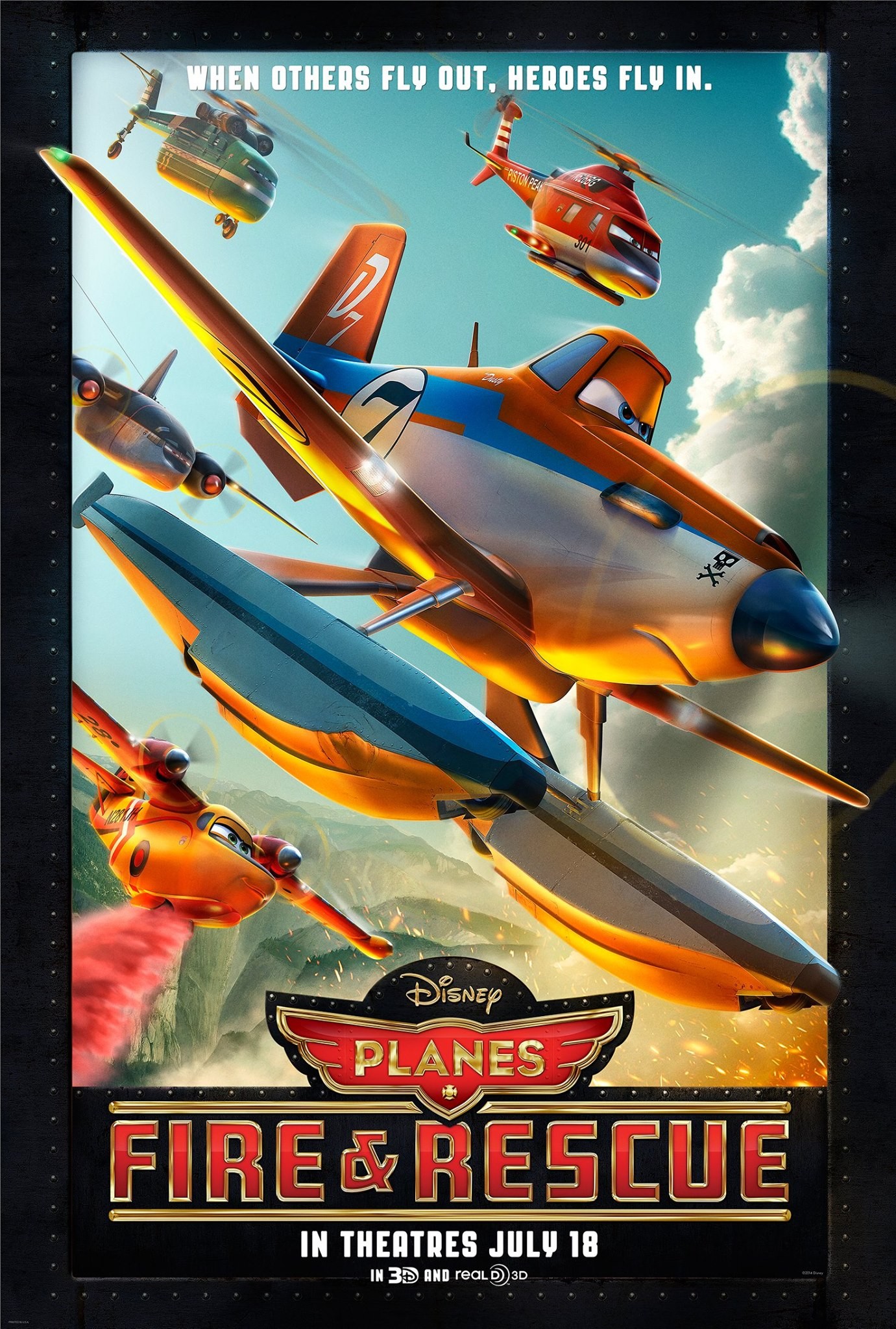
Planes_fire_rescue_poster

The visuals are stunning, the details are witty, the 3D effects are splendid,  the songs are lively, the voice actors are top-notch, but the storyline feels like an episode of “Thomas the Tank Engine.”  That’s when it was still analog and old-school and before it went to animation, but still — especially as the gender politics of this film are uncomfortably old-school as well.

Last year’s Planes added another mode of transportation to the charmingly retro world of Cars. A plucky crop-duster named Dusty (Dane Cook) learned to race and became a champion. As this movie begins, he is an international superstar. But his vintage gearbox has been worn down by the races, and no replacement is available. Dusty is going to have to find something that is as meaningful to him as racing.

When he accidentally starts a fire at Piston Peak National Park, Dusty sees that old Mayday (Hal Holbrook), the fire and rescue truck is not quite up to the task.  More important, he is not up to code.  The stern Transportation Management Safety Team inspector informs them that they need more capacity if they are going to stay in business.  That means some upgrades for Mayday and it also means a second firefighter.  Dusty feels responsible. And if he cannot race, he has to find something new to do, to help make up for his mistake. So he agrees to take the training to become a certified fire fighter.

Dusty is welcomed by the team, including the flirtatious Lil Dipper (“Modern Family’s” Julie Bowen), the heavy-lift helicopter Windlifter (Wes Studi), ex-military transport Cabbie (Captain Dale Dye) and The Smokejumpers, a brave collection of all-terrain vehicles who leap out of the planes and parachute down to the fire.  But he stern Blade Ranger (Ed Harris), who is in charge of the training facility, is not at all sure Dusty is up to the task.

The action sequences are very well staged and the effects, especially the water and sky images, are truly astonishing. The usual pun-studded, meta humor for the series shows up throughout, from the show business trade news magazine titled “Cariety” to a female vehicle dismissing a lame come-on with a cool, “Pick-up trucks!” The choicest surprise is a videotape with a car-ified version of a classic television series, with that very recognizable series star contributing a character voice.  Of course the television show appeared in the late 70’s-early 80’s, so it is likely to be over the heads of today’s children and their parents, too.

The real villain here is the fire, of course, but there is also a comic villain, a pompous administrator voiced by John Michael Higgins.  But the movie never works up much interest in him or his schemes, and the post-credits stinger barely stings.

More troubling is the poor treatment of the female characters, despite being called out for that same problem in the first one.   At least in the original, the female characters were capable and independent.  Poor Bowen is relegated here to a role that recalls the man-chasing stereotypes of television in the 1960’s, often played by Rose Marie or Ann B. Davis.  She is constantly trying to tell Dusty that they are on a date and, when he politely says they will be going as a group, dementedly agrees that it is a good thing for her to meet his friends until he reminds her that the firefighting team members are her friends.  And a major plot twist occurs when the previously ultra-capable mechanic voiced by Teri Hatcher is casually outdone by a male character.  It’s completely unnecessary, it subverts the primary premise of the storyline, and it demeans the female mechanic for no reason.  It isn’t Dusty who’s got filings in his gearbox.  It’s the script.

Parents should know that this film includes peril, including fire, collapsing bridge, rapids, engine failure, action and some violence (no one irreparably hurt, but a reference to a sad death), and some bathroom humor.

Family discussion: Who in this movie has to decide how to handle it when their plans do not work out? How do you think about your own back-up plans?  What does “better than new” mean?

If you like this, try: “Cars” and “Planes”

Related Tags:


3D Animation Fantasy Series/Sequel
THE MOVIE MOM® is a registered trademark of Nell Minow. Use of the mark without express consent from Nell Minow constitutes trademark infringement and unfair competition in violation of federal and state laws. All material © Nell Minow 1995-2026, all rights reserved, and no use or republication is permitted without explicit permission. This site hosts Nell Minow’s Movie Mom® archive, with material that originally appeared on Yahoo! Movies, Beliefnet, and other sources. Much of her new material can be found at Rogerebert.com, Huffington Post, and WheretoWatch. Her books include The Movie Mom’s Guide to Family Movies and 101 Must-See Movie Moments, and she can be heard each week on radio stations across the country.

Website Designed by Max LaZebnik