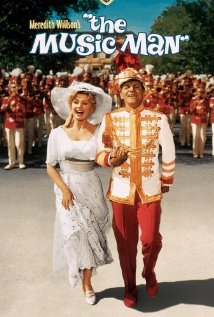
The Music Man

Posted on December 13, 2002 at 5:17 am

“Professor” Harold Hill (Robert Preston) is a con man posing as a salesman of band instruments and uniforms. He happens upon River City, a small town in Iowa. As the citizens explain in song, Iowa is a place of stubborn people who keep to themselves unless someone needs help. But Hill happens upon an old friend, Marcellus Washburn (Buddy Hackett), and is ready to run his favorite scam. He plans to sell the town on the idea of a boys band, with himself as leader, get them to order instruments and uniforms, and skip town with the money. Marcellus tells him a bit about the town and its people, and especially about the town librarian and music teacher, Marian Paroo (Shirley Jones).

Copyright Warner Brothers 1962

Marian lives with her mother (Pert Kelton) and her little brother Winthrop (Ronny Howard), a shy boy with a lisp, who deeply mourns his late father. In her own way, Marian, like Winthrop, is still grieving, and finds it hard to allow herself to become close to anyone. This is especially difficult because she is the subject of some gossip in the town. She has the job as librarian because an elderly man, a friend of her fathers, bequeathed the library building to the town, but left the books to her, to ensure that she would have permanent employment. This has caused some speculation about their relationship. And the ladies in the town also think the books she recommends (including the Rubiyat and Balzac) are improper. Despite her mother’s attempts to encourage her to be friendlier, Marian is very skeptical about Harold’s motives and his credentials. He is able to dazzle the town (with the famous patter song “Trouble,” offering the band as an alternative to the decadence of the town’s new pool parlor), but she vows to check his credentials.

The town gets caught up in the notion of the band. Harold’s charm and smooth promises enrapture everyone from the town council (he transforms them from four squabbling politicians into a harmonizing barbershop quartet) to the teen-age boy all the others look up to (Harold challenges him to invent an apparatus for holding the music so that the piccolo player can read it and encourages his romance with the mayor’s daughter). Harold even charms Winthrop, who is at last excited and happy about something. Harold tells all the parents that their children are wonderfully gifted and that the band will make them stars. Meanwhile, Harold’s attention to Marian is becoming more than just a way to help him get the money. And, despite evidence that he does not have the credentials he claims, and her certainty that he is not what he pretends to be, she finds herself softening toward him and protecting him.

Because of her, he stays too long, and he is arrested. As he says, “For the first time, I got my foot caught in the door.” But somehow, the boys force a few sounds out of the instruments, enough for their proud parents. And Harold stays on — it turns out that all along, deep inside, what he really wanted was to lead a band.

Discussion: Robert Preston brought his award-winning performance as Harold Hill on Broadway to the screen in this impeccable production, perfect in every detail. In addition to the glorious production, with some of the most gorgeous music and dancing ever filmed, there is a fine story with appealing characters. Marian learns about the importance of dreams from Harold, and he learns about the importance of responsibility from her.

Harold has made a life out of other people’s dreams, creating them and then spoiling them. He gives people an image of themselves as important and creative, and it is clear that this is what he loves about what he does, not stealing the money from them. Marian has faith in Harold. It is not the blind faith of the rest of the town, the people who see the seventy-six trombones he sings about. She sees what is good inside him, the real way that he affects people like Winthrop, the way he affects her. As she sings, “There were bells on the hills, but I never heard them ringing, oh, I never heard them at all, ’til there was you.” When Marian sees Harold and is willing to love him in spite of his past, he is for the first time able to move on from the notion of himself as a thief and a liar. Each finds the core of the other, allowing both of them to heal and take the risk necessary to make their dreams come true. For him, the risk is prison and disgrace. For her, the risk is the kind of hurt she felt when her father died, the risk we all take in loving someone. And because this is a musical, they live happily ever after.

Questions for Kids:

· Why is Winthrop so shy? What makes him change?

· How does Harold change people’s minds? Is that good or bad?

· How does the music help to tell the story? Listen to the songs “76 Trombones” and “Goodnight My Someone” again. They are very much alike, as you can tell when they are sung together. What did the composer want that to tell you about the people who sing them?

· Why were the parents worried about their children playing pool? What do parents worry about today?

· How is Marian’s library like yours? Do you know your librarian? Do people in your town ever argue about what books should be in the library?

Connections: This movie shows some of the most talented people of their time at the top of their form. Shirley Jones appeared in many musicals, including “Oklahoma” and “Carousel,” always exquisitely lovely in voice and appearance. She also won an Oscar for her dramatic role as a prostitute in “Elmer Gantry.” And of course she was the mother in television’s musical comedy series, “The Partridge Family.”

Robert Preston had more luck in theater than in movies finding roles that gave him a chance to show all he could do. But every one of his film appearances is worth watching, including “The Last Starfighter” and “All the Way Home.” Choreographer Oona White also did the sensational dance numbers in “Bye Bye Birdie.” Composer Meredith Willson never came close to the glorious score for “The Music Man,” but he produced some nice songs for “The Unsinkable Molly Brown.”


Related Tags:


Classic Crime For the Whole Family Musical Romance

Guys and Dolls

Posted on December 13, 2002 at 5:17 am

Plot: The story takes place among the small-time underworld characters of New York. Nathan Detroit (Frank Sinatra) runs a “floating crap game” (held in a different place each time) that provides entertainment and bankrolls for many members of the community. His problem is that he can’t find a place to have the next game. The only place available wants $1000 up front, and he does not have it. Furthermore, his (very) long- term fianceé, Adelaide (Vivian Blaine), a showgirl, is so distressed over his failure to marry her that she has developed a psychosomatic cold.

Trying to get the money he needs, Nathan makes a bet with Sky (as in willing to bet sky-high) Masterson (Marlon Brando). After Brando brags that he can get any “doll” to go out with him, Nathan challenges him to ask Sarah Brown (Jean Simmons), the local mission worker. Sky persuades Sarah to go to Havana for dinner, and, after he spikes her drink with liquor, they have a wonderful time, and she starts to fall in love with him.

When they get back, however, she finds that the crap game was held in the mission, and feels betrayed. In order to persuade her that his intentions are honorable, Sky rolls the dice in the crap game against the “souls” of the other players, and when he wins, they must all go to a meeting at the mission, the two couples get married, and everyone lives happily ever after.

Discussion: This musical classic, based on the stories of Damon Runyon, is a lot of fun, despite the fact that two of the leads are not singers and none of them can dance. But Brando and Simmons do surprisingly well, especially in the scenes set in Havana, and the movie is brash and splashy enough to be thoroughly entertaining.

Themes worth discussing include honesty in relationships and in competition (Harry the Horse cheats and threatens the other players) and how people decide whether to align themselves with (or between) the two extremes presented by the mission workers and the grifters and gamblers. Questions for Kids:

· Adelaide says she has developed a cold from waiting for Nathan to marry her.

· How do people get physically sick from unhappiness or worry?

· What is the meaning of Sky’s father’s advice about the deck of cards? Is that good advice?

· Who changes the most in this movie? How can you tell?

Connections: Other movies based on Runyon’s colorful characters include “Little Miss Marker” (three versions, one called “Sorrowful Jones,” but the best one has the original title and stars Shirley Temple), “Lady for a Day” (remade with Bette Davis as “Pocketful of Miracles”), “The Lemon Drop Kid” (also filmed twice, with the Bob Hope version the better one), and a very sad movie starring Lucille Ball and Henry Fonda called “The Big Street.”

Activities: Kids who like this movie may enjoy reading (or having read aloud to them) some of Damon Runyon’s stories, especially “Butch Minds the Baby.”

Related Tags:


Classic Drama Musical

Aladdin

Posted on December 13, 2002 at 5:17 am

A+
Lowest Recommended Age: Kindergarten - 3rd Grade
MPAA Rating: G
Profanity: None
Alcohol/ Drugs: None
Violence/ Scariness: Characters in peril
Diversity Issues: Class issues
Date Released to Theaters: 1992
Date Released to DVD: October 5, 2015
Amazon.com ASIN: B00WR534TK

One of the best of the contemporary Disney releases, this classic tale of the magic lamp benefits tremendously from the energy and humor of Robin Williams as the genie. Only the Disney animators could find a way to keep up with Williams’ pop culture torrent of a brain, and the big blue genie is a marvel of rapid-fire images and associations, deliciously irreverent, a nice surprise in a Disney film.  This 2015 Diamond edition

Aladdin, a “street rat,” meets the beautiful Princess Jasmine, when she sneaks out to wander through the city. Jasmine refuses all of the men who want to marry her to get the throne and wants to find out more about the world outside the castle walls. Evil Jafar, the trusted advisor to the Caliph, sends Aladdin to get the magic lamp. The genie appears and offers Aladdin three wishes. Aladdin promises he will use the third wish to free the genie, and then wishes to be a prince, so he can court Jasmine.

But Jafar, too, wants Jasmine, and the kingdom she will inherit. Aladdin has to find a way to free the King from Jafar’s control using his own powers. And he has to find a way to feel comfortable enough about himself to allow Jasmine to know who he really is.

The songs by Alan Menken and Howard Ashman are tuneful, sparkling, and exceptionally clever, one of Disney’s all-time best scores. After Ashman’s death, lyrics for three songs were written by Tim Rice of “The Lion King” and “Jesus Christ, Superstar,” including those for the Oscar-winning song, “A Whole New World.”

Families who see this movie should discuss these questions: Why didn’t Aladdin want to tell Jasmine the truth? Why did Jasmine’s father trust Jafar? If you had three wishes, what would they be?

Disney issued two made-for-video sequels, “The Return of Jafar” and “Aladdin and the King of Thieves” (only the second one featuring Williams), both very entertaining. Parents may have concerns about some aspects of the story in the second. Aladdin behaves in an honorable and accountable fashion, there is a fairly happy resolution of the relationship between Aladdin and his father, Kaseem, and Kaseem acknowledges that the relationship with his son is “the ultimate treasure.” However, Kaseem’s original desertion of Aladdin and his mother and his failure to care for Aladdin after his mother’s death are never really justified or apologized for; nor does he ever address or repent for his his lifelong career as a thief. Kaseem seems unconcerned when the outlaws insist that Aladdin pass the test for becoming one of them, a fight to the death, and almost casually approves. He leaves the outlaws to drown when their ship sinks. And at the end, he rides off with Iago the parrot (again voiced by the wickedly funny Gilbert Gottfried), apparently to return to a life of crime. Parents should be prepared for questions, and may want to initiate discussion of how Aladdin might feel about his father and why he has decided to make different choices in his own life.

Related Tags:


Animation Based on a book Classic DVD/Blu-Ray Pick of the Week Fantasy For all ages For the Whole Family Musical Romance

Fantasia 2000

Posted on December 13, 2002 at 5:16 am

Almost sixty years ago, the original “Fantasia” was released and hard as it may be to believe it now, the response was unenthusiastic. Today, images like Mickey as the Sorcerer’s Apprentice, the little black Pegasus getting some extra help learning how to fly and the dances of the mushrooms and the ballerina hippos are a part of our culture. Walt Disney hoped that “Fantasia” would be released each year with new episodes, but the lacklustre box office and the distractions of other ventures meant that the idea of adding new material was shelved. Still, the animation studio hoped for another chance, and one of the pleasures of this movie is the chance to see some of the proposals for new episodes submitted by animators over the years.

Disney called the original “a grand mixture of comedy, fantasy, ballet, drama, impressionism, color, sound, and epic fury,” and that well describes the very worthy successor. As the first theatrical release designed exclusively for IMAX screens, it fills the eyes of the audience with splendor. Now on video and DVD, it is still a delight, even better in one respect because you can see the entire screen and catch some of the details that are lost in the vast expanse of the IMAX experience.

The audience is reassured from the beginning that this is not going to be some strange or boring culture lesson. Glimpses and sound clips from the original float into view, and then suddenly we are in the midst of the most famous opening notes of classical music, the da da da DUM of Beethoven’s Fifth, accompanied by an abstract battle between groups of triangles. Then Steve Martin comes on to make a joke, and we’re off to the next episode, whales in moonlight, to Respighi’s “Pines of Rome.” The light on the water, the stillness, the dignity and grace of the whales in the water and then as they float up into the sky are magnificent.

Other segments include a rollicking Al Hirschfeld-inspired look at 1930s New York, to the music of Gershwin’s “Rhapsody in Blue,” a very romantic “Steadfast Tin Soldier” set to Dimitri Shostakovich’s second piano concerto, and a mystical tale about death and rebirth in the forest, to Igor Stravinsky’s “Firebird Suite.” From the original, we get Mickey as the Sorcerer’s Apprentice with glowing colors and dazzling detail. And Donald finally gets his chance, as Sir Edward Elgar’s famous “Pomp and Circumstance” accompanies not a procession of graduates to their diplomas but a procession of animals to Noah’s ark. Celebrities like Angela Lansbury, Quincy Jones, and James Earl Jones provide smooth transitions.

The movie is rated G, but the experience may be overwhelming for some children. A three year old sitting near me in the theater was in tears throughout the first segment, though she enjoyed some of the others. Parents should also know that magicians Penn and Teller do a trick that may scare some kids, though they immediately show that everything is all right.

Families should talk about the way that music makes pictures in our heads, and experiment by asking children to draw pictures as they listen to music. Ask children why the people in “Rhapsody in Blue” are sad, and how they find what they were dreaming of. They may be especially interested in the rich little girl who is dragged around to all kinds of lessons by her nanny, but who dreams of spending time with her busy parents. Talk to them about the spirit of spring in “The Firebird Suite,” who learns that she cannot prevent death, but can help the forest to renew itself. Ask them about “The Steadfast Tin Soldier” (which has a Disney-ized happy ending). Why did the solider first like the ballerina? Why did he think she would not like him? Why was the Jack in the Box so jealous? Show children some of the drawings of legendary artist Al Hirschfeld, who hid the name of his daughter “Nina” in his pictures. Kids who are interested in the adaptation of his work for “Rhapsody in Blue” will enjoy the award-winning documentary about him, “The Line King.”

Families should watch the original, and compare them — one has a segment on the coming of fall and one on the coming of spring, both have music by Stravinsky, both have a non-representational segment, both have a processional number, and both have a funny animal segment — this one “answers the age-old question, ‘What would happen if you gave a flamingo a yo-yo?'” And see if kids can figure out the closest approximation in the new version of the original’s little black Pegasus. All of this may require a repeat viewing, but hardly anyone will object — and it will give you time to search for the Ninas in “Rhapsody in Blue!”

Families who enjoy this movie will also enjoy three new Disney releases on video — originally produced as “Fantasia” follow-ups with modern music. “Melody Time,” “Make Mine Music,” and “Fun and Fancy Free” feature some of Disney’s classic animation, with outstanding segments like “Peter and the Wolf,” “Casey at the Bat,” and “Mickey and the Beanstalk.”

DVD note: The DVD version has some exceptionally entertaining extras, including commentary by Hirschfeld on his segment and a hilarious commentary by Mickey about his experiences making “The Sorcerer’s Apprentice” — he is reassuring that no brooms were harmed in the making of the movie!

Related Tags:


Animation Fantasy For all ages For the Whole Family Musical Remake Talking animals

Quest For Camelot

Posted on December 13, 2002 at 5:16 am

A young girl named Kayley dreams of being a knight like her father, who was killed defending King Arthur from the brutal Ruber. When Ruber steals Excalibur from Camelot, Kayley goes into the forbidden forest to find it. There she meets Garrett, a squire befriended by her late father, who left Camelot after he became blind. Joined by a two-headed dragon, they find the sword and fight Ruber to return Excalibur to Arthur.

This is the first attempt by Warner Brothers, home of Bugs Bunny and Donald Duck, to get into Disney territory with a full-length animated musical drama, and it is a step in the right direction, even if it does not match Disney or even non-Disney features like “Anastasia.” questforcamelot.jpg
The movie’s greatest strength is the first-class talent providing the voices: Cary Elwes as Garrett, Jane Seymour and Gabriel Byrne as Kayley’s parents, Don Rickles and Monty Python’s Eric Idle as the dragon, and (all too briefly) Sir John Gielgud as Merlin. The animation has some good moments, especially a sleepy ogre. The heroine and hero are spirited if a bit too generic. But with the exception of the dragon’s cute duet, the songs add little and slow down the story. Themes worth discussing include the importance of cooperation, loyalty, and the strengths of those considered disabled.

Related Tags:


Action/Adventure Animation Fantasy For the Whole Family Musical Talking animals
THE MOVIE MOM® is a registered trademark of Nell Minow. Use of the mark without express consent from Nell Minow constitutes trademark infringement and unfair competition in violation of federal and state laws. All material © Nell Minow 1995-2026, all rights reserved, and no use or republication is permitted without explicit permission. This site hosts Nell Minow’s Movie Mom® archive, with material that originally appeared on Yahoo! Movies, Beliefnet, and other sources. Much of her new material can be found at Rogerebert.com, Huffington Post, and WheretoWatch. Her books include The Movie Mom’s Guide to Family Movies and 101 Must-See Movie Moments, and she can be heard each week on radio stations across the country.

Website Designed by Max LaZebnik