Oscar-winning director Barry Jenkins (“Moonlight”) is making a new film based on James Baldwin’s If Beale Street Could Talk and this teaser trailer looks like it is going to be magnificent.
Comic peril and mayhem, reference to sad death of a parent, brief wartime battle scenes
Diversity Issues:
None
Date Released to Theaters:
August 3, 2018
Date Released to DVD:
November 5, 2018
Copyright Disney 2018
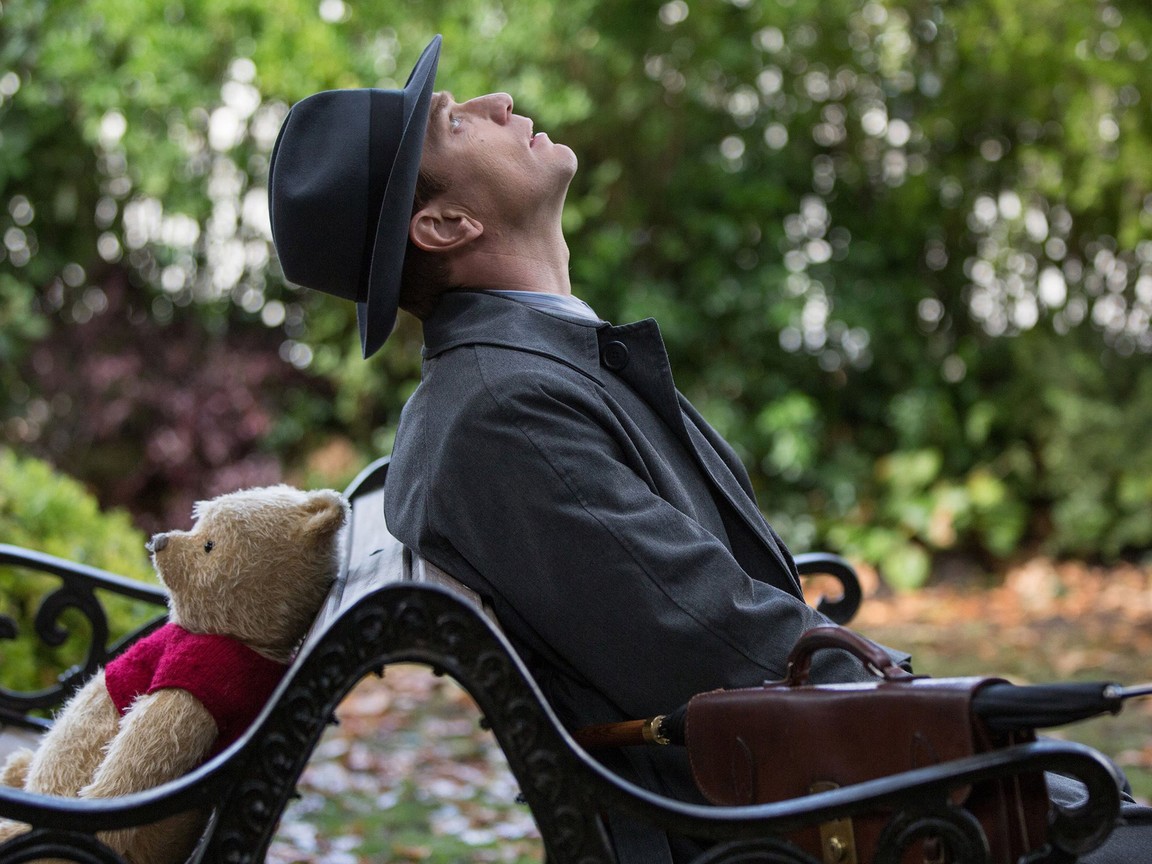
You can’t become a child again. But you can reconnect to the child who still lives within you, and when you do, it means even more because you know how precious it is. That is not just the theme of “Christopher Robin.” It is the experience of watching it. Enchanting production design from Jennifer Williams and cinematography from Matthias Koenigswieser make the 100 Acre Wood the place anyone would love to do nothing in.
Last year year we had the very disappointing “Goodbye, Christopher Robin,” a sour and unfocused film about the Milne family, the traumatized father, the distant mother, and the unhappy child who inspired the classic Winnie the Pooh books. This fantasy is far truer to the spirit of those books, and a most welcome late-summer pleasure. Those who know and love the books will be happy with the fidelity to the stories and characters. Those who do not know them will enjoy the film and, I hope, be inspired to read the books as well, and check out the Disney animated stories.
For those new to A.A. Milne: there are four books, two chapter books and two of poetry, about the life of young Christopher Robin (Orton O’Brien), and his stuffed toys, especially his best friend, a “bear of little brain” and unquenchable thirst for honey, Winnie the (or ther) Pooh, known affectionately just as Pooh. With his friends, the anxious Piglet, the gloomy donkey Eeyore, the devoted kangaroo mother Kanga and the baby she carries in her pocket, Roo, the bossy Rabbit and the occasionally wise Owl, he lives in the Edenic Hundred Acre Wood, where there is always time to pleasantly do nothing at all.
But the sad fact is that children grow up. “The day finally comes as it does to all children, to say good-gye.” Christopher Robin is being sent to boarding school. He has one last tea in the woods with his friends, and then he’s gone.
We follow his story with Ernest Shepard-like illustrations that match those in the books, but it is idyllic no more. Christopher Robin’s father dies. He grows up (now played by Ewan McGregor) and falls in love with Evelyn (Hayley Atwell), but he is at war when their daughter Madeline is born.
And then he is home, working as an efficiency expert in a luggage company that is feeling a post-war pinch, and he is under enormous pressure to cut costs. He is affectionate but distracted and neglectful. When Madeline (Bronte Carmichael) asks for a bedtime story he picks up the nearest book and ends up reading to her about the industrial revolution. Then he lets Evelyn and Madeline down again by telling them he cannot join them on a weekend in the country because he has to work.
And then Pooh shows up in London (voiced by Jim Cummings, who also provided the endearing slightly husky voice for the Disney animated Pooh). He needs to be taken back home to find his friends. Christopher Robin (called Christopher by his wife and Robin at work) packs his paperwork in his briefcase (and his brolly, of course), and takes the train, shushing Pooh and trying to find a way to cut twenty percent out of the company’s expenses.
But then he cannot help being beguiled by the charms of his old friends and their enchanted world. Children will enjoy Pooh’s simple questions as a classic comic ploy of having a character whose innocence makes them feel superior. Adults will realize that Pooh’s questions and comments may sound ignorant of adult life, as a bear of very little brain whose only concern has been finding honey might be, but in fact the very simplicity of them is what makes them profound. Christopher Robin tells his daughter that “nothing comes from nothing.” But “Doing nothing,” Pooh says, “often leads to the very best kind of something.” He asks Christopher Robin, “Is a briefcase more important than a balloon?”
Christopher Robin is split in two, like his name. He has lost touch with himself. He tells his boss that nothing matters more to him than his work and he tells his daughter she means the world to him, but he does not act as though either is true. He has delivered the message of efficiency so thoroughly that when Evelyn tells Madeline to go play, she solemnly assures her mother “I’m going to play better and harder than any child has before.”
Christopher Robin has to rediscover the pleasures of, well, pleasure before he can share it with his daughter, and it is pure pleasure to see McGregor’s face shine with the joy of remembering how to play. For all of his worry about taking care of everyone at the office and at home, he was doing poorly at both. His stuffed friends teach him how to take care of those you love with patience, by listening to them to understand what they really need. If his solution at the office is half “Mary Poppins” and half slightly skewed Keynesian economics, by then we are so sweetly beguiled, that seems just right.
Parents should know that this film includes comic peril and mayhem, reference to death of a parent, and brief wartime battle scenes.
Family discussion: Which questions from Pooh made Christopher Robin change his mind? Ask everyone in the family to describe a toy that they loved. What comes from nothing? Try playing “Say What You See” and see how different people’s answers are.
Reference to a brutal murder, tense family situations, sad offscreen death
Diversity Issues:
A theme of the movie
Date Released to Theaters:
August 3, 2018
Copyright Sundance Selects 2018
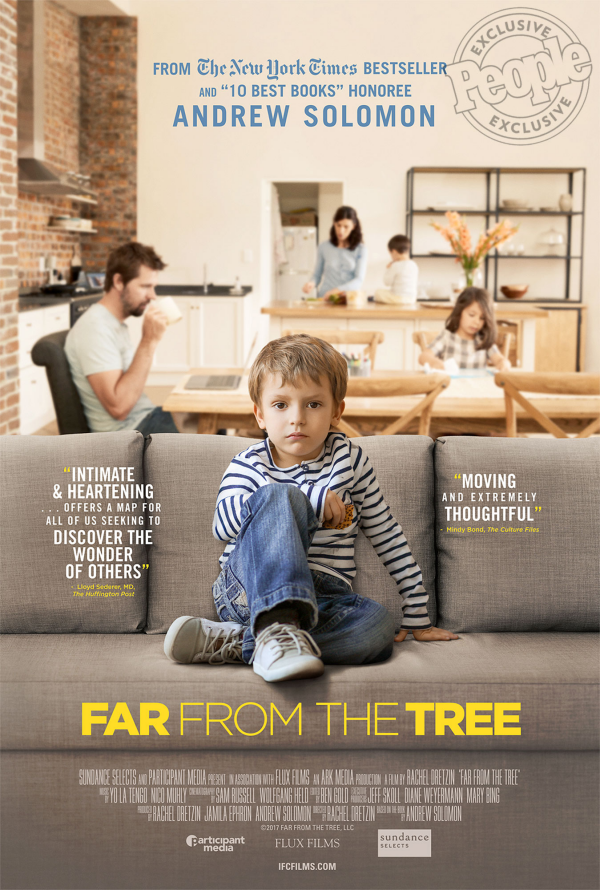
All parents at some point look at children and think, “Who is this and how did they get to be part of my family?” Children think that from time to time about their parents, too, especially when they get to their teens. “Far from the Tree,” based on the award-winning book by Andrew Solomon, is a documentary about the most extreme versions of that sense of disconnection. Solomon tells his own story about growing up gay and the incomprehension and rejection he experienced from his heterosexual parents, who exemplified the conventions of their era. But most of the focus of the film is on other families: Jason, a 41-year-old man with Down syndrome and the mother who worries about how he will manage when she is gone, a young woman and a married couple who are Little People, a teenager with autism who is finally able to communicate with his family, and the parents and siblings of a teenager who committed an unthinkable crime.
The movie raises questions about nature and nurture, about what “normal” means, and about the different but both vitally important feelings of connection and support we get from the families we are born into and the families we find because we understand each other. Loini Vivao, a Little Person in an affectionate but otherwise average-sized family, wonders, “Is there anybody out there like me?” When she attends her first annual Little People convention, her sense of wonder and acceptance is breathtaking. When she is invited to appear in the convention’s fashion show, she immediately demurs. She is too shy. But then we see her glowing as she owns the catwalk. One of the other attendees explains why this gathering is so important: “They come to be seen. And to disappear.” No one looks away or stares. When everyone is little, everyone is the right size.
That makes a conference room discussion among the organization’s leaders especially poignant. The topic is an experimental new drug that could “cure” some forms of dwarfism. Like the controversy over cochlear implants, this raises the question of whether dwarfism is something that needs to be “cured.” “I don’t think I need to be fixed,” says Leah Smith, who, with her husband, Assistant Professor of Philosophy Joseph Stramando, show us just how “normal” their lives are, casually using various work-arounds, from a wheelchair to a flip-flop sandal to push a hotel light switch.
Jason Kingsley’s parents wanted to prove the experts wrong, and they were successful, to a point. When Jason was born with Down syndrome, the doctor told the parents, “We send them away before attachment is formed.” But “you don’t write off a person because of the label that he wears,” his mother explains. With a lot of support, Jason became a literal poster child for people with Down syndrome, appearing on television to show that he was keeping pace academically. Jason has a job, delivering mail in an office. He lives with two other men with Down syndrome and they call themselves “The Three Musketeers.” It is not what his mother envisioned for him and she is concerned about his fragile understanding of the difference between fantasy and reality. He thinks if he can go to Norway, he can meet Elsa from “Frozen.”
The most astonishing moment in the film is when Jack Allnut, severely impaired with autism and seemingly unable to communicate or even understand what is being said to him, is given a chance to use an alphabet board. His first message is stunning. His mother says, “My God, he’s in there. It’s like I was meeting him for the first time.” And the saddest moment is the family of the teenager who committed a terrible crime. In a way, it was like they were meeting him for the first time. The family continues to love and support him, but his two siblings say they have decided never to have children.
They may change their minds. This movie is not so much about the family differences we have to surmount as it is about the imperishable love that sustains us. As Norman Mclean says in “The River Runs Through It,” “we can love completely without complete understanding.” The true greatness of families — and of humanity — is that we choose to do so.
Parents should know that this unrated film includes discussion of a brutal murder, pregnancy and miscarriage, disabilities, sex, sad offscreen deaths, and family tensions.
Family discussion: What makes you most like the rest of your family? What makes you different? Who is your tribe?
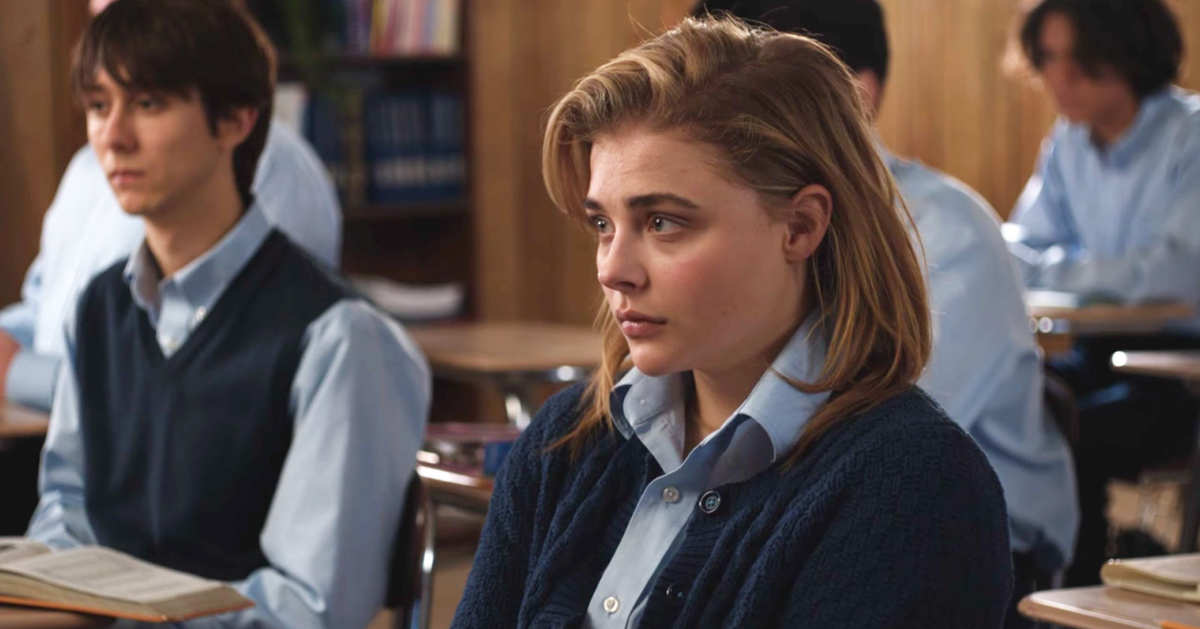
“Pray the gay away.” That is the idea behind “gay conversion” facilities, now thankfully outlawed in fourteen states as contrary to both science and human dignity. But “The Miseducation of Cameron Post,” based on the novel by Emily M. Danforth, is set in 1993. It might as well have been 1793 for the Puritanical attitude of the God’s Promise facility the title character is sent to when her date discovers her making out with a girl on prom night.
Copyright FilmRise 2018
Cameron (a performance of exceptional sensitivity by Chloe Grace Moretz) is packed up immediately by her aunt and uncle (her parents are dead) to become a “Disciple” at God’s Promise, run by the guitar-strumming, upbeat Reverend Rick, played by John Gallagher, Jr., showing us flickers of anxiety as he tries to reassure the teens at the facility that if he could be “cured” of being gay, so can anyone. The resident bad cop to Reverend Rick’s relentless cheer is Dr. Lydia Marsh (Jennifer Ehle), who runs a tight ship, whether she is telling Cameron that she will not allow her to be called “Cam” (“Cameron is already a masculine name. To abbreviate it only exacerbates your gender confusion.”) or directing the “Disciples” to reveal their most private conflicts in publicly posted iceberg diagrams. What is important lies beneath the surface, and that is dangerous enough to sink the Titanic, she explains. There is a pretense of choice, as Cameron is given a contract to sign, though she is underage and has no alternative.
Marsh tells the teenagers that “There’s no such thing as homosexuality. There’s only the sin we all face.” She compares being gay to dangerous, self-destructive behavior: “Would you let drug addicts throw parades for themselves?” And she posits the cause of what they term SSA (same-sex attraction): “too much bonding with a father over sports,” for example.
A quiet tone keeps the outrageous setting from turning into parody, even when they watch the (real) Christian workout video, “Blessercize,” and the teenagers are asked leading questions like, “When did you let same sex attraction get in the way of your goals?” While a non-conversion facility might impose some restrictions on interactions between the boys and girls, there are few here. Presumably, despite professed very strict rules about sexual behavior, Marsh and Reverend Rick are hoping the opposite genders will tempt each other.
The film won the top award at Sundance, a tribute to the understated mood and to an outstanding performance from Moretz, who allows us to observe her as she observes those around her. Neither she nor we are miseducated by the end.
Parents should know that this film includes explicit sexual references and situations, homophobia, some language, and marijuana.
Family discussion: What does it mean to say, “when I am weak, I am strong?” What ideas have changed since 1993?
If you like this, try: “But I’m a Teenager” and the upcoming “Boy Erased”
Interview: Rachel Dretzin and Andrew Solomon on “Far from the Tree”
Posted on August 2, 2018 at 8:00 am
Copyright IFC 2018“Far from the Tree” is a new documentary based on the award-winning book by Andrew Solomon that explores the challenges families families face when they have children who in one way or another seem to be especially different and hard to understand. The movie uses Solomon’s own story as a gay man whose parents struggled to accept him as a starting point to examine other families: a mother and her adult son with Down syndrome, a teenager with autism and his parents who tried every possible therapy until one had a remarkable result, three people with dwarfism and their families, and the parents and siblings of a young man who committed a brutal murder when he was still in his teens.
In an interview, Solomon and director Rachel Dretzin talked about the lines between nature and nurture and between helping and accepting people who are different.
I remember in the 1960’s and 70’s, the authorities were still blaming “refrigerator mothers” for autism. Now we see it as entirely a matter of physical causes. Where are we in the attribution of our abilities and personalities between nature and nurture?
Solomon: Well, I think both nature and nurture can occur, and we look at a range of conditions in the film. I mean Down syndrome was not caused by nurture, but how well someone with Down syndrome is able to function in the world may have something to do with nurture. Different people with Down syndrome have different capacities, just as different people without Down syndrome have different capacities, but there’s no question that really good parents are able to bring their child to a higher level of functioning. So, certainly refrigerator mothers don’t cause autism, but mothers who are warm and engaged and supportive are able to help their children through autism. The family you see in the film devoted themselves one hundred percent to their autistic child, and ultimately were able to help them quite a lot.
So that’s what parenting is, is figuring out what their nature is and then nurturing whatever their nature is?
Solomon: Well, nurturing whatever their strengths are and helping them to realize their full potential. I mean parenting involves loving your children, it involves accepting your children, and what it shouldn’t involve is trying to transform their children because you are uncomfortable with the way that they’re different. You don’t want to have families to say “I have a child with Down syndrome and I’m going todo all of these things because I hate having a child with Down syndrome and I want to make it disappear and go away.” You recognize that it can create a lot of difficulties in life and so here is the way that we’re going to help him to be independent or self-reliant or give him as much education as we can and so on and so forth.
We all as parents have a responsibility for changing our children. We have to educate them, to give them moral compass, teach them some manners, and we also all have to accept and celebrate our children for who they are. Some things clearly need to be accepted and celebrated and some things clearly need to be changed and a great deal falls in a very funky middle. The film is really about how people navigate through that foggy middle
While we know different in theory, do we still somehow expect that our children will be Xerox copies of ourselves?
Dretzin: I think we all have some fantasy when we have children. Andrew says it in the book, I think it’s the first line, “There’s no such thing as reproduction.” Having children is an act of production. It is always a leap into the unknown and we all know it’s a leap into the unknown, so I think imagining that our children are gonna be just like us is a sort of comforting way of padding the jump.
The families in the movie have very little overlap with the book. How did you select them?
Dretzin: The first decision that we made, which we made very, very early on, was not to for the most part not to use the same stories that are in the book. Jason Kingsley is the one character in the film who’s also in the book, but his life has kind of moved into a new phase and a whole set of new experiences that were not part of the book, so that’s part of the reason we decided to include him.
Once we decided we were going to find new characters it was about really narrowing down the scope of what we were going to look at. There are twelve chapters in the book, ten of which are devoted to different identities. We knew we couldn’t do them all, so we thought about it thematically in terms of stories that would address some of the most important ideas in the book, and not necessarily repeating them.
So for example, there’s a lot of overlap between the themes of the Deaf chapter in the book and the themes of the dwarf chapter in the film. Both are about communities that have wrestled mightily with the question of whether cure is something they want, both are communities that have an organized empowered community that is very positive, if not celebratory, of their condition. So we decided we would do dwarfism because deafness is something that’s been looked at a lot and is further along.
Then we went out and met people. My producer, Jamila Ephron, and I spent about a year meeting dozens and dozens and dozens of families. Whether it was conferences or conventions or through different groups, then narrowing it down, then meeting them in their homes multiple times before we ever brought cameras in.
You were dealing with very intimate, often painful topics. How did you make them comfortable with you and with being so public on screen?
Dretzin: We’ve built a lot of trust. I mean, again, the film was made over a couple of years and we spent many, many, many hours with these families, multiple visits. So, in some cases the trust was there right away. Emily Kingsley and Jason, partly because they had been in the book and they knew Andrew and partly because they were just further along, they’ve done quite a bit of media before, they were comfortable almost immediately. But other families took time. It’s a funny thing that happens. You spend enough time with people and you like them enough and they like you enough, and eventually everything else just kind of goes away and people really do just relax and there are times where nobody is thinking about the cameras because we’ve been there for so long. I hope those are reflected in the film. That’s the magic moment.
There is a moment in the film at the Little People convention where they discuss a possible “cure” for dwarfism and some people are reluctant. As one of them says, “I don’t think I need to be fixed.” How do we decide and who decides whether something needs to be fixed?
Solomon: The question is whether it’s addressing short stature because it’s uncomfortable to be in the world with short stature, or whether it’s addressing short stature and these other health complications and proposing ways to avoid all of the complications that are involved. Every condition that we looked at has elements of social deficit and elements of inherent deficit. So if you’re a dwarf and you need spinal decompression, that is a biological reality, that is something that no degree of adjusting our social attitudes can address and it needs a biological response, but if you said the problem with dwarfism is that everyone stares at you and people take pictures without permission, and you can’t reach things in grocery shelves, those are all things that can be shifted and fixed, and they should be shifted and fixed and there should not be reasons for eliminating dwarfism from the spectrum of human experience.
The question is to try to tease apart the inherent problems of the conditions, and the social problems of the conditions, and to ensure that more medicine is focused on the biological issues, and that social reform is focused on the social issues.
If I had a deaf child, if one of my children was born deaf, I would get him cochlear implants because I think communication between parents and children is paramount and I’m not good at languages and I would not have become fluent in sign in three weeks, it would have taken many, many years. But I would also bring that child up around other Deaf people and learning to sign as the surest way to leave the child later on with the option. You can keep the implant on and function mostly in the hearing world, and you could move back and forth between those two worlds in a fluid and easy fashion.
Dretzin: I would just add to that that I think there’s been a kind of misconception about the inclusion of a crime story in the film that we’re trying to equate what Trevor did with being deaf or being a dwarf or any of these other sorts of conditions. It’s really in the film to show the enduring nature of parental love, and that story challenges parental love in ways that none of the other stories in the film actually can. It’s not there to suggest that we should fully accept what Trevor did or that he doesn’t meet to be fixed or anything of that nature.
I loved the music in the film. Tell me about it.
Dretzin: Well, we have two composers actually, Nico Muhly was one of the prodigies featured in Andrew’s book, so that was kind of a no-brainer. His music is beautiful particularly what he does with the autism section with Jack. You hear those voices and the buzzing and it mimics some of what is going on in Jack’s brain. Yo La Tengo was an absolute delight to work with. They came into the project a bit late because there was a song of theirs that I wanted to use and I approached them about using it. We got into a conversation about the film and they expressed so much interest in getting involved. One of the most interesting moments was actually when I screened the film for Yo La Tengo for the first time. It was a rough cut and they loved it but they thought there was too much of their music in and actually encouraged me to pull back, which was the smartest call I think that they could have made. We really had to be careful with this film not to get sentimental or manipulative emotionally because it’s such an emotional film and the music has a lot to do with that. So we really tried to pull back with the music and not overdo it, and in the end I think that that helps make the film not feel sappy.
The movie is about family members, who are often very different from one another and still find ways to support each other. But it is also about the importance of being with other people who are like you, about finding your tribe, whether you are born into it or not.
Solomon: We live in the era of the internet, I think a lot of these families find other families going through similar experiences. If you know only people who are like you you become a caricature of yourself but if you don’t know anyone who’s like you it’s hard to figure out who you are.