Only the Brave

Only the Brave

Posted on October 19, 2017 at 5:19 pm

B
Lowest Recommended Age: High School
MPAA Rating: Rated PG-13 for thematic content, some sexual references, language and drug material
Profanity: Some strong and crude language
Alcohol/ Drugs: Drinking, drugs, substance abuse
Violence/ Scariness: Extended peril and violence, many characters killed, snake bite
Diversity Issues: None
Date Released to Theaters: October 20, 2017
Date Released to DVD: February 5, 2018
Copyright 2017 Sony

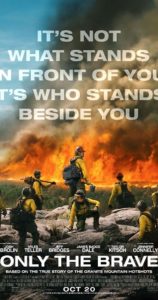
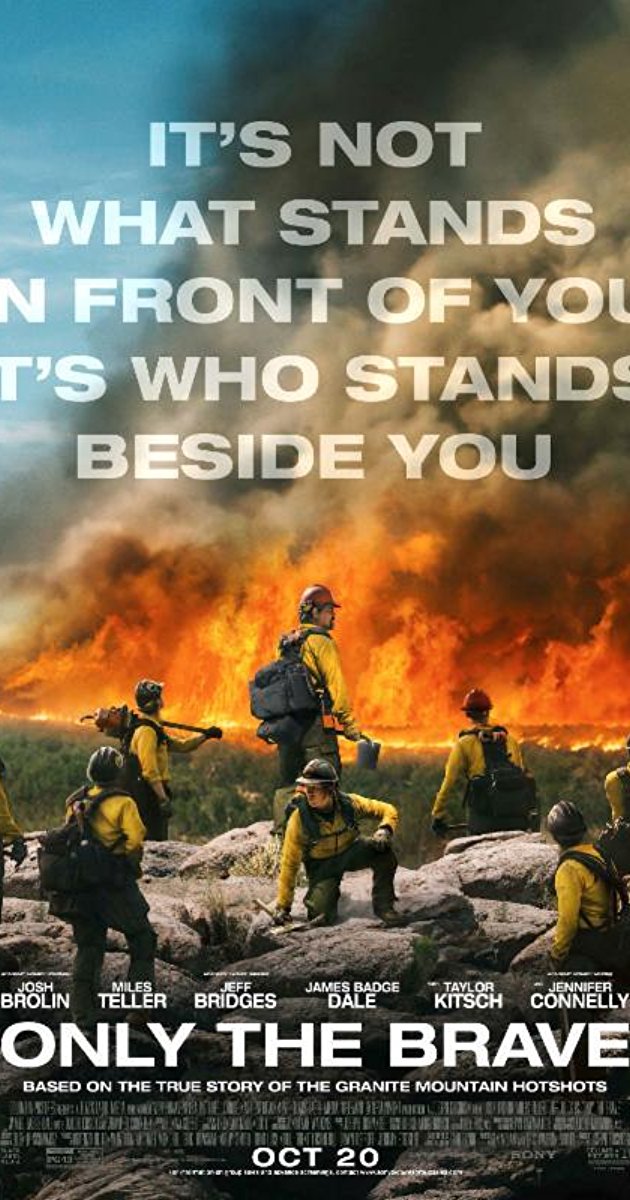
They literally fight fire with fire. Unlike “structure fires,” burning buildings doused with water, wildfires in non-residential areas are contained by setting a line of fire to stop them from spreading. Sometimes it does not work. “Only the Brave” is the story of the Granite Mountain hotshots, the “alpha” team of 19 Arizona firefighters who were killed in 2013. Like “The Perfect Storm,” this is a real-life story that spends three-quarters of its time making us love the characters and then heart-wrenchingly shows us how painful it was to lose them.

Josh Brolin, who has spent some real-life time as a firefighter, plays Eric, the leader of the group that, as the movie begins, is the second team, not allowed to set the fires on “the line.” “You guys are type two and we’re hotshots so why don’t you do what deucers do best, which is stay in the back and mop up our ?” sneers the leader of the alpha team. Eric and his group want very much to be certified as alphas and they train hard, the more experienced members of the team as the newcomer, Brandon (Miles Teller), good-naturedly dubbed “Donut” by the team for his zero score when quizzed on the rulebook.

“It’s not easy sharing a man with a fire,” a wife explains. The same qualities that make these men (they are all men) good at what they do can make it difficult for them to be the good husbands and fathers they strive to be.  For Brandon, the discipline and support of the team makes it possible for him to stay away from his past life of slacking and substance abuse.  But for some of the others, the intensity of the fire fighting experience is something of an addiction and it is difficult for them to go back to normal life with their families, who can never really understand what they face and what they do.

The moments of struggle are touching, as Brandon’s discovery that he is going to be a father inspires him to change his life and Eric’s wife Amanda (Jennifer Connelly) tries to stay close to a husband who is not ready to share what he has been through. The movie’s greatest strength is in its presentation of the music of man-talk, indirect, mock-aggressive, often crude, but always in service of the most profound commitment and loyalty.  For a moment, we get to be a part of that group of hotshots, and it is piercingly sad to lose them.

Parents should know that this is the true story of firefighters with a lot of peril and many sad deaths, some strong language, sexual references (some crude) and situations, pregnancy, drinking, and some drug use and references to substance abuse.

Family discussion: What qualities does someone have to have to be a hotshot? Why didn’t Brendan want painkillers at the hospital?

If you like this, try: “The Perfect Storm,” “Backdraft,” and “Ladder 49″
Related Tags:


Based on a true story Drama DVD/Blu-Ray Pick of the Week

Joe Berlinger on Armenian Genocide and Efforts to Suppress the Story

Posted on October 19, 2017 at 3:05 pm

Copyright Falkun Films 2017

The word “genocide’ was created to describe the massacre of 1,500,000 Armenians by the Turks, a century ago. And yet, the story has all but been eliminated from our understanding of the 20th century, a more devastating erasure of history than the genocide itself because it erased the story, and because it erased any hope for justice.

A new documentary from director Joe Berlinger is the story about the story, about what happened, and about the efforts to prevent what happened from being told. “Intent to Destroy: Death, Denial, and Depiction,” in theaters November 10, 2017, has three chapters: behind the scenes in the filming of “The Promise,” starring Oscar Isaac and Christian Bale, an exploration of the denial that it ever took place, and the deception that led to repression of efforts to tell the truth and creation of a false counter-narrative.

Why start a documentary with the behind the scenes of a production about a fictional version of the event?

There are a couple of reasons why. From an aesthetic standpoint, this is complex and dense history and you want to make it digestible for a modern audience. I’m not a historical filmmaker who normally does things with talking heads and archival footage. From a practical standpoint it put me in a familiar place to tell an unfolding story and that gave me the dramatic structure to then hang all of this history.

From a thematic standpoint, there have been other documentaries about the facts of the genocide itself but what’s more interesting to me, what I actually wanted to make a film about, was the mechanism of denial, the aftermath of the denial and how denial operates. There is a checkered history of movie making on the theme of the Armenian genocide in Hollywood because any prior attempt to do a mainstream movie has been basically shut down. The Turkish government complains to the State Department and the State Department twists the Hollywood studio’s arm and it drops the project. As early as 1935 that’s what happened to Irving Thalberg when he was trying to make “Forty Days of Musa Dagh” and so when I heard a film was actually being made independently financed by Kirk Kerkorian, an Armenian, so clearly this was private money but it involved a lot of Hollywood people, an A-list director, I saw “The Promise” as a historic event.

So it wasn’t just embedding with the film to get some visual eye candy of behind the scenes of a movie. It was the perfect way to express what to me is the more important aspect of the film which is not just the history of the genocide but the actual hundred years of denial and how all that happened. I can tap into that thing that I think is the most interesting aspect of this story, how the narrative has changed. In 1915 when the genocide was beginning there were 145 articles in the New York Times and it was the largest humanitarian relief effort up until that point ever mounted to help people in a foreign country. Babe Ruth’s 50th home run bat was auctioned off to raise money so it was a shining moment in American history and yet today we have lost that vision of our past because it’s been systematically repressed and a counter narrative has been put out there. So what better way to talk about dueling narratives than by making a film about filmmaking?

A really special moment in the documentary is where we see them filming a character finding all the dead bodies because it’s where all the scenes kind of come together. You have Terry George trying to present an atrocity for a PG audience intercut with the actual survivors’ testimony so that it’s real for them while it’s a movie for these people, intercut with the archival footage of the day showing those gruesome photographs just to give an inkling to an audience of what it’s really like in a way that could never be shown in a mainstream motion picture and then we have the true behind the scenes with tender moment with Christian Bale working with a child.

Part of what made the third chapter so powerful was the way that it resonates with the era of fake news, Nazis being called “good people,” fights over Civil War statues and climate change denial.

For many of these people that history is still present today and if we discount those histories, if we don’t understand what we do when we blow up Iraq and unleash the wave of the ethnic strife as a result, we will keep getting it wrong. I’m not saying Saddam Hussein should have remained in power; it’s too complex to go so deeply into that. The Armenian Genocide is like the quintessential example of history that’s not been reckoned with and accounted for and beyond that you see how techniques are used to invalidate a historical reality.

Much smarter people than me have said that the final stage of genocide is denial. It’s absolutely essential that we recognize the historical realities of a situation and I find it morally reprehensible that the United States does not recognize the genocide because we’re afraid of losing our strategic allies because they have air force bases where we can launch missions from. Even if we do lose our strategic air force bases. I just believe that we have to be accountable to our history and as Serj Tankian says so eloquently in the film genocide should not be bargained as political capital and that goes for our own reckoning with history. These are all painful aspects of history that we have not fully dealt with and that’s why we’re seeing the repercussions that we saw in Charlottesville so the lesson of the movie is that you have to respect the history and account for it and hold people accountable.

Originally published on Huffington Post.

Related Tags:


Directors Documentary Interview
Rory Kennedy on Laird Hamilton and Her New Movie “Take Every Wave”

Rory Kennedy on Laird Hamilton and Her New Movie “Take Every Wave”

Posted on October 19, 2017 at 2:55 pm

Copyright 2017 Moxie Firecracker

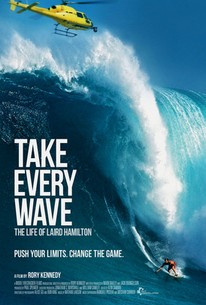
Rory Kennedy usually makes documentaries about complicated issues, with more than 30 films on topics like poverty, political corruption, domestic abuse, drug addiction, human rights, and mental illness. Her latest film is something different. Take Every Wave: The Life of Laird Hamilton is the story of a man who became one of the world’s most accomplished sports figures even though he does not compete in organized events.

Your cinematography of the surfing scenes is remarkable. I kept asking myself as I watched, “Where is the camera? And how can it be so steady?”

To capture Laird on these ginormous waves was certainly something that I had never come across before in my own career. I explored using a drone or jet-ski or somebody in the water but they all had their own limitations and ultimately I really leaned on the helicopter shot. The thing is about these waves that is funny and interesting is that you can have a really huge wave and if you shoot it at a certain angle it looks teeny. And what I found is actually being below the wave looking up at it with a little bit of distance was the most dramatic shot but of course that means the helicopter needs to be below the wave. Don King has worked extensively with Laird and Don Shearer has also worked with him as a helicopter pilot.

You assembled an extraordinary collection of archival footage with some rare and very personal material. Where did it all come from?

It’s a bit of a scavenger hunt really trying to find the best footage. We went to Laird and Gabby first and foremost but there was also footage through the archive houses at NBC, ABC, and CBS, who had some archives that we used. Then reaching out to friends and family and really asking people to go deep into their garages and their basements to retrieve some of the footage, a lot of which has never been seen before. The footage of Laird rescuing his friend came from the production company that they had because that was something that they were filming as it happened. We were able to track it down and it was pretty dramatic.

Laird is married to a world-class athlete who competed in the Olympics, Gabrielle Reece. He is covered by sporting journalists but he does not participate in conventional competition.

He has a comfort in competing in say a foot race where there’s an objective winner but what bothers him in surfing competitions was the sense of judgment. Laird is probably one of if not the most competitive person that I know and there are pretty extreme stories about him in that respect but I think ultimately he didn’t want to bring that to his surfing experience. Part of what he loves about surfing is being out on the water and being in touch with nature and being up against these gigantic waves. And I think that you’re up against your own kind of personal chatter in your head that’s telling you to get off the wave and that you might die. You know that’s a pretty intense adrenaline moment, right? So then you add on other things to that like competition and judgments and all the rest of it and it might feel a little deflating or less interesting.

He is an extraordinary athlete and a big part of that is his exceptional mental focus and drive.

That was part of a huge part of what drove me to make this film. Surfing is really the backdrop of the film but the story is what you’re tapping into which is what drives a guy to surf and go up against 80-foot waves. He has the personal drive towards water. I think that manifests at his very young age. I think he was exposed to some of the biggest waves in the world and he was surrounded by surfers. From age two, three; he was in the ocean every day and going out into water that most of us would never even dream of going into even as adult. He had a childhood that was a broken home. He’s lived in poverty. He had an abusive family situation and I think the outside environment was also difficult where he was one of the only white guys in Hawaii at the time. There was a lot of anger towards people who were not Hawaiian and who were white who had brought a lot of disease and devastation to the island though. Because of all those factors he ended up really focusing and finding refuge in the water.

Even though he doesn’t have much formal education he and the other surfers have really PhD level understanding of the properties of water; the physics of it.

Their level of knowledge is striking. One of the scenes that we have in the film is Laird working with the Oracle team, Jimmy Spithill who is the captain of the America’s Cup because they really looked to him for expertise in terms of foil boarding. And these are guys are engineers and they’re analyzing with computer technology the most efficient way to get a boat to move across a lot of water and they’re looking at Laird for his personal expertise in that and I think there’s a good reason for it. When you have spent that much time as a human being engaging in something, you have kind of an instinctual understanding of it that they’re able to translate in pretty beautiful ways both in terms of the language that they use and the poetry and the beauty of it but also on a very technical level in terms of how it works and how a wave is formed. He’s incredibly articulate and knowledgeable about that.

Would you say that there’s a common theme in your films?

A great story.

Related Tags:


Directors Directors Documentary Interview
Goodbye Christopher Robin

Goodbye Christopher Robin

Posted on October 12, 2017 at 5:53 pm

C
Lowest Recommended Age: Middle School
MPAA Rating: Rated PG for thematic elements, some bullying, war images and brief language
Profanity: Brief strong language
Alcohol/ Drugs: Alcohol
Violence/ Scariness: Wartime violence, post-traumatic stress
Diversity Issues: None
Date Released to Theaters: October 13, 2017
Copyright 2017 Fox Searchlight

This telling of the story behind the creation of some of the world’s most beloved books for children is sincere and well-intentioned but what Pooh might call a bit of a muddle. The movie is not at all clear about whose perspective it is giving us or what story it is trying to tell.

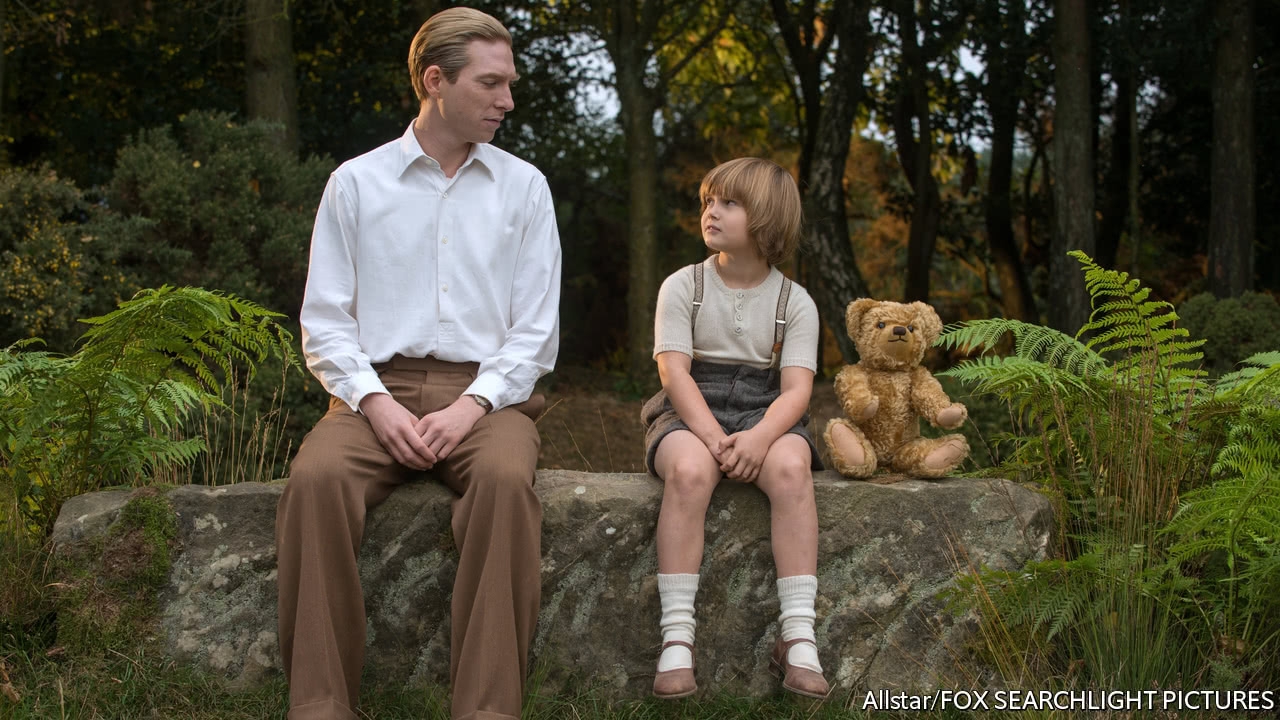
Author A.A. Milne, called Blue by his family and played by Domhnall Gleeson, was a successful playwright and humorist before the Great War, but came back badly shaken from the experience of combat and carnage. His wife Daphne (Margot Robbie) is affectionate but impatient. Neither one of them is very interested in their son, Christopher Robin (Will Tilston), who spends most of his time with his devoted nanny, Nou (Kelly Macdonald). Milne insists the family move to the country, where Daphne feels isolated from the parties and friends she enjoys. She goes back to London, saying she won’t return until Milne begins to write again, just as Nou has to take some time off to care for her mother. This leaves Milne alone with his son, called Billy Moon by the family, and for the first time they spend time together, playing in the woods with the child’s stuffed bear, named Winnie after the bear in the zoo. It is these days that inspire the two chapter books and two books of poems that have been read aloud to generations of children who have grown up and read them to their own children, plus, Disney movies and a television series (Disney now own the rights to the characters) and more books and toys.

And it is these days that are the best part of the film, especially when Milne’s friend, the illustrator Ernest Howard Shepard (Stephen Campbell Moore) comes to visit, and we see the stories Milne and Billy Moon tell melting into the sketches that are as beloved as the writing.

The problem is the rest of the movie, which is really four movies fighting with each other, none of them very good. There is the story of a shattered veteran trying to find a way to return to civilian life and work that is meaningful to him. There is the story of a man and a boy who do not realize how much they need each other discovering a common language. There is the story of enormous success that benefits one family member but at great cost to another.  The stories lead to feelings of betrayal and bitterness when Billy Moon becomes famous, more famous than his father, and much more famous than his boarding school classmates.  And there is the story of estrangement and partial reconciliation.

It is never clear what the point of view of the movie is, or what the point of the movie is.  Is it that art can be healing and wounding at the same time?  Is it that behind tales of wonder and enchantment there can be pain and bitterness?  Fans of the Winnie the Pooh books may enjoy some of the classic biopic “ah, that’s where this part I loved came from” moments, but they do not provide any additional insight or depth to the work itself, not even an exploration of what the books have to say about childhood and whether they represent a child’s perspective or a parent’s.  Most of all, unlike Pooh, Piglet, Kanga, Roo, and Owl, these characters are not very interested or interesting.

Parents should know that this movie includes wartime violence, PTSD, marital estrangement, sad offscreen death of a parent, apparent death of a child, and social drinking.

Family discussion:  What should Blue and Daphne have done differently?  Why did Christopher want to go into the army?  Is “the great thing” finding something to be happy about?

If you like this, try: the books of A.A. Milne

Related Tags:


Based on a true story Biography Drama DVD/Blu-Ray Family Issues movie review Movies -- format Movies -- Reviews
Marshall

Marshall

Posted on October 12, 2017 at 5:25 pm

B +
Lowest Recommended Age: Mature High Schooler
Profanity: Some strong language
Alcohol/ Drugs: Alcohol, smoking
Violence/ Scariness: Allegations of rape and attempted murder, fights and beatings, gun
Diversity Issues: A theme of the movie
Date Released to Theaters: October 13, 2017
Date Released to DVD: January 8, 2018
Copyright 2017 Open Road

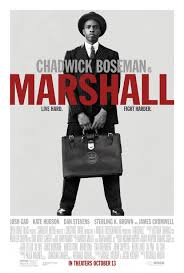
“It’s a real life Bigger Thomas,” says a character describing the new case assigned to a young lawyer named Thurgood Marshall (Chadwick Boseman). Bigger Thomas was the young black protagonist who could not escape the fundamental racism of American society in Richard Wright’s novel, Native Son, accused of rape and murder. In this real-life case, a black chauffeur named Joseph Spell (Sterling K. Brown of “This is Us”) was accused of rape and attempted murder of his employer, Eleanor Strubing (Kate Hudson), a wealthy Connecticut socialite. Marshall, then the entire legal staff of the NAACP, was going from town to town representing black defendants, many whom “confessed” after being beaten and starved, but, Marshall insists, only those who are innocent. They do not have time or resources to devote to those who did what they are accused of.

This case is unusual because it is in the North and because it is so high-profile. It has been a front page story in the newspapers and many white families are firing their domestic employees because they are so terrified.

Connecticut may not have the overt, explicit racism of the Jim Crow laws, but in some ways that makes fighting its version of bigotry more difficult. The judge (James Cromwell) refuses Marshall the normally automatic courtesy of allowing him to represent Spell in court without being a member of the state bar association. Instead, a local lawyer named Sam Friedman (Josh Gad) must argue the case, even though he has no experience in criminal trials and is very reluctant to get involved. “That must be difficult,” Marshall tells him wryly. “To have a reputation to think of.” Marshall may sit at the counsel’s table but may not address the judge or examine witnesses. He says that not being allowed to speak is the worst blow he has had as a lawyer, worse than having to enter the courthouse by the back door.

This is an absorbing drama on many levels, working purely as an “Anatomy of a Murder”-style courtroom mystery, as a historical depiction of the roots and mechanics of social change, and as the personal story of the two young lawyers facing enormous professional and personal challenges, developing a friendship, and becoming better at what they do.

The screenplay by father and son Michael and Joseph Koskoff is forthright in addressing the complicated ethics of preparing a defense for an individual client that many not always be consistent with the larger political imperatives. It also delicately if not always sucessfully skirts the complicated problem faced by contemporary films based on real-life events: if the white character teaches the black character, it’s condescending, but if the black character teaches the white character it’s “magical Negro.” In real life, Samuel Friedman was already active in civil rights cases before the Spell case, and he was slender and athletic. But for dramatic purposes, here he is played by Josh Gad and his character only takes insurance cases. We first see him winning for an insurance company on a technicality that leaves the disabled plaintiff without any damage payment. And Marshall’s character changes very little over the course of the film. He is sophisticated, tough, smart, and confident all the way through which is great as a tribute to one of the towering figures of the 20th century, but without some kind of character arc like the one given to Friedman, the risk is that he becomes a supporting character in the movie that has his name in the title. Fortunately Boseman is intensely charismatic and a gifted actor who is able to bring a great deal to the role, and he and Gad have a strong chemistry that benefits and is benefited by director Reginald Hudlin’s gift for understanding when comedy is needed to lessen the tension. Brown is also excellent in a role far removed from the high educated and successful characters on “This is Us” and “People v. O.J.” Indeed, the entire cast is outstanding, especially Hudson, Ahna O’Reilly as a juror, and Barrett Doss as Marshall’s host and friend.

The film balances the personal, the political, and the professional lives of its heroes and is frank about the opportunism — and the opportunity — of their choices. It places it in the context of its time, as Friedman’s family in Eastern Europe is captured by the Nazis and white thugs attack both lawyers. It makes its case as effectively as Friedman and Marshall make theirs — that courage and persistence bring change and that there are good people out there who will work, with all of our help, to make it happen.

Parent should know that this story concerns a real-life trial for rape and attempted murder with sexual references and situations, themes of racism including beatings and police brutality, some strong language, domestic violence, and some strong and racist language.

Family discussion: Why did Marshall represent only innocent clients? Did Spell have a fair trial? What has improved since that time? What has not?

If you like this, try: “Separate But Equal” and “Mr. Civil Rights: Thurgood Marshall and the NAACP”

NOTE: Read my interview with Boseman and director Reginald Hudlin at rogerebert.com

Related Tags:


Based on a true story Courtroom Drama DVD/Blu-Ray Pick of the Week movie review Movies -- format Race and Diversity Race and Diversity
THE MOVIE MOM® is a registered trademark of Nell Minow. Use of the mark without express consent from Nell Minow constitutes trademark infringement and unfair competition in violation of federal and state laws. All material © Nell Minow 1995-2026, all rights reserved, and no use or republication is permitted without explicit permission. This site hosts Nell Minow’s Movie Mom® archive, with material that originally appeared on Yahoo! Movies, Beliefnet, and other sources. Much of her new material can be found at Rogerebert.com, Huffington Post, and WheretoWatch. Her books include The Movie Mom’s Guide to Family Movies and 101 Must-See Movie Moments, and she can be heard each week on radio stations across the country.

Website Designed by Max LaZebnik