
Interview: Bryan Carberry and J. Clay Tweel on the Documentary “Finders Keepers”

Posted on October 7, 2015 at 3:30 pm

Bryan Carberry and J. Clay Tweel have made some of my favorite documentaries, including “King of Kong” and “Make Believe,” bringing us into worlds that at first seem exotic and downright weird and seamlessly making us feel a part of small fringe communities like competitive video gamers still in cutthroat battles via the near-antique “Donkey Kong” or teenage magicians. Their latest is Finders Keepers, the story of one of the most improbable lawsuits ever filed — over ownership of a severed leg. John, the man whose leg it was wants it back from Shannon, the man who accidentally and unknowingly bought it in the disposition of storage facility contents seized for nonpayment and wants to keep it because he thinks it is his ticket to fame and fortune. I spoke to Carberry and Tweel about finding the funding for the film via Kickstarter and normalizing a story that seems at first to be outlandish and grotesque.

Co-producer Ed Cunningham first started covering the story. Carberry explained, “Initially Ed was coming off King of Kong in 2007 and looking for his next thing so this was kind of like his baby for awhile. He went out of his pocket for a bit flying out there with his little handycam. After a couple of years there wasn’t really much funding behind this and I came across Ed’s footage and we thought, ‘Okay, this needs to happen.’ It’s amazing by then crowdfunding came along and we got the Kickstarter together for eighty thousand dollars. That paved the way. It got us go out and shoot the bulk of the story and get into the edit room.”

They talked about creating sympathy and even identification with the characters. Tweel said, “We try to structure our documentaries in the same way that a lot of narrative fictional films are structured, kind of like a screenwriting type of format and so in doing that we are trying to tell the most universal story possible, whether it’s about arcade video game players or teenage magicians or two guys fighting over a leg. We’re constantly in search of the underlying truth in the ways in which our audience can connect with these people. And so really we struck gold here not just because John and Shannon are funny and quirky but they are also very vulnerable and honest and so are their family members. And so we were able to get to the kind of deeper levels to the story that you can relate with, like you can relate with a sister who has a drug addict as a brother and she is trying to protect him but also he’s hurting her. We felt like the parallel stories of these guys kind of mirror each other in so many different ways and that was something Bryan and I were very much interested in exploring.”

Ed Cunningham was the one who first made the people in the film feel comfortable talking very candidly in front of a camera. Tweel said, “Basically, he just laid everything out on the line. A) He was able to give them “King of Kong” and say, ‘This is the treatment we give. This is just a fair account. We’re not going to be playing this up or anything.’ But once you have a camera pointing at someone for long enough, they are just describing it like you’re a friend on the block or something. It’s completely natural for them because they’re with it they’ve been with it for so long so when they are talking without grinning or whatever about them hanging the leg in a tree in the front yard or something it’s because that’s their life. It’s not strange to them. And after working with them for a couple years it wasn’t strange to us either. The first time we screened at Sundance for the people we couldn’t believe the laugh it was getting because it had become incredibly normal for us having worked with it every day.” It also helped that Cunningham and Carberry were both born in Virginia, so the people in the movie did not think of them as Northerners trying to make fun of the hicks in the South.

One of the most fascinating elements of the film is that the documentary itself contrasts with at least three different “reality” television shows that became involved, including Judge Mathis, who finally resolved the dispute and sent John to rehab. So this is a documentary that includes the impact of a more heightened version of what they do. Carberry said, “I think that the reality TV version of the story is they are coming at it from a different angle and they are not there to give more of the context behind the story that we are. So we as much as possible like to let people talk themselves and let things kind of happen organically where reality TV is more operating on machine, a little bit like they have schedule and they’re cranking up shows. We’re just trying to show how that affects our characters.” “They are more hands on and we are hands off,” added Tweel.
Related Tags:


Directors Documentary Interview

List: Movies about Peter Pan

Posted on October 7, 2015 at 8:00 am

James M. Barrie’s play “Peter Pan” premiered in 1904 and the story of the boy who wouldn’t grow up is still one of the best-loved of all time. This week the prequel “Pan” opens up in theaters, with Hugh Jackman, Rooney Mara as Tiger Lily, and Garrett Hedlund as the young not-yet-captain Hook. And there’s a hit musical on Broadway called “Finding Neverland,” based on the Johnny Depp movie that was based on Barrie’s life, and the friendship with some children that inspired his most famous story.

https://www.youtube.com/watch?v=1jsR7_EqQSs

There was also a theatrical Peter Pan prequel on Broadway called “Peter and the Starcatcher.”

There was a silent film version in 1924.

https://www.youtube.com/watch?v=DdnZUszqGOY

A generation of baby boomers adored the Mary Martin musical version.

The Disney movie was the first to have the title role played by a boy.

https://www.youtube.com/watch?v=zf00mEe9EOs

The theatrical version was remade with Cathy Rigby and Sandy Duncan. Here Duncan is introduced by Mary Martin.

Rigby played the part longer than anyone else, more than 30 years.

Steven Spielberg made a sequel called “Hook,” starring Robin Williams with Julia Roberts as Tinkerbell.

The PJ Hogan-directed version had Jason Isaacs as Captain Hook.

And Allison Williams starred in the live telecast last Thanksgiving.

Related Tags:


Based on a book Based on a play Fantasy Lists
The Martian

The Martian

Posted on October 1, 2015 at 5:50 pm

A-
Lowest Recommended Age: Middle School
MPAA Rating: Rated PG-13 for some strong language, injury images, and brief nudity
Profanity: Some strong language
Alcohol/ Drugs: None
Violence/ Scariness: Intense peril throughout with some injuries, some graphic and disturbing images
Diversity Issues: Diverse characters
Date Released to Theaters: October 2, 2015
Date Released to DVD: January 11, 2016
Amazon.com ASIN: B017S3OP34
Copyright 2015 Twentieth Century Fox

In a crackling sharp movie about brilliant people solving very tough problems, it is endearing that the first and most important involves one of the earliest skills developed by mankind. Indeed, it is the skill that made it both possible and necessary to develop the very first communities. It is the skill that turned nomads and hunters into complex societies: the cultivation of crops.

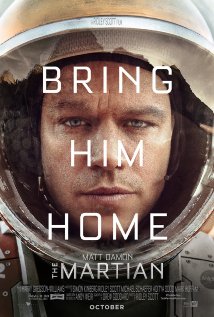
Mark Watney, played by Matt Damon as an endlessly resourceful Eagle Scout-type who would run over from next door to help carry your groceries, is part of a US astronaut team on a mission to Mars. When a storm comes up, they have to make an emergency evacuation weeks before the mission is completed. He is separated from the group and they believe he is dead. So, like ET, he is left behind on an alien planet. But no Reeses Pieces here, and no Elliot to befriend him. The first thing he has to do is figure out how to feed himself. “Fortunately,” he explains to us via his video log, “I am a botanist!” {Hmmm, just like ET, who came to earth to collect plant specimens.) That credential has never been announced with such deserved satisfaction. What if the one left behind was the expert in telemetry or navigation?

As he explains in an unnecessary coda, one of the tightly constructed film’s few excesses, he knew he was probably going to die. But his attitude was, “Not today.” He understands that any hope of rescue is 140 million miles away. Even if NASA could figure out that he was still alive and could figure out a way to rescue him, it would take years before they could reach him. He counts out the meals left behind by the crew to figure out how long he has before he has to have some sustainable source of nourishment. Of course there are no seeds. There is no water (Mark would be very happy with the latest reports that in fact there might be water on Mars, but for this movie, there is none.) The ground (I guess you can’t call it “earth”) does not have the necessary nutrients. But there’s a bag marked “Do not open before Thanksgiving,” and inside, there are potatoes. And Mark is a botanist. He rigs up a machine to create water and empties out the lav for fertilizer. He plants the potatoes and sure enough, little shoots appear.

Meanwhile, the crew is still on its way back to earth. On earth, there is a state funeral for Watney. And then an analyst looking at transmissions from Mars sees something that could be a person. NASA realizes that Watney is alive. Can they mount a rescue mission before it is too late? Given the risks to the crew, should they?

Director Ridley Scott and the nicely space-named screenwriter Drew Goddard (based on the book by first-time author Andy Weir) have created a completely believable and utterly immersive world, and Damon’s Watney is an idea hero for the story. He is smart, self-deprecating, optimistic, and inventive. “I’m going to science the s*** out of it!” he says, understanding that the odds are against him but also understanding that the only way to stay sane and focused is to work each problem, one at a time. He genuinely enjoys the challenge (well, most of the challenges) and that makes it fun to watch.
Watching the way he thinks through problems is endlessly enthralling. He even rigs together a version of ET’s Speak and Spell to phone home. On earth, we see characters debate the politics and practicality of a rescue operation, ranging from who should know what when to whether the US should work with the Chinese on a launch mission. Jeff Daniels as the head of NASA, Kristen Wiig as the media liaison, and the various people in charge of crew and equipment all have different perspectives and priorities. The political and personality puzzles are as tricky as the scientific ones.

Production designer Arthur Max and cinematographer Dariusz Wolski (who worked with Scott on “Prometheus”) provide striking images of stunning beauty that are both strange and familiar. At times, it almost looks like the red rocks of the American Southwest but we are also aware of the peril constantly surrounding Watney, where a crack in the helmet can mean death. The scenes on the spacecraft, with the captain (Jessica Chastain) and crew matter-of-factly floating through corridors, are brilliantly realized.

This is an exciting, absorbing story, an adventure with a genuine hero whose courage, fortitude, and intelligence will spark the hero inside anyone who see it.

Parents should know that this film includes intense and prolonged peril with injuries, some disturbing images, brief nudity, some strong language

Family discussion: What was Mark’s most difficult challenge? What were the differing priorities of the people at NASA and when there are conflicts, who should decide?

If you like this, try: “Gravity” and “Apollo 13” and the miniseries “From the Earth to the Moon” — and the book by Andy Weir

Related Tags:


3D Based on a book DVD/Blu-Ray Pick of the Week Science-Fiction
Interview: Giulio Ricciarelli of Holocaust Drama “Labyrinth of Lies”

Interview: Giulio Ricciarelli of Holocaust Drama “Labyrinth of Lies”

Posted on October 1, 2015 at 3:43 pm

Giulio Ricciarelli co-wrote and directed the German film “Labyrinth of Lies,” based on the real-life story of the courageous post-WWII German prosecutors who insisted on investigating the atrocities of the concentration camps and prosecuting those responsible. Surrounded by former Axis and Allies officials who wanted to put the past behind them and move on to fighting the communists. He talked to me about the inspiration for the film, what really happens to the movie’s couple after the ambiguous ending, and why the owners of the vintage cars used in the film drove him crazy.

The movie’s opening takes us into a world almost impossible to imagine, where concentration camp survivors are living with the people who imprisoned and abused them and the world has almost no information about what would later come to be called the Holocaust. An artist is offered a light by a teacher watching some children in a school playground. When he bends over to reach the flame, he sees the teacher’s hand and recognizes him as a former Nazi. “That symbolized the theme of the movie, the tormented meeting the tormenter. And the second thing that was important that I wanted it to be a teacher because if you imagine him teaching children that is so horrible and that’s something that actually happened a lot. And so we had these two elements and I knew that as a filmmaker I needed a point of seeming harmony in perfect world, an innocent world. A school is like that. So it was important, the tree and the school and the children playing. And then the movie starts and you realize there is something very wrong there and so it was important to have this. There is a German word that means like a mix of sane and beautiful. It’s like an untouched world.”

The “big complex task” of the film was making what is very familiar to us unfamiliar, so we could feel the shock and horror of the young Germans who came of age after the war and did not know about the “Final Solution.” The movie’s main character is fictional, a young lawyer working as a prosecutor, though some of the other characters are based on historical figures. “That‘s why we choose this young naïve main character, hoping that we enter his world, we start looking through his eyes and the reaction I get is great. It seems to be working with go back in time and go with it. The other thing is esthetically of course; first of all you got to plot what you just mentioned.” The very pervasiveness of the portrayal of the Holocaust created a separate challenge as well. It is so well known that it is impossible to replicate in a persuasive way. The audience at some level always knows it is a re-creation. “The audience can almost hear the director say, ‘Okay lunch.’ And you see actors who are well fed. So I said, ‘Okay, we will not have any of that. We’ll not even have testimony like an actor acting as if he was in a camp and we will trust that these iconic images will come when we give them room to come and the audience.” And so, when the scene comes where a survivor provides testimony for the first time to the lawyers, we do not see or hear him. We just see the reaction of the woman taking dictation, and we feel we know what she heard and saw.

Copyright 2015 Universal Pictures

One reason for the film was to recognize the courage of the lawyers who insisted on the truth. But just as important was showing that the only way to move forward after unthinkable inhumanity is to completely honest about it. “In Germany, anything we do politically or culturally is seen through that lens, that’s the reality and if you are talking about refugees if you are talking about Greece, if we talking about anything it’s all we see in the frame of this. The country who did that now does this. The thing is, you cannot deny it, that’s not the way, and you can’t leave it behind.” One way to do that is what he did here, finding a new way to tell the story by looking at a part that has not been told.

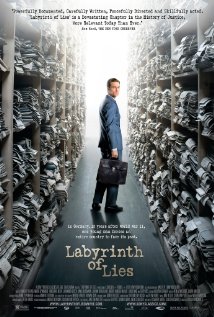
“I think what is important with our film is that it’s a not told story. I think what is most important is the movie doesn’t pull any punches when it comes to the involvement of Germany as a whole because there is sometimes a tendency to show two evil Nazis and the rest of the population is confused. That’s not historical fact but at the same time not to sit on a moral high horse. That’s why the main character says, ‘I do not know what I would done.’ And if you look at the atrocities not just in Germany but all over the world the human beings are usually not heroes but they go along and they do the easy thing and they don’t risk their own lives and there are heroes but they are few and far between.” He described the continual presence of this history in Germany as an iceberg. “Under the waterline it’s still huge and it’s still usually influential in Germany, it’s certainly the biggest influence in German politics and culture today.” Everyone in Germany was supportive of the film and cooperative in helping to get it made, including Frankfort, where they filmed on location at the places where the events actually happened. One of the most striking images is the rows and rows of documents. The real archive no longer exists in that form, but they found another storage facility with old documents and used camera angles to make it look biggers.

But one challenge they faced was the vintage cars they needed for the shoot. “First of all they are very expensive, but you know what the biggest problem is? They are owned by collectors, so in the morning you always get that spit shine car and they would say, ‘Don’t dirty it up,’ but we have to spray dust over it and sprinkle it with dust and tell them to bring it back dirty but the next day it’s clean again.”

He has been very moved by the response to the film from people who still struggle with the truth of what happened. “And how much rawness there still is. Like a woman came to me and said, ‘We have a box from our grandfather and our family and it’s closed as we are all afraid to open it, because we don’t want to know how grandpa died in the war.’ Or the man who shook my hand and said, ‘Thank you for this film,’ and then he went five steps and he came back and he looked me straight in the eyes and he said very quietly, ‘My father was a bad man.'”

The movie ends on a positive note about the prosecution of those responsible for wartime atrocities, including cooperation with the Mossad agents who tracked down Adolf Eichmann. But it is ambiguous when it comes to the future of the couple in the film. I pressed Ricciarelli to tell me what he thought would happen to them after the movie. He told me he shot two endings but went with the one he thought was more realistic. Still, he smiled and admitted “there is a ray of hope.”

Related Tags:


Based on a true story Directors Interview Writers
THE MOVIE MOM® is a registered trademark of Nell Minow. Use of the mark without express consent from Nell Minow constitutes trademark infringement and unfair competition in violation of federal and state laws. All material © Nell Minow 1995-2026, all rights reserved, and no use or republication is permitted without explicit permission. This site hosts Nell Minow’s Movie Mom® archive, with material that originally appeared on Yahoo! Movies, Beliefnet, and other sources. Much of her new material can be found at Rogerebert.com, Huffington Post, and WheretoWatch. Her books include The Movie Mom’s Guide to Family Movies and 101 Must-See Movie Moments, and she can be heard each week on radio stations across the country.

Website Designed by Max LaZebnik