
Trailer: Slow Learners
Posted on August 16, 2015 at 8:00 am
Posted on August 16, 2015 at 8:00 am
Posted on August 16, 2015 at 7:19 am
Bryan Cranston plays Dalton Trumbo, the brilliant screenwriter whose experiences during the McCarthy era inspired some of the greatest movies ever made about freedom. Trumbo was blacklisted but continued to write screenplays by having them attributed to “fronts,” men who were hired to take credit for them. During this period, two of his fronts were awarded Oscars, which were later re-presented to the man who was truly responsible for them.
Posted on August 14, 2015 at 3:48 pm
“The Lost Key” is a documentary that explores contemporary society’s confusion of sex and intimacy, and how the ancient principles from Jewish theology can restore the holy connection between husbands and wives. I spoke to director Ricardo Adler, whose own divorce inspired him to explore these traditions, and Rabbi Manis Friedman, who introduced him to Kabbalah’s ancient secrets to attain the highest form of intimacy. The film portrays the dramatic transformation of Ricardo’s new marriage, and the reactions of other couples to this revolutionary way to sexual connection. Adler says that “‘The Lost Key’ reveals forgotten wisdom that could inspire society to rediscover intimacy, one bedroom at a time.”
I asked Adler how he got started with this project.
Adler: I grew up in just a regular, modern, traditional, secular Jewish home. And at some point when I was getting divorced, as the film says, I just decided to start exploring different things, and I ended up discovering that in my own Jewish roots there’s all the answers I need in life. In fact, a lot of the things that I discovered in Judaism and in Kabbalah include some of the ideas that I used to like about other belief systems. You know, Buddhism, Taoism, and etc, so that was kind of nice. And then that process, you start going to school and meeting rabbis and talking to different types of people. After about a year of having started that process, the local Chabad house here in Venezuela organized a shabbaton with Manis Friedman. So he came down, and I must say, I was fascinated by him and his talks and just the way he conveys the knowledge. In fact, he gave one talk where he answered a question I was asking myself for over 20 years, which is,
“What’s the purpose of life? Why are we here?” In one hour, he answered a 20 year search. So I just loved him. So I proposed the idea to him and to my surprise he said yes. And here we are.
What is the difference between sex and intimacy?
Rabbi Friedman: So the difference is a number of things. Number one, what we’re referring to generally, casually to as sex is impersonal. It’s an activity, it’s a performance, it’s a thing. It’s something you do. And this thing can be good, it can be bad, it could be better, it could be worse, like anything. Intimacy means connecting person to person beyond all things. So if we have to put it in a simple phrase, the lost key is the ability to connect to a person beyond all things, which is really what we all want and need.
Why do we get so many contrary messages?
Rabbi Friedman: Actually I think that the experts of the mental health field very recently are saying that it was a mistake to emphasize the pleasure of the relationship and to make people paranoid about whether they’re getting the maximum pleasure, the greatest pleasure, the 25 new secrets to greater sex, constant, constant bombardment, when in fact, people don’t really need more pleasure, they need closeness. Because with all the freedom that we have, and with all the openness on the subject, I think Americans are pretty much, and even so-called happily married couples, the moment they’re quiet and sober, they would admit that they basically feel alone. It’s a very lonely society. Even though we’re very social and we’re very cosmopolitan and we’re outgoing, everything is open, everything is free and casual, but in the end, we feel alone. Because until relate intimately, we really are isolated and alone.
Adler: I think this started with the so-called sexual revolution of the 60’s which emphasized pleasure-based sex and you should have sex with as many people as you want and all this stuff. And then that led to a sexual invasion of society. Sex is used to sell everything. And so that’s what sells because it’s an emotional directive. They are talking to something that is very dear, very important and intimate to any human being, and that’s the pleasure of sex. So it sells, it works, that’s who we are today. The story’s not over. Here we come, hopefully, with a different message. And it’s not just us. I think there’s a lot of people that are really looking at sexuality views today and just saying there’s something wrong here. I mean, if sexuality is your number 1 cause for divorce, along with financial issues, there’s something going on, right? We have a new thing called sexual addictions we didn’t have before. Something’s going on. You have all these young people with these self-esteem problems; something’s going on. We think it’s the lack of intimacy in sexuality.
The adults in the film seem to know very little about intimacy. Who should teach kids and teenagers about this? And when?
Rabbi Friedman: It should be the parents or the teachers. It shouldn’t be a secret subject, a taboo subject that you have to find an expert to talk to your children about it. It should be a natural part of life. You don’t sit your children down and your child and say, “We’re going to have the talk. Now you’re old enough or whatever it is and we’re gonna have the talk.” That sends a bad message. Why don’t you just talk about it the way you talk about anything else in casual conversation? I don’t mean make it casual. It’s not different from the rest of life. You don’t have “the talk” about money, you don’t have “the talk” about jobs, about career, it comes up in casual conversation—you talk about it. So you hear a story of kids who got in trouble or whatever, so you talk about it. It’s not “the talk”. Don’t treat it like something other than life itself.
In the film you talk about not having any devices like phones or television in the bedroom. How do couples create physical and emotional space for intimacy?
Rabbi Friedman: If the bedroom is sacred, then walking into the bedroom actually supports the intimacy that you’re going to engage in because it promotes that feeling of intimacy. You set it aside for that purpose and that kind of generates that kind of energy. So when a husband and a wife walk into a bedroom and close the door, it creates an intimate atmosphere, an intimate mood that supports the emotions that you’re supposed to feel but you can’t always. So you come into a bedroom with all sorts of concerns and distractions, and you’re worried about your bills and you’re worried about your job and you’re worried about your extended family, and now all of a sudden you have to focus to become intimate? That’s not easy. So if you can have some support from the room, from the environment, from the atmosphere, it’s very helpful. I mean, you need help. You do. We all need help to achieve intimacy.
Are there lessons in the film for those who are not Jewish?
Adler: The film is for any married couple. The idea is that you are one before you got married and you can reclaim that oneness within marriage. So intimacy is for any couple whether you are Jewish or non-Jewish, old or young, black or white etc. etc. If you are married you can be intimate. You can have a beautiful healthy marriage and this is one way to get there.
Rabbi Friedman: Absolutely, absolutely. I mean, just thinking about the benefits to the children born from the relationship. When husband and wife are truly focused on each other, it invites the baby into a world in a much healthier way than if the baby is an afterthought. Nothing you get from your spouse can be more important than your spouse. And that includes love, the love you get from him is not as important as him, otherwise you’re married to love. And it includes the physical pleasure of intimacy, because if that’s what you’re looking for, then you’re married to it, not to him. And also, the difference between sex and intimacy is that after sex, you feel a little diminished. You feel a little loss of dignity or self-respect or respect for the person you’re with. It’s just the nature of the behavior of the act that it takes you down a little. Whereas intimacy, after you’ve experience intimacy, each time you feel more innocent than before. Because to be intimate, you have to get past all things to just be you and I, the I and thou, and that is the most innocent part of ourselves.
Posted on August 13, 2015 at 5:38 pm
B+| Lowest Recommended Age: | Mature High Schooler |
| MPAA Rating: | Rated R for language throughout, strong sexuality/nudity, violence, and drug use |
| Profanity: | Constant very strong and crude language, racist and homophobic terms |
| Alcohol/ Drugs: | Drinking, drugs, drug dealing |
| Violence/ Scariness: | Violence including guns, fights, riots, sad deaths |
| Diversity Issues: | A theme of the movie |
| Date Released to Theaters: | August 14, 2015 |
| Date Released to DVD: | January 18, 2016 |
| Amazon.com ASIN: | B013P0X16Q |

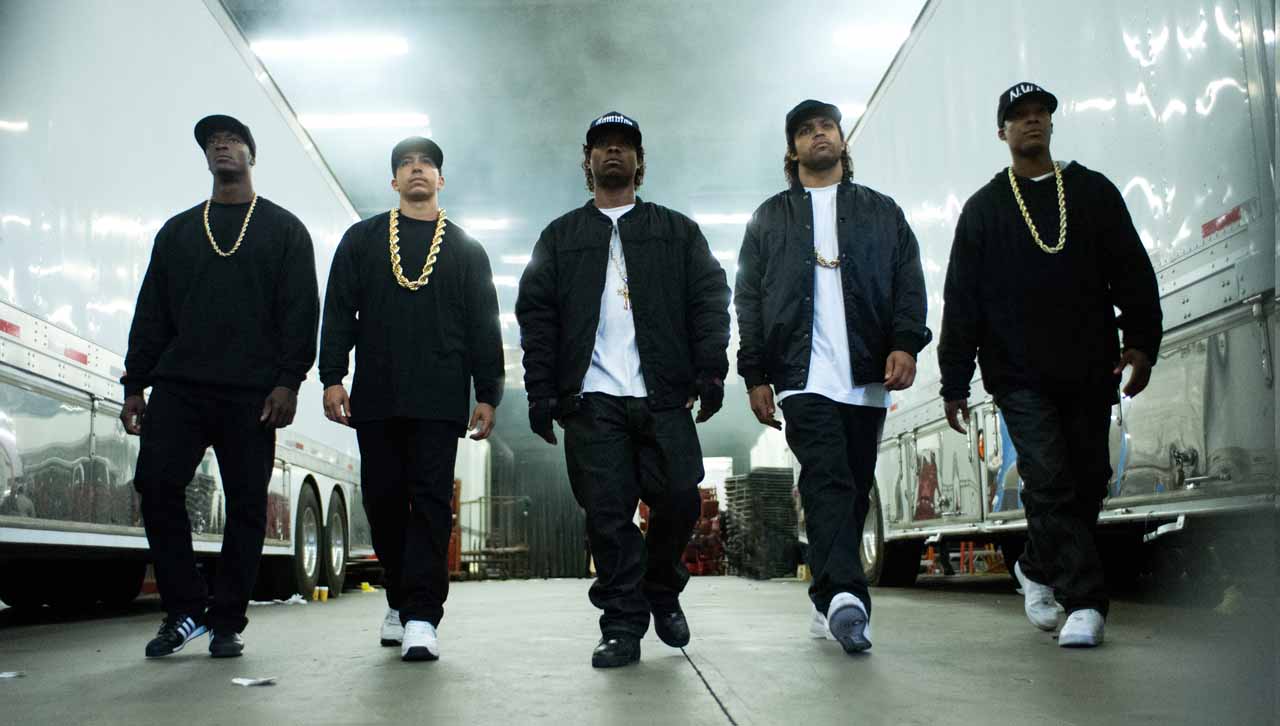
“No,” Eric “Eazy-E” Wright answers: “N**** Wit Attitude.”
NWA liked to think of itself as speaking truth to power, a CNN of oppressed minorities. When the Detroit police force told them that they would be arrested for obscenity and inciting violence if they performed their notorious “F*** the Police” in concert, they performed it. And they were arrested. When they were accused of glamorizing drugs and violence, they said they were journalists, reporting what they saw. They had a lot of attitude, a lot of anger, and a lot of ambition. They were savvy about what we might call branding. When their song “F*** the Police” got them a warning letter from the FBI, Eazy understood that it was the best possible publicity to present them as rebels being attacked by the Man, marketing money could not buy.
Much of the story is familiar from every other musical biopic you’ve ever seen plus every single episode of “VH1: Behind the Music.” 1. Talented young people from a marginalized community are told that their music is neither good nor commercial. “If you find the next Bon Jovi, call me,” says one label executive as he walks out of their performance. 2. And then they find their audience. They become successful beyond their wildest dreams. 3. And then they discover that fame and money present their own challenges, including fights over money and the direction of the business. But this biopic, produced by the original members of NWA is unexpectedly sweet, even tender, presented with affection and perspective. (Perhaps this is the reason the film omits the genre’s most frequent cliche, the scenes of family members complaining that the musical superstars are not spending enough time at home.)
The script is sharp, often funny, and compelling. When a kid on a school bus taunts a thug in a nearby car, the thug boards the bus at gunpoint to tell the kids to treat him with respect — and stay in school. “We just got a motivational speech from an OG ,” says O’Shea Jackson, soon to be Ice Cube.
It has one of the best ensemble casts of the year and all of the performances are superb. But a considerable percentage of the movie’s power comes from its timing. While the events it depicts occurred three decades ago, it could easily be referring to the current headlines about police abuse and the virulent persistence of racism throughout American society. The footage of Rodney King being brutally attacked is chilling because it shows us where NWA’s anger came from and reminds us of how little progress we have made. More chilling than the attitude from NWA is the way that the constant trauma from the community and the society around it have created a particular kind of ambition. This first generation born after the heyday of the Civil Rights movement does not want promises or the traditional idea of progress. They are not about passive resistance and sit-ins. They are not looking for a seat at a segregated lunch counter. They want to tell their stories. And their contempt for the system is so deep that they show no interest in activism or putting their money back into the community.
Jason Mitchell gives a star-making performance as Eazy-E, the fearless and canny co-founder of NWA who started Ruthless Records with money he made dealing drugs. O’Shea Jackson, Jr. plays his real-life father, better known as Ice Cube, who created the lyrics for many of the group’s biggest and most influential pieces. And Corey Hawkins is Dr. Dre, master of the turntable. The movie is well over two hours and never seems long, but with that running time there should have been space for more about the creative drive. We see the guys writing in notebooks and there is a funny scene with Eazy as a last-minute substitute Dre has to show how to get on beat for their first recording. But we never get a sense of what it feels like to create these songs or to perform them before thousands of fans or how they felt about the complaints that their lyrics were misogynistic. Later we glimpse Ice Cube working on the screenplay for “Friday,” the first film from this movie’s director, F. Gary Gray. But we do not learn that it would be even more influential in Hollywood than NWA was in music. Instead, we get an admittedly very funny call-out to that film (“Bye, Felicia“). And we get fan service scenes re-creating Eazy’s pool parties and spouse service scenes like Cube meeting Nicole. There are two other members of the group we learn very little about.
There is still room for a more objective NWA story as cultural and political history. At middle age, Dr. Dre, Ice Cube, and Eazy’s widow are not as clear-eyed about their own history as NWA was in calling themselves citizen journalists, matching the harshness and brutality around them with the force of their rap. But this is a compelling story with a message as vitally important now as it was during NWA’s brief recording career, with plenty of attitude and then some.
Parents should know that the film includes very strong and crude language, drug dealing, smoking, drinking, wild parties, nudity, sexual references and situations, sad deaths, peril and violence, and archival footage of police brutality and riots.
Family discussion: Was NWA right to perform their song in Detroit? Do you agree that they are journalists? Should there be limits on song lyrics that are profane or bigoted?
If you like this, try: the documentaries about A Tribe Called Quest and Tupac Shakur and the music of NWA
Posted on August 13, 2015 at 5:34 pm
B+| Lowest Recommended Age: | Middle School |
| MPAA Rating: | Rated PG-13 for action violence, some suggestive content, and partial nudity |
| Profanity: | Brief crude language |
| Alcohol/ Drugs: | Social drinking, smoking |
| Violence/ Scariness: | Extended action-style violence, guns, chases, explosions, torture, bombs, some archival wartime footage |
| Diversity Issues: | None |
| Date Released to Theaters: | August 14, 2015 |
| Date Released to DVD: | November 16, 2015 |
| Amazon.com ASIN: | B00ZS21J6E |

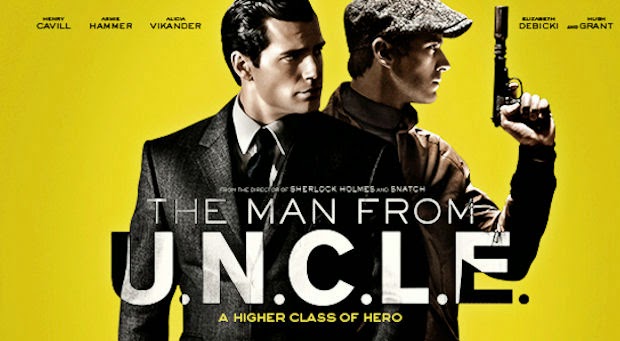
Guy Ritchie’s update of the 1960’s television spy series is sleek, sophisticated, and sexy, with lively banter, high style, and oodles of roguish retro charm.
Henry Cavill (“Superman,” “The Tudors”) takes the Robert Vaughn role of Napoleon Solo, an army vet turned cool, elegant high-end thief turned reluctant spy in a plea deal to avoid a jail sentence. We meet him as he is arranging an extraction from the divided city of Berlin. An auto mechanic named Gaby (Alicia Vikander of “Ex Machina”) is the daughter of “Hitler’s favorite rocket scientist,” a man who came to work for the United States after WWII but has now disappeared and is thought to be working for some very dangerous people who are interested in his invention, basically a quicker, smaller, atomic bomb. The CIA is not the only group to figure out that Gaby might be the way to find her father. A very tall, very determined Soviet agent named Ilya Kuryakin (Armie Hammer of “The Social Network”) is after her, too. After a thrilling chase, Napoleon delivers Gaby to the CIA only to find out that he has been assigned to work with both Gaby and Ilya to find her father and make sure that the bomb does not fall into the wrong hands.
As with his “Sherlock Holmes” films, Ritchie has a lot of fun with the chemistry between his actors. There’s a fire and ice vibe; Napoleon’s understated confidence and unflappable charm plays off well against Ilya’s smoulder and barely-controlled rage. They call each other “Cowboy” and “Peril” (as in “Red Peril”) and one-up each other with gadgets that are endearingly analog. What they refer to as a “computer disk” looks like a scotch tape dispenser made out of Fiestaware. Vikander continues her unstoppable trajectory into superstardom with another impeccable performance. And then there are the bad guys. Elizabeth Debicki (“The Great Gatsby”) plays Victoria Vinciguerra, “a lethal combination of beauty, brains, and ambition.” She is a 1960’s high fashion vision, part Catherine Deneuve, part Jean Shrimpton, part Penelope Tree, and a femme fatale in the most literal and lethal sense. They should give Joanna Johnston the costume design Oscar right now, and maybe the Nobel, too for her take on 60’s couture, from Courreges to Mary Quant.
Ritchie’s kinetic camerawork, spiced up with some split screen work is accompanied by Daniel Pemberton‘s swanky cocktail-stirrer of a score. With Hugh Grant’s unmatchable dry wit as a spy honcho and charm to spare from the leads, it’s enormously entertaining — with a welcome hint at the end that a sequel is in the works.
Parents should know that this film includes extended action-style violence, chases, explosions, shoot-outs, bombs, torture, some disturbing images including archival wartime footage, sexual references and situations and brief nudity, drinking, and smoking.
Family discussion: How do Napoleon’s and Ilya’s backgrounds affect the way they approach their jobs? Do you agree with their decision about the computer disk? What has changed the most since the Cold War era shown in the film?
If you like this, try: “Mission Impossible: Rogue Nation,” “Torn Curtain,” and the old “Man from UNCLE” television series