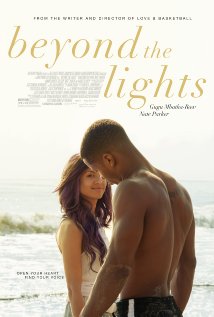
“Beyond the Lights” is a welcome return to the grand traditions of movie romance, with sizzling chemistry between gorgeous, fabulously charismatic stars Gugu Mbatha-Raw and Nate Parker. And it also has some very astute insights about family, ambition, and the pressure put on young women, especially those in the performing arts, to present themselves as sexually provocative and available.
Minnie Driver plays Macy Jean, a ruthlessly ambitious stage mother who sees her talented young daughter, Noni, as her ticket out of poverty and powerlessness. We first see them at a singing competition when Noni is a little girl (India Jean-Jacques). Her performance of Nina Simone’s “Blackbird” gets her a trophy that her mother smashes to the ground because she did not come in first. Then Noni is grown up (Mbatha-Raw), singing and dancing in a steamy music video, featuring a successful rapper named Kid Culprit (Richard Colson Baker, aka Machine Gun Kelly). Macy Jean is pushing Noni hard to do whatever it takes to become a star, and she is on the brink of a breakthrough, with an upcoming television appearance that should launch her into superstardom.
But in the midst of all of this sound and fury, Noni feels lost. The image her mother has created for her is so overpowering that she does not know who she is anymore. She is a singer with a million-dollar voice, but she is also a person who feels that it belongs to someone else, that she is lost somewhere beneath the glitter and fakery. Alone in her hotel room, she goes out the window and sits on the ledge, contemplating allowing herself to just fall off.
She is rescued by a cop assigned to her security detail. His name is Kaz (Parker) and he grabs her hand and looks into her eyes. He says “I see you.” And she believes he does.
Of course, the incident is spun for the press. “We’re selling fantasy here, and suicide ain’t sexy.” Noni jokes about the risks of combining champagne and stilettos and poses with her handsome savior. But Kaz did see Noni. He saw her the way she wanted to be seen. And she saw him, too.
Kaz has a demanding parent, too, a father (Danny Glover) who wants him to run for office, and knows that Noni is not first lady material.
Writer-director Gina Prince-Bythewood (“Love and Basketball”) keeps the love story glamorous but never soapy, through the subtle, moving performances by Mbatha Raw and Parker, and a script that respects the characters, with thoughtful details and easy humor. In the very beginning, Macy Jean is frantic because she does not know how to handle her biracial child’s hair. Later, Noni is wearing a purple-streaked weave for her music video. And when she begins to be happy again, she frees her hair as she finds her true voice. Prince-Bythewood’s confidence in her own voice as much a pleasure of this film as the love story and the star power, which add up to the best date movie of the year.
Parents should know that this film includes very provocative sexual imagery and musical performances with very skimpy clothing, sexual references and situations, strong and crude language, attempted suicide, and tense family confrontations.
Family discussion: What does it mean to “do small things in a great way?” How did Noni and Kaz help each other? Why did being on the brink of great success was Noni in despair? What can we do to protect girls from the overwhelming focus on appearance?
If you like this, try: “The Rose,” “The Bodyguard,” “Lady Sings the Blues,” “Dreamgirls,” “Love Me or Leave Me,” “Gypsy,” and “Mahogany”
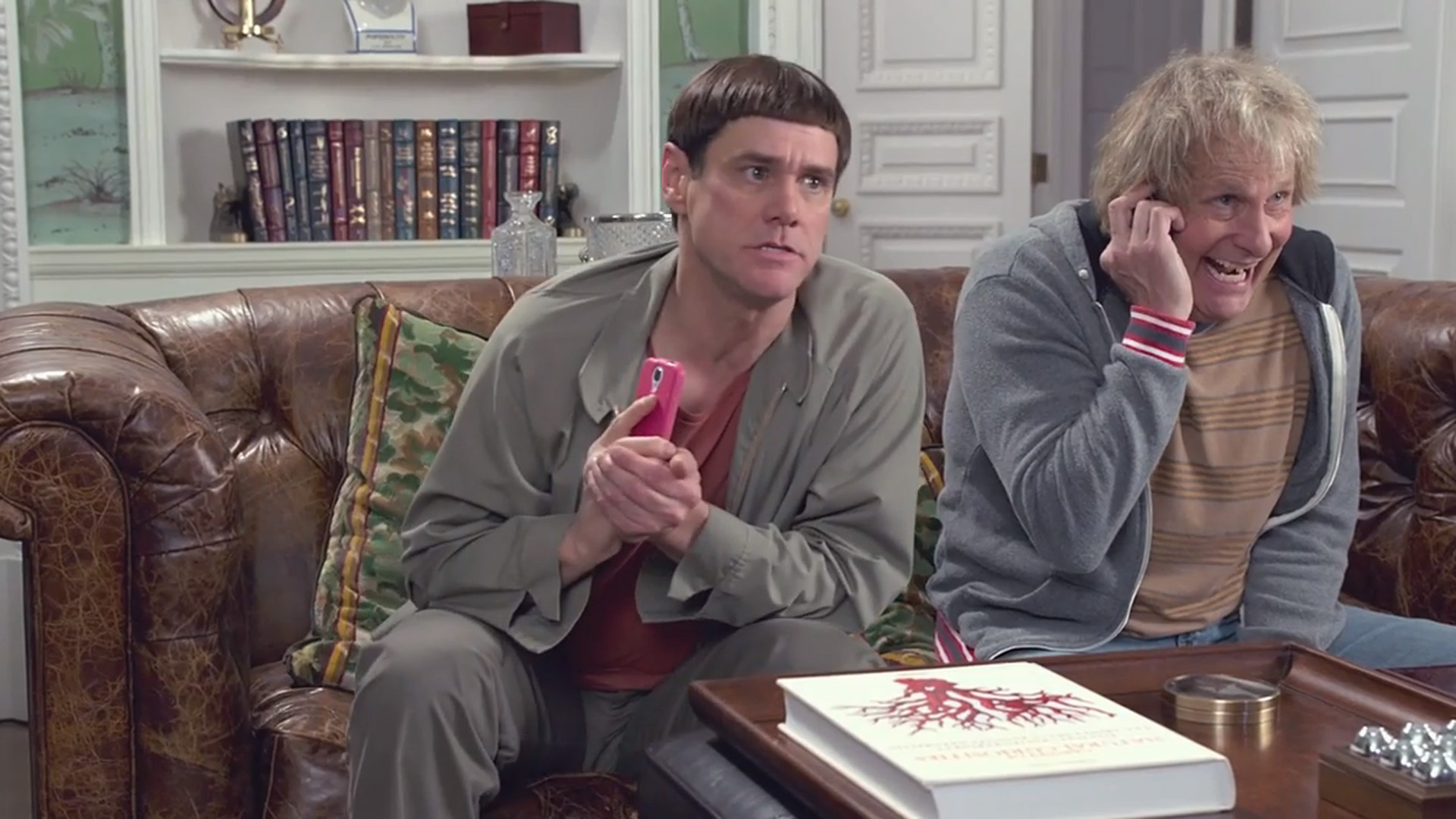
A poorly timed cameo appearance by Honey Boo-Boo’s sexual predator-consorting Mama June is dumb. Making a sequel 11 years after the original “Dumb and Dumber” and the best-forgotten prequel “Dumb and Dumberer: When Harry Met Lloyd” is dumber. Too. Jeff Daniels and Jim Carrey do their best and clearly enjoy themselves, but 20 years after the original, it just isn’t as funny. It feels like those late-era Three Stooges comedies, past the Shemp era, even past Joe Besser, with Curly Joe. As Lloyd (Carrey) says, comedy is all about timing. And this one is too late.
Factor this into your assessment of this review. The movie relies heavily on the viewer’s familiarity with and affection for the original, which I do not share. Also, I do not find jokes about stupidity funny, don’t care much for slapstick, and I am not a fan of potty humor. If any of the following appeals to you, then by all means buy a ticket: naming a character after a crude sexual act, a snot bubble, feeding someone with fingers that have just been up someone’s butt, changing an adult diaper, holding a bag of urine with one’s teeth, jokes about lobotomies and shock treatments, a cat ingesting meth and swinging from a chandelier, slicing off a portion of the male anatomy, giving a young girl having her first period a cork, an elderly lady in a nursing home tricking a man into sexual touching (when he removes his hand, there’s dust on it!), potentially inscestuous thoughts, and a character who confuses lepers and leprechauns.
Like the first one, this is a road movie. Harry (Daniels) says he needs a new kidney, so he has to find a donor who is a match. His parents inform him that he was adopted. Someone else might have picked up on the fact that they are Asian, but of course that never occurred to our heroes. But Harry finds out that he has a daughter who herself was adopted by a Nobel-winning scientist. When Lloyd takes one look at her photo, she imprints on him like Renesmee on Jacob, setting us up for a little potential incest joke later on, only exceeded in its inanity by the discovery that our heroes are not exactly clear on what makes babies.
So Harry and Lloyd set out to find this girl and see if she will donate a kidney. She is representing her father at an event where he is to receive an award, and he has given her a package with his latest discovery to turn over to charity for the good of humanity. His wife Adele is planning to kill him and get the package back so she and her lover can sell the discovery and live happily ever after on the millions he tells her it is worth.
Carrey’s choices are always fascinating, even when the movie is at its grossest and most disgusting. He has a ferocity and fearlessness and a sheer joy in committing to the character that rises above the lazy material. Kathleen Turner, as the character with the filthy name, still has that magnificent husky voice and acerbic delivery. It is too bad that one of the jokes is about how she is a “Titanic whore.” Rob Riggle shows up not once, but twice, as identical twins. Even though he does not have much to do other than appear in some bizarre disguises and one really atrocious haircut, the movie picks up when he’s on screen.
I did appreciate a welcome (if gentle) parody of the TED Talks. And I admit that I laughed three times, which were pretty much the only three jokes that were not about bodily functions or substituting faux outrageousness for humor. It can be funny to be politically incorrect. But political incorrectness is not itself funny. There is a lot of great comedy in dumb characters. But not when the script is as dumb as they are. To.
Parents should know that this movie has material that would receive an R rating if it were not a comedy. The movie includes strong and crude language, drinking and drugs, extremely vulgar sexual references, extensive bodily function humor, brief nudity, and fantasy/comic violence including a murder plot, guns, poison, and ninjas.
Family discussion: How does this movie compare to the original?
If you like this try: “Stuck on You” and “Shallow Hal,” from the same writers/directors
We have seen many film biographies of great individuals (mostly men). But we have seen almost no films, fact-based or fictional, about great marriages. And we have certainly never seen any films about great marriages that end up with the couple married to other people. But that is what this is. It is the story of a “marriage of true minds,” an equal partnership in every way, with two very intelligent and committed people working as hard as they can to be the best they can for one another.
And they are portrayed by two people of enormous talent, with both Felicity Jones and Eddie Redmayne giving performances of enormous depth and understanding. Of course Redmayne has the showier, awards-bait role, and he is meticulous in Hawking’s physical decline. In his previous films like “Les Miserables” and “My Week With Marilyn,” Redmayne has shown a gift for the sensitive, doe-eyed young hero. But as Hawking, he shows a shrewdness and wit we have not seen from him before, even at the end, when Hawking has just one cheek muscle he can control. There is never a hint of stunt-ishness. It is always about the character whose mind is perhaps even freer to roam the farthest reaches of the universe and of human comprehension as his body is failing and he is completely physically dependant.
The luminous Jones matches him every bit of the way as Jane Hawking ages and as she grapples with finding a way to continue to relate to her husband as an adult and an equal while caring for him. She is also a scholar in her own right who wants to do her own work, while somehow caring for her children and her husband, an intellectual supernova who is becoming an icon.
The screenplay is based on the book by Jane Hawking, the first wife of the scientist many people think of as the greatest mind of our generation, the physicist Stephen Hawking, best known for his appearances on “The Big Bang Theory” and his mega-best-selling book for the lay audience, A Brief History of Time. (The book’s purported status as the most-bought but least-read best-seller has inspired the “Hawking Index.”) And so we get a rare glimpse into what it was like from the point of view of the “wife of.”
Jane met Stephen when they were both students. They had very little in common. He was studying physics. She was studying Spanish poetry. He was an atheist. She was a churchgoer and believer. He was disorganized, not socially adept or at least not interested in fitting in. She was a natural rule-follower and very comfortable in social situations. There was never anything conventional about their encounters or conversations.
And yet, they felt the kind of pull that is better described by poetry than physics, the kind that seems to mean that only the similarities matter. She smiles, “I like to time travel. Like you.”
And then Hawking is given the devastating diagnosis of motor neuron disease (ALS), with a life expectancy of perhaps two years of calamitous decline of all muscles. “Your thoughts won’t change,” he is told, “but eventually no one will know what they are.”
Hawking’s father warns Jane away. “This will not be a fight. This will be a heavy defeat for all of us.” But Jane is resolute. She is determined that they will get married and they will fight. They get married, with him leaning heavily on a cane. They have two children. And he loses muscular control, more every day. Each downward ratchet is wrenching, but ultimately he has to give up walking and move to a wheelchair as eventually he will have to give up speech and learn to operate a computer with one muscle in his cheek to have it speak for him. Adding insult to injury, it will be with an American accent.
In the meantime, he is transforming our understanding of the universe and our place in it, and then turning those theories upside down and starting over as he attempts to synthesize the two areas of physics into one simple, elegant, beautiful formula that will explain how it all fits together.
Screenwriter Anthony McCarten and director James Marsh (“Project Nim”) show deep understanding and extraordinary sensitivity in conveying with small, intimate details what is going on in this marriage. Hands reach casually across a dinner table while two of the people at the table watch, just a slight tightening of the muscles around the eyes or mouth revealing what it is like to see it be so easy for other people. They can love each other despite his awful knowledge of being a burden while resenting the healthy. And despite her equally awful knowledge of his humiliation in being a burden. We see the combined beauty and soul-destroying relentlessness of being a caretaker.
They try to keep relating to each other as a couple, not as patient and nurse. They have another baby. That is joyous but it is more work and more of a reminder of how little he can do as a parent. He is in many respects more dependent than the children. And Jane is exhausted.
Jane’s mother (Emily Watson) has some advice. She tells Jane to sing in the church choir. “That is the most English thing anyone has ever said,” Jane replies, but she goes, and as soon as we see the handsome young choir leader, just widowed, (Charlie Cox of “Stardust” as Jonathan), we know there is going to be trouble. Jonathan, at a loss in his grief, offers to be of help to the family. He is kind and understanding but he is also healthy and in a beautifully poignant scene at the beach, he runs with the children while Hawking’s wheelchair sinks into the wet sand.
Jonathan and Jane develop feelings for each other. Hawking and his new nurse Elaine (Maxine Peake) develop feelings for each other. Perhaps it is because she never sees him as less than a version of himself that is long gone. Perhaps it is just that he wants Jane to have a chance to be with a healthy man. Perhaps he knows that there is some parallel universe where they are living happily ever after. I’d like to think so.
Parents should know that this is a sad movie about a family dealing with a very serious disease. There are some sexual references.
Family discussion: Why did Stephen chose that moment to talk about God to Jane? Why was it important to her?
The Other Stephen Hawking Movie — With Benedict Cumberbatch
Posted on November 11, 2014 at 3:42 pm
Before “The Theory of Everything” with Eddie Redmayne as cosmologist Stephen Hawking, there was “Hawking” with Benedict Cumberbatch. You can see it on YouTube.


 . (The book’s purported status as the most-bought but least-read best-seller has inspired the “