The Fifth Estate

Posted on October 17, 2013 at 6:05 pm

B
Lowest Recommended Age: High School
MPAA Rating: Rated R for language and some violence
Profanity: Very strong language
Alcohol/ Drugs: Drinking
Violence/ Scariness: Some violence including murder of two people and footage of military killings
Diversity Issues: None
Date Released to Theaters: October 18, 2013
Amazon.com ASIN: B00BEIYRYM

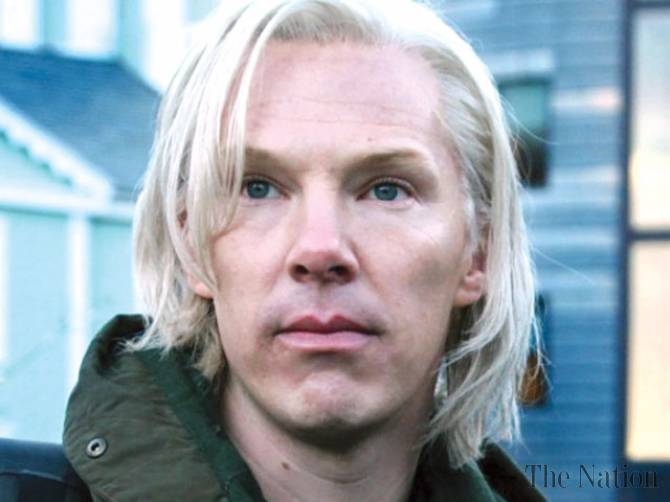
the-fifth-estateIn late medieval times, when people first began to divide each other into groups defined by status and power, they began to speak of a “first estate” (the clergy), a “second estate” (the nobility, which also at the time meant the government), and a “third estate” (the common people.  Later, the “fourth estate” was added to describe journalists and what today we call news media.  Julian Assange, the Australian teenage hacker turned founder of Wikileaks is singular, unprecedented, gui generis.  He collects masses of “secret” data and publishes it without editing, digesting, analysing, or redacting any of it.  And so, this movie, with Benedict Cumberbatch as the white-haired Assange, is called “The Fifth Estate.”

This movie, from director Bill Condon (“Kinsey,” “Dreamgirls”), and based on a book by Assange’s now-estranged former partner Daniel Berg (played in the film by “Rush’s” Daniel Brühl) at times feels as though it is un-digested and un-analyzed.  As a government official forced to resign due to some of the disclosures says near the end of the film, “I don’t know which of us history’s going to judge more harshly.”  I would advise anyone interested in Wikileaks to begin with the documentary, “We Steal Secrets: The Wikileaks Story,” directed by Alex Gibney.

Assange says that he has two goals for what he calls “a whole new form of social justice.”  He says he wants transparency for institutions and privacy for individuals.  The problem, or, at least, one problem is that institutions are made up of individuals.  And so, when one of Wikileaks’ early scoops is a list of British members of the far right “National Party,” it does not bother him that the members’ contact information is disclosed.  Assange is an absolutist.  He refuses to edit or redact (remove identifying information from) any of the documents he publishes.  “Editing reflects bias,” he says.  He is also something of a monomaniac and a megalomaniac, at least in the view of his one-time colleague.  According to this film, he grew up in an odd Australian cult called “The Family,” with severe beatings, and has been diagnosed as being on the autism spectrum.  He is very protective of his own privacy as he exposes the secrets of others.  And, as they say, just because you’re paranoid does not mean they’re not really out to get you.  Once Assange starts exposing the secrets of the wealthy and powerful, they start coming after him, and the thing about being wealthy and powerful is that they have the resources to inflict a lot of harm.  Two of his sources are murdered.

Condon does his best to minimize the scenes of people staring intently into monitors while they bang on the keyboards.  He has some nice visualizations to evoke the experiences, some fantastic, some just the rocky topography of Iceland, one of many places Assange hid.  And he takes a balanced approach.  Everyone would agree with some of what Assange has uncovered.  And everyone would object — even be horrified — by something he has done.  Both sides quote Orwell.  Big Brother is watching.  Like “The Social Network,” the movie focuses on the rise and fall of the friendship and partnership more than the impact of the product they were working on.  In this case, that is in part because we don’t know what that impact will be.  But in this case, we do know that the impact is transformational.  This is not some Facebook advertiser using an algorithm on your status posts to figure out what to sell you.  This is a 22-year-old destroying the confidentiality that allows candid conversations between diplomats, including information about the foreign nationals who are giving them information.

Assange explains early in this film that the program he has developed to protect the identity of the providers of leaked documents is to drown them in false and phony data.  He can say that editing reflects bias, but in the case of terabytes of information dumped in undigested and unredacted form, the data dump can be just as distorting.  Like the journalists Assange worked with on the Bradley Manning material, this film tries to put some shape and perspective on a story that is still too big and too new to frame as a definitive narrative.  But it is an absorbing story and as good an assessment as we can get for now.

Parents should know that this film has very strong language, violence including shooting and wartime scenes with some disturbing images.

Family discussion:  What is the answer to the State Department official’s question about whose side history will be on?  Who should decide what gets released?  If Wikileaks makes other organizations accountable, who makes Wikileaks accountable?  Do you agree with the two things Assange says you need to have to succeed?

If you like this, try: the documentary “We Steal Secrets: The Story of Wikileaks,” read up on the most recent leaker, Edward Snowden, and take a look at the Wikileaks page

Related Tags:


Based on a true story Drama Movies -- format Politics

Carrie

Posted on October 17, 2013 at 5:50 pm

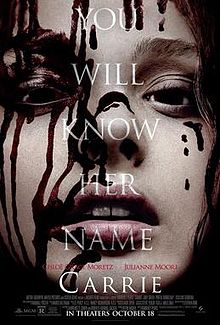
The remake of “Carrie” is not a bad movie; it’s just a completely unnecessary one.  The 1976 original is a horror classic, directed by Brian de Palma and the first film based on a novel by Stephen King, just 26 years old when he sold the rights for $2500.  Both of its stars were nominated for Oscars, almost unheard of for a genre film, and it is number 46 on the American Film Institute’s list of the top 100 thrillers.Carrie poster

The idea of updating the story of the bullied high school girl to the era of Facebook and YouTube had some intriguing possibilities, especially directed by Kimberly Peirce, whose extraordinary “Boys Don’t Cry” had an insightful authenticity in the portrayal of young people who felt like outsiders.  But there is nothing especially timely, revealing, or surprising in this remake.  The performances are not up to the level of the original and even the special effects do not seem much better than those in the version that came out when Gerald Ford was President.

Less than a moment into the film, we are already immersed in blood.  We hear screams and we see a Bible.  Margaret White (Julianne Moore) is in bed, the sheets all bloody, moaning and praying.  She thinks she is dying and she thinks it is because she is being punished.  But the pains she feels are contractions and she is shocked to find a baby emerging from her.  At first, she wants to kill her new daughter with her sewing shears.  But she loves the newborn too much to hurt her and, as we learn, she sees the baby as another chance for her to be pure, to be kept safe from the predations of sin and the devil.

We then see Margaret’s daughter, Carrie (Chloë Grace Moretz of “Kick-Ass” and “Let Me In”), a shy, repressed, somewhat backward senior in high school and ignored or insulted by the other girls.  She gets her period for the first time in the locker room after PE and becomes hysterical.  Like her mother, she has no idea what is going on with her body and she thinks she is dying.  The other girls are horrified that she is so ignorant and make fun of her, throwing tampons and sanitary napkins at her.  Chris, the ringleader (Portia Doubleday) gets it all on her cell phone camera and uploads it to YouTube.

Margaret seems to think that if she had been able to keep Carrie “pure” she never would have gone through puberty.  She locks Carrie in a small closet under the stairs and tells her to stay in there and pray.

But puberty seems to have unlocked some special powers in Carrie, powers that seem tied to her emotions.  As she sits in the principal’s office, his water cooler bubbles and then explodes. Carrie gets books on miracles and telekinesis from the library and begins to see what she can do and how much she can control.  For the first time, she begins to sense some independence and to rebel against her mother.

Sue (Gabriella Wilde) feels guilty about her role in making fun of Carrie and asks her boyfriend, Tommy (Ansel Elgort, soon to be seen in both “Divergent” and ‘The Fault in Our Stars”) to invite Carrie to the prom.  She says no at first, but then accepts, and his kindness and courtesy make her feel appreciated for the first time.  Until….

And that’s the thing.  Everyone knows what happens at the prom.  It is one of the most famous images in cinematic history.  This replay adds nothing new.

Moretz is a thoughtful and serious young actor, but she is better at playing a precociously sophisticated and capable character like Hit Girl or even the friend of the Wimpy Kid than she is at trying to show us the innocent and vulnerable Carrie.  More at fault is the script, which fails to provide a consistent emotional truth for the character. Like the Hulk, her powers are rooted in fury.  King, even in his 20’s, knew how satisfying that would be for everyone who has been picked on (that is everyone), and Moretz is at her best when enjoying the sense of righteous revenge.  To make the movie work, though, that would need to be balanced by an underlying sense of the character that is never there.  The same goes for Margaret. In 2013, the thoughts of a religious fanatic open up some possibilities worth exploring but Peirce is more interested in re-creating the original than updating it.

Parents should know that this film has extensive and graphic peril and violence with many characters brutally killed, disturbing and bloody images, sexual references and situations involving teenagers, a graphic childbirth scene, teen drinking, and strong language.

Family discussion:  Why were the girls so mean to Carrie?  How has bullying changed since the story was first written?  How did Carrie feel about her powers and why?

If you like this, try: the original film and some of the other Stephen King adaptations like “The Shining” and “Sleepwalkers”

Related Tags:


Based on a book High School Horror Remake Stories about Teens Thriller

Tonight on TV: Toy Story of Terror

Posted on October 16, 2013 at 8:00 am

Pixar’s first ever television special has the “Toy Story” characters (including “Toy Story 3’s” master thespian Mr. Pricklepants, voiced by Timothy Dalton) in a story filled with funny scares and scary fun.  Tonight on ABC 8PM (7 Central)

http://www.youtube.com/watch?v=CUp91G7DI00
Related Tags:


Animation Holidays Series/Sequel Television

Interview: Dustin Putman on The Fright File: 150 Films to See Before Halloween

Posted on October 11, 2013 at 12:42 pm

It was a special treat to interview my friend Dustin Putman about his new book, The Fright File: 150 Films to See Before Halloween. As horror director Scott Derrickson says on the cover, “Dustin Putman knows the horror genre inside and out!”

What’s the first scary movie you remember seeing?photo-3

A lot of my early childhood memories run together, but I do distinctly remember watching “Friday the 13th“ with my older brother, Rudy, one Saturday afternoon shortly after my family got our first VCR. I must have been four or five. It was also quite a personal triumph for me the first time I watched the macabre 1985 Disney sequel, “Return to Oz,” by myself. What an amazingly creepy film! Disney likely would never release something like that nowadays.

There are a lot of different kinds of scary — suspense, psychological, gory, monster. What makes each one work and which do you like best?

The great thing about the genre is that all of the above can work as long as there is a definite vision behind them, they are done well, and the filmmakers do not insult their audience. Passionate horror fans are actually quite discriminating, and when one works it can be one of the great movie-watching experiences. Supernatural horror can be fascinating and scary because it deals with the unknown—things that often cannot be explained. There is really nothing like psychological horror, especially from the 1970s, when studios were making films for adults rather than teenagers. 1973’s “The Exorcist,” and that same year’s unforgettably complex, chilling “Don’t Look Now,” directed by Nicolas Roeg and starring Donald Sutherland and Julie Christie, are two of my favorites. 1973 must have been a banner year. I also do still have a soft spot for slasher flicks, as well, probably because while growing up those were the ones I most gravitated toward. I should say there is a VERY fine line between a smart, scary, suspense-laden slasher and a lazy, derivative, throwaway one, which is what they tended to become as a result of the success of 1978’s “Halloween.”

There are a lot of horror/thriller movie series, including “A Nightmare on Elm Street” and “Halloween.”  Which is your favorite?

When people ask me what my favorite horror movie is, I always have the same answer: John Carpenter’s “Halloween.” It is pretty much the epitome of perfection to me in cinema, a low-budget production made by talented young artists that relied on atmosphere, classical building of tension, memorable characters, frightening situations, fluid camerawork, and a brilliant instrumental score to tell a simple story brilliantly. It should also be mentioned that “Halloween” has little violence and almost no onscreen blood. These kinds of films quickly became more gory and almost pessimistic. “Halloween” cared about its characters and delivered a thrilling, inspiring experience.

Who is the all-time greatest horror movie villain and why?  Which one has the best motive?

I will have to piggyback on my previous answer and say the killer from “Halloween,” Michael Myers. Before the sequel devised the whole brother-sister angle between he and Laurie Strode (Jamie Lee Curtis) and Rob Zombie tried to throw cockamamie explanations into his inferior 2007 remake, the most terrifying thing about Michael was that there was no motive at all. As psychiatrist Dr. Samuel Loomis (Donald Pleasence) explains in the film, he is “purely and simply evil.” This is much scarier to me because Michael isn’t just a mentally disturbed man, but, for all intents and purposes, the boogeyman.

Who is the all-time greatest horror movie director?

There are a lot of directors I admire, usually from different periods in their careers. 1970s/’80s-era John Carpenter is certainly up there (in little more than a decade’s time, he made “Halloween,” “The Fog,” “The Thing,” “Christine,” “Prince of Darkness,” and “They Live”). Wes Craven is responsible for two of my favorites, “A Nightmare on Elm Street” and “Scream.” More recently, Ti West is, for me, a modern-day master. His movies are all different in story, but very specifically his own style. It is quite telling that every film of his that has been released, to date, made it into my book, “The Fright File,” including 2005’s underseen gem “The Roost,” 2007’s even more underseen thriller “Trigger Man,” 2009’s “The House of the Devil,” and 2011’s “The Innkeepers.”

Without giving it away, which movie has the best twist ending?

There are two that come to mind, and they are both impossible to forget for anyone who has seen them: 1983’s “Sleepaway Camp” and 1999’s “The Sixth Sense.” I can’t give them away, obviously, but they were both impeccably constructed in a way that surprised upon first viewing and hold up on successive revisits even after you know the “truth.”

TFF_FrontCoverOnlyHow do American horror movies differ from those made in other countries?

My temptation is to say that horror movies from other countries are smarter than American ones, but this would actually be a gross generalization. There are plenty of outstanding U.S.-made horror efforts, and a lot of foreign titles that aren’t very good. One distinction, I think, is that genre movies from other countries tend to be more courageous and cerebral and trend-setting, while American horror is perhaps more concerned with the bottom line and trying to recreate past successes. This is why we see so many remakes these days, and went through a phase a few years back where every Japanese horror title was being redone in the States.

Horror movies get remade a lot — which is the best remake?  Which is the worst?

Best remakes: 2004’s “Dawn of the Dead,” directed by Zack Snyder, did a fabulous job of updating the story and putting a fresh spin on the subject while still adhering to the spirit of the Romero classic. Also, I thought 2010’s “Let Me In,” a remake of “Let the Right One In,” actually improved upon the acclaimed Swedish original by adding underlying layers involving the political climate and so-called “Satanic Panic” of the 1980s.

Worst remakes: 2005’s “The Fog” and 2006’s “The Wicker Man.” Both of these were disasters, missing the entire points of their predecessors. Every possible bad decision one could imagine seemed to be made tenfold when these updates were put in front of the camera. At least Rob Zombie’s “Halloween,” which I am not a fan of, had an undeniable vision behind it. “The Fog” and “The Wicker Man” were two examples of remakes made by committee, with zero creative insight.

What do you love most about horror?

The horror genre is one of a kind in the way that it can play so heavily on the viewer’s deeper emotions. An effective horror film can be an incredibly cathartic experience, and a whole lot of fun. Also, because many of them deal with very extreme situations and ideas, there is more room to explore different themes and use fantastical or frightful subject matter as metaphor for larger universal topics. This is why, I believe, so much has been written on the subject of horror; its scope, and where filmmakers can take their stories, is boundless. 

Dustin’s reviews of hundreds of movies in every genre are available at DustinPutman.com

Related Tags:


Books For Your Netflix Queue Horror

Captain Phillips

Posted on October 10, 2013 at 6:00 pm

B+
Lowest Recommended Age: High School
MPAA Rating: Rated PG-13 for sustained intense sequences of menace, some violence with bloody images, and for substance use
Profanity: Strong language
Alcohol/ Drugs: Drugs
Violence/ Scariness: Intense, graphic, and disturbing violence including threats, torture, and guns
Diversity Issues: Diverse characters
Date Released to Theaters: October 11, 2013
Date Released to DVD: January 21, 2014
Amazon.com ASIN: B008JFUNKU

captain phillipsMemorable movie villains tend to fall into two categories: volatile and violent or sociopathic and megalomaniac. Both kinds are caricatures, sketched in exaggerated terms to justify our feeling of triumph when the hero prevails. But in “Captain Phillips,” the true story of a US merchant ship taken over by Somali pirates, the villain is far more real and far more terrifying. Somali native Barkhad Abdi stars as Abduwali Abdukhadir Muse, the leader of a group of four teenagers sent to hijack ships for ransom money by elders in their village. Muse is the scariest of villains, someone with no other options and nothing to lose. Abdi’s performance in his first acting role is stunning, terrifying, and heartbreaking.

An awkward opening scene shows Captain Phillips (Tom Hanks) is at home in Vermont, preparing for his trip and driving to the airport with his wife (Catherine Keener), with some clunky, exposition-heavy dialog intended to foreshadow upcoming unrest.  Once he gets to the boat, called the Maersk Alabama, director Paul Greengrass locks into the taut, intimate style he showed in “United 93” and two Bourne movies.  The ship has a crew of 20.  They have been warned about the possibility of pirates and have had some training in how to respond.  Phillips orders a surprise drill to make them practice their defensive tactics.  But this is not a military ship. They are carrying 17 metric tons of cargo.  Their primary tactics are diversion and their primary weapons are their firehoses.

At first, the firehoses work.  But then the Somalis get close enough to the ship to attach their ladder and climb aboard.  “I’m the captain now,” says Muse.  His lack of affect is chilling.

Director Paul Greengrass has an intimate, documentary style that keeps even those who remember the details of the real story on edge.  The pirates search the ship, looking for the crew like a nightmare game of sardines.  Phillips leads them around, genial and cooperative on the surface, but always thinking about how to impede them without making them angry.  When their boat is destroyed, they take one of the lifeboats, more like a capsule than a ship, and they take Phillips as hostage.  For four grueling days, Phillips has to try to keep calm and do what he can to help the US Navy, which is assembling its response.  Hanks goes deeper than he ever has before, ultimately reaching a place of wrenching vulnerability.

After a shaky start, Greengrass and his talented cast make this into more than a story of courage and resilience.  While he clearly has a point of view and never pretends that the pirates are justified, he allows us to understand their desperate circumstances.

Parents should know that this is the true story of a pirate attack on a US ship, featuring intense and disturbing scenes of threats, torture, and violence with some graphic images and dramatic emotional breakdown.

Family discussion:  What was Captain Phillips’ most difficult decision?  What was the most difficult decision for the US military in responding to the pirates? Do you disagree with any of their actions?

If you like this, try: “United 93,” another true story from the same director and Captain Phillips’ book, A Captain’s Duty: Somali Pirates, Navy SEALS, and Dangerous Days at Sea

Related Tags:


Based on a true story Drama DVD/Blu-Ray Pick of the Week Thriller
THE MOVIE MOM® is a registered trademark of Nell Minow. Use of the mark without express consent from Nell Minow constitutes trademark infringement and unfair competition in violation of federal and state laws. All material © Nell Minow 1995-2026, all rights reserved, and no use or republication is permitted without explicit permission. This site hosts Nell Minow’s Movie Mom® archive, with material that originally appeared on Yahoo! Movies, Beliefnet, and other sources. Much of her new material can be found at Rogerebert.com, Huffington Post, and WheretoWatch. Her books include The Movie Mom’s Guide to Family Movies and 101 Must-See Movie Moments, and she can be heard each week on radio stations across the country.

Website Designed by Max LaZebnik