
Interview: Janet Tobias of the Holocaust Documentary “No Place on Earth”

Posted on April 7, 2013 at 3:58 pm

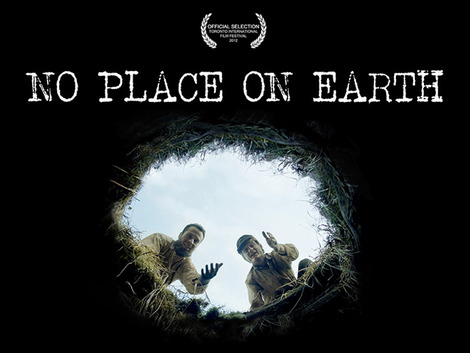
No Place on Earth is the extraordinary new documentary about a small group of Jews from Ukraine who hid from the Nazis in two caves for almost two years.  Interviews with the survivors, narration from a book written in the 1960’s by the woman who was one of the leaders of the group, some re-enactments, and a powerful return to the caves 67 years after the end of the war.  Tonight, as the annual observance of Yom Hashoah, the day of holocaust remembrance, it is especially meaningful to share this story.

http://www.youtube.com/watch?v=n00EE5CeatA

I spoke to director Janet Tobias about making the film.

One of the people in the film says, “We were not survivors.  We were fighters.”  What do you think that means?
They were fighters.  They stuck together.  Esther Stermer was an incredible mother and grandmother, a matriarch. She didn’t do the obvious thing.  She decided to do what was necessary to survive and to protect her family.  It’s an incredible story of what they accomplished.  The lesson I take away from it is how much we depend on each other.  they were greater as a collective whole than they were individually.  Many of them would not have made it on their own.  We do much better when we have each other than on our own.  

The families were extended families, but it was a tough world.  There had to be a group of people from each family who were willing to risk their lives on a weekly basis.

Tell me about the re-enactments of some of the scenes, which you shot in Hungary.

I was blessed with an incredibly great group of Hungarian actors, from Kati Lábán, who played Esther Stermer who is a very well-known actor in Hungary to some who had never acted before. We looked for approximation of physicality but I was not going to be completely literal because it is more important to have the person who has the right understanding of the story and the spirit.  We did recreations, a hybrid between documentary and drama, because on the one hand you are in the presence of the last years of people who were eyewitnesses, who can say, “That happened to me.  I saw it,” which is an incredible gift in documentary.  On the other hand, the Stermers were fighters, as you said.  They were actors on their environment.  Lots of documentaries are about people contemplating their life.  But the Stermers were fighters, not contemplators.  They are doers.  To show the incredible thing they accomplished, what they got up and did, that needed actors.  Esther Stermer had a clock in her head.  She kept a cooking schedule, a cleaning schedule.  They knew when they could go out without moonlight. They observed the holidays.  When they were buried alive, they did not give up and say “It’s over.”  They said, “We need to do the following things in construction to even have a chance of figuring this out.”  They were dramatic actors in real life, so we needed to match that.

And we had to show what it was like to live in the cave.  I had never been in a cave except to walk by the opening on a hike.  That world is a crazy strange world, the claustrophobic spaces, the mud, the darkness.  It’s really hard to imagine, so we really needed to show people the world they were living in and navigating in, the world they ultimately found safer than the outside world.

You can see how dynamic they still are when they return to the cave, 67 years later.  They were so young when they were in the cave.

You do hear Esther’s words in the book she wrote in 1960.  And the leadership in the cave passed to young men.  It shows how incredibly brave and honorable young men can be.  Esther was running things underground but the father was afraid and so the leadership in the cave was teenage boys and young men in their 20’s because they were capable of doing things that kept everyone alive.

The story of the horse is almost like a fairy tale, especially when the families, who are so hungry, decide not to eat the horse but to let him go.

Even Sol did not believe his brother would come back with a horse.  For Sol, it was this miraculous thing for his brother to find a horse to help them get supplies.  They felt so blessed and lucky that they did not eat the horse.

And when they returned, no one in the town even said hello to them.

After the war, fighting continued in Ukraine.  Partisans were fighting the Russians.  Their possessions were taken by people who did not want to give them back.  There was a lot of hostility to Jews, which is why there are no Jews in that town anymore.  Their dog gave them the only greeting.  We really wanted their return to be meaningful for them and it was.  They are very special people.

Why was it important to show the photographs of the families of the survivors at the end?

What these 38 people did, each with individual experiences, each fighting hard, from the children to the grandparents — the ripple effect is life.  All the children and grandchildren and great-children who became lawyers, doctors, construction workers, physical therapists, they are all alive because these people fought.  Fighting and survival and preventing genocide, that starts one person at a time.  One Polish woodcutter giving information, one person saying “We’re not going to leave our cousin behind,” that has a ripple effect of life with generations who make a difference.


Related Tags:


Directors Documentary

From Up on Poppy Hill

Posted on April 4, 2013 at 6:00 pm

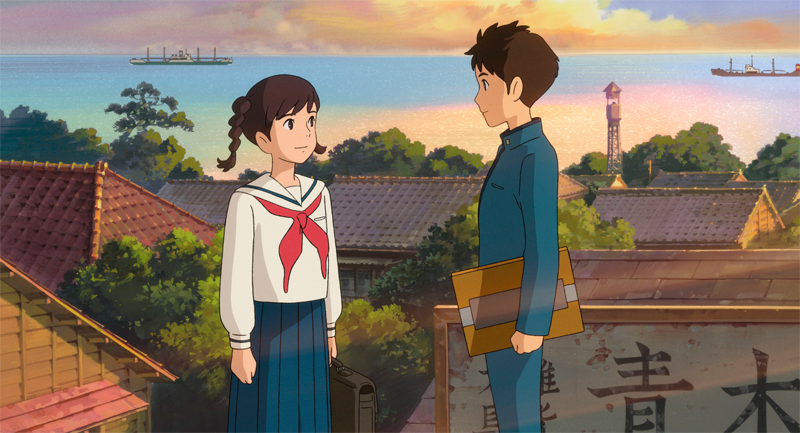
The animated films from Japan’s Studio Ghibli are adored by many American families for their lush and intricate hand-drawn animation and imaginative story lines.  But others, like me, find many of them uneven and inaccessible.  The latest, from Goro Miyazaki, son of  legendary writer/director/animator Hayao Miyazaki (“Spirited Away,” “My Neighbor Totoro,” “Princess Mononoke”), has the gorgeous settings we expect from Ghibli, inspired as much by European fairy tales as by the mid-century Japanese seaside town where the story takes place.  But it also has the inexpressive faces and oddly un-family-friendly storyline of some of the studio’s other productions.  It seems more than a little off that a large part of the plot concerns a disturbing issue of possible paternity, a questionable theme for a movie about and intended to be seen by children.

Hayao Miyazaki co-wrote the film, based on a popular manga comic.  Like many of the Studio Ghibli films, it is the story of a young girl who has had to take on a lot of responsibility.  It is set in the Umi (voice of Sarah Bolger of “In America”), a quiet, respectful girl.  She lives with her grandmother, who runs a boarding house above in the port city of Yokohama.  Umi’s father was lost at sea fighting in the Korean War.  Her mother is studying in America.  Every day, Umi hoists a “safe voyage” signal flag for all the boats.  In her heart, it is also a message to the father she still dreams will someday come back to her.

One day, she meets the outgoing, impulsive Shun (Anton Yelchin).  As she works with him to help restore a dilapidated house Shun and his friends are using for their club meetings.  They hope to persuade local officials not to knock it down.  They never speak about their feelings but it is delicately shown that they are drawn to one another.  And then they discover >they may be siblings.  “I guess we stop feeling how we feel,” Shun says, and they agree to stay friends.  Fortunately, they find a kind and reassuring answer to their question.

It is strange to see so much focus on the details of the backgrounds, which are exquisitely rendered, when there is so little attention to the expressiveness of the characters.  The fluttering of a signal flag conveys more emotion than the impassive faces and delivery of the characters.  The resonance of the story’s context in the years between Japan’s defeat in WWII and its hosting of the 1964 Olympics 20 years later will be lost on today’s children, which leaves the thin storyline inadequate to sustain our interest to the end.


Parents should know that this movie includes references to sad parental losses and separation and war and a discussion about how the two young teens who have romantic feelings for each other might be siblings.

Family discussion: What did Umi and Shun like about each other?  Why was the house important to the kids?

If you like this, try: “Spirited Away”

Related Tags:


Animation Stories About Kids

Jurassic Park 3D

Posted on April 4, 2013 at 6:00 pm

A
Lowest Recommended Age: Middle School
MPAA Rating: Rated PG-13 for intense science fiction terror
Profanity: Brief strong language (s-word, SOB)
Alcohol/ Drugs: Smoking, drinking
Violence/ Scariness: Intense and sometimes graphic peril and violence featuring children and adults, adult characters injured and killed
Diversity Issues: Diverse characters
Date Released to Theaters: April 5, 2013
Date Released to DVD: April 22, 2013
Amazon.com ASIN: B00B4804KS

Back in 1993, what was astonishing in “Jurassic Park” was the special effects that seemed to bring dinosaurs back to life.  Two decades later, rediscovering Steven Spielberg’s mastery of cinematic storytelling is the best reason to go see it again.

It is back in theaters with the best 3D conversion I’ve seen, avoiding the cheesy Viewmaster effect too often the result of adding 3D effects after a movie has already been filmed.  Other than a couple of shots where the foreground is distractingly blurred, the effects are immersive and organic, and the dinosaurs-jumping-toward-you moments are sparing and effective.

My favorite moment in the film has always been when the characters are trying to outrace the charging T-Rex in a jeep.  All of a sudden, we see a toothy dinosaur coming at them fast and angry in the side rear-view mirror.  It takes a moment for the words on the mirror to register: “Objects in mirror are closer than they appear.”  Spielberg has found a way to make us laugh and ramp up the tension at the same time.  And it is even more compelling in 3D.

The movie holds up remarkably well, other than the computers and walkie-talkies used by the characters, which will seem to today’s audiences almost as prehistoric as the dinosaurs.  On the other hand, its then-state-of-the-art special effects, a combination of mechanical creations and computer images, are still as immediately believable as the high-techiest creatures on screen today.  

Spielberg has gone on to weightier and more prestigious projects, but this thrill ride of a popcorn pleasure is one of his best and a masterpiece of the genre.  It shows his unparalleled gifts for pacing and for the visual language of movies, and his ability to make us invest in the characters.  That is what makes all the special effects pack an emotional wallop.  He conveys more with ripples in a glass of water — or a sneeze — than most filmmakers can with 15 pages of dialogue.

The story, based on a book by the late Michael Crichton, begins with hubris, the sin of pride so great that a man places himself with the gods and thus sets the stage for his downfall.  John Hammond (Richard Attenborough) is a vastly wealthy man who dreams of extracting dinosaur and plant DNA that has been trapped for millions of years in amber and using it to reboot species of flora and fauna that have not been seen on earth.  Spielberg grounds the story with a strong moral core that lets us enjoy the catastrophic destruction ahead without any inconvenient pangs of conscience.

Spielberg also makes sure we have someone to root for, lining up our loyalties with a quick introduction to characters we can both identify with and admire.  Laura Dern and Sam Neill play experts in paleolithic animals and plants. They are (1) interested in science, not money (except to pursue more science), and (2) in love.  That’s all we need to know.  But just to make sure, he adds in a couple of children (Hammond is their grandfather), who not only get our automatic protective instincts going but give Neill’s character a chance to grow.  At the beginning, he does not like children.  At the end — spoiler alert — he does.

Go to see “Jurassic Park” in 3D.  Go to take your kids who were not born when it was released.  Go to see it the way it should be seen, on a big screen in a theater filled with happily terrified fans.  Go to see Samuel L. Jackson before he was SAMUEL L. JACKSON. And for a young female computer whiz who could grow up to be Sheryl Sandberg.  But most of all, go for the resoundingly satisfying delight of watching pure Spielberg movie magic.

Parents should know that this movie has non-stop peril, with characters injured and killed and some graphic scenes of injury, including a severed limb, brief strong language (s-word, SOB), drinking and smoking

Family discussion: How many different controls were in place to prevent the dinosaurs from hurting anyone and how did each one fail?  What have been the biggest changes in science and technology since this movie was made? Learn about current experiments with gene splicing of animals by reading Frankenstein’s Cat by Emily Anthes

If you like this, try: your local museum to see dinosaur fossils and Spielberg’s “Jaws” and “Duel”


Related Tags:


3D Action/Adventure Based on a book DVD/Blu-Ray Pick of the Week Science-Fiction Series/Sequel Thriller
THE MOVIE MOM® is a registered trademark of Nell Minow. Use of the mark without express consent from Nell Minow constitutes trademark infringement and unfair competition in violation of federal and state laws. All material © Nell Minow 1995-2026, all rights reserved, and no use or republication is permitted without explicit permission. This site hosts Nell Minow’s Movie Mom® archive, with material that originally appeared on Yahoo! Movies, Beliefnet, and other sources. Much of her new material can be found at Rogerebert.com, Huffington Post, and WheretoWatch. Her books include The Movie Mom’s Guide to Family Movies and 101 Must-See Movie Moments, and she can be heard each week on radio stations across the country.

Website Designed by Max LaZebnik