
The Dark Knight Rises

Posted on July 18, 2012 at 11:38 am
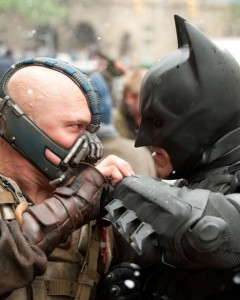
There’s a reason you never hear about “your friendly neighborhood Batman.”  Spidey may have some angst and guilt and abandonment issues but he is downright sunny-natured compared to the brooding soul of Bruce Wayne (Christian Bale), holed up in Wayne Manor with only his loyal manservant Alfred (Michael Caine) and his tortured memories.  At the end of the second chapter of director and co-writer Christopher Nolan’s Dark Knight trilogy, Wayne decided it would be better for the citizens of Gotham to believe that Harvey Dent (Aaron Eckhart) died a hero than to tell them to truth about the descent of a once-honorable man into madness and vigilantism.  So everyone thinks that Batman is the villain who killed Dent instead of the hero who saved the city and Wayne is refusing to see anyone.

In Dent’s memory, legislation has been passed to keep dangerous criminals imprisoned and the crime rate is down so low that a policeman jokes they may be reduced to chasing people down for overdue library books.  But everyone in this story is tortured by secrets and shame, even Commissioner Gordon (Gary Oldham), who carries in his breast pocket a speech setting the record straight but does not have the nerve to deliver it.  There is the lissome but light-fingered catering assistant who turns out to be the notorious Selina Kyle (Anne Hathaway, rocking the leather catsuit).   And there is Bane (Tom Hardy), a terrorist who shows his contempt for humanity by cynically couching his atrocities in the idealistic vocabulary of social justice, trashing spirits as he trashes the concrete and social structures of the community.

It is overlong at two hours and 40 minutes but the action scenes are superbly staged, from the audacious plane-to-plane maneuver at the very beginning to the literally earthshaking attack on the city.  The “pod” motorcycle chases are sensational, especially with Hathaway at the helm.  She is never referred to as Catwoman, by the way, but when her goggles are up on her head, they amusingly evoke cat’s ears.  Joseph Gordon-Levitt is a standout as a perceptive young detective who understands Wayne too well.  Hardy does his best to overcome the daunting limitations of the masked role, acting with his eyes and body language, but the weirdly disembodied voice is unconnected to the action and at times seems like a bad dub job in a cheesy karate film.  Bale’s performance in this role (or, I should say, these roles) has always seemed thin to me, but fellow Oscar-winners Marion Cotillard, Morgan Freeman, and Michael Caine add some heft, especially Caine’s devoted Alfred, and it is good to see Tom Conti and Juno Temple in small but important roles.

The “Dark Knight Rises” title applies equally to both hero and villain in this story.  This is like a chess game where all the pieces are black.  Everyone has masks.  Everyone has scars and a soul corrupted by a bitter stew of anger, fear, betrayal, abandonment, and isolation.  Wayne says more than once he wears a mask to protect those he cares about, but he wears it to keep himself from getting too close to them, too.  Nolan continues his exploration of duality and untrustworthy narrators (though one logical inconsistency inadvertently telegraphs a plot twist).  Even the WMD at the heart of the action was originally designed for a benign, even heroic, purpose.  This is a thoughtful, ambitious story that explores the metaphor and heightened reality of the superhero genre to illuminate the fears and secrets — and potential for heroism and yearning for a clean slate — we all share.

Parents should know that this film has extended comic book-style action, peril, and violence, many characters injured and killed, torture, hostages, references to sad loss of parents, brief mild language, non-explicit sexual situation

Family discussion: Almost everyone in this movie has secrets and conflicts — how many can you identify?  Was Bruce Wayne right in thinking the risks of the energy technology were greater than the benefits? How are Bane and Batman alike?

If you like this, try: the Frank Miller “Dark Knight” comic books and the other “Dark Knight” movies

Related Tags:


Action/Adventure Comic book/Comic Strip/Graphic Novel Crime Series/Sequel Superhero

Ice Age: Continental Drift

Posted on July 12, 2012 at 6:00 pm

The “Ice Age” folks have the formula down very well, and this fourth entry is one of their strongest, with enough of the familiar to be satisfying and enough that is new to keep things interesting.  The real expertise is the mixture of heart, humor, and adventure, in what is now one of the most reliably entertaining series for families.

It begins, as “Ice Age” must, with Scrat, the saber-toothed squirrel who is the Sisyphus of the pre-historic era.  Scrat (voiced, or, I should say, squeaked and squealed, by  director Chris Wedge) wants an acorn, but it is his destiny to have it always just beyond his reach or to create chaos when he tries to bury it.  Both happen right off the bat as inserting the tip of the acorn into the ice has results that are literally earth-shattering.  Yes, it turns out that the reason the continents separated and moved to opposite sides of the oceans was because of a squirrel.

Meanwhile, our old friends Diego the cranky saber-toothed tiger (Denis Leary), Manny the anxious Mammoth (Ray Romano), and Sid the silly sloth (John Leguizamo) are on the wrong side of the dividing tectonic plates and become separated from Manny’s mate Ellie (Queen Latifah) and his tween daughter Peaches (Keke Palmer).  Just as Manny and Peaches are in conflict because she wants to hang out with her friends and he thinks she is too young, the ground buckles and cracks underneath them.  Diego, Manny, and Sid are adrift on an ice floe along with Sid’s dotty grandmother (Wanda Sykes).  Like Daniel Day-Lewis in “Last of the Mohicans,” Manny promises, “I will find you.”  But they have no cell phones or GPS or even maps.

And then things get worse, as they run into a pirate crew on a ship made from ice led by the piratical Captain Gutt (a sensational Peter Dinklage of “Game of Thrones”).  His first make is a female saber-toothed tiger named Shira (Jennifer Lopez).  Our heroes must battle Gutt’s gang and find their way back home.  Gutt and Sid’s granny are welcome additions to the cast, adding vitality and flavor to a cast whose conflicts have subsided in the previous chapters.  The animation is exceptionally well executed, especially the roiling water and a very funny reaction to a paralyzing plant.  The action scenes continue to be crisply executed and the happy ending includes lessons on loyalty for friends and family.  If it merrily ignores any historical or scientific legitimacy, it shows its value with wit and heart.

(more…)

Related Tags:


3D Action/Adventure Animation Comedy Family Issues For the Whole Family Series/Sequel Talking animals

Interview: Lauren Greenfield of “The Queen of Versailles”

Posted on July 12, 2012 at 8:00 am

Lauren Greenfield is the director of the new documentary, The Queen of Versailles, the story of Jackie Siegel and her husband David, a monumentally wealthy couple who were building the largest residence in the United States, a 90,000 square foot mansion with ten kitchens, a baseball field, a spa, and two tennis courts.  While Greenfield was filming, the financial crisis hit the Siegels and like millions of other Americans, they were suddenly and unexpectedly at risk of losing their home.  It is just that their home was modeled on the palace that Marie Antoinette and Louis XVI lived in before the French revolution.  Greenfield spoke to me as she was in town for the Silverdocs film festival and was preparing to show her film to the Secretary of the Department of Housing and Urban Development.  David Seigel’s fortune comes from the timeshare company Westgate.

http://www.youtube.com/watch?v=bqDreqlPe98

Where are the Siegels now?

Jackie was here at Silverdocs last night and she’s on a road trip with her kids, a vacation road-trip. I asked if it was a downsized vacation and she said “kind of,” but she stopped at Saks Fifth Avenue and went to Chanel and Westgate is continuing to make sales, and David says it’s very profitable. At the end of the film Richard, his son, says, “If he gives up the keys to Vegas, the lenders will continue to lend and they can go back to making money, and he can go back to his life as it was.” Some of that has happened, the lenders have continued to land and so the rest of the resorts are making money and they are still in debt (I think they have estimated a few years to get out of debt). And David would like to start construction on the house again.

He’s such a good businessman in so many ways and yet he was very foolish about not segregating his own assets from the company’s and that put him under a lot of financial pressure he’d really didn’t need to be under.

Vegas was such a gamble and in a way such an irrational gamble, I think was part business and part emotion because he was also thinking about the $2 billion he was going to make there and was kind of holding onto that as his crowning achievement. He also had the Westgate name and lights brighter than anything else on the strip, perfect spot on the strip, and then the legacy of Vegas with his parents and then perhaps the other legacy of their gambling which ultimately kind of brings that dream down for him.

How do you as a film maker state close to a family like that over such a long period of time and yet maintain some objectivity? It must’ve been very difficult, particularly as you observe the way they behave with each other.

In a way that’s my modus operandi. I feel like I have that perspective in all my work and in my photography, too. I do get really close to the subjects, but I also am always kind of looking at things from a sociological perspective. I think with Jackie and David’s story – I could feel a lot of compassion for them and I really liked Jackie a lot and respected David.  The original premise of the film I really saw it as allegory that represented what happened to so many Americans. So, I saw their virtues and their flaws as speaking to our virtues and flaws as Americans, too, and so I guess I solve them as individuals and also sort of symbolic. I am able to kind of get close to people and be there on a day-to-day basis but also step back and look at “what does it mean, what does it mean for us in the context of the bigger picture, eventually the allegorical picture?” With that said, some of that comes with living with the footage.  I filmed over a three-year period and I cut over a six-month period in that process would show mentors and other editors and I went to the Sundance lab with the film, so I also had a chance to kind of step back, how do people react what do they get what do they not get?  But in terms of my view I was always looking at them as both incredibly fascinating characters, incredibly fascinating story and also kind of a symbolic one; that in a way is a viewpoint in all my work.

I just don’t take on being an interventionist in the work. I feel like in a way this is a social issue film, it’s about the housing crisis, it’s about our culture of consumerism. I feel like it’s a morality tale that also speaks to the consequences of access, but I would never take it upon myself to intervene. I try not to judge, too, and I think you can see that in the perspective of the film that I am kind of there, and let’s step back and see what it means.

Tell me about the decision to include in the film the incredibly poignant commentary from Virginia the nanny about her own situation.

The minor characters are always important to me, and even before when they were building the house, when I thought this was going to be about the building of the house, I was interested in the upstairs downstairs quality of the house and the kind of different cultures, different classes all living as a kind of unusual extended family and with Virginia and with Cliff and with Jonquil , I was really interested in showing other experiences of the American dream, both their similarities and their differences. So, Virginia has a tragic story about not seeing her kids for over 20 years now. And yet, I think her story also speaks to so many people stories about coming to America to find fortune and Virginia is a salaried employee, her two other colleagues have gone back to the Philippines and yet Virginia chooses to send all her money home and not go there herself. I think she would like to, she was actually saving for it but her mother died and there was a funeral to pay for.  So, these are really hard choices. I saw a parallel, too, between Jackie and Virginia because money was the reason both of them were not doing direct parenting. So, I guess I saw a lot of relationships and when Virginia said her dream was to build a concrete house in the Philippines, that was really poignant to me, and I also got the sense that she thought it was hard to go back if you didn’t have something to show for it – in other words, she could afford the ticket, but she couldn’t afford to go and give everybody money, and she didn’t want to go back without that. Again, I think that story speaks to the virtues and flaws of the American dream and the importance of money. She works seven days a week she has another job on the weekends at the supermarket.

What does Jonquil bring to the story?

Jackie’s niece and adopted daughter Jonquil is another story; in a way, she represented Jackie’s experience because she came from Binghamton, but overnight she went from poverty (she came from a poor family and her mother passed away and Jackie took her in) to the mansion overnight, and also has a down to earth, quirky character. What was interesting was to see her evolution because she kind of goes from “I can’t believe I’m in this house” and Victoria—her sister now talks about how she’s had this positive influence on all the other kids so they won’t be spoiled.  By the end you can see how she is  when she says, “When I used to see rich people on TV, I thought I’d be happy, and now I see I just want more and more” and so that, to me, really speaks to the whole story.

Have you been surprised by people’s reaction to the film?

I’ve been really pleased that people have found them relatable. Not everybody does, but most people tell me that they don’t expect to in the beginning, and they’re surprised to find themselves in the end. I feel like that is really what I wanted to get through because I think there’s no point in a film where you’re like, “Look at them and their bad decisions!” It’s really only valuable if you’re kind of like, “Did I spend too much on my credit card? How am I complicit in this?”  It makes the movie more compelling if you understand them or care about them.


Related Tags:


Directors Documentary Interview

Movieline Asks Both “Spider-Man” Filmmakers the Same Questions

Posted on July 8, 2012 at 8:00 am

If they’re going to make the same movie, why not ask the same questions?  Movieline went for it — with a side-by-side comparison showing the responses by the directors and stars of “Spider-Man” and “The Amazing Spider-Man” to the same questions.  From asking directors Sam Raimi and Marc Webb how they balance the action and comedy to asking stars Tobey Maguire and Andrew Garfield how they got into shape and what if feels like to wear the Spidey suit, you can see if the people behind the film are as different, or as alike, as their performances.


Spider-Man: Tobey Maguire vs. Andrew Garfield


Related Tags:


Behind the Scenes Superhero

Interview: David France of “How to Survive a Plague”

Posted on July 7, 2012 at 8:00 am

“This isn’t a movie about what AIDS did to us,” writer/director David France told me as he was preparing to present “How to Survive a Plague,” his documentary about AIDS activism at the prestigious Silverdocs film festival in Silver Spring, Maryland.  “This is a movie about what we did to AIDS.”

France made the film because most of the cultural touchstones associated with AIDS like the award-winning plays “The Normal Heart” and “Angels in America” and the book and movie “And the Band Played On” document the early years.  They are filled with images of emaciated victims, weeping friends and family and bleak prospects.  But this is a story of inspiration and triumph, as one of the most devastating diseases in modern history went from being a certain death sentence to an illness that can be managed.  More than that, the people in this movie changed the way the medical and research communities interact with patients and their families who are coping with all diseases and conditions.

The film recognizes that the activists who led the fight in what became one of the most successful public initiatives in American history deserve recognition for their extraordinary accomplishment.  In less than 15 years they were able to transform the medical options for people with HIV and AIDS and the ways that all medicines and treatment are developed.  Along the way, they established the foundation for full integration of gay members of American society, with the freedom to be themselves and love the people they love.  I spoke to director David France about the unique opportunity he had to make use of the extraordinary archive of footage used to document the movement from its earliest moments.  This is not just the story of a brave and dedicated group of activists literally fighting for their lives.  It is the story of how a heroic and remarkably effective political movement came of age, with its internal conflicts as well as the external ones.  And it is the first time any movement has had the benefit of this range and depth of documentation, an explicit commitment going back to the earliest days.

“I didn’t want to over-burnish the halos of these guys, although I do think of them as heroic. But heroism is never a direct line; it is not a single path leading you straight to victory. And as in all movements, there are sharp differences and especially over time. ‘How to Survive a Plague’ covers nine years and four Presidents and in that period we see a lot of accomplishment and a lot of failure, as with any movement. The failures, despite the accomplishments, meant people kept dying. And people who were in the trenches, comrades of people I was following, didn’t make it. The desperation that underlay turned inward, as one might expect and ultimately created real battle lines among the activists. Those I thought were essential to tell, not just because they’re true, but because that’s human nature—and the fact that they were able to accomplish what they accomplished despite that was phenomenal. That made their triumphs even more unusual, that they worked through that anger and despair and self-doubt, suspicions among one another and still found a way to their end, and their end was the development of a drug that would finally make survival possible.”

http://www.youtube.com/watch?v=LQbM4bb6Zpk

What makes the film so remarkable is its use of the extraordinary archive of footage.  In all the political movements that have been recorded over the years, this one was probably the most thoroughly documented.  France explained, “It’s the first kind of self-documented movement.  HIV was first identified in the medical literature in 1981, the summer of 1981, and the camcorder hit the stores for the first time in the summer of 1982. So, in a way, they’re like siblings—sibling epidemics, really.  They grew up together and became pandemic, right? So people involved in AIDS saw the value of the tool at a time when no one was covering AIDS. AIDS suffering was not being paid attention to. AIDS activism was ignored and the only images that we saw through the 80’s and really through the 90’s about AIDS were skeletonized patients in bed. We saw them on the news from time-to-time. We saw victims, and the people who were doing AIDS activism and knew that that was only a small fraction of the story and that the story of what was going on was really about self-empowerment and that it was brilliant, and that it was new. There was never a patient population that had identified and developed the kind of strength that this group had, and in order to be able to capture that and reflect it back to the individuals, they’d use these tools—and they started shooting everything. By 1987 when AIDS activism took full force, cameras were everywhere. From the very beginning of Act Up, they had a committee called DIVA TV, Damned Interfering Video Activists, that’s what they called themselves, DIVA, and they created TV. It was also the beginning of cable, of public access—they grabbed a public access station—and every week they would, on their public access shows, show the footage of what happened last week in a way to build the movement and to reflect back to the people who were doing it, the beauty, really, of what they were doing and to show AIDS power, to show fierceness, to show agency in AIDS at a time when that was being denied. That footage was—my thought was from the beginning that there was enough of that, because I saw those cameras—there was enough of that footage that I could create a documentary that would bring us back to that time. I brought in, ultimately, footage from thirty-three different individuals.  It was shot by activists; it was shot by video artists who would come through like the Guggenheim program, by film-makers who are now well-known, and by loved ones who just wanted to capture what the people they love looked like in their youth, knowing that that’s all they were ever going to have.”

(more…)

Related Tags:


Directors Documentary Interview
THE MOVIE MOM® is a registered trademark of Nell Minow. Use of the mark without express consent from Nell Minow constitutes trademark infringement and unfair competition in violation of federal and state laws. All material © Nell Minow 1995-2026, all rights reserved, and no use or republication is permitted without explicit permission. This site hosts Nell Minow’s Movie Mom® archive, with material that originally appeared on Yahoo! Movies, Beliefnet, and other sources. Much of her new material can be found at Rogerebert.com, Huffington Post, and WheretoWatch. Her books include The Movie Mom’s Guide to Family Movies and 101 Must-See Movie Moments, and she can be heard each week on radio stations across the country.

Website Designed by Max LaZebnik