The Dictator

Posted on May 15, 2012 at 6:00 pm

Chutzpah has never been a problem for Sasha Baron Cohen, whose previous films, based on characters he created for television, were semi-documentaries of encounters with ordinary people who did their best to accommodate his outrageously offensive behavior.  Whether he was getting a group of people at a rodeo to sing along with an anti-Semitic anthem as an Eastern European journalist in Borat, or get parents of babies to eagerly agree to put their infants in danger in order to be in a movie as the gay fashionista Brüno, Cohen exposed hypocrisy, bigotry, and general cluelessness, as well as the occasional sweetness and tolerance of Americans willing to respect cultural differences.  After appearances in mainstream Hollywood films “Sweeney Todd” and “Hugo,” Cohen has returned to his favorite themes with a scripted film, working again with director Larry Charles, in a sharp political satire in the grand tradition of Chaplin’s “The Great Dictator” and Eddie Murphy’s “Coming to America.”  Except much dirtier.  Chaplin never thought of shooting a scene from inside a woman in the middle of delivering a baby.

Cohen plays Aladeen the totalitarian dictator of North African country called Wadiya, which has caused concern in the rest of the world by developing a nuclear weapon.  The development of the weapon as well as just about everything else in the country is obstructed by Aladeen’s egomania and peremptory Queen of Hearts-style ordering of executions for anyone who disagrees with him, bumps into him, or offends him in any way.  He has an entire wall of famous Americans he paid to have sex with him, including Megan Fox, Oprah, Lindsay Lohan, and Arnold Schwarzenegger.

Aladeen’s closest aide is Tahir (Sir Ben Kingsley), who is plotting to assassinate Aladeen so that he can take over and sell the country’s lucrative oil rights to Exxon, wealthy Chinese businessman Mr. Lao (Bobby Lee), a heterosexual who enjoys demonstrating his power by making male celebrities have sex with him (leading to a perfectly performed and hilarious cameo by a movie star not known for his sense of humor).  Aladeen uses doubles (also played by Cohen) as decoys.  After one is killed, he finds another who is something of a simpleton.

Aladeen and his  new double go to New York so that he can address the UN about the nuclear weapon.  Tahir arranges for the dictator to be captured and killed so that the double can sign the papers establishing Wadiya as a democracy that he needs to sell Mr. Lao and other corporations the oil rights — and become monumentally wealthy.  Aladeen is captured and there is a funny scene when he talks his captor (John C. Reilly) out of torturing him with a friendly and knowledgeable discussion of torture implements and techniques.  He does not get tortured but he does get shaved and thus unrecognizable as the dictator.  So Aladeen ends up working in a Brooklyn collective food market run by Zoe (the ever-effervescent and always-game Anna Faris).  Despite his contempt for her politics — and her unshaven underarms — he can’t help being captivated by her.  Cohen tempers his fascination with the offensive and making the audience uncomfortable with a little bit of sweetness this time, and the story and the film benefit from it.

Parents should know that this movie has extensive crude and intentionally offensive material including racist and sexist and sexual humor, potty jokes, male nudity, and political humor.

Family discussion: How is Sasha Baron Cohen able to make points through satire that are not possible in serious political commentary and debate?  Do you think he goes too far and how do you draw that line?

If you like this try: Chaplin’s “The Great Dictator,” “Coming to America,” and Cohen’s other movies
Related Tags:


Comedy Satire

Fandor’s Primer on Horror

Posted on May 14, 2012 at 8:00 am

Fandor, the terrific new site for watching “essential films instantly” has a great primer on horror by Dennis Harvey, which reminded me of the superb exhibit on the history of horror film I saw at the EMP Museum in Seattle earlier this year.  I’m not a fan of watching horror but I do enjoy the theories and history of the genre and Harvey’s essay on “bringing the uncanny to celluloid life” is lively, insightful, and a lot of fun to read.  He puts the films of each era in the context of their time and describes luminaries like Lon Chaney, Bela Lugosi, and Boris Karloff, along with the monster films of the atomic/drive-in era. psychological thrillers like “Psycho,” slasher films, vampires, and zombies.

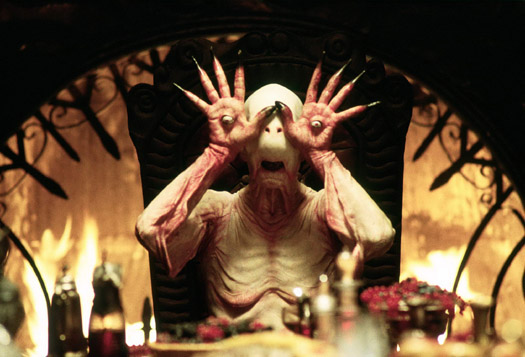
More horror films are produced each year today than probably ever before. From major studio releases to the most shoestring direct-to-download fan project, a majority are clock-punching exercises that recycle familiar ideas without much inspiration—and sometimes without much competence, either. Still, there have been encouraging signs, like the deployment of horror tropes in critically lauded, genre-defying films from around the world like del Toro’s Pan’s Labyrinth, Darren Aronofsky’s Black Swan, Lars von Trier’s Antichrist and Chan-wook Park’s Thirst.

Then there are the number of talented rising directors who’ve emerged from indie roots and so far managed to avoid being homogenized by their variable degrees of commercial success. That would include Brits Neil Marshall (The Descent, Doomsday), James Watkins (Eden Lake, Woman in Black) and Christopher Smith (Severance, Black Death). Yanks worth watching include Ti West (House of the Devil, The Innkeepers), Adam Wingard (Pop Skull, You’re Next) and the three writer-directors behind The Signal (David Bruckner, Dan Bush, Jacob Gentry). Farther afield, Australia’s Sean Byrne and Mexico’s Jorge Michel Grau have made such promising first features—The Loved Ones and We Are What We Are, respectively)—that one can hardly wait to see what they do next.

Cinematic history has seen a few once-invincible genres fade from favor, like the musical and western. Yet it seems safe to say that horror will endure as long as the medium itself exists. At the very least, it offers the comfort of schadenfreude in bleak times: No matter how bad the environment, economy, political landscape and whatnot gets, there will always be celluloid monsters and madmen to reassure us that things could indeed be even worse.


Related Tags:


Horror Internet, Gaming, Podcasts, and Apps

The Listen to Your Mother Show

Posted on May 13, 2012 at 3:55 pm

Celebrate mothers everywhere with the Listen to Your Mother Show.  Launched by Ann Imig in Madison, WI two years ago, the show gives local writers a platform to gather and present their work on motherhood, under the slogan “Giving Mother’s Day a Microphone.” LTYM was met with such success and demand that Imig rolled it out in ten cities in 2012: Austin, Chicago, Madison, New York City, Northwest Arkansas, Northwest Indiana, Philadelphia, San Francisco, Spokane and Washington DC. Born of the creative work of mothers who publish online, each production is directed, produced, and performed by local communities, for local communities, with (at least) 10 percent of ticket proceeds benefiting a local non-profit cause.  The videos of past shows are smart and funny and heartwarming and inspiring.

The May 6 performance at the Synetic Theater at Crystal City featured live readings by some of DC’s most talented newer and veteran writers and bloggers: Chrissy Boylan, Sarah Braesch, Nicole Crowley, Anna Whiston-Donaldson, Lindsay Felix, Lis Fogt, Cindy Green, Devra Gordon Renner, Monica Sakala, Elena Sonnino, Sue Wagner and Jean Winegardner.  The first reading by Cindy Green, titled “The Mother Warrior,” set the theme for the 2012 show. Cindy read, “The universal concepts of motherhood are of gentleness, self-sacrifice and unconditional love. And this is all true. But there is another part of motherhood that is just as vital – the primal, overwhelming desire to defend and fight for what is best for our children.”  All of the essays expressed this image of mothers as everyday warriors, fighting the good fight in motherhood – for their children and for themselves. The stories presented celebrate the power of motherhood.

Related Tags:


Family Issues

Dark Shadows

Posted on May 10, 2012 at 6:00 pm

“Dark Shadows” tries to sink its teeth into the legendary 1960’s supernatural soap opera with both ironic distance and visceral thrills.  It can be done — see the original “Men in Black” — but wonderfully weird visuals from director Tim Burton and a highly watchable performance by his muse, Johnny Depp cannot keep the tone from faltering and the results are unsatisfying.  One big problem is a criminally underused cast.  Eva Green matches Depp as Angelique, the woman scorned whose witchcraft turns the young heir Barnabas Collins into a vampire and curses all of the Collins family forevermore.  But Michelle Pfeiffer, Johnny Lee Miller, Jackie Earle Haley, and Chloe Grace Moretz (“Hugo,” “Kick-Ass”) have little to do but pose in Colleen Atwood’s fabulous 70’s costumes.  Co-scripter Seth Grahame-Smith, whose genre mash-ups include Abraham Lincoln: Vampire Hunter and Pride and Prejudice and Zombies) has produced a script that does not work as tribute or update.

Barnabas Collins was the young son of a wealthy family who came to America in the 1770’s and settled in a 200-room mansion on a cliff near a Maine fishing town.  Angelique (Green), the daughter of a servant, loved Barnabas or, more likely, she loved his wealth, position, and power.  When he told her he could not love her, she unleashed her witchy revenge.  She enchanted Josette (Bella Heathcote), the girl Barnabas loved, so that she committed suicide by jumping off the cliff.  When Barnabas tried to follow her, Angelique turned him into a vampire who could not die.

Barnabas is captured and shut into a coffin for nearly 200 years.  When a construction project digs him up, he enters the world of 1972, which is almost as confusing and dysfunctional as his descendants.  They are: Elizabeth (Pfeiffer), her louche brother Roger (Miller), her sullen teenage daughter Carolyn (Moretz), and Roger’s “I see dead people” son David (Gulliver McGrath).  They live in a partitioned-off wing of Collinwood Mansion with drunken caretaker Willie Loomis (Haley), a dotty housekeeper, and a substance-abusing psychiatrist named Dr. Julia Hoffman (Helena Bonham Carter), who came for a brief time to help David after his mother’s death but stayed for years.

No one believes Barnabas at first, despite a convincing resemblance to the family portrait.  But he tells Elizabeth he is there to restore the family to wealth and power and proves his good intentions by leading her to treasure hidden in a secret room and he begins to seem no less believable than the other members of the family.  With some vampire version of the Vulcan mind meld, he persuades the local captains to switch from their association with the dynamic woman who controls most of the fishing business in the area.  She is none other than Angelique, still going strong and still in the midst of a big love-hate thing with Barnabas.  And there is Victoria, a new governess for David, who looks just like Josette (Heathcote again).

Depp is clearly having a blast with his character’s gothic formality of movement and linguistic curlicues and Green has a great triumphant/demonic smile.  Whenever they are on screen the movie picks up and their intimate encounter is hilariously room-shaking.  Barnabas experiences the wonders of the modern age, including some that we take for granted (paved roads, television) and some that feel as mystifying to us as they do to him.  Shag rugs?  Lava lamps?  But the plot is as creaky as the hinges on Barnabas’ coffin.

Parents should know that the ghoulish plot concerns vampires, ghosts, and witches.  While some elements are comic, the film has stylized but graphic horror-style violence, characters injured and killed, sexual references and an explicit comic sex scene, some strong language, smoking, drinking, and drug use.

Family discussion: What were the biggest differences Barnabas found when he returned after 200 years?  How was he most like and unlike his relatives?

If you like this, try: Episodes of the original black and white television series and the fantasy film “Stardust”

Related Tags:


Based on a television show Fantasy Horror Thriller

The Best Exotic Marigold Hotel

Posted on May 3, 2012 at 6:00 pm

A dream team ensemble cast of British acting superstars gives a predictable story of displaced retirees spark and depth in this cozy tale based on the novel These Foolish Things, by Deborah Moggach.

A group of British retirees come to India for one last adventure.  Or, they come because they have nowhere else to go.  Some have not let themselves think about which it is, or whether it is both.  Easy-going Douglas (Bill Nighy) and the perpetually disappointed Jean (“Downton Abbey’s” Penelope Wilton) come because their limited resources cannot cover the life Jean sees for herself.  “Would it help if I apologize again?” he asks.  “No, but do it anyway,” she replies.

Muriel (Maggie Smith) is appalled by having to leave “proper” Britain to live among foreigners but it is the only way she can get the operation she needs without long delays from the National Health Service.  Evelyn (Judi Dench), a recent widow in reduced circumstances, must learn to take care of herself — and finds that she likes it.  Madge (Celia Imrie, the “we’re going to need bigger buns” “Calendar Girl”) hopes to find romance.  Norman (Ronald Pickup) wants something a bit more carnal.  Graham (a courtly Tom Wilkinson) wants to reconnect with his past.  They each find The Best Exotic Marigold Hotel “for the elderly and beautiful” in Jaipur via a website.  When they arrive, they learn the description of “a luxury development for residents in their golden years” was more aspirational than accurate.   “You Photoshopped it!” one new resident accuses.  “I offered a vision of the future,” Sonny explains.  He tells them that everything will be all right in the end and “if it is not all right, it is not the end.”  

The young proprietor is Sonny (“Slumdog Millionaire’s Dev Patel), whose grand plans and grander hopes for the hotel are so vivid he seems a bit surprised when it is pointed out that the the place is falling down and lacking some of the most basic of amenities, like doors with locks and reliable water.  There are the expected culture clashes.  The Brits are not used to chaotic riot of noise and color on the streets and the spicy food.  But it is worth it to see Maggie Smith’s disdainful expression as she nibbles defiantly on the chocolate biscuits she brought from home, pronouncing, “I won’t eat anything I can’t pronounce!”

Seeing the impeccable performances of this magnificent cast is reason enough to see the film as these actors transform the most conventional of situations by making us care about the characters and their hopes.  Wilton’s portrayal of Jean, the bitter wife, shows us how she cannot seem to find her way out of a labyrinth of disappointment.  Dench as Evelyn, sitting on the phone listening to an endless recording telling her that her call is very important, knows that she has never really been very important.  But there is something more than the kind of bittersweet but cozy story of plucky septuagenarians.  Perhaps the reason they stay in the rundown hotel is that they understand how superficial appearances are.  Perhaps the idea of restoring its grandeur to what it once was means something to them in a world where old age is “outsourced.”  It is encouraging for some of them to learn that “like Darwin’s finches, we are slowly adapting to our environment.”

Parents should know that this film includes some strong language (f-word), sexual references (gay and straight) and partial nudity, sad death, and drinking.

Family discussion: Who gets the biggest surprise?  Who changes the most?

If you like this, try: “Enchanted April,” “Monsoon Wedding,” “Mrs. Palfrey at the Claremont,” and “A Room With a View”

Related Tags:


Based on a book Comedy Date movie Drama Romance
THE MOVIE MOM® is a registered trademark of Nell Minow. Use of the mark without express consent from Nell Minow constitutes trademark infringement and unfair competition in violation of federal and state laws. All material © Nell Minow 1995-2026, all rights reserved, and no use or republication is permitted without explicit permission. This site hosts Nell Minow’s Movie Mom® archive, with material that originally appeared on Yahoo! Movies, Beliefnet, and other sources. Much of her new material can be found at Rogerebert.com, Huffington Post, and WheretoWatch. Her books include The Movie Mom’s Guide to Family Movies and 101 Must-See Movie Moments, and she can be heard each week on radio stations across the country.

Website Designed by Max LaZebnik