Interview: Morgan Spurlock of “Comic-Con Episode IV: A Fan’s Hope”
Posted on April 6, 2012 at 8:00 am
I was especially excited to talk to Morgan Spurlock about his newest documentary because it is about one of my favorite events of the year, San Diego’s Comic-Con. Produced by Comic-Con heroes Stan Lee and Joss Whedon, the film follows five people — two artists with portfolios who want to become professional comic book artists, a costume designer who is participating in Comic-Con’s famous Masquerade competition, a dealer hoping to sell his $500,000 Red Ryder comic to keep his business going, and a fanboy hoping to propose to the fangirl he met at Comic-Con the year before, with a ring modeled on the one in “Lord of the Rings,” of course. The movie was filmed during Comic-Con 2010 and it includes some of the people and events I saw when I was there. The movie is available everywhere On Demand today.
http://www.youtube.com/watch?v=hqC1pGb89XQYour movie makes clear that Comic-Con attracts the most passionate fans of comics, movies, games, and television in the world. What makes people into super-fans?
I think that if you can openly profess your love for something, then that makes you a real fan. I think that for a long time, a lot of things that were in the film weren’t cool to like, whether it was comic books, or video games, or collecting toys—it was one of those things that was shunned. We live in a world where we’re told to grow up and throw away childish things, and we live in a time now where these are things that really do start to define you as a person, as a character, as an individual, as a creative person. They kind of shape your world around you, whether it be a hobby or a desire that can’t get fulfilled anywhere else.
One of the things that struck me about this film is the way that it presents a more gentle and affectionate view of commercialism than your previous films. You’re looking at it from this consumer side this time. Do you think that there is a beneficial side to the commercialism that you’ve been critical of in previous films?
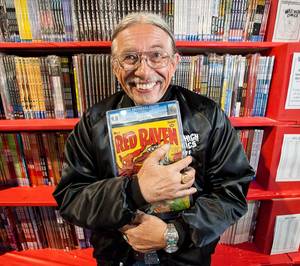 Well, I don’t know if it’s beneficial. I think that if you’re a fan of something you’re going to buy whatever you want and get whatever you like. Anthony Calderon, nothing was going to stop him from getting his 18 inch Galactus, no matter what it was, and if he didn’t get it then he would’ve been online that night buying one on eBay. I feel like when you are a collector and you buy certain things, you’re supporting that hobby. I collect art, I buy a lot of low-brow and street art, pop-art—and it’s one of the things where it is a constant desire for me to seek these things out, and I think that it’s just part of who you are. It does really start to define a part of your psyche and your individuality.
How did you find the people that you focused on?
We put out a kind of mass casting call through websites, through comic book shops, through Ain’t It Cool News. Harry Knowles came on as a producer for the film, and we just got this deluge of submissions, probably around 2,000 people from around the world—e-mails, videos—and from there we started to whittle it down. We wanted to find people who were going their own, to find people who already had tickets, you know, we weren’t giving people tickets, we weren’t flying you there, we were just coming along for the ride. We wanted to find people who were going with a real purpose. We didn’t want somebody who’s just like, “Yeah, it’s my first Con, I’m so excited, I can’t wait to see what it’s like!” That’s not a good story. You want to have somebody like Holly Conrad, who’s like “I’ve already competed in two masquerades, this is the final time I’m allowed to compete, if we don’t win I don’t know what’s going to happen, I really want to use this to break into the costume design business.” That’s a great story, she’s a great character, and she’s incredibly talented. Eric Hansen and Skip Harvey, who are going to comic–con for the first time to try and finally get this closeted desire to draw comics out into the world. They’re basically putting their egos on the table in front of the likes of Marvel and DC and Dark Horse; those are great stories, and those are the things you never get to see or hear about when it comes to Comic-Con.
That’s right. The news reports are always about thousands of people waiting in line for the big events at Hall H with all the movie stars.
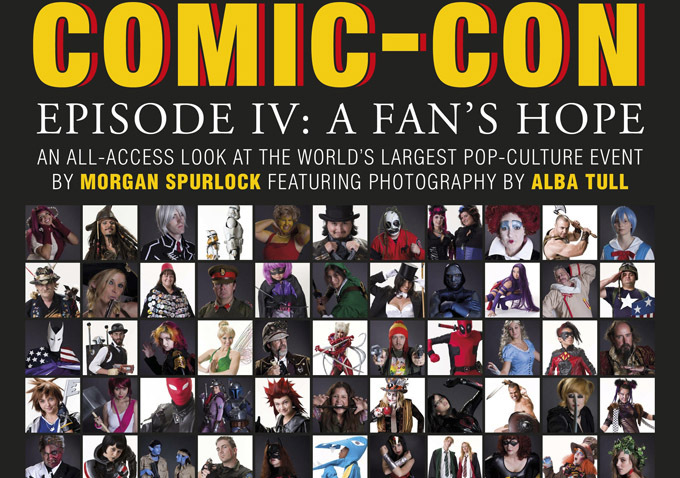
And that’s what people love to talk about, they say, “How do you feel about movies taking over Hollywood?” And it’s always journalists who ask this, and I say, “Well, just to be clear, movies haven’t taken over Comic-Con. Movies have taken over your coverage of Comic-Con, because somehow somebody said that this is all that matters, this is all that’s important at this giant, pop-culture Mecca. And, we’ve turned it into, “Here’s Angelina Jolie, she’s putting out her new movie—and look at these freaks in costumes,” that’s all the media ever wants to talk about. I went there in 2009, and there’s a much deeper story to tell here that isn’t being realized in any of the coverage.
I think it’s also fair to say that Comic Books have taken over movies.
That’s true. Comic books have become this never-ending well of brand-new characters and entertainment for the studios, and for television, and so now the comic-books, the guys who are actually trying to sell these paper comics are saying, “We’re getting pushed to the side, we’re getting shoved out of the convention.” They’re getting shoved out of everything. The reality is, the comic book business is a dying business.. The Comic Book industry is not a dying industry, but the actual idea of printing paper comics is, just like printing paper books is dying. We don’t even buy paper books. I don’t even know the last time I bought a book, but since I’ve gotten my iPad, I’ll tell you what—I buy more comics now as an adult than I did probably in like 10 years as a kid, because it’s much easier to download them straight to my iPad.
I love that there is still a real heritage to Comic-Con, there’s still a respect for that heritage, the artists who dated these comics are still there, so I disagree that comics are getting pushed out of comic-con. I think it is transforming into something else.
Tell me a little bit about the guy who proposed to his girlfriend at Comic-Con. Did he get in touch with you and not only wanted to propose in public, he wanted to propose to her in a movie?
He wanted to propose to her at Comic-Con. It was part of the casting that we sent out, we wanted to find a couple who fell in love because of a mutual appreciation and passion for some geeky thing, whether it was “We both love Star Trek” or “We both love that video game.” We got a ton of submissions from people who fell in love or got married because of that and this story of James Darling and Se Young Kang was so fantastic because they had met the previous year as they were both getting ready to go to Comic-Con and fell in love because they both love these things at Comic-Con. So they basically talked about, “We’re going this year, we both love Kevin Smith, we’d love to be in the film,” and after the end of their joint submission video, they cut to James Darling in a closet, holding the camera next to his face, and he goes…”but what I really want to do is propose to Se Young at Comic Con this year.”
Some people say that Comic-Con is so driven by big business products that there’s no imagination any more and people are just taking the imagination that’s imposed on them from a commercial entity. How do you respond to that?
Well, I think there’s a tremendous amount of creativity in the world, it is exploding with creativity. You see it in this movie, you see it in people like Holly Conrad, you see it in people like Skip Harvey and Eric Hansen, and so I disagree with that. I do think that there’s a tremendous amount of spoon feeding of genres. The fact that we’re continuing to make remakes of movies that have been made, we’re continuing to reboot the franchises, that’s the more frustrating thing—that there’s not a search in that world for new ideas, or that many new ideas. So when someone like Christopher Nolan comes along and makes a film like “Inception,” you’re like, “Oh my God, this is the greatest thing ever,” because it’s not derivative, you’re not living off of something you’ve seen seven, eight, nine times.
Which is even more reason for everyone to stay home this weekend and watch “Comic-Con: Episode IV,” to put on your costumes and have a fantastic geek-out party.
What’s the best way for them to watch it? Is it on Video-On-Demand?
We’re opening this weekend in select cities, so this weekend it’ll be in theaters in Los Angeles, San Francisco, Portland—if you live in any of those three cities, you should put on your costumes and come to the theater and create the new “Rocky Horror Picture Show.” I feel like everyone one of these screenings should feel like Comic-Con. I encourage people all the time, “Wear your costumes, come to the movie, and let people see what it’s really like.” That will be awesome. If you can’t come and you want to see the movie, you should have a Comic-Con party at your house, have a little mini-con, play video games, bring your comics over, put on your Spock ears and your hobbit feet and your Wookiee mask, grab your light saber, and tell your friends, “We’re going to have a Con party!”
Not only is it on Video-On-Demand, it’s on iTunes, streaming, if you download movies through the Xbox platform, it’ll be available there. It’ll be iTunes worldwide, so it’ll be iTunes streaming world-wide this weekend as well.
What do you, as a film maker, think about that kind of distribution method? Did that open things up more than traditional theatrical release?
With “Pom Wonderful Presents The Greatest Movie Ever Sold,” we had so much press leading up to that film, and the week before the movie opened I was on Conan, Colbert, Jimmy Kimmel, all within ten days and then the movie opened on 18 screens. So the majority of the people in the United States couldn’t even see the movie. I’m a film-maker, and I have yet to have a movie show in my own home town in West Virginia where I grew up. There’s got to be a better way—especially when it comes to documentaries.
If you’re not making a big, giant, huge mainstream Hunger-Games-esque film that’s going out on 3000 screens, how do you start to compete with those movies? For me, the best way to compete is by collapsing the window, giving anyone across the country who wants to see this film access to it immediately. You know, there’s a great line in ‘The Greatest Movie Ever Sold,” “In today’s world, in today’s media landscape, there is a cultural decay rate of ideas that is about two weeks.” So you basically have two weeks to capitalize on whatever surge you have around your moment, your film, your music, whatever it is, get people to get excited about it, to see it, to consume it, to share it—because really soon, something else will jump in there—there’ll be another movie, there’ll be something else that’s the conversation driver. So, for me this weekend, I just wanted to make sure that anyone who wanted to see this film could see it.

 are a very good introduction to the story of how the Jews came to live in Egypt and how Moses led them out of slavery.
  is a great introduction to the holiday for preschoolers. Children may also enjoy
  ,
,  and
and  , which explains all of the elements of the seder.
 and the more recent versions of the story, starring
  , and
, and  .
. and
and