
Our Idiot Brother

Posted on August 25, 2011 at 6:00 pm

C
Lowest Recommended Age: Mature High Schooler
MPAA Rating: Rated R for sexual content including nudity and for language throughout
Profanity: Very strong language
Alcohol/ Drugs: Drinking, marijuana, character goes to prison for giving marijuana to a policeman
Violence/ Scariness: Comic peril
Diversity Issues: Diverse characters
Date Released to Theaters: August 26, 2011
Amazon.com ASIN: B004UXUWEC

You can’t really make a bad movie with Paul Rudd, Elizabeth Banks, Rashida Jones, Kathryn Hahn, Adam Scott, Zooey Deschanel,  Emily Mortimer, and Steve Coogan.  They are seven of the most able and appealing performers of our era.  But it turns out that does not necessarily guarantee a good movie, either.  The actors have a lot more fun than the audience in this light but strange tale of a man whose irrepressibly sunny and guileless nature makes his angsty sisters frustrated, angry, and then, inexplicably refreshed.

Rudd plays Ned, a leftover hippie who grows organic produce with his girlfriend (Hahn).  By inclination and by choice he expects the best intentions from everyone.  So, he gives a stranger on the subway some cash to hold onto while he organizes his things.  And when a uniformed cop asks him for some marijuana, he hands it over.  That one results in some jail time, and when he returns, he finds he has lost his girlfriend, his home, and his dog, Willie Nelson.  So, he goes back home, where he briefly stays with his mother and then each of his sisters, creating chaos at every stop.

Liz (Mortimer) is married to a snobbish and self-centered documentary filmmaker (Coogan) and they have two children.  Liz is passionate about providing a cloyingly wholesome environment for her children (they are named River and Echo) and has not noticed that her husband is having an affair with the subject of his latest film.  Ned breaks River’s finger and, worse, messes up his crucial admissions interview for a tony private school.

He also disrupts the lives of the ambitious Miranda (Banks) who works at Vanity Fair, thwarting her big break by refusing to let her print a story told to him in confidence by a socialite, and flighty Natalie (Deschanel), by revealing to her girlfriend (Jones) that Natalie has been unfaithful with a man and is pregnant.

Jesse Peretz (son of former Harvard professor and New Republic publisher Marty Peretz) directed, from a screenplay by his sister, Evgenia Peretz, a writer for Vanity Fair, and her husband David Schisgall, a documentary filmmaker who has worked with Errol Morris.  Given the sibling bond on and off-screen it is especially disconcerting that there is no sense of the chemistry between family members.  These characters never show the kind of rhythms and short-cuts in communication that come from decades of shared experience or the affections and retro rivalries of adult family members.  It would have been interesting to get a sense of what the family dynamic was like and how it produced characters do different in their priorities and strengths.  The script feels more like a chart than a storyline, with each character selected to represent a different New York type.  The actors have a lot of fun creating their characters but there is not one believable relationship between any of them, except perhaps Ned’s with the hippie who replaced him at the farm.  Peretz never establishes a consistent tone and the reconciliation and appreciation at the end is forced and awkward.

Ned may be right about expecting the best from everyone, but as he learns in the film and we learn about the Peretzes, sometimes they let you down.

(more…)

Related Tags:


Comedy Family Issues Movies -- format
Interview: Vera Farmiga of ‘Higher Ground’

Interview: Vera Farmiga of ‘Higher Ground’

Posted on August 24, 2011 at 3:48 pm

Vera Farmiga (“The Departed,” “Up in the Air”) directed and stars in a new film based on the memoir by Carolyn S. Briggs, Higher Ground: A Memoir of Salvation Found and Lost.  As she spoke to a small group of reporters in a Georgetown hotel, it was clear that she shares her character’s passionate yearning for an intimate connection with the Almighty.
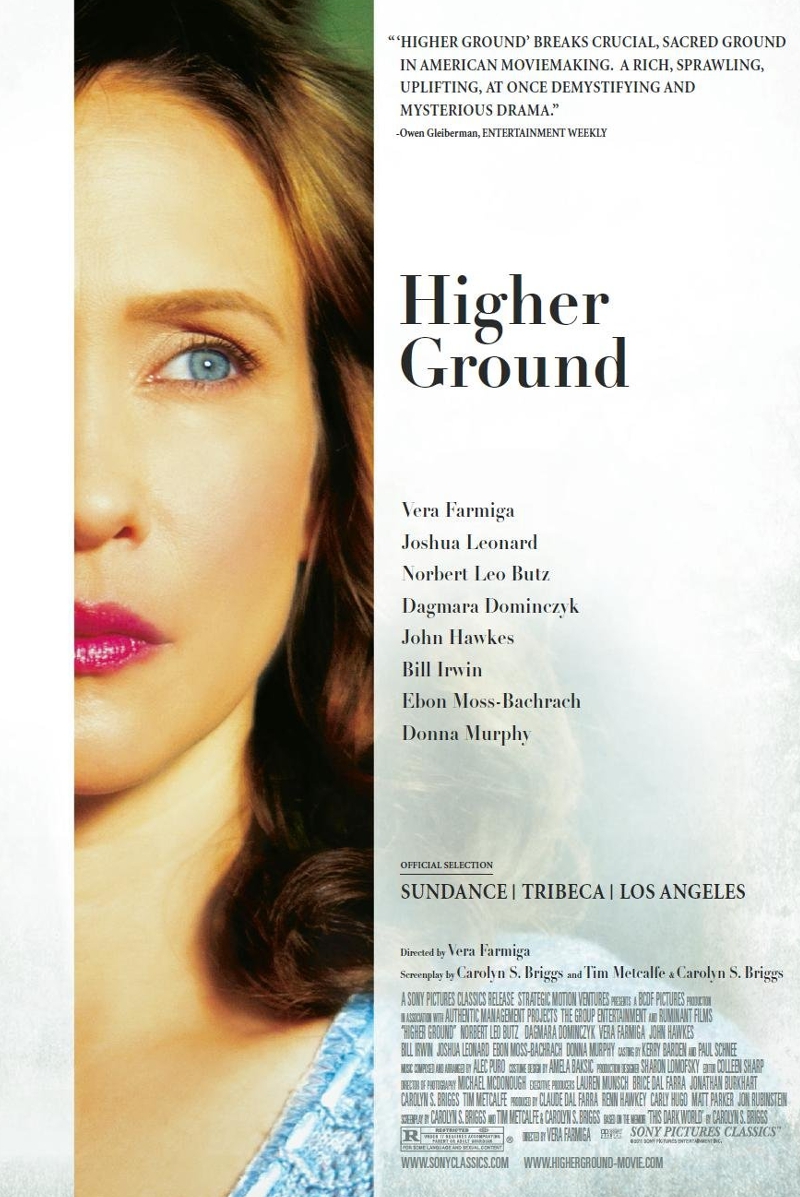
I began by asking her about her character’s hair, which seems to reflect not just the changing fashions over the decades covered in the film, but her spiritual and emotional state as well.  “It was three different time periods.  The church changes.  It goes from worshipping outside to worshipping in basements, hallways, annexes, to a proper, steeple-topped church.  As the hippies turn into yuppies, so do the hairstyles.  Her hair starts off wild and carefree and long and tangled.  And passionate.  And then there are the trials and tribulations and ebbs and flows of her path, and she engages in spiritual warfare and her hair also has its phases.  Childbirth, and then she gets shorter.  We did a perm curl – it gets corrupted.  It gets poisoned — by a home perm!  And then by the end it’s a looser wave, gentler.”

She admitted that this book was an unusual choice for her debut as a director.  “It chose me.  I really feel that way.  I tried to wriggle out of its grasp, several times.  Every time I tried, something else would happen that made it unstoppable….It touched me in divinely mysterious ways.  It slayed me in the spirit.  I loved this woman’s yearning to be passionate in her faith and all her relationships.  That yearning is such a holiness to me that it touched me in a very deep way.  I wanted to defend her journey….It was so juicy to me….I had a lot of ideas I wanted to bring into the film, ideas about music and praise and worship and joy.”  It began to come together when her mentor, Deborah Granick, agreed to advise her and John Hawkes (from Granick’s “Winter’s Bone” agreed to appear in the film. “Before I knew it, I was on the set, having to deliver the last speech first.”  And after that, she relaxed and enjoyed it.

“A story about God tends to make people tremble,” she said, “as the Almighty should.  We all have our personal concepts of that that means.  But that three-letter word makes people quake, especially in Hollywood.”  But she had the support of her producers (including her husband) who “totally vibed with my vision, no mockery or judgment, just to look at how arduous that spiritual road is, how bumpy.  No matter what your religion is, what your spiritual tenets are, what your idea of God is, we’re all on the same human team, trying to transcend self and look upwards for healing and holiness.”

She spoke of learning from directors like Granik, Anthony Minghella, and Martin Scorsese about the spirit they bring to their work, “their leadership, their approach, their wholesomeness, their joy, the good cheer that they spread as they attack their missions.  In order for it to be a ‘holy experience,’ everyone’s got to be invested.  You have to treat them like kings and queens and show them you are truly grateful.”

Farmiga cast her real-life sister as the younger version of her character.  “We have the benefit of genetic similarity, so we did not have to do much as far as matching our performances.  We move in similar ways because of the house we grew up in, probably even the Ukranian folk-dancing!”

I asked her about the portrayal of the main character’s friendship in the film.  “I’ve learned so much from my best friends and they demand so much of me and inspire me in the ways that make me me.  The character is able to be her best carnal self and her best spiritual self because of her friendship with Annika.  We wanted to make it the most passionate and pure relationship — and then it gets taken away so she can find it within herself, the same energy, the same approach with the rest of her relationships, including her relationship with God.”

The tone of the film is respectful of all of its characters and their journeys.  “My heart and my intent, indigenous to my personality is not cynicism, but compassion and serenity and gentleness and respect.  I’m curious, what draws me into a story is recognizing my humanity, my imperfections, telling a story about struggle.  This is not a general statement about Christianity; this is a moment this woman found herself in.  We are still finding our voices.”

Related Tags:


Actors Directors Interview Spiritual films

Interview: Harry Markopolos of Chasing Madoff

Posted on August 22, 2011 at 5:32 pm

The award for the biggest “I told you so” of all time has to go to Harry Markopolos, who fought for nine years to convince anyone — regulator, prosecutor, journalist, or customer — that Bernard Madoff was a crook.  Finally, Madoff turned himself in for what turned out to be the biggest financial fraud in history.  At least, it’s the biggest one we know about so far. And it continues to make headlines, the latest today as a court ruled that Madoff victims cannot recover the fictitious profitsreflected on the statements they received.

Markopolos is the subject of a new documentary called “Chasing Madoff.”  He spoke to me about preventing and detecting fraud and the cases he is involved with now.  He will be attendng the Taxpayers Against Fraud conference in Washington, D.C. next month.

In the movie, you describe yourself as the boy who cried wolf — except that there was a wolf.

It felt like a fairy tale or was entering The Twilight Zone, no straight lines, just crooked lines.

I can understand why harried bureaucrats and conflicted politicians and journalists might be reluctant to tell the emperor he had no clothes. Madoff was a very connected and distinguished man. But why would the people who had money invested with him have no interest at all in asking him about the questions you raised?

The key point is that the smart people assumed he was front-running. That would put Madoff in jail if he was caught, but not the people who invested with him, and they’d still have the money. He was handling 5-10 percent of the stock value trades in the US and they assumed they were the beneficiaries of the fraud, not the victims. He intimidated people into not asking any questions. If you tried, he’d offer to give your money back. People did not pursue it because they wanted to remain in the money club.

Why would such a successful man think fraud was worth the risk?

You’re assuming he was successful before. He had a boiler room operation out of his apartment when he first entered in 1962. He had a 46-year-long crime spree.

Why did he finally give up?  To protect his sons?

To protect himself. It didn’t start out dangerous. When I saw the offshore hedge funds putting money in, I knew it was organized crime, laundering money against host nation tax authorities. Prison was the only place to keep him alive.

Do we know the truth now? Have you read his interviews since going to jail?

He is still lying. One or two or three things are true; the rest are lies. It is true that he hates me; he said that. He worked with the Chicago Board of Exchange and the big banks; they were willing conspirators. He named some names, threw some people under the bus. But three out of four of them are dead and the other one is 99 years old. There were a lot of people in bed with him.

Have any lessons been learned? Are we doing a better job of preventing and spotting fraud?

Not really. They should call them “compliant officers,” not “compliance officers.” Their specialty is looking the other way and not rocking the boat. You might as well give them a broom, they just sweep things under the rug. They are about appearances, not reality. Our cases against Bank of New York and State Street are moving forward and more are in the pipeline. For years, they were taking .3 of a percent from every trade for their pension fund clients.

Related Tags:


Crime Documentary Interview

Win Win

Posted on August 22, 2011 at 8:00 am

B+
Lowest Recommended Age: Mature High Schooler
MPAA Rating: Rated R for language
Profanity: Very strong language
Alcohol/ Drugs: Drinking, teen smoking, offscreen drug abuse
Violence/ Scariness: Offscreen violence, tense confrontations
Diversity Issues: None
Date Released to Theaters: March 25, 2011
Date Released to DVD: August 22, 2011
Amazon.com ASIN: B0057LOEGS

Writer-director Tom McCarthy gives us stories of the families we choose.  In “The Station Agent” and “The Visitor” the main characters were loners who found themselves unexpectedly drawn into caring for people who were very far outside their usual circles.  In this, McCarthy gives us a man who already has a loving, stable family and a best friend (“The Station Agent’s” Bobby Cannavale) and is under enormous stress trying to take care of everyone.  But he, too ends up meeting someone who at first seems a threat, then a burden, and then, somehow, family.

Paul Giamatti plays Mike Flaherty, a lawyer with a solo practice that is not bringing in the money he needs for repairs at the office and at home.  Most of his clients are indigent but Leo, a man in the early stages of dementia (“Rocky’s” Burt Young), has a comfortable bank account.  In a guardianship proceeding, Mike impulsively has himself appointed as guardian so that he can get the fee.  Then he puts Leo in an assisted living facility, contrary to his assurances at the hearing that he would keep Leo in his own home.

Mike did not know that Leo had any relatives.  But a teenage grandson who has never seen Leo turns up.  His name is Kyle (newcomer Alex Shaffer).  He has dyed blonde hair and he smokes.  His mother, Leo’s daughter, is in rehab and he has come to stay with Leo.  Mike and his wife Jackie (Amy Ryan) reluctantly take him in.  Mike coaches the high school wrestling team part-time.  Kyle turns out to be an exceptional wrestler.  He begins to work out with the team.

There is a wonderful decency, naturalism, and humanity to this story, thanks to a sensitive script and superb performances.  Ryan and Giamatti have the rhythms of a long-married couple, with a real sense of established teamwork, and appreciation.  Her “what is that?” expression and his “it’s okay and under control” gesture to her are eloquent in conveying their depth of trust and understanding.  The look on Mike’s face when he wishes Kyle luck in keeping his secrets reflects more than a decade of seeing her ability to get the truth out of anyone.  And yet Mike himself is keeping bigger and bigger secrets from Jackie.  He thought it would not hurt anyone.  But there really isn’t any such thing as win-win.  Someone always pays a price.


(more…)

Related Tags:


Drama DVD/Blu-Ray Pick of the Week Sports

Spy Kids: All the Time in the World 4D

Posted on August 20, 2011 at 10:53 pm

Jessica Alba was dressed for her role in Robert Rodriguez’s ultra-violent “Machete” when, on a break from filming, she stopped to change her baby’s diaper.  Rodriguez says he saw her performing this most domestic of tasks in her action-movie attire and knew it was time to start up the “Spy Kids” series again, this time with Alba taking her baby with her on a mission.

The first Spy Kids was about Carmen and Juni Cortez (Alexa Vega and Daryl Sabara), children of super-spies who got caught up in the family business.  It was sharp and funny and imaginative and made it clear that the real adventure is being part of a family.  It was a rare film for audiences of any age with strong, smart female and Latino characters.  And Rodriguez, known for his ultra-violent films for adults (“Once Upon a Time in Mexico,” “Machete”), kept the “Spy Kids” series refreshingly non-violent.  If this fourth in the series is not as good as the first, it is better than the unfortunately titled Spy Kids 3D: Game Over.  And much, much better than The Smurfs.

Alba plays Marissa Wilson, a spy who goes into labor in the middle of a chase but manages to capture the evil Time Keeper on her way to the delivery room.  She quits to be a stay-at-home mom for the baby and her twin step-children, Cecil (Mason Cook) and Rebecca (Rowan Blanchard).   Her husband Wilbur (a likable Joel McHale), has a “Spy Hunter” television show but somehow never figured out that his wife was not a decorator.

A year later, the Time Keeper is creating chaos and Marissa, the twins, and the baby are off to save the world and do some family bonding as well.  The original spy kids, now grown up, arrive for some bad guy chasing and family conflict resolving as well.

Everyone gets a chance to know each other better, of course, but the film has a bit more substance.  Cecil is hearing-impaired and he and everyone around him are completely comfortable with it.  It is very rare in movies of any age that we get to see a character with a disability  rather than a disability with a character.  Cecil is a regular kid who happens to have hearing aids and Cook gives a nice comic snap to his comments.  The gadgets are a lot of fun, including a robot dog with more functions than a Swiss Army Knife, hilariously voiced by Ricky Gervais, and “hammer hands” gloves that can punch through walls.  Like all parents, Rodriguez is dismayed by the ever-quickening passage of time.  So in the midst of the silliness with a “4 dimension” scratch and sniff card to accompany some of the story’s most odoriferous moments, a muddled storyline, and too much potty humor, there is a sweet theme about seizing the moment for what matters most.


(more…)

Related Tags:


3D Action/Adventure Family Issues Series/Sequel Spies Stories About Kids Talking animals
THE MOVIE MOM® is a registered trademark of Nell Minow. Use of the mark without express consent from Nell Minow constitutes trademark infringement and unfair competition in violation of federal and state laws. All material © Nell Minow 1995-2026, all rights reserved, and no use or republication is permitted without explicit permission. This site hosts Nell Minow’s Movie Mom® archive, with material that originally appeared on Yahoo! Movies, Beliefnet, and other sources. Much of her new material can be found at Rogerebert.com, Huffington Post, and WheretoWatch. Her books include The Movie Mom’s Guide to Family Movies and 101 Must-See Movie Moments, and she can be heard each week on radio stations across the country.

Website Designed by Max LaZebnik