
Stop-Loss
Posted on July 8, 2008 at 8:00 am
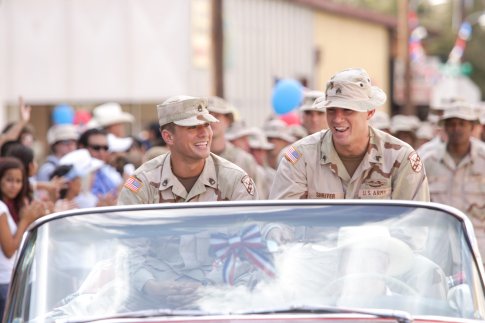 A young soldier who has come home from Iraq is forced to rethink his ideas about heroism and patriotism when he is “stop-lossed” — informed that instead of leaving the Army he has been involuntarily assigned to another tour of duty. Brandon (Ryan Phillippe) and Steve (Channing Tatum), his best friend since high school, were greeted with an old-fashioned hero’s welcome right out of a Norman Rockwell painting, with a parade and a warm handshake from their Senator, who says his door will always be open to real-life American heroes. They speak proudly about “killing ’em in Iraq so we won’t have to kill ’em in Texas.” But when Brandon finds out that the government has the right to send him back, he goes AWOL and leaves for Washington with Steve’s estranged fiancée (Abbie Cornish), hoping the Senator will find a way for him to stay home.
The real-life Army euphemism “stop loss,” sometimes referred to as a “backdoor draft” for the all-volunteer army, takes on multiple meanings as the film progresses. Brandon’s efforts to stay home are his own stop loss program. When he first comes home, he seems to be the most stable and responsible of the returning soldiers. But he crumbles quickly when ordered to return. For him, leaving the Army is the only way to stop further loss of his ability to return to a normal life. His efforts to resist only create conflicts with the people closest to him.

 to
to  .
.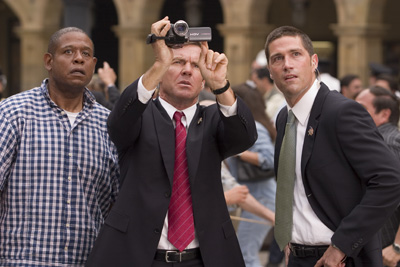 A gimmicky thriller without much of a gimmick or many thrills, “Vantage Point” suffers, too, from being out of synch with its time. Its premise may be current — an assassination attempt at an anti-terrorism summit — but its tone is off. A good thriller — or even a good episode of “Law and Order” — uncovers our underlying fears, recognizes that they are closely tied to curiosity, and pushes them to the point of pleasurable fear and cathartic release. This film clumsily builds on the headlines with a simplistic story that, even told in mosaic bits and pieces is obvious and clunky, with big logical gaps. It would be more intriguing to see the same story told several times from different perspectives, each one adding another layer of information, if the underlying story was worthwhile. But this story of a terrorist attack at an anti-terrorism summit, is too thin to withstand the repetition. Instead of making it deeper and more complex, the retellings get tiresome and overblown.
 “Definitely, Maybe” is the story of the three great loves of a man’s life. That’s “story” in the literal sense, as in the bedtime story he tells his young daughter, who wants to know how he met her mother and, implicitly, why they are getting divorced.
 ‘s Abigail Breslin), just out of her first sex education class, asks him how he met her mother, and he answers by telling her about all three of the women he loved, making her guess which one became his wife. Both of them realize that it is not really how they met but a better understanding of what went wrong that matters.