
Spider-Man

Posted on December 13, 2002 at 5:17 am
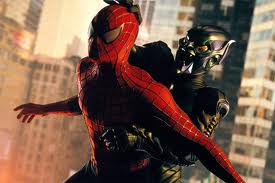
Remember when “Superman” was released with the tagline, “You will believe a man can fly?” Well, “Spider-Man” will not only make you believe that a teenager can swing from the skyscrapers; it will almost make you believe that you are up there swinging with him.

Comics were hugely popular back in the days when they could show us stories that no one else could. But now, movies can show us anything that can be imagined, and a movie like this does it so well it makes you think that this is what imagination is for.

Toby Maguire plays Peter Parker, a brilliant and sensitive high school senior, so deeply in love with his red-headed next door neighbor Mary Jane (Kirsten Dunst) that he can barely bring himself to say hello to her. On a school field trip, he is bitten by a genetically engineered spider and the next morning he wakes up with some distinctly arachnid-like qualities. He can see without his glasses and he has become muscular. He can climb walls, eject webbing with the swinging power of rope and the strength of steel, and anticipate danger.

So, like any teenager, the first thing he does is impress a girl and humiliate a bully. He enters a wrestling match to get money so he can buy a car to impress the girl even more. His decision not to interfere with an armed robber has tragic consequences, and so he learns that his uncle was right in telling him that with great power comes great responsibility. Great risk comes as well — everyone he cares about is put at risk because of who he is.

Meanwhile, Peter’s best friend’s father, industrialist Norman Osborn (Willem Dafoe) has decided to try out his company’s new product on himself. He, too, develops extraordinary power and a mad fury. He is dubbed the Green Goblin for his bizarre armor-like covering.

Maguire is just right as Peter, thoughtful, sensitive, thrilled with his new powers. You can believe that he is the kind of kid who would spend his time a little bit apart from the others, taking photographs that are clear and perceptive. The supporting cast is great, especially stage star Rosemary Harris as Aunt May and J.K. Simmons as Peter’s bombastic editor. The script is excellent, and strikes just the right note of respect and affection for the source material. It has a contemporary feel without being showily post-modern or ironic.

The special effects are thrilling. New York City is brilliantly stylized. Peter’s relationship with MJ is sweetly romantic. And when a bunch of New Yorkers throw things at the Green Goblin, yelling, “This is New York and we fight back!” it is genuinely touching.

The movie’s weakest point is that it fails in the single most important requirement for a comic book-based movie — the villain is not unforgettably crazy or evil or larger-than-life. The best Batman movies featured Jack Nicholson as The Joker and Jim Carrey as The Riddler. Willem Dafoe is a brilliant actor (just take a look at his Oscar-nominated performance in “Shadow of the Vampire”), but the part of Osborn/Green Goblin is just not interesting enough to be truly scary. The flying surfboard he rides around on is very cool, but his exoskeleton costume and mask are just dumb-looking.

Parents should know that the PG-13 rating comes from a couple of mild words, a clingy wet t-shirt, and a great deal of violence. The violence gets very intense, and includes not just fires and explosions but people getting vaporized, shot (off-camera), and impaled. Characters lose people close to them to violent deaths. A group of schoolchildren are in peril. Parents emotionally abuse their children.

For parents who are struggling with whether this movie is appropriate for kids under 13, the best guide I can provide is to say that it is about at the level of X-Men. I recommend caution, especially for children under 10. Keep in mind that just because a child can repeat after you “it’s only pretend” does not mean that he fully understands what that means until he is 10 or even older, and that the terrorist attacks may make some of the material scarier than it would have been before (scenes featuring the World Trade Center have been removed from the movie). Some kids may see the movie and appear to have no problems with it, but may act out in other ways. Be watchful for kids who respond by desensitizing themselves to violence or re-enacting it. And if you are going to let childrn see the movie, make sure that they know that this is an exception and that you will not be permitting them to see any PG-13 just because you allowed this one.

Families who see this movie should talk about the idea that the people we love make us feel good about who we are at the same time they make us see a way to be better. Do you agree that “people love to see a hero fail?” Characters in the movie keep a lot of secrets. What makes them decide not to tell, and who is and is not right in making that choice?

Families who enjoy this movie will also enjoy Superman and Batman. Mature audiences will enjoy Toby Maguire’s outstanding performances in “Wonder Boys,” “The Cider House Rules,” and “The Ice Storm.”
Related Tags:


Action/Adventure Comic book/Comic Strip/Graphic Novel Romance Superhero

E.T. The Extra-Terrestrial

Posted on December 13, 2002 at 5:17 am

A+
Lowest Recommended Age: Kindergarten - 3rd Grade
MPAA Rating: Rated PG for language and mild thematic elements
Profanity: Brief but very strong language for a PG
Alcohol/ Drugs: E.T. gets tipsy
Violence/ Scariness: Characters in peril, apparent death
Diversity Issues: All characters white
Date Released to Theaters: 1982
Date Released to DVD: October 8, 2012
Amazon.com ASIN: B003UESJLK

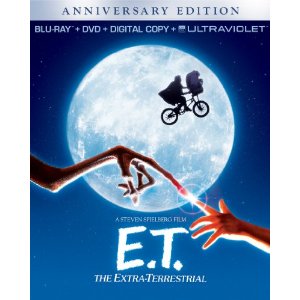
“E.T’s” 30th anniversary is being celebrated with a gorgeous new re-issue and I have one to give away.  To enter, send me an email at moviemom@moviemom.com with E.T in the subject line and tell me your favorite movie alien.  Don’t forget your address!  (US addresses only.)  I’ll pick one winner at random on October 14.  Good luck!

A young boy named Elliott (Henry Thomas) finds an extraterrestrial who has been left behind when his expedition of alien botanists had to depart quickly to avoid detection. He brings E.T. home, finding through their connection a way to begin to heal his sense of loss at his father’s absence.

E.T. loves Elliott, but begins to weaken in the Earth’s atmosphere and needs to go home. With the help of Elliott and the neighborhood children, he sends a message to his friends. But before they can come for him, he is captured by government scientists. E.T.’s connection with Elliott is so strong Elliott becomes very ill, too. But both recover, and the children return E.T. to the spaceship, after E.T. reminds Elliott that they will always be together in their hearts.

This is an outstanding family movie, with themes of loyalty, friendship, trust, and caring. One of the most purely magical scenes in the history of film is when Elliott’s bicycle lifts off up into the sky.

Parents should know that the movie has scenes of peril that may be too intense for younger children. An apparent death is also upsetting. There is brief very strong language for a PG movie. This film was justifiably criticized for its almost complete absence of non-white characters.

DVD extras: Making of documentary, cast reunion, archives, trailer, behind-the-scenes footage, etc. Families who see this movie should talk about the way that the adults and the kids see things differently, and have a hard time understanding each other’s perspective. One reason is that they don’t try to share their feelings with each other. Could Elliott have talked to his mother about E.T.?

Families who enjoy this movie will also enjoy “Close Encounters of the Third Kind,” and they should try some Reese’s Pieces! They might also want to check out the classic movie E.T. catches a glimpse of, “The Quiet Man.”

Related Tags:


Action/Adventure Classic Contests and Giveaways Drama DVD/Blu-Ray Pick of the Week Science-Fiction Stories About Kids

Quiz Show

Posted on December 13, 2002 at 5:17 am

Plot: This true story takes place in the early days of television. One of the most popular and successful program formats was the quiz show, in which contestants competed for huge cash prizes by answering questions. Charles Van Doren (played by Ralph Fiennes) was a member of one of America’s most distinguished literary families, and he became an immensely popular contestant, on “Twenty-One.” When it turned out that the quiz shows were fixed, and that contestants were supplied with the answers by the shows’ producers, Van Doren became the symbol of betrayal.

In this film, Van Doren is contrasted with Herb Stempel (John Turturro), and Congressional staff investigator Dick Goodwin (Rob Morrow). Stempel, a Jewish man from Brooklyn with “a face for radio” is bitter over being pushed aside for the impeccably WASP-y Columbia professor. Goodwin shares the Jewish outsider’s background with Stempel and the Ivy League polish (as he frequently mentions, he was first in his class at Harvard Law School) with Van Doren. Dazzled by Van Doren, Goodwin does not want to believe that he, like Stempel, participated in the fraud. When he finds out that Van Doren did, Goodwin tries to protect him from being discovered. He wants to bring the real culprits, the network executives, to light. But when the hearings are held, the Congressmen’s cozy relationships with the network executives prevent any tough questions from being asked. The producer takes the blame.

Eight years later, the producer was back in television. Stempel became a bureaucrat. Van Doren, forced to leave Columbia, lived very privately, working for Encyclopedia Britannica. Goodwin went to work for President Kennedy and later wrote highly respected books.

Discussion: This is an outstanding drama that provides an excellent opportunity for examining the way that people make moral choices. Stempel cheats because he wants to be accepted and respected, and because he believes that is the way the world works. Nevertheless, he is outraged and bitter when he finds that he has been cheated, that the producer has no intention of living up to his promise to find him a job in television. And it is important to note that his decision to tell the truth was based on vengeance, not on taking responsibility for a moral failure.

When first presented with the option of cheating, Van Doren reflects (“I’m just wondering what Kant would make of this”), and then refuses. Indeed, he concludes this is just a test of his suitability, and one that he has passed. Once on the program, however, he is given a question he had answered correctly in the interview. He knows the answer, but he also knows that it is not a legitimate competition for him to answer it. (He does not know that Stempel has agreed to fail). At that moment, what is he thinking? What moral calculus goes through his mind? Is this the decision to cheat, or is that a separate decision, later? In the movie’s most painful scene, Van Doren must tell his father what he has done. At first, Van Doren makes some distinctions between being given the questions, so he can get the answers on his own, and being given the answers. But he knows that both are equally wrong.

Why, then, did he do it? The movie suggests that it was in part a way to establish himself as independently successful, out of the shadow of his parents and uncle. He enjoyed the fame and the money. He argues that no one is being hurt by it. Goodwin, on the other hand, sees that it is wrong, and never for a moment hesitates when the producer tries to buy him off. Yet, as Goodwin’s wife points out, he makes his own moral compromises when he tries to protect Van Doren. In part, he does it because he is after those he considers the real culprits. But in part he does it because he likes Van Doren, and because as much as he takes pride in being first in his class at Harvard, some part of him still thinks that the Van Dorens are better than he is.

Questions for Kids:

· Why did Stempel agree to cheat? Why did he tell the truth to the investigators? Why did Van Doren cheat?

· What were some of the feelings Van Doren had about his parents? How can you tell?

· In what ways was Goodwin like Stempel? In what ways was he like Van Doren? Why was Goodwin intimidated by the Van Dorens?

· Who was responsible for the “quiz show scandals?” Was the outcome fair? Who should have been punished, and how?

Connections: Goodwin’s account of the story can be found in his book, Remembering America: A Voice from the 60s. “Champagne for Caesar,” a light satiric comedy on the same subject, was produced in 1950, several years before the events portrayed in this movie. It is very funny, with outstanding performances by Ronald Coleman as the professor/contestant and Celeste Holm as the femme fatale brought in to shake his concentration. The question they find to stump him with is a lulu! Van Doren’s father is played by Paul Scofield, who appeared as Sir Thomas More in “A Man for All Seasons.” Goodwin’s wife is played by future Oscar- winner Mira Sorvino.

Related Tags:


Based on a true story Drama

The Maltese Falcon

Posted on December 13, 2002 at 5:17 am

Plot: Sam Spade (Humphrey Bogart) is a private detective. A woman who says her name is Ruth Wonderly (Mary Astor) comes to see him, asking for help in finding her sister. Sam sends his partner, Miles Archer (Jerome Cowan) to follow her when she meets Floyd Thursby, the man she thinks her sister is with, and both Archer and Thursby are killed. It turns out that the woman has given him a false name. She is really Brigid O’Shaughnessy, and it turns out it is not her sister she is seeking, but a small, jeweled statue of a falcon, and she is mixed up with some people who will do anything to get it.

One of those people is Joel Cairo (Peter Lorre), who comes to see Sam to insist — with a gun — that he be allowed to search Sam’s office to see if it is there. Sam is not at all intimidated by Joel, but allows him to search. Also after the statue is Mr. Gutman, “the fat man” (Sidney Greenstreet), with his “gunsel,” Wilmer. They alternately threaten and attempt to bribe Sam, while Brigid appeals to his protective nature and his heart. But Sam turns them all over to the police, including Brigid, whom he loves.

Discussion: One of the most interesting aspects of this classic movie is the way that Sam Spade thinks though the moral dilemmas. When he is deciding whether to tell the police about Brigid, he is very explicit about weighing every aspect of his choices. It is not an easy decision for him; he has no moral absolutes. On one hand, he loves her, and he did not think much of his partner. On the other, he does not trust her, he does not think she trusts him, and he knows that they could not go on together, each waiting to betray or be betrayed. And he has some pride; he says that when your partner is killed, you are supposed to “do something.” While it may be good for business not to appear too ethical, it is bad for business to allow a partner in a detective firm to get killed without responding. If he turns her over to the police, he loses her. But if he does not, he loses a part of himself, his own kind of integrity.

When this movie was made, moviegoers were used to cool, debonair detectives (like Philo Vance and Nick Charles, both played by William Powell), a sort of cross between Sherlock Holmes and Fred Astaire. But Sam Spade, created by Dashiell Hammett based on his experiences as a detective, was a modern day version of the cowboy, a loner with his own sense of honor.

This was the first movie directed by John Huston, who also wrote the screenplay, but he was already a master. Watch the two scenes where Sam goes to talk to Gutman, and see how the camera angles in the first scene lead the viewer to suspect that Sam’s drink is spiked (it isn’t), and then how different angles are used in the second one to make the viewer confident that it won’t be (it is).

Questions for Kids:

· What does Sam mean when he says the statue is “the stuff dreams are made of”?

· Where is Sam faced with moral conflicts? How does he resolve them? What are his reasons?

Connections: Bogart appeared as a similarly tough detective, Philip Marlowe, in “The Big Sleep,” based on the novel by Raymond Chandler. The books by Hammett and Raymond Chandler are well worth reading. Note the director’s father, Walter Huston, in an uncredited brief appearance as Captain Jacobi. Jerome Cowan, who appears briefly as Miles Archer, plays the prosecuting attorney who tries to prove that Kris Kringle is not Santa Claus in “Miracle on 34th Street.”

Related Tags:


Based on a book Classic Crime Thriller

The Music Man

Posted on December 13, 2002 at 5:17 am

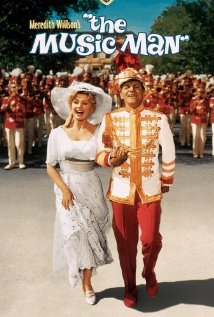
“Professor” Harold Hill (Robert Preston) is a con man posing as a salesman of band instruments and uniforms. He happens upon River City, a small town in Iowa. As the citizens explain in song, Iowa is a place of stubborn people who keep to themselves unless someone needs help. But Hill happens upon an old friend, Marcellus Washburn (Buddy Hackett), and is ready to run his favorite scam. He plans to sell the town on the idea of a boys band, with himself as leader, get them to order instruments and uniforms, and skip town with the money. Marcellus tells him a bit about the town and its people, and especially about the town librarian and music teacher, Marian Paroo (Shirley Jones).

Copyright Warner Brothers 1962

Marian lives with her mother (Pert Kelton) and her little brother Winthrop (Ronny Howard), a shy boy with a lisp, who deeply mourns his late father. In her own way, Marian, like Winthrop, is still grieving, and finds it hard to allow herself to become close to anyone. This is especially difficult because she is the subject of some gossip in the town. She has the job as librarian because an elderly man, a friend of her fathers, bequeathed the library building to the town, but left the books to her, to ensure that she would have permanent employment. This has caused some speculation about their relationship. And the ladies in the town also think the books she recommends (including the Rubiyat and Balzac) are improper. Despite her mother’s attempts to encourage her to be friendlier, Marian is very skeptical about Harold’s motives and his credentials. He is able to dazzle the town (with the famous patter song “Trouble,” offering the band as an alternative to the decadence of the town’s new pool parlor), but she vows to check his credentials.

The town gets caught up in the notion of the band. Harold’s charm and smooth promises enrapture everyone from the town council (he transforms them from four squabbling politicians into a harmonizing barbershop quartet) to the teen-age boy all the others look up to (Harold challenges him to invent an apparatus for holding the music so that the piccolo player can read it and encourages his romance with the mayor’s daughter). Harold even charms Winthrop, who is at last excited and happy about something. Harold tells all the parents that their children are wonderfully gifted and that the band will make them stars. Meanwhile, Harold’s attention to Marian is becoming more than just a way to help him get the money. And, despite evidence that he does not have the credentials he claims, and her certainty that he is not what he pretends to be, she finds herself softening toward him and protecting him.

Because of her, he stays too long, and he is arrested. As he says, “For the first time, I got my foot caught in the door.” But somehow, the boys force a few sounds out of the instruments, enough for their proud parents. And Harold stays on — it turns out that all along, deep inside, what he really wanted was to lead a band.

Discussion: Robert Preston brought his award-winning performance as Harold Hill on Broadway to the screen in this impeccable production, perfect in every detail. In addition to the glorious production, with some of the most gorgeous music and dancing ever filmed, there is a fine story with appealing characters. Marian learns about the importance of dreams from Harold, and he learns about the importance of responsibility from her.

Harold has made a life out of other people’s dreams, creating them and then spoiling them. He gives people an image of themselves as important and creative, and it is clear that this is what he loves about what he does, not stealing the money from them. Marian has faith in Harold. It is not the blind faith of the rest of the town, the people who see the seventy-six trombones he sings about. She sees what is good inside him, the real way that he affects people like Winthrop, the way he affects her. As she sings, “There were bells on the hills, but I never heard them ringing, oh, I never heard them at all, ’til there was you.” When Marian sees Harold and is willing to love him in spite of his past, he is for the first time able to move on from the notion of himself as a thief and a liar. Each finds the core of the other, allowing both of them to heal and take the risk necessary to make their dreams come true. For him, the risk is prison and disgrace. For her, the risk is the kind of hurt she felt when her father died, the risk we all take in loving someone. And because this is a musical, they live happily ever after.

Questions for Kids:

· Why is Winthrop so shy? What makes him change?

· How does Harold change people’s minds? Is that good or bad?

· How does the music help to tell the story? Listen to the songs “76 Trombones” and “Goodnight My Someone” again. They are very much alike, as you can tell when they are sung together. What did the composer want that to tell you about the people who sing them?

· Why were the parents worried about their children playing pool? What do parents worry about today?

· How is Marian’s library like yours? Do you know your librarian? Do people in your town ever argue about what books should be in the library?

Connections: This movie shows some of the most talented people of their time at the top of their form. Shirley Jones appeared in many musicals, including “Oklahoma” and “Carousel,” always exquisitely lovely in voice and appearance. She also won an Oscar for her dramatic role as a prostitute in “Elmer Gantry.” And of course she was the mother in television’s musical comedy series, “The Partridge Family.”

Robert Preston had more luck in theater than in movies finding roles that gave him a chance to show all he could do. But every one of his film appearances is worth watching, including “The Last Starfighter” and “All the Way Home.” Choreographer Oona White also did the sensational dance numbers in “Bye Bye Birdie.” Composer Meredith Willson never came close to the glorious score for “The Music Man,” but he produced some nice songs for “The Unsinkable Molly Brown.”


Related Tags:


Classic Crime For the Whole Family Musical Romance
THE MOVIE MOM® is a registered trademark of Nell Minow. Use of the mark without express consent from Nell Minow constitutes trademark infringement and unfair competition in violation of federal and state laws. All material © Nell Minow 1995-2026, all rights reserved, and no use or republication is permitted without explicit permission. This site hosts Nell Minow’s Movie Mom® archive, with material that originally appeared on Yahoo! Movies, Beliefnet, and other sources. Much of her new material can be found at Rogerebert.com, Huffington Post, and WheretoWatch. Her books include The Movie Mom’s Guide to Family Movies and 101 Must-See Movie Moments, and she can be heard each week on radio stations across the country.

Website Designed by Max LaZebnik