Little Orphan Annie: From Comic Strip to Radio, Broadway, Television, and Two Movies
Posted on December 18, 2014 at 8:00 am
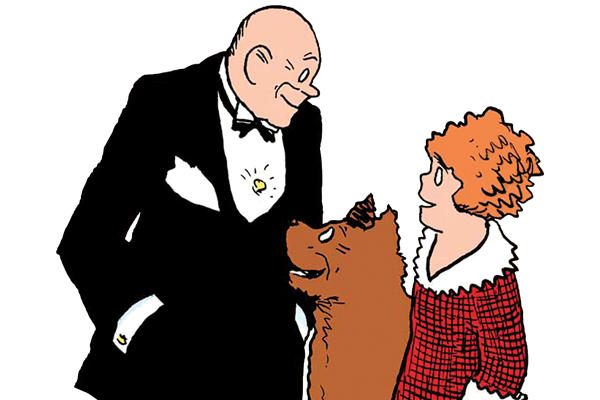
Copyright Harold Gray and Tribune Syndicate
The spunky little girl with the curly red hair and a dog named Sandy began as Little Orphan Annie in 1924, created by Harold Gray. Her pluck, self-sufficiency, and resilience caught the imagination of the Depression-era audience in the 30’s, and soon she was everywhere. You could buy books, dolls, jewelry, even dishes showing Annie with her iconic red dress and pupil-free eyes. There was a popular radio program (remember Ralphie and his Little Orphan Annie decoder disappointment in A Christmas Story. After Gray’s death, the strip was continued by the brilliant Leonard Starr (Mary Perkins On Stage).
In 1977, the Broadway musical version became one of the biggest hits in history. Here is the original star, Andrea McArdle, singing “Tomorrow.”
Dozens of young girls appeared in the play, including Sarah Jessica Parker. The documentary Life After Tomorrow has interviews with many of them about the stress of auditions and performing and how it affected their feelings about growing up. And in 2013, PBS aired another documentary about the casting of a revival of the stage show.
The 1982 movie musical version starred Albert Finney, Aileen Quinn, Carol Burnett, and Bernadette Peters and was directed by John Houston.
In 1999, a version made for television starred Alan Cumming, Audra McDonald, Kristin Chenoweth, Kathy Bates, Victor Garber, and Alicia Morton.
All of those versions kept the 1930’s setting — they even feature a rousing musical number with Franklin Roosevelt and his Cabinet. But this week’s release, produced by Will Smith, Jada Pinkett Smith, and Jay-Z, updates the story to the era of Instagram and Twitter. It stars Jamie Foxx, Cameron Diaz, Rose Byrne, and, as Annie, “Beast of the Southern Wild’s” Oscar-nominated Quvenzhané Wallis.
The story of Exodus is central to three of the world’s most significant religions and one of the Bible’s most cinematic stories, with a flawed but charismatic hero and a stirring story of slaves seeking freedom. It has already been filmed at least eight times, from Veggie Tales’ Moe & The Big Exit to Cecil B. DeMille’s epic The Ten Commandments, with Charlton Heston and Yul Brynner and Jeffrey Katzenberg’s animated The Prince of Egypt. Now Ridley Scott, who showed his mastery of sword and sandal epics with Gladiator has taken on the story with an all-star (but mostly non Middle-Eastern) cast and the latest 3D technology to really deliver on the special effects. Not so much on the theology part, though, or even the morality or meaning of it. Scott is clearly more interested in chases and battles and plagues, and so busy with it that he leaves out some of the story’s most important incidents. For example, instead of having to leave the palace because he killed an Egyptian who was beating a slave, Scott gives us a soapy story about Ramses’ jealousy. And we know Ramses is decadent because every time we see him, he’s eating.
The action and special effects work well, though. This is a two and a half hour movie that starts in the middle of the story and Scott keeps it moving. We first see Moses (Christian Bale) and Ramses (Joel Edgerton) as Seti (John Turturro), the Pharaoh, is giving them each a sword. At first, Ramses, Seti’s son, thinks he has been given the wrong one. But Seti has given them each other’s swords on purpose, to remind them that they must care for each other as they are about to go into battle. A seer has a prophesy: “In the battle, a leader will be saved and his savior will someday lead.” This inflames Ramses’ insecurity, especially when it comes true.
After Seti’s death, Ramses puts Moses in prison and tries to have him killed. Moses finds a home with a small community of shepherds and falls in love with Zipporah (María Valverde). Their life there is very sweet for nine years until he sees a burning bush and receives a message from God. Scott makes an imaginative choice here about portraying the Deity that I won’t give away, but I am still trying to decide how I feel about it. God tells him what he already knew in his heart. The Hebrews are his people and he cannot run away from his responsibility to help them find freedom. So he goes back to Memphis.
Bale holds the screen well as Moses, but Turturro, Kingsley, and Sigourney Weaver as Ramses’ mother do not have enough to do to. But there is a lot of time devoted to spectacle. Well past the two-hour mark, there are still 40 years of wandering in the desert and the Ten Commandments (twice) to get through, and they are sped through very quickly. The striking of the rock to get water, manna, the golden calf, and Moses not being permitted to enter the promised land are all skipped over. Two significant ideas that are included are Moses’ disagreements with God (and God’s approval of it) and the journey from the first scene, where Ramses believes in omens and faith and Moses believes in reason, to the end of the film, where they switch places.
Moses tells Ramses he must free the slaves and Ramses says the same thing that people have said throughout history when there is no possible moral justification for their position. He says that it is not economically feasible and will take a long time. Moses, trained as a general, gets the Hebrews to attack the Egyptians’ supply chain, but God gets impatient and steps in with the plagues, which are very vivid and rather disturbing. After the death of the Egyptian first-born children, including his own son, Ramses tells the Hebrews to go. But then he and his army ride after them, until the miracle at the Red Sea, very impressively staged. But, again, the focus is shifted from the story of the Exodus to much less interesting battle between two cousins raised as brothers.
The visual scope here is impressive. There just isn’t much soul.
Parents should know that this movie includes Biblical themes including slavery, plagues and other kinds of peril and abuse, extensive peril and violence, battles, many characters injured and killed including children, and disturbing scenes with dismemberment and dead bodies.
Family discussion: How did being raised as a prince affect the way Moses saw himself and his role? How was he affected by learning the story of his birth? Why does he object to the plagues?
If you like this, try: “The Ten Commandments” with Charlton Heston
Peter Pan, the boy who would not grow up, has been enchanting children and their families for more than a century now. This week’s live broadcast of the Broadway musical version starred Alison Williams and Christopher Walken. And next year we’ll see Hugh Jackman as Blackbeard in “Pan,” which looks like a prequel that will tell us how Peter Pan and the Lost Boys made it to Neverland and how Hook (Garrett Hedlund) became Captain Hook.
“Left Behind” is being marketed as Christian entertainment, but it does not qualify in either category.
It is far inferior to the modestly budgeted but sincere straight-to-DVD starring Kirk Cameron, based on the blockbuster best-selling book series by Tim LaHaye and Jerry B. Jenkins, itself inspired by the Book of Revelations. This version has a bigger budget and a real, Oscar-winning movie star, Nicolas Cage. But what it doesn’t have is any meaningful spiritual content aside from referring to a couple of Bible verses and the underlying premise that people of faith are taken up to heaven while those who did not live Godly lives are “left behind.” All of the significance and context of the book and the original film are swept away for just another disaster movie. This is not a movie about faith or grace. It is a movie about a plane that is in the air when the Rapture occurs, so that children and babies disappear along with some of the passengers and crew, and the sole remaining pilot (Cage) has to keep everyone calm and safe while he thinks about how he should have listened to his wife (Lea Thompson), a believer, instead of being driven away by her faith into a possible dalliance with a flight attendant.
With a musical score that sounds like the music you are stuck with on hold waiting for tech support and cheesy special effects, it feels like a low-budget disaster film from the 1970’s. There was laughter throughout the theater in one scene where a plane crashed in a parking lot because the stock footage used for the explosion was so clumsily inserted. And when Nicolas Cage plays a pilot on a plane in trouble, it is a huge disappointment that we only get one brief outburst. What is the point of putting the Cage rage-monster in a film if he doesn’t blow his top? Instead he just alternates between moping and steely determination, not his strengths.
But the real failure here is the hollowing out of the storyline. It is a sad irony that a movie intended to warn about the dangers of soullessness is itself so empty. At the end of 2014, it turned up on most critics’ worst of the year lists.
Cassi Thomson (who plays a devout Christian on “Switched at Birth” and a Mormon on “Big Love”) is Chloë, who comes home from college to surprise her father on his birthday only to find out that he won’t be there. Her father is the heroically named Rayford Steele (Cage), and he is a pilot and he will be flying to Europe. She waits at the airport to say goodbye to him before he leaves, and rescues a handsome television reporter named Buck Williams (Chad Michael Murray, in the film’s best performance) from a woman who tries to warn him of a coming Biblical catastrophe. Then Chloë sees her father walking to the gate with a flight attendant. There is something about the way they are leaning toward each other that indicates a close relationship. Chloë is devastated. It turns out Buck is on Ray’s plane, and Chloë gives him a message for her father.
Suddenly, when the plane is over the Atlantic and Chloë and her brother are at the mall, people disappear, taken out of their clothes. The rest of the film is Ray in the plane and Chloë on the ground, trying to figure out what has happened and why and what to do next.
The book and the original film had provocative notions of how current world events were playing into the predictions contained in Revelations. There were characters who represented the forces of evil and there were characters trying to make sense of what it meant to be left behind. This version has none of that. There is the thinnest gloss of faith-based content, as though the filmmakers are afraid of offending a mainstream audience. Even worse, it appears they assume that the faith-based audience is so loyal they will not care about cardboard characters, clumsy dialog, painful attempts at humor involving a little person, and poorly-staged action scenes. I hope that the success of well-made faith-based media this year will make it impossible for the filmmakers here to complain that the criticism of this film, which showed up on most of the 10 worst lists of 2014, is based on bias.
Parents should know that this film has a great deal of peril and violence, discussions of infidelity, sad losses, drinking and drugs, and some disturbing images.
Family discussion: What separated those who were taken and those who were left behind? What would you have written on the ticket envelope Chloë asked Buck to deliver?
If you like this, try: the original film with Kirk Cameron and the book series
Rated R for strong bloody violence and language throughout, including some sexual references
Profanity:
Very strong and crude language
Alcohol/ Drugs:
Drinking, drugs and drug dealing
Violence/ Scariness:
Extended and very graphic violence, with many characters injured and killed and graphic and disturbing images
Diversity Issues:
Diverse characters
Date Released to Theaters:
September 26, 2014
Date Released to DVD:
December 29, 2014
Amazon.com ASIN:
B00NX6WZIS
Copyright 2014 Columbia Pictures
The only thing nicer than having a real-life friend who could circumvent any obstacle of power or law or, you know, logic to deliver the roughest but most just of rough justice would be to have that friend be Denzel Washington. And that’s the story of “The Equalizer,” very loosely based on television series starring Edward Woodward, but in theme and character closer to a superhero saga.
Washington plays Bob McCall, a kind and quiet inventory clerk at a big box store, but we can tell right away that he has seen some stuff and knows even more stuff. His alarm clock goes off in a room so spare it might be occupied by a monk. But the bed has not been slept in. Bob prepares for the day, serious, precise, and methodical. He does one thing at a time. At work, he eats his bag lunch and gently but firmly coaches his young colleague Ralphie (Johnny Skourtis) on losing weight and working on the skills he will need to pass the test for security guard. And at night, he brings a book to the diner (Hemingway’s The Old Man and The Sea), sits at a table, unwrapping the tea bag he brought with him, and exchanges a few words with Teri (Chloë Grace Moretz), a young “escort.” “The old man met his adversary just when he thought that part of his life was over,” Bob tells Teri. “The old man got to be the old man. The fish got to be the fish. Got to be what you are in this world.” But what is Bob? And what is Teri?
We do not know Bob’s past, but we know he has one (especially if we’ve seen the trailer). If, as Spider-Man learns, with great power comes great responsibility, then with great power come some wrenching conflicts as well. When Ralphie and Terri get in trouble, Bob will step in, risking escalation, retribution, and blowing whatever cover he has worked very hard to create. On the other hand, if he does not step in, it will not be much of a movie. And if you have any question, his next choice of classic literature will make it clear: Don Quixote, who “lives in a world where knights don’t exist anymore.” In his own way, Bob is a Knight of Rueful Countenance. But unlike Don Quixote, Bob does not tilt at windmills. He takes on very bad people and he is very, very good at it. “The two most important days in your life are the day you are born and the day you find out why,” the film tells us at the beginning, quoting Mark Twain. Bob was not born to haul sacks of gravel.
A superhero movie has to have a character with power, whether it is money plus gymnastics and cool toys (Batman) or extra strength and speed (pretty much all of the Avengers). But we usually like them to have a secret or at least downtime identity — Bruce Wayne, Clark Kent, Tony Stark. There’s a lot of satisfaction in seeing them take down the bad guys. But there is even more satisfaction in what I call the “who is that chef?” moments (a reference to Under Siege). It’s not enough to kick the butt of the bad guy, you have to have the vast, immense, profound satisfaction of letting him know just how massively he has underestimated you. I mean Bob.
We get a lot of both in this film as Bob takes on bigger, meaner, and tougher bad guys in bigger, meaner, tougher confrontations. Bob likes to set his stopwatch so we know he is setting himself against more than the bad guys; he is still in some competition with, what? His abilities when he was younger? Or, as he says, “progress, not perfection” — is he moving toward some goal that is still just out of his reach?
Basically, this is a slow burn movie, with a build-up to introduce us to the characters and then a series of action sequences, all well staged but very, very violent, as to be expected from director Antoine Fuqua (“Training Day”). The bad guys are very, very, very bad. The good guy is very, very, very, very good. Denzel Washington is as good as it gets.
And a sequel is in the works.
Parents should know that this movie is extremely violent, with many characters injured and killed and many explicit and disturbing images. Characters use strong language. Bad guys use every possible kind of weapon and engage in every possible kind of criminal behavior including sex trafficking, extortion and arson, and drug dealing.
Family discussion: Why did Bob go to see his former colleague? What did he learn from the classic books he read?



 to Cecil B. DeMille’s epic
  , with Charlton Heston and Yul Brynner and Jeffrey Katzenberg’s animated
  . Now Ridley Scott, who showed his mastery of sword and sandal epics with
  has taken on the story with an all-star (but mostly non Middle-Eastern) cast and the latest 3D technology to really deliver on the special effects. Not so much on the theology part, though, or even the morality or meaning of it. Scott is clearly more interested in chases and battles and plagues, and so busy with it that he leaves out some of the story’s most important incidents. For example, instead of having to leave the palace because he killed an Egyptian who was beating a slave, Scott gives us a soapy story about Ramses’ jealousy. And we know Ramses is decadent because every time we see him, he’s eating.
 , itself inspired by the Book of Revelations. This version has a bigger budget and a real, Oscar-winning movie star, Nicolas Cage. But what it doesn’t have is any meaningful spiritual content aside from referring to a couple of Bible verses and the underlying premise that people of faith are taken up to heaven while those who did not live Godly lives are “left behind.” All of the significance and context of the book and the original film are swept away for just another disaster movie. This is not a movie about faith or grace. It is a movie about a plane that is in the air when the Rapture occurs, so that children and babies disappear along with some of the passengers and crew, and the sole remaining pilot (Cage) has to keep everyone calm and safe while he thinks about how he should have listened to his wife (Lea Thompson), a believer, instead of being driven away by her faith into a possible dalliance with a flight attendant.
 , but in theme and character closer to a superhero saga.
 ), sits at a table, unwrapping the tea bag he brought with him, and exchanges a few words with Teri (Chloë Grace Moretz), a young “escort.” “The old man met his adversary just when he thought that part of his life was over,” Bob tells Teri. “The old man got to be the old man. The fish got to be the fish. Got to be what you are in this world.” But what is Bob? And what is Teri?
 , who “lives in a world where knights don’t exist anymore.” In his own way, Bob is a Knight of Rueful Countenance. But unlike Don Quixote, Bob does not tilt at windmills. He takes on very bad people and he is very, very good at it. “The two most important days in your life are the day you are born and the day you find out why,” the film tells us at the beginning, quoting Mark Twain. Bob was not born to haul sacks of gravel.
 ). It’s not enough to kick the butt of the bad guy, you have to have the vast, immense, profound satisfaction of letting him know just how massively he has underestimated you. I mean Bob.