G.B.F.

Posted on January 14, 2014 at 1:50 pm

Writer George Northy and director Darren Stein manage to subvert and salute the traditions of the high school comedy in this smart, fresh, and funny story that shakes up the classic elements of teen movies but recognizes their eternal verities.  It is fitting that a story about undermining stereotypes slyly undermines expectations of high schoolers and high school movies.  Everything from “Mean Girls” to “Clueless” to “Pretty in Pink” gets shaken and stirred.

High school makes a great setting because it is a universal experience of heightened emotions that lend themselves well to comedy, drama, and identity.  It is the last place where everyone is pretty much stuck together.  The core elements of high school movies usually feature an outcast and often end up at prom.  “G.B.F.,” which stands for “gay best friend” follows that formula.  It is the story of two closeted gay seniors in a school that (improbably) does not have a single out gay student.  While a few years ago, this might have been a touching story about the courage to come out and confront homophobia, and a few years before that a comedy about a student pretending to be gay but really being straight, this film is set in a school with straight students who are desperately hoping for openly gay classmates to come out so that they can befriend them.   It’s hard to have a gay-straight alliance without any gay members.  And not one, not two, but three high school divas are desperately seeking a GBF as an accessory, to tell them how fierce they are.

The three divas are drama queen (really, she rules the theater clique) Caprice (Xosha Roquemore), Mormon goodie girl ‘Shley (Andrea Bowen) and capo de tutti capi Fawcett (Sasha Pieterse).  When Tanner (Michael J. Willett) is accidentally outed via an app on his phone, he all goes from zero to hero as the three girls compete with each other for his attention and favor.  The girls have a few surprises in store as well, as does Shley’s boyfriend.

The tone falters in spots and the acting falters frequently.  The appearance of Natasha Lyonne as a teacher just reminds us of how much better she was as a teen actress (especially in another gay-themed film, “But I’m a Cheerleader”) than many of the cast here.  But the quick, witty dialogue and the good heart of the film make it fun to watch and the heartening message helps smooth over the rough spots.

Related Tags:


Comedy High School Satire Stories about Teens

American Hustle

Posted on December 19, 2013 at 6:00 pm

american-hustle

“Some of this actually happened,” the movie’s opening shot deadpans.  It is true that the United States government both threatened and paid a con man to help them con some bigger fish and then accidentally ended up conning some of the biggest fish ever caught — six US Congressmen and a Senator.  David O. Russell directed and co-wrote “American Hustle,” the story of 1970’s fraud, insanity, and betrayal, plus a lot of “what were we thinking” hair and clothes and a rockin’ soundtrack, from “Goodbye, Yellow Brick Road” to “How Can You Mend a Broken Heart,” “Does Anybody Really Know What Time it Is?” and the inevitable “Horse With No Name.”

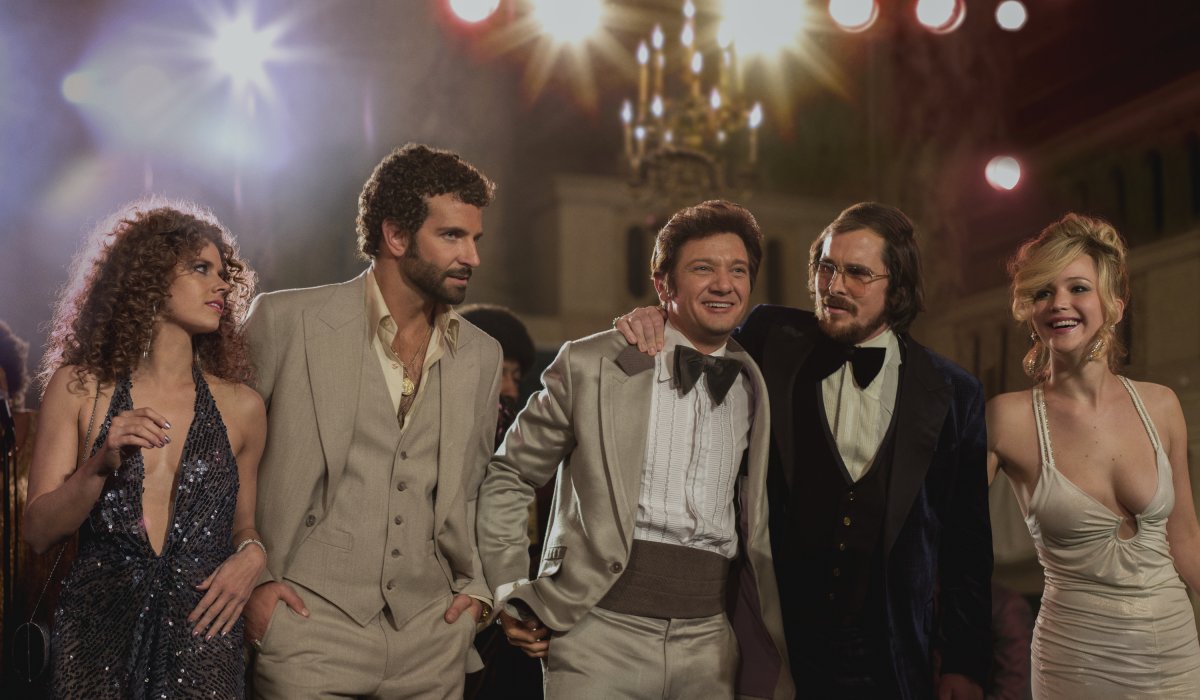
The storyline has so many layers of double-cross, lies, betrayal, grandiosity, and sheer insanity that the audience may feel they are getting lost, but in a way, that is the point, and of course, that is the decade for it.  I mean, look at the home perm on Bradley Cooper, who plays the hotdog FBI agent Ricky DiMaso as something of a cross between Starsky, Hutch, and Huggie Bear.

And then there is the hair on Christian Bale as Irving Rosenfeld.  It can perhaps best be described as an edifice.  As the movie begins, we are treated to the painstaking assembly of his pompadoured comb-over, remarkable to witness and a dead-on detail that lets us know who we will be following for the rest of the film.  He is a phony, he is all about making the surface look better than it should, and  he will do whatever it takes to put forward the image that will sell whatever he is trying to sell. Ascot, check.  Pinky rink, check. Briefcase full of cash, check.

Flashback.  Rosenfeld is the master of at least half a dozen medium-sized scams when, at a party, across the room, he spies a beautiful woman.  It is Sydney Prosser (Amy Adams).  They share a love of Duke Ellington and a talent for re-invention.  “My dream” she tells us, “more than anything, was to become anything else than what I was.”

They cook up an almost-legal scam, taking  up-front fees on the promise of using their connections to obtain loans from some vaguely defined “London connections.”  All is fine until they get busted.  And DiMaso, intrigued by their world of deception, persuades them to work for him to bring down some big-time criminals.

But things get complicated and messy.  DiMaso’s boss (a terrific Louis C.K.)  is reluctant to have federal officers engage in criminal activities, even to catch other criminals.  One of the great joys of this film is when the boss keeps trying to tell DiMaso an ice-fishing story that never gets to the point because the hotheaded DiMaso keeps interrupting him.  Rosenfeld is married to an unhappy, volatile wife named Rosalyn (a dazzling performance of astonishing depth and mesmerizing assurance by Jennifer Lawrence) and stepfather to her son.  He has to find a way to resolve things with the FBI, the mob, and the politicians.

The unfinished ice-fishing story is the point.  This is not a nice, linear explanation for what happened.  This is a bunch of stories that intersect in a maze of all seven of the deadly sins plus a few that should also be on the list.  Brilliant performances by everyone in the cast (including Alessandro Nivola as an FBI official and an unbilled guest star as a guy from the mob) and a witty, insightful script are what hold it together.  Lawrence makes us furious at and sorry for her character at the same time, and she is sizzlingly funny.

The purpose of this film is not to illuminate the particular events of Abscam.  It is to meditate on the irrepressible American enthusiasm for self-invention and the thicket of betrayal and damage that can be the result.  It is about the stories we tell, even the ones like the ice fishing story that never get to make a point.  Russell himself can’t resist tweaking the details, making the characters more interesting and sympathetic than they really were.  But that wouldn’t be a good story.

Parents should know that this film has very strong adult material including constant bad language, explicit sexual references and situations, nudity, drinking and drug use, extensive criminal behavior and betrayal.

Family discussion: Who are the biggest con artists in this story?  How do the characters determine who deserves their loyalty?  Was justice done?

If you like this, try:  “Flirting with Disaster,” “The Fighter,” and “Silver Linings Playbook,” from the same director


Related Tags:


Based on a true story Crime Drama Politics Satire

The Campaign

Posted on August 9, 2012 at 6:05 pm

“Freedom.” “Jesus.” “America.”  And whoever you are, you are “the backbone of this country.”  This attempted political satire feels as empty as the platitudes spouted by the candidates in this R-rated comedy that, like the political system it portrays, goes for the easy and expedient and the trashy instead of the substantive or constructive.  Bill Maher, “The Daily Show,” and “The Colbert Report” have raised the bar on political comedy, so we expect more bite than this lackluster film, as generic as its title.

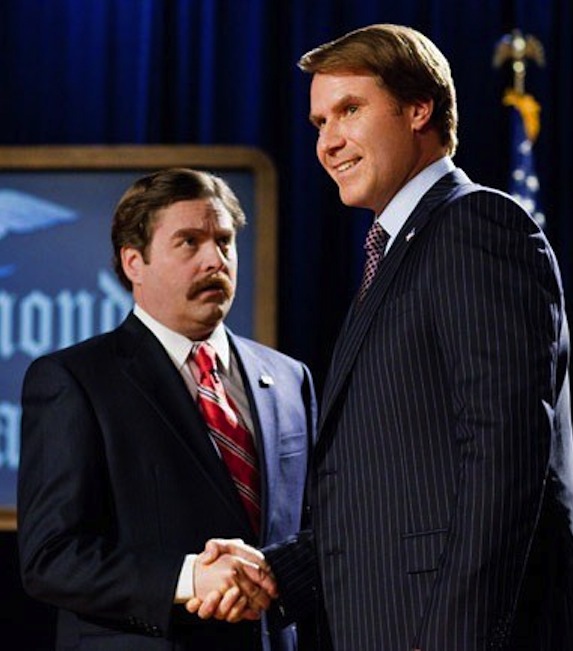
Will Ferrell plays four-term Congressman Cam Brady, a Democrat from North Carolina, expecting to run unopposed in the upcoming election.  But he all of a sudden becomes vulnerable when leaves a raunchy voicemail for his mistress on the wrong answering machine.  The mega-wealthy Motch brothers (played by John Lithgow and Dan Aykroyd and inspired by the real-life Koch brothers, who fund many right-wing causes and politicians) decide they would be better off with another candidate.  So, even though he is “weird” and has no experience in politics, they pick Marty Huggins (co-producer Zach Galifianakis).  He is the son of a wealthy man (Brian Cox) who has strong connections to business and government.  The Motches send in Tim Wattley (Dylan McDermott), their best political operative to run the campaign, and he crisply cuts right to the point: “I’m here to make you suck less.”

Immediately, Marty’s life is turned upside down as his beloved pug dogs are replaced with a golden retriever and a black lab — both in bandanas — because those breeds have the highest approval ratings.  He and his wife and their home get extreme makeovers and Tim keeps Marty on talking points.  Meanwhile, Cam’s overconfidence and poor judgment help Marty rise in the polls.  The Motches have been using a loophole to sell goods produced in China labeled as “made in America” (based on convicted felon Jack Abramoff’s deal in the Mariana Islands).   They plot to create an enterprise zone in the district, waiving environmental, safety, and wage regulations so they can create American sweatshops with imported Chinese workers (“insourcing”).  They just need a Congressman who will do what they tell him. And their control goes even deeper than money.

It is briefly intriguing to see Dan Aykroyd taking over the kind of “Trading Places” rich bad guy brother role Don Ameche and Ralph Bellamy played when he and Eddie Murphy were the leads, but the contrast just shows how little energy and bite this film in comparison.  McDermott picks things up with some dark wit and Katherine LaNasa is a highlight as Cam’s steel magnolia of a wife.  But Ferrell is deprived of his greatest asset as a performer.  He is at his best when he plays flawed men who are immature and self-centered but still likable because they really want to be liked and struggle to do the right thing.  Cam just does not care.  And Galifiniakis’ mincing affect and Southern drawl are not as witty as he intends them to be.  This is one of those campaigns when you wish the ballot had an option for “none of the above.”

Parents should know that this movie includes extremely crude humor with very explicit sexual references and situations and very strong and vulgar language, brief female nudity, drinking, drunkenness and drunk driving, smoking, comic peril and violence including snake bite and shooting injury, a lot of corruption and overall bad behavior played for comedy.

Family discussion:  What elements of the story seemed most true about our current political system?  What is the impact of “Citizens United” on elections?

If you like this, try: “In the Loop” and documentaries like “The War Room” and “Unprecedented”

Related Tags:


Comedy Politics Satire

Rock of Ages

Posted on June 14, 2012 at 6:00 pm

The era of big power ballads reaching to the back rows of big stadiums filled with big crowds of fans with big hair is paid big tribute in this irresistibly entertaining anthem-rock love letter to the 80’s.  Sung almost entirely by actors rather than rockers, the music is homogenized, somewhere between a “Glee” episode and a real glee club performance.  But, let’s face it.  Some of these songs were close to parody even at the time.

Marx famously said that history repeats itself, first as tragedy and then as farce.  When it comes to music, history repeats itself, too.  First — at least ideally — it is raw and authentic expression of emotion and, as “School of Rock” reminds us, “sticking it to The Man.”   When it repeats itself, it is The Man.  Yes, “Rock of Ages” is a jukebox musical that turns the barbaric yawps and screeches of rock and roll into something between karaoke, elevator music, and Up with People.  Journey’s “Anyway You Want It” is currently being used as an insurance company jingle and background music in an animated kids’ film, Madagascar 3 and Dee Snider sings in an ad about cleaning the rock and roll out of your carpet.  So it’s hard to say that it dilutes the authenticity of these songs to be performed by Mary J. Blige, Constantine Maroulis, and Julianne Hough.

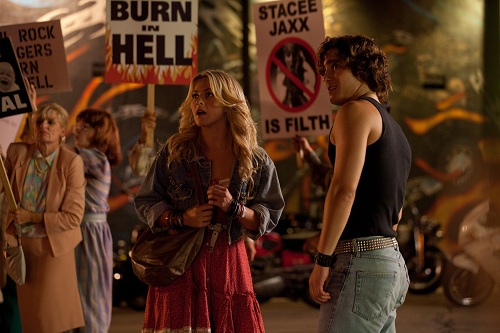
Various romantic, business, and existential conflicts provide excuses for songs from Bon Jovi, Guns N Roses, Def Leppard, Twisted Sister, Poison, and Pat Benetar.  Hough plays Sherrie (how did they not include “Oh, Sherrie?”), a small-town girl, living in a lonely world, who takes not the midnight train to anywhere but the midnight bus from Oklahoma to Los Angeles, in search of the excitement and adventure she has glimpsed through her beloved collection of record albums.  They — along with everything else she owns — are stolen as soon as she arrives.  But Drew (Diego Boneta), a city boy who works at a club and wants to be a singer, gets her a job as a waitress.  The club is owned by Dennis (Alec Baldwin), who is hoping that an upcoming show from a superstar rock group he helped in their early days will solve his financial problems.  His devoted techie (that’s sound technology, not computers, back in the 80’s) is Lonny (Russell Brand).

The group is the fictitious Arsenal and this is their last show.  Their rock god frontman, Stacee Jaxx (Tom Cruise) is leaving them for a solo career.  Also arriving is the Rolling Stone reporter who is, uh covering Jaxx (Malin Ackerman).  And also on her way is the wife of the mayor (Catherine Zeta Jones), leading the charge against rock and roll for its outrageous lyrics and sexual rhythms, in support of her husband’s plan to drive out sex, drugs, and rock and roll so he can let his business cronies gentrify the area.  The irony is not lost that the storyline in the movie gentrifies not only the music it portrays but the plot of the already-prettied-up musical playing since 2009 near the already-gentrified Times Square.  The script has a few choice moments, including a funny joke about another element of 80’s music — boy bands.  And it is cute to have the protesting women sing a real rock anthem, “We’re Not Going to Take It” while the rock fans sing the song even the Jefferson Starship (nee Airplane) is embarrassed by, “We Built This City.”  (Look carefully in the crowd for some real 80’s stars including Debbie Gibson and Sebastian Bach.)

If the songs are a little soft in the middle, well so are the teenagers of the 80’s who are this film’s target audience.  Hough and Boneta are so bland they all but disappear fromt the screen.  The only real singer in the cast is Mary J. Blige, but Cruise vamps like a superstar and his performance is choice.  As the rock star who is as zonked by ennui as he is by substance abuse and groupies but who comes alive on stage imploring us to pour some sugar on him, he is a hoot.  He is clearly having the time of his life and the pure enjoyment he, Baldwin, Brand, and Zeta Jones bring to the film is as buoyant as the still-hummable music.  Yes, we were young, heartache to heartache we stood, and like the brick-sized cell phones, buying albums at Tower Records, and cassette tapes,  the memories bring a smile.  And some devil’s horns.

Parents should know that this film includes gay and straight sexual situations and explicit situations including groupies and strippers, drinking and drunkenness, and some strong language.

Family discussion: What has changed the most in popular music since these songs were hits?  Which of today’s songs will still be popular 30 years from now?

If you like this, try:  “Across the Universe” and concert films from some of the groups whose songs are featured in this movie like Def Leppard’s “Rock of Ages,” Bon Jovi’s “Life at Madison Square Garden,” and Guns ‘n’ Roses’ “Use Your Illusions” I and II

For a weekly newsletter with my latest reviews, sign up here!

Related Tags:


Based on a play Comedy Music Musical Romance Satire

The Dictator

Posted on May 15, 2012 at 6:00 pm

Chutzpah has never been a problem for Sasha Baron Cohen, whose previous films, based on characters he created for television, were semi-documentaries of encounters with ordinary people who did their best to accommodate his outrageously offensive behavior.  Whether he was getting a group of people at a rodeo to sing along with an anti-Semitic anthem as an Eastern European journalist in Borat, or get parents of babies to eagerly agree to put their infants in danger in order to be in a movie as the gay fashionista Brüno, Cohen exposed hypocrisy, bigotry, and general cluelessness, as well as the occasional sweetness and tolerance of Americans willing to respect cultural differences.  After appearances in mainstream Hollywood films “Sweeney Todd” and “Hugo,” Cohen has returned to his favorite themes with a scripted film, working again with director Larry Charles, in a sharp political satire in the grand tradition of Chaplin’s “The Great Dictator” and Eddie Murphy’s “Coming to America.”  Except much dirtier.  Chaplin never thought of shooting a scene from inside a woman in the middle of delivering a baby.

Cohen plays Aladeen the totalitarian dictator of North African country called Wadiya, which has caused concern in the rest of the world by developing a nuclear weapon.  The development of the weapon as well as just about everything else in the country is obstructed by Aladeen’s egomania and peremptory Queen of Hearts-style ordering of executions for anyone who disagrees with him, bumps into him, or offends him in any way.  He has an entire wall of famous Americans he paid to have sex with him, including Megan Fox, Oprah, Lindsay Lohan, and Arnold Schwarzenegger.

Aladeen’s closest aide is Tahir (Sir Ben Kingsley), who is plotting to assassinate Aladeen so that he can take over and sell the country’s lucrative oil rights to Exxon, wealthy Chinese businessman Mr. Lao (Bobby Lee), a heterosexual who enjoys demonstrating his power by making male celebrities have sex with him (leading to a perfectly performed and hilarious cameo by a movie star not known for his sense of humor).  Aladeen uses doubles (also played by Cohen) as decoys.  After one is killed, he finds another who is something of a simpleton.

Aladeen and his  new double go to New York so that he can address the UN about the nuclear weapon.  Tahir arranges for the dictator to be captured and killed so that the double can sign the papers establishing Wadiya as a democracy that he needs to sell Mr. Lao and other corporations the oil rights — and become monumentally wealthy.  Aladeen is captured and there is a funny scene when he talks his captor (John C. Reilly) out of torturing him with a friendly and knowledgeable discussion of torture implements and techniques.  He does not get tortured but he does get shaved and thus unrecognizable as the dictator.  So Aladeen ends up working in a Brooklyn collective food market run by Zoe (the ever-effervescent and always-game Anna Faris).  Despite his contempt for her politics — and her unshaven underarms — he can’t help being captivated by her.  Cohen tempers his fascination with the offensive and making the audience uncomfortable with a little bit of sweetness this time, and the story and the film benefit from it.

Parents should know that this movie has extensive crude and intentionally offensive material including racist and sexist and sexual humor, potty jokes, male nudity, and political humor.

Family discussion: How is Sasha Baron Cohen able to make points through satire that are not possible in serious political commentary and debate?  Do you think he goes too far and how do you draw that line?

If you like this try: Chaplin’s “The Great Dictator,” “Coming to America,” and Cohen’s other movies

Related Tags:


Comedy Satire
THE MOVIE MOM® is a registered trademark of Nell Minow. Use of the mark without express consent from Nell Minow constitutes trademark infringement and unfair competition in violation of federal and state laws. All material © Nell Minow 1995-2026, all rights reserved, and no use or republication is permitted without explicit permission. This site hosts Nell Minow’s Movie Mom® archive, with material that originally appeared on Yahoo! Movies, Beliefnet, and other sources. Much of her new material can be found at Rogerebert.com, Huffington Post, and WheretoWatch. Her books include The Movie Mom’s Guide to Family Movies and 101 Must-See Movie Moments, and she can be heard each week on radio stations across the country.

Website Designed by Max LaZebnik