A classic moment from one of the best-loved holiday treats, Rudolph the Red Nosed Reindeer . Cheers to all of the misfit toys out there!
http://www.youtube.com/watch?v=5SH1j1luFOw
The very touching story behind the Rudolph song and its creator, Bob May, was told by his friend, my beloved late uncle, Stanley A. Frankel, in a magazine story more than sixty ago.
Rudolph that Amazing Reindeer
by Stanley Frankel
His lovable antics have delighted millions of children; here is the inspiring story of how he was born when a father tried to comfort an unhappy little girl.
On a december night in Chicago ten years ago, a little girl climbed onto her father’s lap and asked a question. It was a simple question, asked in childish curiosity, yet it had a heart-rending effect on Robert May.
‘‘ Daddy, ’’ four-year-old Barbara May asked, ‘‘ why isn’t my Mommy just like everybody else’s mommy? ’’
Bob May stole a glance across his shabby two-room apartment. On a couch lay his young wife, Evelyn, racked with cancer. For two years she had been bedridden; for two years, all Bob’s small income and smaller savings had gone to pay for treatments and medicines.
The terrible ordeal already had shattered two adult lives. Now, May suddenly realized, the happiness of his growing daughter was also in jeopardy. As he ran his fingers through Barbara’s hair, he groped for some satisfactory answer to her question.
For Bob May knew only too well what it meant to be ‘‘different. ’’ As a child he had been weak and delicate. With the innocent cruelty of children, his playmates had continually goaded the stunted, skinny lad to tears. Later at Dartmouth, from which he was graduated in 1926, Bob May was so small that he was always being mistaken for someone’s ‘‘little brother.’’
Nor was his adult life much happier. Unlike many of his classmates who floated from college into plush jobs, Bob became a lowly copy writer for a New York department store. Later, in 1935, he went to work writing copy for Montgomery Ward, the big Chicago mail-order house. Now, at 33, May was deep in debt, depressed and miserable.
Although Bob didn’t know it at the time, the answer he gave the tousle-haired child on his lap was to catapult him to fame and fortune. It was also to bring joy to countless thousands of children like his own Barbara. On that December night in the shabby Chicago apartment, May cradled the little girl’s head against his shoulder and began to tell a story …
Once upon a time there was a reindeer named Rudolph — the only reindeer in the whole world that had a big red nose. Naturally, people called him ‘‘ Rudolph the Red- Nosed Reindeer. ’’ As Bob went on to tell about Rudolph, he tried desperately to communicate to Barbara the knowledge that, even though some creatures of God are strange and different, they often enjoy the miraculous power to make others happy.
Rudolph, Bob explained, was terribly embarrassed by his unique nose. Other reindeer laughed at him; his mother and father and sisters and brothers were mortified too. Even Rudolph wallowed in self- pity.
‘‘Why was I born with such a terrible nose?’’ he cried.
Well, continued Bob, one Christmas Eve, Santa Claus got his team of four husky reindeer– Dasher, Dancer, Prancer and Vixen– ready for their yearly round- the- world trip. The entire reindeer community assembled to cheer these great heroes on their way. But a terrible fog engulfed the earth that evening, and Santa knew that the mist was so thick he wouldn’t be able to find any chimneys.
Suddenly Rudolph appeared– his red nose glowing brighter than ever– and Santa sensed at once that here was the answer to his perplexing problem. He led Rudolph to the front of the sleigh, fastened the harness and climbed in. They were off! Rudolph guided Santa safely to every chimney that night. Rain and fog– snow and sleet– nothing bothered Rudolph, for his bright nose penetrated the mist like a beacon.
And so it was that Rudolph became the most famous and beloved of all reindeer. The huge red nose he once hid in shame was now the envy of every buck and doe in the reindeer world. Santa Claus told everyone that Rudolph had saved the day– and from that Christmas Eve onward, Rudolph has been living serenely and happily
… Little Barbara laughed with glee when her father finished. Every night she begged him to repeat the tale– until finally Bob could rattle it off in his sleep. Then, as Christmas neared, he decided to make the story into a poem like ‘‘ The Night Before Christmas’’– and prepare it in booklet form, illustrated with crude pictures, for Barbara’s personal gift.
Night after night, Bob worked on the verses after Barbara had gone to bed, polishing each phrase and sentence. He was determined his daughter should have a worthwhile gift, even though he could not afford to buy one.
Then, as May was about to put the finishing touches on ‘‘ Rudolph, ’’ tragedy struck. Evelyn May died. Bob, his hopes crushed, turned to Barbara as his chief comfort. Yet despite his grief, he sat at his desk in the quiet, now-lonely apartment, and worked on ‘‘ Rudolph’’ with tears in his eyes.
Shortly after Barbara had cried with joy over his handmade gift on Christmas morning, Bob was asked to an employees’ holiday party at Montgomery Ward’s. He didn’t want to go, but his office associates insisted. When Bob finally agreed, he took with him the poem — and read it to the crowd. At first the noisy throng listened in laughing gaiety. Then they became silent — and at the end, broke into spontaneous applause.
Several Ward executives asked Bob for copies. Then someone suggested: why not put the poem into booklet form as a free gift of Ward customers the following Christmas? Next year, 1939 — a year in which Bob labored to pay his debts and keep Barbara fed and clothed — 2,400,000 copies of the book were printed and given free to youngsters whose parents were customers at the hundreds of Montgomery-Ward stores all over the country.
The story of the reindeer caught on immediately. Psychologists, teachers and parents hailed Rudolph as a perfect gift for children. Newspapers and magazines printed stories about the new hero. Ward’s stores and catalogue offices, placing orders for the following Christmas, asked for 3,000,000 copies.
Meanwhile, May won acclaim — but little else. Montgomery Ward owned the copyright. Yet May was happy in the knowledge that his child — and millions of other children — loved his red-nosed reindeer.
Then the war came, and the giveaway project was shelved. Throughout the war years, however, requests poured in for Rudolph books, toys, games, puzzles, records– all nonexistent. And the demand mounted each Christmas season as parents got out the old Rudolph book and read it to growing families of new Rudolph enthusiasts.
Meanwhile, Rudolph’s success did things to Bob May. He forgot his pessimism, began to laugh again and associate with friends. And among those friends was a pretty brunette, a secretary at Montgomery Ward’s. In 1941, Bob married Virginia Newton. Together they created three new Rudolph fans — Joanna, Christopher and Ginger.
Finally the war was over — and Ward executives planned a new Rudolph book for Christmas, 1946. More than that, a message came from Sewell Avery, president of Ward’s. Touched by the beauty and simplicity of the Rudolph story, he ordered the copyright turned over to Bob — so that May could receive all royalties.
In 1946, 3,600,000 Rudolph booklets had been distributed by Ward’s. Promptly a deluge of demands for Rudolph products swamped Ward’s and Bob May. Businessmen wired, telephoned and called, seeking permission to manufacture toys, puzzles, slippers, skirts, jewelry and lamps.
A special recording of the poem was made by Victor. Maxton Publishers, Inc., bought the rights to produce a bookstore edition in 1947. Parker Brothers brought out a Rudolph game. Even Ringling Brothers-Barnum and Bailey circus proudly exhibited a pony, equipped with antlers and an electrically lighted red nose, called ‘‘Rudolph the Reindeer.’’
Christmas of 1947 was the brightest ever for Bob May, his family and Rudolph. Some 6,000,000 copies of the booklet had been given away or sold — making Rudolph one of the most widely distributed books in the world. The demand for Rudolph-sponsored products increased so much in variety and number that educators and historians predicted Rudolph would come to occupy a permanent niche in the Christmas legend.
Sellouts all over the country inspired merchants to make even more elaborate plans for Christmas, 1948. A special feature is the cartoon in Technicolor directed by Max Fleischer and narrated by Paul Wing which is being run this Christmas season in thousands of film houses. Manufacturers are already blueprinting Rudolph merchandise for 1949-1950-1951– with each item sold returning a royalty to Bob May.
His fortune has now been made, and the years ahead look even brighter. Today, Bob is still a shy, thin, affable man who wants more than anything else to build security for himself and his family. He still works at Ward’s– now as retail copy chief– and tackles the job with the same perseverance which has characterized his whole life.
Through his years of unhappiness, the tragedy of his first wife’s death and his ultimate success with Rudolph, Bob May has captured a sense of serenity. And as each Christmas rolls around, he recalls with thankfulness the night when his daughter Barbara’s question inspired him to write the poem that closes on these lines: But Rudolph was bashful, despite being a hero!
And tired! (His sleep on the trip totaled zero.)
So that’s why his speech was quite short, and not bright — ‘‘ Merry Christmas to all, and to all a good night! ’’


 and
and  , former Miss America
  , former Fonzie
  , and former Saturday Night Live star
  . I love them all. But here are my very favorites, the ones I try to watch every year.
 Who better to play Scrooge than his namesake Scrooge McDuck? And who better for the part of the unquenchable Bob Cratchit than Mickey Mouse? This compilation DVD includes other Christmas goodies “The Small One” and “Pluto’s Christmas Tree.”
 has the distinguished actor Michael Caine as Scrooge and the equally distinguished Kermit the Frog as Bob Cratchit. Special mention of
  as well.
 . The voice talent is outstanding, with Broadway star Jack Cassidy (father of teen idols David and Shaun) as Bob Cratchit and of course Jim Backus as Mr. Magoo, in this version an actor playing the part of Scrooge. The tuneful songs were written by Bob Merrill and Jule Styne, who later went on to write “Funny Girl.” (The legend is that their song “People” was originally written for this movie.)
 This MGM classic features the top stars of the 1930’s. Watch for future “Lassie” star June Lockhart as one of the Cratchit children — her real-life father Gene Lockhart played Bob. (He also appears in another Christmas classic, as the judge in
 .)
.) This is the all-time best, with the inimitable Alistair Sim as Scrooge. There has never been a more embittered miser or a more jubilent Christmas morning rebirth. When he orders that turkey for the Cratchits and walks into his nephew’s celebration at the end, everything Dickens hoped for from his story is brought to life.
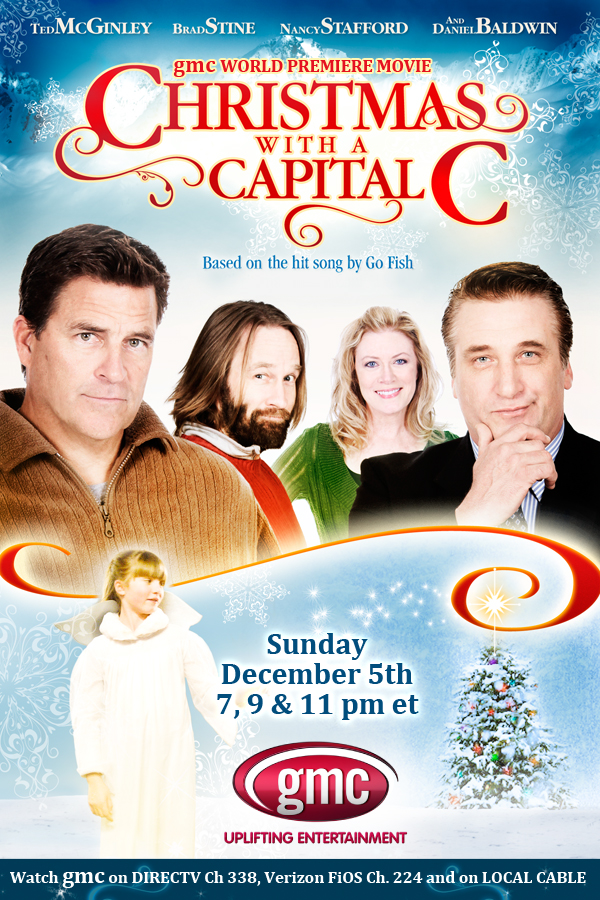
 , now available on DVD. She spoke to me about the movie and about the way her faith leads her to projects that share her message of faith and God’s love for each of us.
 . It’s a 30-day devotional that invites the reader to dive into the heart of God and discover 30 aspects of His love we might not always see or understand. Each one is on 30 different ways that God loves us. It’s really personal but people really seem to respond to it. I love women and I minister to women and
  it was because I desperately needed to be reminded of who I am in Christ. I needed to assured and reminded of my value and my true worth, not based on what I look like or what I have or how I perform but on how He says about me me. The same thing with this book. I needed in my own life to be reminded of God’s actual, unshaking, immeasurable love for me. As I pored over scripture, I just saw it flying off the page. I started writing down a list of the aspects, the qualities of God’s love, His nature. I thought, if I need this, maybe someone else needs encouragement. When I’m walking through shadow times and in heartache or pain or disappointment, when it seems He cannot see me, when I can’t see His love at all, it is steadfast and always there.

