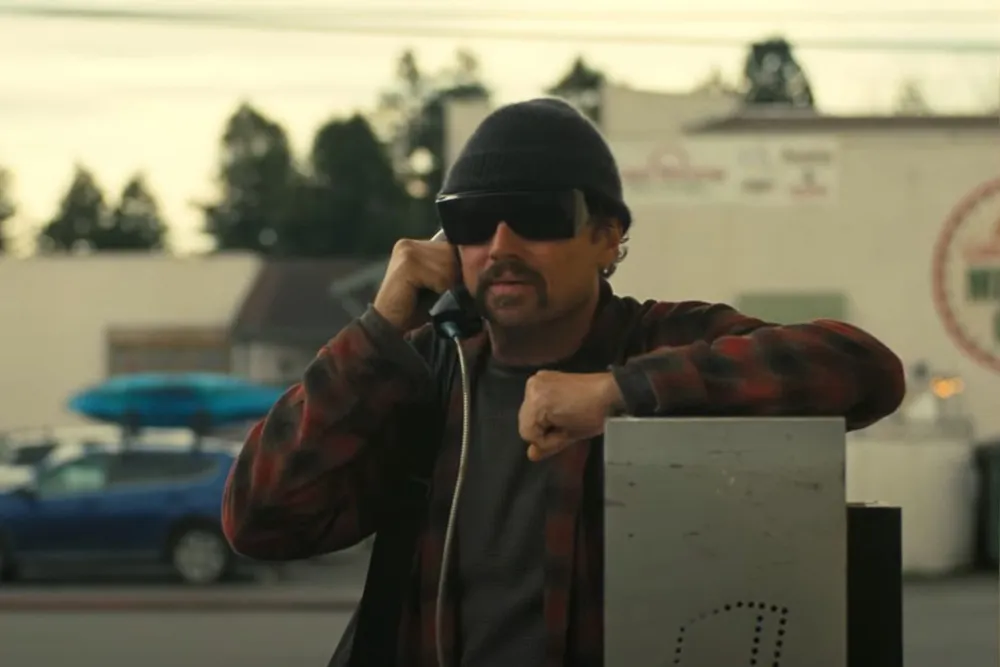
The Life of Chuck

The Life of Chuck

Posted on June 15, 2025 at 12:24 pm

A-
Lowest Recommended Age: High School
MPAA Rating: Rated R for language
Profanity: Strong language
Alcohol/ Drugs: Alcohol
Violence/ Scariness: Apocalyptic themes, sad off-screen deaths including parents and grandparents, references to suicide
Diversity Issues: Diverse characters
Date Released to Theaters: June 13, 2025

When a movie begins with “Act Three,” it is an invitation to open our minds to something unusual. “The Life of Chuck” is based on a story by Stephen King, and it reflects his more mystical side. While it includes dark and tragic themes, it is a story of profound humanity, ultimately spirit-expanding.

Copyright 2035 NEON

It begins at the end in more ways than one. A teacher named Marty (Chiwetel Ejiofor) is meeting with parents who seem oddly disconnected from concerns about how their children are doing in school. The world seems to be collapsing. A major earthquake has knocked California into the ocean. The internet is shutting down. Couples who have been together are splitting up and those that have split up are getting back together. Marty’s ex, Felicia (Karen Gillan) is an exhausted nurse in a hospital where most of the arrivals are attempted suicides. And somehow, signs – billboards, skywriting, bench posters, even projected in the windows of suburban homes — are appearing everywhere thanking someone named Chuck. 

In Act Two we meet Chuck as a young boy and see him grow up. His parents were killed in an automobile accident, and he lives with his grandparents (Mark Hamill as Albie and “Ferris Bueller’s” Mia Sara as Sarah) in an old house with a padlocked room in a cupola on the top floor that he is warned never to open. He is very good at math but what he loves is dancing, and a dance class leads him to what will be one of his life’s most profound and satisfying moments, in part because after moments of doubt and fear of being judged (he is in middle school, the judgiest part of life), he finds the courage to follow his heart and take a risk. Later, as an adult, and, as we are told by narrator Nick Offerman, nine months from his death due to a still-undiagnosed brain tumor, he will have another sublime moment of dance, when he passes by a busking drummer on a break from an accounting conference.

To say much more would be to say too much; this is a film that benefits from an audience without expectations or advance guidance. But for those who have seen it and would like to know what I think it means, I have some spoiler-filled comments at the end of this review. For now, I will just point out that twice in the film teachers share a selection from Walt Whitman’s Song of Myself in their classrooms, the part that goes

Do I contradict myself?

Very well then I contradict myself,

(I am large, I contain multitudes.)

When Chuck’s teacher (played by Kate Sigel) explains this passage to him, she places her hands gently over his ears and asks what is between them. It is the multitudes within each of us, every emotion, every memory, every wish, every fear, every sublime moment, every crushing disappointment, every tiny quotidian interaction we are not even aware that we noticed. 

This movie is a labor of love from both King and writer/director Mike Flanagan, whose wife (Seigel) and son (as the youngest version of Chuck) appear as key characters. It has a transcendent, poetic humanity that should make us better appreciate our own lives and the people we value.  And take the time, at least once in a while, to dance.

Parents should know that a child’s father and pregnant mother are killed (offscreen) in a car accident and there are apocalyptic events. A central character dies and there are references to other deaths, including a suicide. Characters use strong language and there are references to pornography.

Family discussion: What multitudes are in you? Who would you want to be with if things were scary? What do we learn from Marty’s conversations with Sam and Gus? Should Chuck have listened to his grandfather’s advice? 

If you like this try: “It’s a Wonderful Life,” “The Odd Life of Timothy Green,” and “Stranger Than Fiction” 

Stop now if you don’t want spoilers.

CLUES: What does it mean that we see Sam and Gus in different time periods but they do not seem older or younger, while Chuck is played by four different actors as he goes from young childhood to middle age? Why is the Whitman poem so important? 

MY VIEW: Every character in the movie is a part of the “multitudes” that make up one person, Chuck Krantz. The thank you signs are a part of his shutting down as he dies. When we die, our stories, our memories, our relationships, the multitudes within us stop, at least in the form of being contained in one individual consciousness. What Chuck saw in the locked room represents the recognition we all have that our lives are temporary. 

Related Tags:


Based on a book Drama movie review Movies -- format Movies -- Reviews
Sorry, Baby

Sorry, Baby

Posted on June 13, 2025 at 5:33 pm

A-
Lowest Recommended Age: Mature High Schooler
MPAA Rating: Rated R for sexual content and language
Profanity: Very strong, explicit, and crude language
Alcohol/ Drugs: Alcohol
Violence/ Scariness: Sexual abuse
Diversity Issues: Diverse characters
Date Released to Theaters: June 13, 2025
Copyright 2025 A24

Eva Victor makes an extraordinary debut as writer, director, and star of indie festival favorite “Sorry, Baby,” a story that includes profound trauma told with delicacy and even humor. Victor plays Agnes, a young college professor of literature when we first see her, a grad student in flashbacks that over the course of the film reveal an abusive encounter with her thesis advisor.

But the movie wisely begins with what will be the primary theme of the film, not the trauma but the grace that helps her go on.

Lydie (Naomi Ackie) arrives for a visit. She was Agnes’ housemate in college and they are still the closest of friends, the kind whose conversations skim along effortlessly and joyously, un-anchored by having to explain their references or hide their secrets. Their affection, devotion, and unconditional support are palpable.

Later in the film, a character played by the always-great John Carroll Lynch turns out to be an unexpected source of understanding and comfort when Agnes has a panic attack. It is a highlight of the film and one of the best moments we will see on screen this year.

The movie is told non-sequentially, with chapter headings, allowing us to get to know Agnes and get a hint of the reason for her vulnerability before we learn the details. Later we find out what happened and see the immediate aftermath, with responses adding insult to injury from a brusque doctor and from the school’s administrators. The structure is more mosaic than linear, with off-center revelations that allow us to think and feel through the aftermath.

We also get to know Agnes, who as written and portrayed by Victor is endearingly direct, even blunt at times, and yet keeping a lot inside. There comes a tipping point when we recognize the pain of dealing with the trauma is less than the pain of not dealing with it. And we see those moments reflected through Agnes’ interactions with her neighbor (the always-welcome Lucas Hedges), a stray cat, her students and supervisor, the Lynch character, and someone who appears for the first time in a stunning final scene.

Parents should know that this movie includes off-screen sexual abuse and the post-traumatic emotional struggles. There are explicit sexual references and characters use very strong language.

Family discussion: What do we learn from the scene with Agnes in the classroom? Why is Lolita the book discussed by the class? Why are there chapter titles?

If you like this, try: “Never Rarely Sometimes Always” and “The Spectacular Now”

Related Tags:


Critics Choice Seal of Distinction Drama Independent movie review Movies -- format Movies -- Reviews
From the World of John Wick: Ballerina

From the World of John Wick: Ballerina

Posted on June 5, 2025 at 12:50 pm

B +
Lowest Recommended Age: Mature High Schooler
MPAA Rating: Rated R for strong/bloody violence throughout, and language
Profanity: Very strong language
Alcohol/ Drugs: None
Violence/ Scariness: Extended very graphic peril and violence, including two fathers shot in front of their young daughters, many disturbing images, guns, knives, martial arts, grenades, flame throwers, car, much more
Diversity Issues: None
Date Released to Theaters: June 6, 2025
Copyright 2025 Lionsgate

Yes, the stunts are always spectacular, but what makes the John Wick movies enthralling is the world, a parallel universe where rival international groups of assassins operate in ultra-elegant hotels and nightclubs without any interference from law enforcement or, well, reality. No matter. We’re not there to clock the believability. We’re there to enjoy the fantasy. Wouldn’t we all love to have a gold coin to check into one of the glamorous Continental hotels (it is bittersweet to see Lance Reddick in his last role), understanding that the unbreakable rule prohibiting killing anyone on the premises sometimes, like the bodies of the hotel guests, sometimes gets broken? Philip Ivey’s production design continues to entice and dazzle – more on that later. 

For those paying close attention, this movie “from the world of John Wick” takes place not after the most recent film, Chapter 4, but between the third and fourth installments, making it a “midquel.” John Wick (Keanu Reeves), the greatest assassin of all, who left the profession to live a normal live but came back in when the puppy his late wife left him was killed by the spoiled son of a crime kingpin. Unforgettably, when he first heard who it was that his son had offended, the brutal crime kingpin paled. “John wasn’t exactly the Boogeyman. He was the one you sent to kill the f-ing Boogeyman.”

We will see Wick in this film. But the title character in this chapter is Ana de Armas as Eve. We first see her as a child (Victoria Comte), holding onto a music box with a mechanical ballerina dancing to Tchaikovsky’s “Swan Lake.” She is sitting on a bench in some kind of institutional hallway and both she and the music box are smeared with blood. A character we know well, Winston, the founder of the Continental Hotels (rumble-voiced Ian McShane), asks if he can be honest with her. He knows her father has just been murdered (though after killing a dozen or so of the thugs sent to kill him), and he offers to take her to a school where she can study dance. She puts her hand in his, and they go to meet The Director (the heads of assassination organizations are known only by their titles), played with implacable sang-froid by Anjelica Huston. 

The Director runs a ballet company that trains, wait for it, ballerina assassins. “You will always be smaller. You will always be weaker,” the martial arts trainer tells now grown-up Eve. So, she has to learn to “fight like a girl,” to her opponent’s weight and strength against him.

There’s an important difference in Eve’s training, though. Her role will not be to kill people, though that will happen as she does her job, which is to protect those who are vulnerable to attack. Her first assignment (after her final test, with real bullets and real killing this time), is protecting the daughter of some powerful person with powerful enemies. The daughter, is, of course, dancing in a stunningly designed night club that appears to be made in part out of ice and snow. The dancing continues while Eve takes on the goons, wearing, of course, a spangly red gown. 

Then we jump ahead a few months to the aftermath of another of her assignments, as she retrieves her knives from a lot of dead bodies and we have to imagine what the fight was like. Not for long, because she is in another one very quickly.

And soon she is tossing something onto The Director’s desk. “Is there a reason you brought me a severed 

hand?” the Director asks cooly. There is a mark on the wrist Eve saw on the men who killed her father. So, now we are in revenge territory, with escalating stakes and even more escalating weapons and opponents. We will see some firepower, and I mean that literally.

There’s an intriguing shift from the ultra-urban sophistication of the settings to this point, the wonderful old-school phone and retro computer operators, who use vacuum tubes instead of email or texting to transmit documents, the sleek city skyline, the gracious, Victorian-influenced ballet offices. The last series of confrontations are in the kind of charming Bavarian-style village you might see in early Disney or Studio Ghibli, or perhaps in one of those carved wooden chalets with figures that swing in and out to tell you the barometric pressure. 

This group is overseen by The Chancellor (a stoney Gabriel Byrne). And even by John Wick standards (and yes, he shows up), there are some wowza confrontations, fights, and stunts.

The movie does not pretend to be anything but 80 percent style and stunts, 20 percent meaning, but that 20 percent hits on issues of choice and purpose that are as much as we need to give us character and motivation. Given the preposterousness of notions like a training academy for ballerina assassins and dialogue like “The pain is what drives you,” it’s good to have some grounding.

Coming next: An animated prequel about the Winston and Charon characters

Parents should know that this movie, like the other John Wick movies, has non-stop peril and violence including martial arts, knives, guns, grenades, flame-throwers, a car crash, and more. There was some graphic and disturbing images including parents killed or attempted to be killed in front of young children. Characters use strong language.

Family discussion: Who has a choice in this movie and how did they decide? Why are the operators in the Continental so low-tech?

If you like this, try: the other John Wick movies

Related Tags:


Action/Adventure movie review Movies -- format Movies -- Reviews Series/Sequel Thriller
The Karate Kid: Legends

The Karate Kid: Legends

Posted on May 29, 2025 at 9:57 pm

B
Lowest Recommended Age: Middle School
Profanity: Mild language
Alcohol/ Drugs: None
Violence/ Scariness: Martial arts fighting in and out of the ring, some injuries, character murdered with a knife
Date Released to Theaters: May 30, 2025

More tha four decades ago a teenager named Danny LaRusso (Ralph Macchio) learned to wax on, wax off and balance on one leg, taught by an Okinawan-American handyman, and went on to win a championship. Now, after two sequels, a spin-off starring future Oscar winner Hillary Swank, an animated series, a remake starring Jackie Chan and Jaden Smith, and the very popular “Cobra Kai” series on Netflix, we have the remix, with both Jackie Chan from the remake and the original title character and co-star of “Cobra Kai,” Ralph Maccio, who also co-produced, and it has just the right mix of touchstones for the deep cut fans and combination of classic underdog, a touch of romance, and some great fight scenes powered by awesome skill and emotional heft to bring in the next generation.

This episode starts in Beijing, where Li Fong (Ben Wang of “American Born Chinese” and the upcoming next chapter in the “Hunger Games” series) is studying Kung Fu (note: not karate) with his shifu (teacher) Mr. Han (Chan). His mother, Dr. Fong (Ming-Na Wen) does not want him to fight, and we will learn later about the tragic loss that makes her so determined to keep Li away from Kung Fu that she accepts a job on the other side of the world, in New York City.

Copyright Columbia 2025

Li stars school and meets a classmate who works in her father’s pizza place. (Amusingly, his first attempt to order in their restaurant gives him the nickname ”Stuffed Crust.”) Mia (Sadie Stanley) and Li have an instant rapport and quickly become friends. But Mia’s former boyfriend, Conor (Aramis Knight) is a bully and jealous. He hits Li in the eye and later beat him in a schoolyard fight.

Mia’s single dad, Victor (Joshua Jackson) is a former boxer. When he cannot pay a loan shark, the enforcer goons come after him in the alley outside the restaurant. This time, Li is there and in a nicely staged fight scene he defeats the loan shark’s guys. Ben Wang is a great fighter, fast, smart, powerful with hands and feet, and an astonishing ability to appear almost weightless when he jumps. As someone said about a character in another movie, he has the hang time of a helium balloon.

This leads to a fresh twist on the Karate Kid’s focus on the shifu/sensei mentorship of a young person, as Victor asks Li to train him for a comeback fight, so he can win the money he needs to pay back the loan shark.

But pretty soon we’re back in more familiar but not unwelcome territory as it turns out there is a New York City-wide competition called The Five Boroughs with a $50,000 prize and the only way for Victor to pay back the loan shark is for Li to win it. Again, not a surprise that not only will Mr. Han show up to train him, but sensei (teacher) Daniel LaRusso will arrive from California to give him a week’s worth of karate lessons. Kung fu and karate, it turns out, are two branches of the same tree. Both require spiritual as well as physical training, and both are bolstered by some unusual exercises, because “everything is kung fu.” Every action, every breath, every move, every thought can be a part of a mindset of discipline, courage, and integrity. And this comes in handy when there is no gym to train in. Instead of wax on, wax off, which had young Daniel doing the handyman’s chores, it’s jacket on, jacket off, with Li doing upside-down sit-ups with the jacket on/off at the top.

And, once again, we have our young hero going into the ring against an opponent who does not follow the same rules of honor and fairness. His sensei has taught him that “we don’t fight for points; we fight to kill.”

No surprises here, but sometimes that’s just fine.

NOTE: Stay after the credits begin for an extra scene.

Parents should know that this film includes some fight scenes. Characters are wounded and one is murdered, leaving another character feeling responsible for failing to save him.

Family discussion: Why did Mia date Conor? What should she have said to him? How can someone fight an opponent who does not follow the rules? What other ideas are “two branches, one tree?”

If you like this, try: the other Karate Kid movies and the Cobra Kai series.

Related Tags:


movie review Movies -- format Movies -- Reviews Scene After the Credits Series/Sequel Sports Stories about Teens
The Phoenician Scheme

The Phoenician Scheme

Posted on May 29, 2025 at 5:30 pm

C
Lowest Recommended Age: High School
MPAA Rating: PG-13 for violent content, bloody images, some sexual material, nude images, and smoking throughout
Profanity: Some strong language
Alcohol/ Drugs: Drinking and smoking
Violence/ Scariness: Graphic violence with disturbing images, characters injured and killed
Diversity Issues: None
Date Released to Theaters: May 30, 2025
Copyright 2025 Focus Features

You say you want to see a very smart, darkly comic film about the daughter of an unscrupulous businessman who before the story begins has joined a religious order but over the course of the story learns that she can do more to help people in his secular world and becomes drawn to a young professor? Then I suggest you watch the brilliant film “Major Barbara,” starring Wendy Hiller and a young Rex Harrison and with a very young Deborah Kerr, based on the classic play by George Bernard Shaw.

Or, if you would like to see a movie that skitters along the surface of some of those themes without having much to say about them but looks gorgeous, in fact so exquisite that if it starts to drag, which it does, we wish the actors would get out of the way so we could better absorb the beauty of the settings. In other words, we’re in the bento box movie world of Wes Anderson.

What bothers me third-most about Wes Anderson films is the way the characters speak the mildly arcane dialogue in constant near-robotic deadpan. What bothers me second-most is that the dialogue delivered in monotone is not just mildly arcane but pretentiously so, as though the twee-ness indicates both comic sensibility and deeper meaning. There can be humor in saying extreme things with a flat delivery, as though you’re politely asking to pass the butter, can be funny, but not always and not for a whole movie. What bothers me most is the way many people emperor’s-new-clothes the films, believing that the humor and deeper meaning they discern is somehow invisible to the less sophisticated instead of non-existent.

Benicio Del Toro plays Zsa-zsa Korda, a wealthy, powerful, and corrupt businessman, who says his two imperatives are “Who could lick who (or whom)?” (measuring success by beating the competition) and “If something gets in your way, flatten it” (the ends justify even scorched-earth means).

There are those who have similar guiding principles, or lack of principles, and therefore, as we see in the first scene, when an explosion on Korda’s airplane blows a big hole in the hull, and also in one of his aides, slicing his top half from his bottom half. Korda then goes into the cockpit and fires his pilot, in both senses of the word, dismissing him from employment and jettisoning him via ejector seat. Korda survives the crash landing with injuries. He knows more murder attempts are coming, and so he reaches out to his daughter Liesel (Mia Threapleton, daughter of Kate Winslet). She is about to take orders as a nun, and throughout the film she wears a snowy white habit, though as it goes on she also sports colorful eye shadow and bright red nail polish. Korda also has nine young sons, some adopted. His only interest in them is the thought that there are so many of them, odds are one will be brilliant.

Anderson’s two most recent films were episodic, like nested dolls. This one is slightly more linear, but still in chapters as Korda visits a series of characters in very different settings played by stars like Tom Hanks and Bryan Cranston (as American brothers in college sweatshirts), Scarlett Johansson as Korda’s second cousin and possible future wife, Jeffrey Wright as a ship captain, and Benedict Cumberbatch as Korda’s rival and half-brother. There are various murder attempts (the characters refer to them as assassination attempts, but that seems grandiose for a businessman, even one who is rich and powerful and has done evil things, because the term refers to the killing of an important person for political or religious reasons). And Korda and Liesel are accompanied by a character played by Michael Cera, introduced as a tutor brought on to teach them about insects (do not try to make this tie into anything except the overall anemic randomness that translates to “and then this character appears.” He plays a more important role as the story goes on and is the closest the movie comes to having a bright spot. It’s not that it has style and no substance. It has style and anti-substance.

Other than the settings, of course, which are fabulously imagined and entrancingly detailed. (As always with Anderson, look at the titles and covers of the books the characters read.) The movie might work better with no dialogue, just the visuals and the music.

Parents should know that this movie has a lot of peril and violence with some graphic and disturbing images. The movie includes guns, knives, bombs, fire, plane crashes, and quicksand. Characters are injured and killed, including references to a murdered parent. Characters are corrupt and murderous. they behave badly in business and with family, and they drink and smoke. Characters’ religious beliefs are not meaningful or sincere.

Family discussion: Why does Liesel stay with her father? What does she hope to achieve and how does that change? What do we learn from the names of Korda’s projects? From his mottos?

If you like this, try other Wes Anderson Films, especially “The Fantastic Mr. Fox.”

Related Tags:


Comedy Drama movie review Movies -- format Movies -- Reviews
THE MOVIE MOM® is a registered trademark of Nell Minow. Use of the mark without express consent from Nell Minow constitutes trademark infringement and unfair competition in violation of federal and state laws. All material © Nell Minow 1995-2026, all rights reserved, and no use or republication is permitted without explicit permission. This site hosts Nell Minow’s Movie Mom® archive, with material that originally appeared on Yahoo! Movies, Beliefnet, and other sources. Much of her new material can be found at Rogerebert.com, Huffington Post, and WheretoWatch. Her books include The Movie Mom’s Guide to Family Movies and 101 Must-See Movie Moments, and she can be heard each week on radio stations across the country.

Website Designed by Max LaZebnik