
For Colored Girls

Posted on February 9, 2011 at 8:00 am

B-
Lowest Recommended Age: Mature High Schooler
MPAA Rating: Rated R for some disturbing violence including a rape, sexual content and language
Profanity: Very strong and explicit language
Alcohol/ Drugs: Drinking, drug references
Violence/ Scariness: Graphic rape and abortion scenes and tense confrontations
Diversity Issues: A theme of the movie
Date Released to Theaters: November 5, 2010
Date Released to DVD: February 8, 2011
Amazon.com ASIN: B003Y5H4ZC

Tyler Perry’s films frustrate critics and commentators, who are bothered by the awkward mash-ups of high melodrama and low humor and by what many people think is an exaggerated and biased portrayal of men as abusive, neglectful, incompetent, and/or disloyal. And yet, their unprecedented success — he has never had a flop — shows that they speak to the audience in a powerful way. His new film, the first based on material from another writer, reflects a more literary ambition but it is likely to create the same divide between those find that it feels true to their experience and those who think it still aims too low and is likely to perpetuate prejudice inside and outside the African-American community.

Ntozake Shange (born Paulette Williams) was only 23 years old when her groundbreaking “choreopoem” called “for colored girls who have considered suicide/when the rainbow is enuf” first astonished audiences in 1975. The ferocity and rage of the theatrical experience spoke to generations of women, especially women of color, who felt for the first time that they were seeing themselves and people they knew center stage. There was no Oprah back then. The idea of a black woman speaking honestly about her struggles for respect from others and from herself felt revolutionary.

The play’s characters were symbols, their only names the colors of the clothes they wore. They spoke very frankly about topics seldom addressed publicly, much less on stage, and much, much less from the woman’s side of the experience: rape, molestation, betrayal, and oppression. With dance and poetry they expressed their longing for love and acceptance despite the best efforts of individuals, religious organizations, and society at large to make them feel less than beautiful and less than lovable. This was an era when “the personal is political” was a mantra for women who were beginning to question millennia of traditional notions of what they were and how much potential there was for them.

A great deal has changed since 1975, including the emergence of Perry, one of the choreopoem’s biggest fans and clearly influenced by it, as a major power player in Hollywood. Perry has become an omnimedia mogul with live theater, DVDs, films like “Diary of a Mad Black Woman” and “Madea Goes to Jail” and the television series “Meet the Browns” and “House of Payne,” along with the best-seller, Don’t Make a Black Woman Take Off Her Earrings: Madea’s Uninhibited Commentaries on Love and Life. The very power behind and in front of the camera, with nine well-known actresses, provides some counterpoint that puts at risk the unrelenting direness of these characters’ lives.

And yet, these words and these stories may still resonate with any woman who has struggled to love herself enough to expect and deserve love from others. While the nine main characters in and out of each other’s lives have their own stories, they can be seen as different aspects of one woman, or of all women. Tangie (a sizzling Thandie Newton) is almost feral as a bartender who uses men for sex, thinking it makes her the strong one. Her mother, Alice (Whoopi Goldberg), who thinks she gets strength from religious fervor and judgment. Alice is furious with Tangie but thinks that her other daughter, Nyla (the incandescent Tessa Thompson), is close to perfect. Which is why Nyla can’t tell Alice the truth about how much trouble she is in.

Crystal (Kimberly Elise) thinks she has the strength to care for her children, her demanding employer, and the man in her life who loves her deeply but is mentally unstable following his experience in the military. Juanita (Loretta Devine) does not know if she can trust the man she loves. Jasmine (Anika Noni Rose) does not know that she cannot trust the man who seems so gentlemanly. Kelly (Kerry Washington), a social worker, is the only woman in this film who has a man she can trust and rely on, is so concerned about whether she can conceive (due to abuse from another man) that she neglects one of her clients, with tragic consequences. And Gilda (Phylicia Rashad) sees it all and does her best to warn, to teach, and to help.

Perry just sketches in enough story to provide settings for the poetic monologues and he shows some appealing delicacy in balancing the gritty reality of the women’s lives with the more lyrical qualities of their speeches, beautifully delivered by actresses of great talent and beauty. At its best, it has a dreamlike quality and some of the speeches are beautifully done. The film makes a brave effort to show that the victims of abuse have to take responsibility for acting as enablers. But some of the material seems as outdated as the title, and the unrelenting melodrama gets out of hand near the end with an unfortunate speech about being sorry that does not work, despite the best efforts of Janet Jackson. Perry clearly cherishes all of these women, the performers on screen and the characters they play, and the sincerity of his devotion to them and to the material keeps what is on screen watchable even when it does not work as a film.

Related Tags:


Based on a play Drama Movies -- format

Sanctum

Posted on February 3, 2011 at 4:00 pm

C
Lowest Recommended Age: Mature High Schooler
MPAA Rating: Rated R for language, some violence and disturbing images
Profanity: Constant very strong language
Alcohol/ Drugs: Drinking, drug reference
Violence/ Scariness: Characters in peril with many injured and killed, disturbing graphic violence, mercy killing
Diversity Issues: None
Date Released to Theaters: February 4, 2011

The stunningly beautiful cave scenes are breathtakingly realistic in this James Cameron-produced 3D “inspired by a true story” saga of a cave-diving expedition gone wrong.

The plot and characters, not so much.

It’s the basic “and then there were none” plotline. Foolish humans take big risks, get into trouble, and have to find their way out — literally. At first the group is hard to tell apart, but soon those who are least differentiated either escape or get killed and we are left with the core group. And it isn’t enough that they have to escape from a whole series of life-threatening perils (too wet, too high, too cold, too deep, too far); the experience also has to serve as family and couples therapy as a reluctant young cave-diver has to confront his tough old boot of a father (the expedition leader) and the arrogant, impulsive adrenaline junkie of a funder has to deal with his date on her first-ever cave experience.

Cameron’s use of 3D is splendid on this real-world Pandora. The film conveys the cathedral-like spaciousness, the claustrophobic passageways, and the vertiginous drops of the cave very well. But the structure of the film is so predictable and the characters so thin and unengaging that it feels more like watching people at a theme park than anything with any sense of peril or involvement. The best thing about the dialogue is that the actors’ Australian accents sometimes make it unintelligible. And a painful series of complicated moral choices are deployed for sensation, rather than depth — just like the hubristic expedition itself.

Related Tags:


3D Action/Adventure Inspired by a true story Movies -- format Thriller
Rabbit Hole

Rabbit Hole

Posted on December 23, 2010 at 7:43 am

B+
Lowest Recommended Age: Mature High Schooler
MPAA Rating: Rated PG-13 for mature thematic material, some drug use and language
Profanity: Strong language
Alcohol/ Drugs: Drinking, marijuana
Violence/ Scariness: References to tragic deaths, tense and unhappy confrontations
Diversity Issues: Diverse characters
Date Released to Theaters: December 17, 2010

When you suffer a devastating loss, there is the pain of missing what you once had. But there is pain that goes beyond the space circumscribed by the person who is gone. Grief is its own planet and everyone who goes there lives alone.
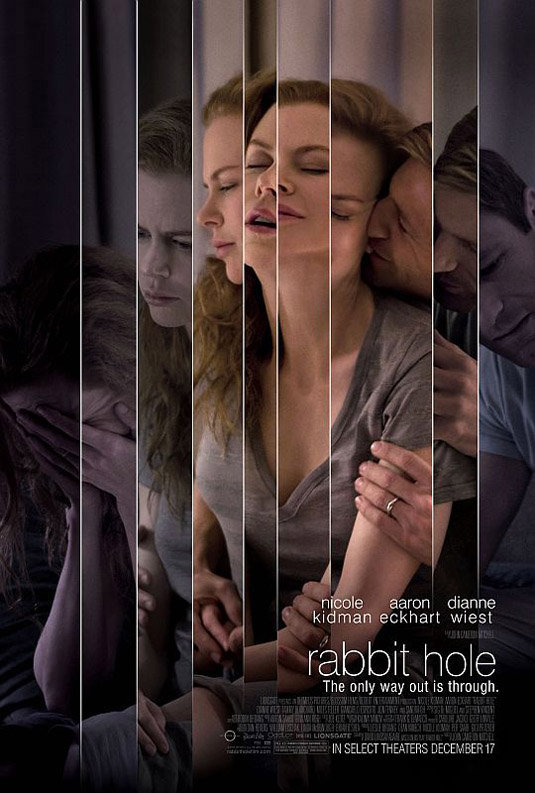
“Rabbit Hole” begins eight months after the death of a little boy. His parents move like highly functional but very fragile zombies through their lives. Some of those around them, think and even use words like “closure” and “move on” and even “try again,” mostly out of their own discomfort at the way this loss has threatened their own sense of the rightness of the world. Others just stay away, paralyzed by their inability to think of anything to say in this most unthinkable of moments. And Becca (Nicole Kidman) and Howie (Aaron Eckhart) are still being confronted with horrifically painful decisions — should they keep or get rid of their child’s things? — and even more painful reminders that for others life goes on (Becca’s careless sister is pregnant). Rabbit-Hole-Poster.jpg
David Lindsay-Abaire has sensitively adapted his award-winning play by to the screen and with director John Cameron Mitchell (“Hedwig and the Angry Inch,” “Shortbus”) has filled the story with privileged moments, beautifully performed by Nicole Kidman (Becca) and Aaron Eckhart (Howie). Both of them have to find a way to re-invent their interaction with the world or perhaps to re-invent their understanding of what world they live in. Her response is to hold everything inside, to try to maintain control. She affects an almost grotesque normality. When he comes up behind her for a hug as she is at the stove, she is bright but brittle as she shoos him away. She rolls her eyes at the support group for bereaved parents and will not return. But Howie wants to hold on to his memories and process his pain; he needs that kind of contact. He stays in the group. He keeps watching a video of their son — until Becca erases it.
They cannot reach out to each other, but each reaches out to someone else who is uniquely understanding. Howie becomes close to the leader of the bereavement group (Sandra Oh). And Becca watches and then begins to talk to the teenager who was driving the car that killed her son. It is heart-wrenching to see how he is able to reach her instincts as a mother, feelings for which she no longer has any other place.
This is a touching, insightful film with exquisite performances. If we all grieve on our own planet, it is art like this that illuminates the way home.

(more…)

Related Tags:


Based on a play Drama Movies -- format
Howl

Howl

Posted on October 14, 2010 at 6:00 pm

B
Lowest Recommended Age: High School
MPAA Rating: NR
Profanity: Very strong and explicit language with sexual references, some crude
Alcohol/ Drugs: Drinking, smoking
Violence/ Scariness: None
Diversity Issues: A theme of the movie
Date Released to Theaters: October 15, 2010

In the post-WWII era of peace and prosperity — and the Cold War and the blacklist and conformity — a small group of writers found much to terrify and infuriate them. “I saw the best minds of my generation destroyed by madness, starving hysterical naked,” one of them wrote, the beginning of a barbaric yawp of a poem of fury and protest called “Howl.” His name was Allen Ginsberg.
This movie is not the story of Ginsberg (smoothly played by James Franco), who would go on to become one of the 20th century’s most acclaimed and influential poets, though he is affecting, even at times electric. It is the story of the poem itself, taking us back and forth between three key moments. First is Ginsberg’s own performance, reading the poem aloud in a small, smoky club. Second is an interview two years later with a now-bearded Ginsberg in his apartment. And third is a courtroom, where the obscenity charges brought not against Ginsberg but against his publisher, fellow poet Lawrence Ferlinghetti, were being argued.
“Experts” (Mary-Louise Parker, Alessandro Nivola, Jeff Daniels) debate the literary merit and destructively prurient content of Ginsberg’s work on the witness stand. The prosecution (David Straithairn) argues that the poem is so detrimental to the minds of Americans that it should not even be seen. For the defense, Jake Ehrlich (“Man Men’s” Jon Hamm), with a natty four-cornered pocket square handkerchief, who shows the court that far more important than any expert’s opinion on the value of Howl as a work of art is the freedom for Americans to decide that issue for themselves.
And for me at least, that is where the real poetry is.

(more…)

Related Tags:


Based on a book Based on a true story Biography Courtroom Drama Movies -- format
Never Let Me Go

Never Let Me Go

Posted on September 23, 2010 at 6:44 pm

B+
Lowest Recommended Age: High School
MPAA Rating: Rated R for some sexuality and nudity
Profanity: Some strong language
Alcohol/ Drugs: None
Violence/ Scariness: Disturbing theme, some images of medical procedures and injuries, sad deaths
Diversity Issues: None
Date Released to Theaters: September 24, 2010

Kazuo Ishiguro’s novel The Remains of the Day, about a butler who devoted his life to service without questioning his master’s authority or the validity of his judgment became a movie starring Anthony Hopkins and Emma Thompson. And now his book, Never Let Me Go is a movie that while very different in genre addresses some of the same themes. Once again, the setting is the English countryside, and once again the main characters are born into a life of service that they do not question.

It’s a science fiction story without a single lab coat, spaceship, or gizmo. It isn’t even set in the future, but the recent past. It appears very much like the world we knew in the the 1980’s, but we are told before it begins that a medical discovery in 1952 has led to life expectancy of 100 years in 1967.

Then Kathy H. (Carey Mulligan of “An Education”) starts to tell us her story. She is a “carer,” and thinking back on her childhood at a school called Hailsham. As we go back to see her there with her friends Ruth and Tommy, it all seems perfectly normal at first. But there are some elements that seem strange. The headmistress (Charlotte Rampling) makes the usual speech after finding cigarette butts at the school, but why does she emphasize that for these children especially “keeping yourselves healthy is of paramount importance?” Why do they seem to have no families or even last names? And what is that panel on the wall that beeps when they casually touch their wrist to it every day as they come back indoors?

The excitement in the children’s lives comes from the visits by “Madame,” who examines their artwork and selects the items she thinks are the best for her gallery, and even more on the rare opportunities they have to buy trinkets with the tokens they are given for good behavior. They are very happy when they hear they are getting a “bumper crop” and enjoy their treasures but to our eyes the items look like garage sale cast-offs. These are not poor children; they attend school in an almost-idyllic countryside setting. But they do not seem to have anything.

Just once, a teacher tells them the truth, and then she is fired. SPOILER ALERT: the secret not fully revealed until the end of the book is disclosed much earlier in the movie so I am going to include it here. If you don’t want to know, skip this paragraph. The fate of these children has already been decided. They have been bred for use as spare parts. They are to be kept healthy and happy like farm animals until, in their 20’s, they will become “donors.” And after three or four “donations,” they will “complete.” Their purpose is to give of themselves literally and ultimately to keep others alive.

Director Mark Romanek (“One Hour Photo”) understands that just as “Rosemary’s Baby” tapped into a whole new category of dread by putting a Gothic story in modern Manhattan, giving us an alternate reality that seems so familiar to us is eerie and unnerving. It is not familiar through experience, set in the recent past. But it is also familiar through movies. The accents and Hailsham setting lull us into a Merchant-Ivory/Masterpiece Theater civilized world of tea being served at four. The fact that the truest horror happens off screen is haunting. When the headmistress says, “We were answering questions no one wanted asked,” it is as devastating as any gory attack by zombies or aliens. When the characters show their humanity by hoping for a better outcome, we see how much has been taken from them because they have no idea of how to insist on it.

The title comes from a “bumper crop” treasure, a used audio cassette by a torchy 60’s singer (performed by Jane Monheit), given to Kathy by Tommy.  She plays it over and over.  What does it mean to have someone who wants to hold on to you that way?  Kathy knows how it feels to care deeply about someone.  She loves Tommy.  As they grow up, though, it is Ruth who becomes his — what?  Girlfriend does not seem the right word as they have little sense of what that means.  Ruth does tell Kathy that she will not let Tommy go.  But then things change and as she has to let go of so much more, she thinks about what she can leave behind, what will give her life meaning beyond the limited scope that has been set for her.

Romanek, best known for music videos, is stronger on visuals than with story.  He does very well in creating a world so believable, so thoroughly familiar and sturdily institutional, that the slight variances from what we know quickly seem natural.  Like the people who proposed and approved and benefit from this system, the ones who are never seen and hardly referred to, we can watch without considering too deeply the consequences and significance of what we see — for a while.  

The three sections of the film are starkly different in architecture and color scheme.  Hailsham shows a little of the benign neglect of institutions that have existed for hundreds of years and are expected to be around forever.  After graduation, they move to “cottages,” rural, rustic, remote.  They make shy ventures into the world but can barely order a soda in a restaurant and feel most at home on a beach where an abandoned ship washed up on the shore somehow seems to resonate with them, an empty vessel, once useful, with nowhere to go.
 

Related Tags:


Based on a book Drama Movies -- format Mystery Science-Fiction Spoiler Alert
THE MOVIE MOM® is a registered trademark of Nell Minow. Use of the mark without express consent from Nell Minow constitutes trademark infringement and unfair competition in violation of federal and state laws. All material © Nell Minow 1995-2026, all rights reserved, and no use or republication is permitted without explicit permission. This site hosts Nell Minow’s Movie Mom® archive, with material that originally appeared on Yahoo! Movies, Beliefnet, and other sources. Much of her new material can be found at Rogerebert.com, Huffington Post, and WheretoWatch. Her books include The Movie Mom’s Guide to Family Movies and 101 Must-See Movie Moments, and she can be heard each week on radio stations across the country.

Website Designed by Max LaZebnik