Far from the Tree

Far from the Tree

Posted on August 2, 2018 at 5:39 pm

B +
Lowest Recommended Age: Middle School
MPAA Rating: Not rated
Profanity: Mild language
Alcohol/ Drugs: None
Violence/ Scariness: Reference to a brutal murder, tense family situations, sad offscreen death
Diversity Issues: A theme of the movie
Date Released to Theaters: August 3, 2018
Copyright Sundance Selects 2018

All parents at some point look at children and think, “Who is this and how did they get to be part of my family?” Children think that from time to time about their parents, too, especially when they get to their teens. “Far from the Tree,” based on the award-winning book by Andrew Solomon, is a documentary about the most extreme versions of that sense of disconnection. Solomon tells his own story about growing up gay and the incomprehension and rejection he experienced from his heterosexual parents, who exemplified the conventions of their era. But most of the focus of the film is on other families: Jason, a 41-year-old man with Down syndrome and the mother who worries about how he will manage when she is gone, a young woman and a married couple who are Little People, a teenager with autism who is finally able to communicate with his family, and the parents and siblings of a teenager who committed an unthinkable crime.

The movie raises questions about nature and nurture, about what “normal” means, and about the different but both vitally important feelings of connection and support we get from the families we are born into and the families we find because we understand each other. Loini Vivao, a Little Person in an affectionate but otherwise average-sized family, wonders, “Is there anybody out there like me?” When she attends her first annual Little People convention, her sense of wonder and acceptance is breathtaking. When she is invited to appear in the convention’s fashion show, she immediately demurs. She is too shy. But then we see her glowing as she owns the catwalk.  One of the other attendees explains why this gathering is so important: “They come to be seen.  And to disappear.”  No one looks away or stares. When everyone is little, everyone is the right size.

That makes a conference room discussion among the organization’s leaders especially poignant.  The topic is an experimental new drug that could “cure” some forms of dwarfism. Like the controversy over cochlear implants, this raises the question of whether dwarfism is something that needs to be “cured.”   “I don’t think I need to be fixed,” says Leah Smith, who, with her husband, Assistant Professor of Philosophy Joseph Stramando, show us just how “normal” their lives are, casually using various work-arounds, from a wheelchair to a flip-flop sandal to push a hotel light switch.

Jason Kingsley’s parents wanted to prove the experts wrong, and they were successful, to a point.  When Jason was born with Down syndrome, the doctor told the parents, “We send them away before attachment is formed.”  But “you don’t write off a person because of the label that he wears,” his mother explains. With a lot of support, Jason became a literal poster child for people with Down syndrome, appearing on television to show that he was keeping pace academically.  Jason has a job, delivering mail in an office. He lives with two other men with Down syndrome and they call themselves “The Three Musketeers.”  It is not what his mother envisioned for him and she is concerned about his fragile understanding of the difference between fantasy and reality.  He thinks if he can go to Norway, he can meet Elsa from “Frozen.”

The most astonishing moment in the film is when Jack Allnut, severely impaired with autism and seemingly unable to communicate or even understand what is being said to him, is given a chance to use an alphabet board. His first message is stunning. His mother says, “My God, he’s in there. It’s like I was meeting him for the first time.”  And the saddest moment is the family of the teenager who committed a terrible crime. In a way, it was like they were meeting him for the first time.  The family continues to love and support him, but his two siblings say they have decided never to have children.

They may change their minds.  This movie is not so much about the family differences we have to surmount as it is about the imperishable love that sustains us.  As Norman Mclean says in “The River Runs Through It,” “we can love completely without complete understanding.”  The true greatness of families — and of humanity — is that we choose to do so.

Parents should know that this unrated film includes discussion of a brutal murder, pregnancy and miscarriage, disabilities, sex, sad offscreen deaths, and family tensions.

Family discussion: What makes you most like the rest of your family?  What makes you different?  Who is your tribe?

If you like this, try: “A Kid Like Jake” and the book by Andrew Solomon

Related Tags:


Based on a book Documentary Family Issues movie review Movies -- format Movies -- Reviews
The Miseducation of Cameron Post

The Miseducation of Cameron Post

Posted on August 2, 2018 at 5:29 pm

B +
Lowest Recommended Age: High School
MPAA Rating: Not rated
Profanity: Strong language
Alcohol/ Drugs: Marijuana
Violence/ Scariness: Off-screen self-mutilation and attempted suicide
Diversity Issues: A theme of the movie
Date Released to Theaters: August 3, 2018

“Pray the gay away.”  That is the idea behind “gay conversion” facilities, now thankfully outlawed in fourteen states as contrary to both science and human dignity. But “The Miseducation of Cameron Post,” based on the novel by Emily M. Danforth, is set in 1993. It might as well have been 1793 for the Puritanical attitude of the God’s Promise facility the title character is sent to when her date discovers her making out with a girl on prom night.

Copyright FilmRise 2018

Cameron (a performance of exceptional sensitivity by Chloe Grace Moretz) is packed up immediately by her aunt and uncle (her parents are dead) to become a “Disciple” at God’s Promise, run by the guitar-strumming, upbeat Reverend Rick, played by John Gallagher, Jr., showing us flickers of anxiety as he tries to reassure the teens at the facility that if he could be “cured” of being gay, so can anyone. The resident bad cop to Reverend Rick’s relentless cheer is Dr. Lydia Marsh (Jennifer Ehle), who runs a tight ship, whether she is telling Cameron that she will not allow her to be called “Cam” (“Cameron is already a masculine name. To abbreviate it only exacerbates your gender confusion.”) or directing the “Disciples” to reveal their most private conflicts in publicly posted iceberg diagrams. What is important lies beneath the surface, and that is dangerous enough to sink the Titanic, she explains.  There is a pretense of choice, as Cameron is given a contract to sign, though she is underage and has no alternative.

Marsh tells the teenagers that “There’s no such thing as homosexuality. There’s only the sin we all face.”  She compares being gay to dangerous, self-destructive behavior: “Would you let drug addicts throw parades for themselves?”  And she posits the cause of what they term SSA (same-sex attraction): “too much bonding with a father over sports,” for example.

A quiet tone keeps the outrageous setting from turning into parody, even when they watch the (real) Christian workout video, “Blessercize,” and the teenagers are asked leading questions like, “When did you let same sex attraction get in the way of your goals?”  While a non-conversion facility might impose some restrictions on interactions between the boys and girls, there are few here.  Presumably, despite professed very strict rules about sexual behavior, Marsh and Reverend Rick are hoping the opposite genders will tempt each other.

The film won the top award at Sundance, a tribute to the understated mood and to an outstanding performance from Moretz, who allows us to observe her as she observes those around her. Neither she nor we are miseducated by the end.

Parents should know that this film includes explicit sexual references and situations, homophobia, some language, and marijuana.

Family discussion: What does it mean to say, “when I am weak, I am strong?” What ideas have changed since 1993?

If you like this, try: “But I’m a Teenager” and the upcoming “Boy Erased”


Related Tags:


Based on a book Drama movie review Movies -- format Movies -- Reviews Stories about Teens
Blindspotting

Blindspotting

Posted on July 19, 2018 at 5:31 pm

B +
Lowest Recommended Age: Mature High Schooler
MPAA Rating: R for language throughout, some brutal violence, sexual references and drug use
Profanity: Very strong, crude, and racist language
Alcohol/ Drugs: Drinking and drunkenness, drugs
Violence/ Scariness: Peril and violence including policeman shooting an unarmed man
Diversity Issues: A theme of the movie
Date Released to Theaters: July 20, 2018
Date Released to DVD: November 19, 2018

Copyright 2018 Foley Walkers Studio
Copyright 2018 Lionsgate
More than ten years ago, longtime best friends Daveed Diggs (“black-ish,” “Wonder,” Tony-winner for “Hamilton”) and spoken word poet/academic Rafael Casal began working on “Blindspotting,” inspired by their experience growing up in the uneasily gentrifying Oakland, California area long before either became successful. It took about ten years before they got the financing, and when it premiered at Sundance it was immediately acclaimed as a remarkably assured first film with exceptional performances a gripping story, and a nuanced, sometimes poetic portrayal of issues of race, class, and friendship.

Collin (Diggs), who is black, has just three more days of his year-long probation, following a two-year sentence. As long as he meets every checkpoint and follows every rule for just three more days, he will be able to leave the closely supervised halfway house and regain his freedom.

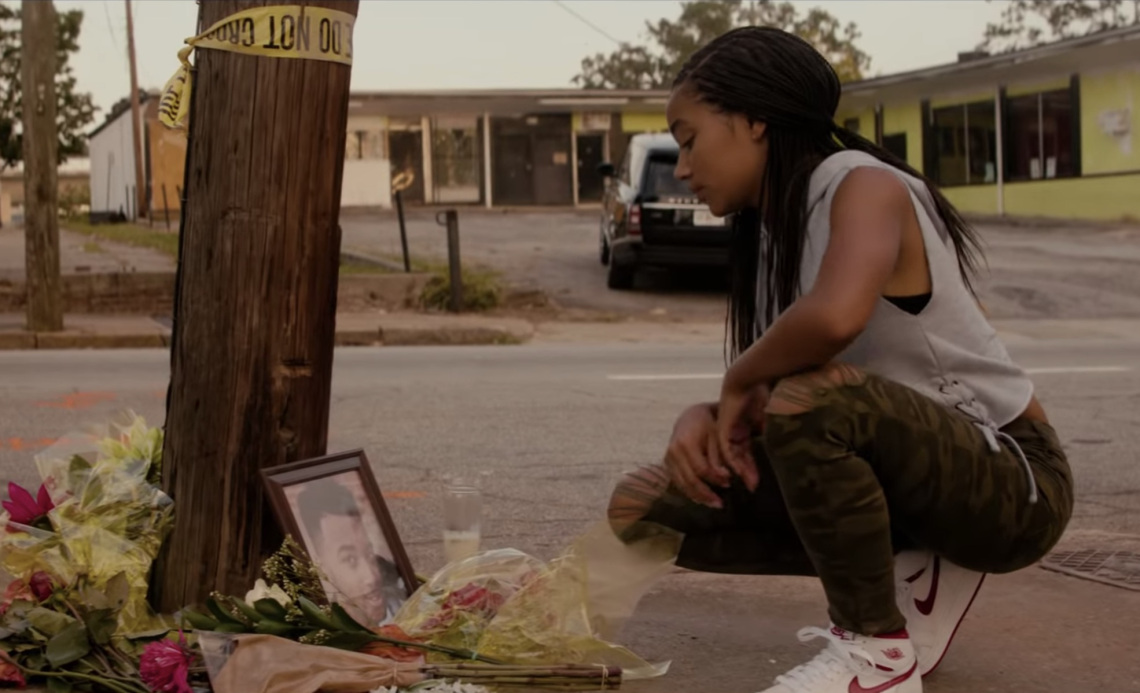
This is a challenge. His best friend Miles (Casal), who is white, is completely loyal to Collin but also impulsive and naturally resistant to any kind of rules. Collin finds himself with Miles and another friend who are smoking weed and playing around with guns. If he is discovered, it would mean an immediate return to prison. And then it gets worse. Collin, already running late getting back to the halfway house, knowing that missing curfew is a probation violation, stops at a red light and sees something he shouldn’t — a white cop killing an unarmed black man. The cop spots him and tells him to go. Terrified of getting shot or going back to prison, he does.

Collin and Miles work as movers, which gives us a chance to see the gentrification of Oakland, from the ten dollar “green juice” drinks suddenly appearing in local stores to the artist (Wayne Knight) who shows them his pictures of the trees that once gave the city its name but have now been cut down for development. A character wears a t-shirt that says, “Kill a hippie; save your hood.” The feeling of displacement is personal as well. Collin’s mother has remarried and her new stepson has moved into his old bedroom.

In some respects, the community is generously diverse. Colin’s black mother is now married to an Asian man. Miles is devoted to his partner, who is black, and their son. But racial divides persist, and this film navigates them and addresses them with a deep understanding of the history and complexity. When the friends finally get into a fight that could divide them forever, it is in large part because even the closest of friendships, even those who feel like family cannot truly understand what it is like to be black unless they are black.

At one point, a character asks Miles and Collin to stand quietly and look deeply into each other’s eyes. As much as these two men share, it is rare for them to look at each other. When they speak, they are often both staring ahead. This movie, conceived a decade ago but somehow coming out at exactly the right time, asks us to look deeply at both of them, and thus at ourselves.

Parents should know that this movie includes peril and violence, very strong, crude, and racist language, drinking and drunkenness, drugs, and family conflict.

Family discussion: What are the pros and cons of gentrification? What should Collin have done when he saw the officer shoot an unarmed man?

If you like this, try: “Do the Right Thing” and “Sorry to Bother You”

Related Tags:


Drama DVD/Blu-Ray movie review Movies -- Reviews Race and Diversity
Uncle Drew

Uncle Drew

Posted on June 28, 2018 at 5:58 pm

B
Lowest Recommended Age: Middle School
MPAA Rating: Rated PG-13 for suggestive material, language and brief nudity
Profanity: Some strong and crude language
Alcohol/ Drugs: Alcohol
Violence/ Scariness: Theme of aging, medical issues
Diversity Issues: None
Date Released to Theaters: June 29, 2018
Date Released to DVD: September 24, 2018
Copyright Lionsgate 2018

There are a lot of movies based on books and plays, and many movies based on songs and video games. And now, apparently, we’ve got a movie based on a television commercial. “Uncle Drew” is inspired by a 2012 series of Pepsi ads written and directed by and featuring real-life NBA player and science skeptic Kyrie Irving, disguised as an old man, astonishing some neighborhood hoopsters with his sweet moves. This version expands the story by adding more real-life players and upping the stakes to the $100,000 prize at the real-life Rucker Park competition in Harlem.

Basically, the serviceable script by Jay Longino and spirited direction from Charles Stone III (“Drumline”) follows the classic formula of all underdog sports movies, but it does so with three key assets. First, there’s an awesome dance-off scene, always a good thing, and here it is especially delightful because it turns out that people who are the best in the world at basketball have some sweet moves off the court as well.  Second, even for someone who is not a sports fan, the skills they show off here are not just impressive; they are truly aesthetically beautiful. Third is the fun these athletes are clearly having, so palpable it is genuinely infectious.  And for those who are sports fans, there are lots of inside jokes including one about too many time outs.

And they have the able support of “Get Short’s” Lil Rel Howery, “Girls Trip’s” Tiffany Haddish, and Nick Kroll, who must be getting a kick out of seeing someone else in old age makeup after wearing it every night in his “Oh, Hello” show on Broadway with John Mulaney.

So, no surprise here, Howery plays Dax, a coach who has put everything into his team in hopes of winning at Rucker Park. When his players and his gold-digging girlfriend (Haddish) are swiped by his rival (Kroll), the same guy whose block in a high school game shamed Dax into deciding never to play again.

Desperate, Dax invites veteran player Uncle Drew (Irving) to put a team together to compete for the prize. This means a road trip to visit each of the former members of what was once the Harlem Buckets. There’s a preacher who holds a baby about to be baptized as though he was a basketball (Chris Webber), a legally blind assisted living resident (Reggie Miller), a silent grandfather in a wheelchair (Nate Robinson), and a martial arts instructor (Shaquille O’Neal).  The preacher also has a wife who does not want him to go.  She is very tall.  She is also played by former WNBA player Lisa Leslie, so don’t be surprised if she gets called in as a replacement at a crucial moment.

It’s very silly, but surprisingly sweet and its unpretentiousness makes this at least a two-pointer.

Parents should know that this film includes crude humor, sexual references, a brief image of a bare butt, and some medical/aging issues.

Family discussion: Why did one bad experience make Dax quit playing basketball?  Why was it so hard for Uncle Drew to apologize?

If you like this, try: “Like Mike”

Related Tags:


Comedy DVD/Blu-Ray movie review Movies -- Reviews Sports
Won’t You Be My Neighbor?

Won’t You Be My Neighbor?

Posted on June 7, 2018 at 5:23 pm

B +
Lowest Recommended Age: Middle School
MPAA Rating: Not rated, some thematic elements and language
Profanity: None
Alcohol/ Drugs: None
Violence/ Scariness: Discussion of difficult topics including assassinations, terrorism, prejudice, disability, loss
Diversity Issues: A theme of the movie
Date Released to Theaters: June 8, 2018
Copyright 2018 Focus Features

“Won’t You Be My Neighbor?” is about Mr. Rogers, a kind, gentle star of PBS children’s programming who liked us us just the way we were and was the neighbor we would all love to have next door.

His story is told in a documentary that matches its subject. It is candid but respectful, utterly heartwarming, and a particularly timely reminder that we don’t have to be swept away in bombast and sensory overload. It is also a welcome reminder that children need us to help them understand themselves and the world around them, even when some aspects are painful and difficult. Indeed, Fred Rogers exemplified the idea that adults were here to protect children not by keeping information about tragedy and hardship away from them but by helping them learn how to respond. His advice to “look for the helpers” is always repeated when some terrible new story is in the news. And of course he was one of the greatest helpers of all. “One of my main jobs,” he said, “is through the mass media to help children through the difficult modulators of life.” These included world events and also family issues like divorce and emotions like anger. One of the film’s most remarkable archival scenes is Fred Rogers testifying before a skeptical Senator about the importance of funding PBS. Instead of reeling off statistics, Rogers recited the lyrics to a song about how to deal with angry feelings. When he was done, the senator, obviously not just moved but pretty much tamed, says quietly, “You just got $20 million.”

Fred Rogers was an aspiring Presbyterian minister when he realized that television had enormous influence on children and that most of children’s programming was loud, rude, and violent. He put his plans on hold to start a series for the new Public Broadcasting Service that would be quiet, low-key, and low-tech. As a producer of the show noted the theory of the series was, “You take all of the elements that make good television and don’t do any of them.” He says, “I never felt I had to wear a funny hat.” And he welcomes elements that are anathema to television, including silence. Mr. Rogers set a timer to show children how long a minute was and just sat there while it moved around the circle. There a lot of “slow space, but no wasted space.” He was patient. He listened.

The show’s first national broadcast was in 1968, a time when there were many difficult modulators to navigate. “What does assassination mean?” a frightened Daniel Tiger puppet asks? He gets an answer that is honest but presented in a way that helps him not just understand it but understand how to process it.

In each episode, Mr. Rogers would come into the house, change his shoes, put on his sweater (one is now in the collection of the Smithsonian Museum of American History), and have a little chat or sing a song to the audience. He would talk to the mailman or another friend from the neighborhood, and maybe interview a guest or explain something, from how biscuits get made in a bakery to how a young Yo Yo Ma plays the cello. Rogers himself never appeared before the camera in the other part of the show, set in a magical land, because he wanted a clear demarcation between the “real” and fantasy parts of the show. But he voiced the puppets, as many as ten characters, and we see more than once that those puppets allowed him to express parts of himself he could not any other way.

Director Morgan Neville (“20 Feet from Stardom”) had nearly 1000 hours of archival footage to choose from and, while he certainly could have made several movies based on Fred Rogers’ life, the clips and contemporary interviews are exceptionally well chosen and well matched. We learn that Rogers asked Francois Clemons, a black man, to play the policeman on the show in part to promote diversity. A scene from the show where the men soak their feet together to cool off on a hot day is juxtaposed with contemporary news footage of black swimmers being thrown out of a public pool. Clemons says he was reluctant to play a policeman because the experience of his own neighborhood with police was not good. But he took the job. And then we learn that Clemons is gay, and hear how Rogers’ response to that news changed over time.

Two of the movie’s most powerful archival scenes are the interview Rogers said was his most memorable, with Jeff Erlanger a cheerful 10-year-old quadriplegic, and his time with Koko, who apparently indicated that he was her favorite visitor. Rogers’ palpable delight and boundless empathy have them end up in an embrace that is utterly endearing.

We hear from his family, friends, and colleagues, and from Ma (whose son is one of the film’s producers). But most of all, we hear from Rogers himself, who tells us, “I don’t think anyone can grow unless he is accepted exactly as he is.” Other than Fox News, who we briefly hear blaming Rogers for the entitlement of the millennial generation, we all feel lucky that Mr. Rogers was exactly who he was, and this lovely film reminds us that we cal all be more like him.

Parents should know that this movie includes discussion of difficult issues and some archival footage of tragic news stories and a brief humorous shot of a bare bottom.

Family discussion: What parts of Mr. Rogers did we only see through the puppets? What are your favorite television shows for children?

If you like this, try: “20 Feet from Stardom” and “Street Gang” (about “Sesame Street”)

Related Tags:


Biography Documentary movie review Movies -- format Movies -- Reviews
THE MOVIE MOM® is a registered trademark of Nell Minow. Use of the mark without express consent from Nell Minow constitutes trademark infringement and unfair competition in violation of federal and state laws. All material © Nell Minow 1995-2026, all rights reserved, and no use or republication is permitted without explicit permission. This site hosts Nell Minow’s Movie Mom® archive, with material that originally appeared on Yahoo! Movies, Beliefnet, and other sources. Much of her new material can be found at Rogerebert.com, Huffington Post, and WheretoWatch. Her books include The Movie Mom’s Guide to Family Movies and 101 Must-See Movie Moments, and she can be heard each week on radio stations across the country.

Website Designed by Max LaZebnik