Miss Bala

Miss Bala

Posted on January 31, 2019 at 5:33 pm

B-
Lowest Recommended Age: Mature High Schooler
MPAA Rating: Rated PG-13 for sequences of gun violence, sexual and drug content, thematic material, and language
Profanity: Some strong language
Alcohol/ Drugs: Drugs and drug dealing, alcohol
Violence/ Scariness: Extended crime and law enforcement-related peril and violence, guns and shoot-outs, knives, bombs, rape, characters injured and killed
Diversity Issues: None
Date Released to Theaters: January 31, 2019
Date Released to DVD: April 29, 2019

Copyright 2018 Columbia Pictures
Miss Bala” is a serviceable action thriller but very much the Hollywood version. In real life, a beauty queen named Laura Zúñiga (her title was “Our Sinaloa Beauty”) was arrested with seven members of a Mexican drug and weapons crime operation. Her story became a Mexican film, also called Miss Bala, which portrayed her as a kidnap victim, forced to work with the La Estrella gang to protect her family.

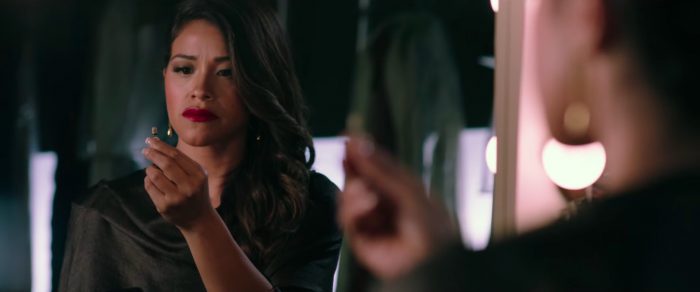
The American remake is closer to Pam Grier’s “Foxy Brown” or Tarantino’s “Death Proof” than to the real story, where the beauty queen did not fire a gun in stilettos and a red evening gown with a slit up the leg. The woman in the dress is “Jane the Virgin‘s” stars Gina Rodriguez as Gloria, a makeup artist from California, an American citizen who returns to her original home in Tijuana to help her best friend Suzu (Cristina Rodlo) look her best in the Miss Baja California beauty pageant. Gloria loves Suzu and her little brother Chava (Sebastián Cano), who are the closest she has to a family. And Suzu seems to be missing some red flags about the pageant, unconcerned about rumors that the local sheriff insists on droit de seigneur privileges with each year’s winner. A pre-competition party is interrupted by a shoot-out. Gloria is almost killed, but won’t take her opportunity to get away because she stays to look for Suzu. She tells a man in uniform that she can identify the killers, but he turns out to be working for them. He takes her to the leader of the group, Lino (Ismael Cruz Cordova), who tells her that if she helps them, he will find Suzu for her.

So Gloria finds herself getting more and more caught up in the terrifying world of warring drug dealers. At first, she is a numb patsy who follows Lino’s directions to park a car by a building, but then it turns out it was packed with a bomb and used to blow up a safe house operated by the US DEA. Desperate to find Suzu and protect Chava, the follows his orders, transporting drugs and cash across the border into California and bringing back guns. The DEA brings her in and threatens her with prison or worse if she does not cooperate. The pressure is intense and the consequences are immeasurably tragic. Lino is suspicious, but also drawn to Gloria, because he, too, has been considered too Mexican to be American and too American to be Mexican. Gloria has to try to navigate between fear and something approaching loyalty while keeping in mind the single driving force of her commitment to rescuing Suzu.

Rodriguez has said in interviews that she insisted on giving Gloria more agency, making her more active, doing whatever a male character in those situations would do, all of which is salutary, but it goes so far it becomes cartoonish.

Almost everyone who worked on this film on screen and off is Latinx, which is also salutary, though the fact that the first major studio film to make that a goal has to be about the most obvious possible stereotype of Latinx characters.

Parents should know that this is a close-to-R PG-13, with themes of sex and drug trafficking, intense peril and violence, guns, knives, bombs, shoot-outs, many characters injured and killed, rape (off-camera), and some strong language.

Family discussion: How did Gloria decide what to do in the parking lot? What do you think she will do next?

If you like this, try: the original Spanish-language version of the story with the same title, and “2 Fast 2 Furious”
Related Tags:


Action/Adventure Crime DVD/Blu-Ray Inspired by a true story movie review Movies -- Reviews Remake
Serenity

Serenity

Posted on January 24, 2019 at 5:34 pm

D
Lowest Recommended Age: Mature High Schooler
MPAA Rating: Rated R for language throughout, sexual content, and some bloody images
Profanity: Constant very strong language
Alcohol/ Drugs: Drinking and drunkenness, smoking
Violence/ Scariness: Peril and violence, domestic abuse, murder
Diversity Issues: None
Date Released to Theaters: January 25, 2019
Date Released to DVD: May 1, 2019
Copyright 2018 Avrion Pictures

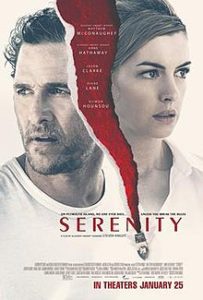
Even by the very low standards of January movies, “Serenity” is a dreary, dumb mess that makes the ultimate mistake of thinking it is smart.

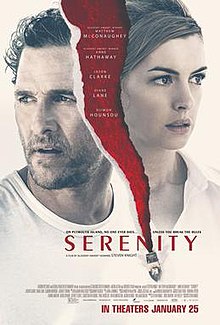
At first, it wants us to think it is a throwback to the classic twisty noir thrillers like “Out of the Past” and “The Lady from Shanghai.” Matthew McConaughey plays a man called Baker Dill (note: I did not say a man named Baker Dill), a veteran who lives on remote Plymouth Island, where he takes out feckless tourists on a fishing boat called Serenity. We glimpse a Purple Heart medal in the corrugated metal shack where he lives, and we can see that he is bitter and struggling with psychological damage and maybe some physical damage as well. There’s a World’s Greatest Father mug in the shack as well. He pours his whiskey into it. Dill has an Ahab-like fascination with a giant tuna he has named….Justice. And he has a relationship with a local woman (Diane Lane, slumming), who pays him to “find her cat,” which is both literal and euphemistic. Same with the only bar on the island, which used to have Hope in its name but then switched to Rope.  This is not a subtle movie.  We also see a mysterious, very proper, precise man in a suit who carries a briefcase (Jeremy Strong), who seems to be looking for Dill. At one point, he removes his shoes to wade robotically across a stream.

And then, the second act complication arrives: femme fatale Karen (Anne Hathaway), honey blonde hair and dressed in white. She is married to Frank (Jason Clarke), a wealthy boor who abuses her and terrifies her son, who is Dill’s son as well. She says Frank will kill her if she tries to leave him, so the only way to protect her is to get Frank drunk out at sea and throw him to the sharks. If Dill will do that, he will not only save his son, but he will get $10 million in cash.

There are some hints that this is not the usual thriller story of seduction, betrayal, and murder, though all of those elements are there. Something is a little off, though. Dill has some sort of mystical mental Skype thing going with the son he has not seen in ten years.  Where is Plymouth Island? The music is Cajun and there are references to Miami but it is becomes increasingly clear that it is strangely isolated and insular. “Everyone knows everything,” we hear repeatedly. At first, it seems to refer to the gossip in any tiny community. But then we begin to wonder “What is Plymouth Island?” when it goes from “everyone knows everything” about the details of what Dill is buying and selling and catching and where he is at all times to “no one knows anything” when it comes to the choices Dill is facing and how he will decide. The best way to enjoy this film is to have a drinking game that lets you take a swig every time a character says either line.

The four leads do their best to persuade us that their stilted dialogue and increasingly artificial interactions are archetypal, not underwritten, but they never find a tone that will withstand the groaner of a twist, which I will be happy to spoil per my legendary Gothika rule*. Trust me, it’s a worthy addition.

*Gothika Rule: If is movie has a truly bad or dumb ending, I will happily give it away to anyone who sends me an email at moviemom@moviemom.com.

Parents should know that this film includes domestic abuse, murder, characters injured and killed, some disturbing images, very strong language, explicit sexual situations, nudity, drinking and drunkenness, and smoking.

Family discussion: In what way did “everybody know everything” and in what way did “nobody know anything?” What were the clues that things were not what they seemed?

If you like this, try: “Out of Time,” “Body Heat,” “The Lady from Shanghai,” and “The Cafe”

Related Tags:


“Gothika Rule” DVD/Blu-Ray movie review Movies -- Reviews Thriller
Bathtubs Over Broadway

Bathtubs Over Broadway

Posted on December 16, 2018 at 11:08 am

B +
Lowest Recommended Age: Middle School
MPAA Rating: Rated PG-13 for brief language
Profanity: Brief strong language
Alcohol/ Drugs: None
Violence/ Scariness: Sad death
Diversity Issues: None
Date Released to Theaters: December 14, 2018
Copyright 2018 Focus Features

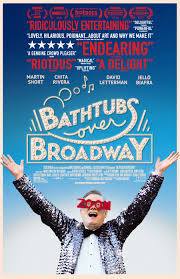
There are really three stories in this adorably engaging documentary about “industrial musicals,” the wildly elaborate in-house productions big corporations used to motivate their employees in the 1950’s-70’s. The first is the story of our guide to this world, Steve Young, a writer for David Letterman’s Late Show who describes himself as comedically “damaged” after years of evaluating everything in the world as comedy material. There was almost nothing that made him laugh anymore. The best he could muster was an analytic, “that’s funny.” “We’ve become hard laughs,” he tells us. Over the course of the film, he will lose the job he has had for two decades when Letterman decides to retire. The second, as in many documentaries, is the story of a tiny sub-culture of people who are deeply passionate about something the rest of the world considers odd or quirky or has never heard of. This one lives “at the far horizon where the adjectives of ‘good’ and ‘bad’ don’t apply anymore.” Young may have found them as something to laugh at but he soon develops affection and then passion for them, and by the end of the movie, we can understand why and feel some of it ourselves.

“How can there be something so large and so crazy in the world that we had no idea of?” Young asks. But the answer we get is to a different question: How can an “eccentric adventure” soothe and enlarge a “comedy-damaged” soul? By the end of the film, Young tells us that delving into this odd world has “opened up my ability to be receptive to people.” Anyone he meets can have this kind of history.

And the third is the story of the musicals themselves, often produced, directed, and performed by actual or future Broadway stars, making a very good living doing something they loved and could learn from instead of waiting tables. Just to give you an idea: one of these musicals had a budget of three million dollars. The original production of “My Fair Lady,” which opened the same season on Broadway, had a budget of $466,000. Were they works of art? Well, no, they had singing and dancing spark plugs and ballads about toilets and an opera about spaghetti sauce called “Raguletto.” But they were very professionally done, often quite clever, astonishingly elaborate, and in their own way artifacts of an era of corporate optimism that saw endless possibilities for itself as providers of consumer goods and great jobs. Of course those jobs were for white males, as we see in the glimpses we get of the audience, all wearing near-identical suits and ties.

“I played a trick on history,” Young tells us. These shows were created for the most specific of audiences and were never intended to be seen by outsiders. The biggest surprise is that these most commercial of enterprises are so free from any kind of cynicism. There’s an innocence about them because they come from the post-WWII era, when America seemed unbeatable, and technology seemed thrilling. The “man in a grey flannel suit” corporate employees were “being shown a version of their world where they’re heroes.” If a marvelous new substance called silicone had 180 uses, why not create a song about it? What better way to introduce fabulous new products to the sales team than a catchy musical number? It may have been the “strangest dead end of show business,” with the idea of “What shouldn’t we write a musical about? Let’s write it and make it good and not let anyone see it!” But companies with lavish budgets created souvenir records for their employees to take home and that is how Young began to discover this world of unseen, un heard entertainment. Over the course of the film he tracks down some of the creators and performers, including Susan Stroman (“The Producers”), who explains that she learned a lot from choreographing industrial shows, Martin Short and Florence Henderson, who talk about the pleasures of performing for wildly enthusiastic audiences (Henderson compares it to a revival meeting), and composer Sid Siegel, who specialized in industrial musicals — and who kept a treasure trove of an archive. They were “selling Tupperware but also selling America,” and their unabashed boosterism makes it impossible to be snarky or condescending, leaving us entertained, and perhaps a little wistful.

Parents should know that this film includes brief strong language and a sad death.

Family discussion: If you were going to create a musical about your job or school, what would you sing about? Which production was your favorite?

If you like this, try: the shows by Sheldon Harnick, Chita Rivera, and Martin Short, and the book by Steve Young. Some of the songs are available, too.

Related Tags:


Documentary movie review Movies -- format Movies -- Reviews
Mowgli: Legend of the Jungle

Mowgli: Legend of the Jungle

Posted on November 29, 2018 at 5:25 pm

B-
Lowest Recommended Age: Middle School
MPAA Rating: Rated PG-13 for intense sequences of action violence including bloody images, and some thematic elements
Profanity: None
Alcohol/ Drugs: Drinking and drunkenness
Violence/ Scariness: Intense peril from animals and human hunter, characters injured and killed, some graphic and disturbing images
Diversity Issues: None
Date Released to Theaters: November 30, 2018
Copyright Netflix 2018

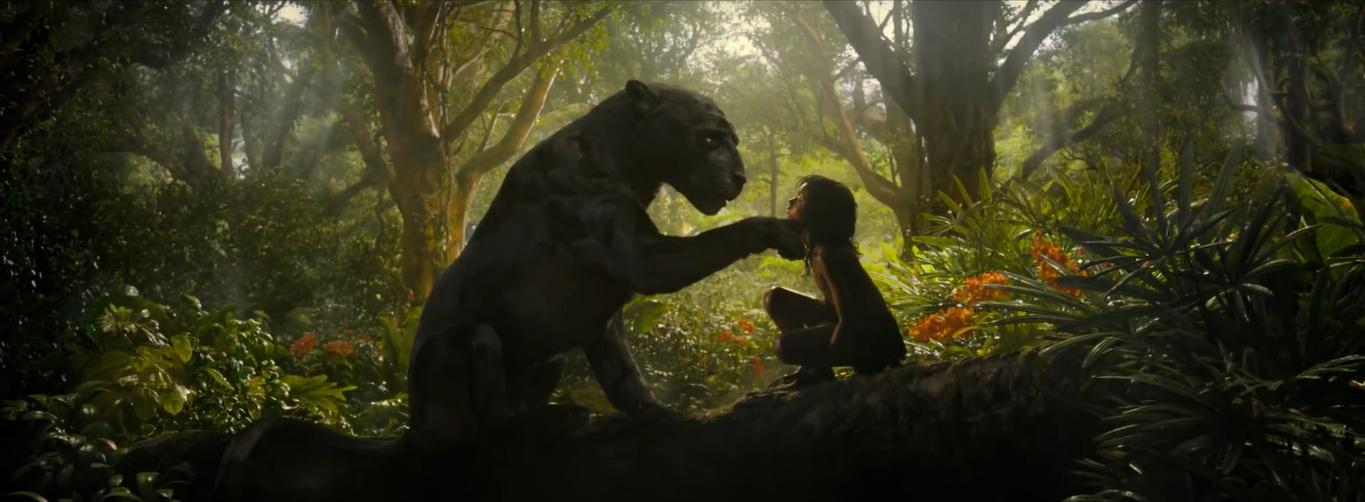
“Mowgli: Legend of the Jungle” is not the “Bear Necessities” Disney version of Rudyard Kipling’s story about the boy raised by wolves and befriended by a cuddly bear and an elegant panther. This is more like Tennyson’s vision of nature as red in tooth and claw. Andy Serkis, master of the art of motion capture acting, has directed this much darker version of the story, with simultaneous release this week in theaters and on Netflix. The motion capture performances are striking. Parents need to know, however, although this is the story of a young boy befriended by talking animals, this is not for young children or for the faint of heart of any age.

Serkis brought along some of his “Hobbit” co-stars, and the movie opens with an introduction from Kaa the snake, voiced by Cate Blanchett telling us that the jungle traditions are being challenged, presumably from the incursion of humans. When a couple are killed by the tiger Shere Kahn (Benedict Cumberbatch), a baby is abandoned. The death of the parents is off-camera, discreetly shown by an overturned, single shoe. But the baby is smeared with blood. Like Harry Potter, he is the Boy Who Lived, and he is special.

A wolf pack wants to adopt the boy they call Mowgli, and that means a meeting of the council of animals. It is agreed that he can stay and we will learn that is only in part because it is in the nature of the wolf mother to feel tenderness toward a helpless baby of any species. While some of the animals fear that keeping Mowgli will bring man into the jungle looking for him, others think that he will help keep them safe from humans. And all of them know that Shere Kahn will be back for Mowgli, and that it will take the full force of the pack to keep him safe.

Mowgli grows up (Rohan Chan), very much at home in the jungle, though painfully aware that he does not have the natural abilities of his wolf brothers. They are being coached by Baloo the bear (Serkis) to pass a racing test to qualify them to become full members of the pack. Mowgli cannot keep up with them if he races on all fours, as they do.

The motion capture work is excellent, as expected from Serkis and the images and camera work are striking, worth seeing on a big screen. But the storyline never fully escapes its colonialist origins. There’s a reason we refer to “the law of the jungle” and no simple way to make that into a workable metaphor about the human world. Think of “The Lion King,” for example (with a live-action version coming next year). It’s fine to sing about the circle of life if you’re at the top of the food chain. Bagheera the panther (Christian Bale) explains to Mowgli that animals who kill must look their prey in the eye as they are dying “so that the soul does not depart alone.” Not much comfort to the departing soul. Mowgli finds appropriate ambivalence in the human world, where the native community has brought in a white hunter (Matthew Rhys) who is kind to Mowgli but will never appreciate the animals like the boy who lived with them. Like the boy himself, the movie is not able to resolve its conflicting dualities.

Parents should know that this film includes animal and human peril and violence, with characters injured and killed, some disturbing and graphic images, guns, fire, animal attacks, sad death of parents (off-screen), drinking and drunkenness.

Family discussion: How are the wolves different from the other animals? What kinds of tests do humans try to pass? Do you agree with Mowgli’s choice about where to live?

If you like this, try: Disney’s animated and live-action “Jungle Book” movies

Related Tags:


Action/Adventure Based on a book movie review Movies -- format Movies -- Reviews Remake Stories About Kids Talking animals VOD and Streaming
The Girl in the Spider’s Web

The Girl in the Spider’s Web

Posted on November 8, 2018 at 5:48 pm

B-
Lowest Recommended Age: Mature High Schooler
MPAA Rating: Rated R for violence, language and some sexual content/nudity
Profanity: Strong language
Alcohol/ Drugs: Drinking, smoking, drugs
Violence/ Scariness: Extended peril and violence, explosions, guns, fights, torture, parent killed in front of child, domestic and child abuse, incest, very graphic and disturbing images, characters injured and killed, suicide
Diversity Issues: None
Date Released to Theaters: November 9, 2018

Copyright 2018 Columbia Pictures
Remember in “League of Their Own” when Tom Hanks said, “There’s no crying in baseball?” Well, there’s no crying in Lisbeth Salander movies, or there should not be. As imagined by the late Swedish journalist and author Steig Larsson, Lisbeth Salander is a pierced, tattooed, bisexual, motorcycle-riding, 21st century Sherlock Holmes, cerebral, relentless, on the side of justice, and with a mastery of logic, observation, and detail that borders on a superpower. And good in a fight.

“The Girl in the Spider’s Web” is the first film based on the authorized continuation of the series by Larsson’s family, and here she is played by “The Crown’s” Claire Foy, following Noomi Rapace (in the Swedish movie trilogy) and Rooney Mara (in the David Fincher English-language film based on the first book in the series). There’s a subtle difference in the title of the book that reflects a shift in tone. The first book’s title is descriptive: The Girl With the Dragon Tattoo, followed by The Girl Who Played with Fire, and The Girl Who Kicked the Hornet’s Nest, both references to risks taken by Salander, with the implication that it was intentional. The Girl in the Spider’s Web is not about a choice she made or a dare she braved. There’s no action verb here. There’s no choice to adorn her body with a symbol of strength and fire. This title suggests a girl who has been placed in danger. Salenger as a damsel in distress? I don’t think so.

And then, like those last seasons of “Bewitched,” when they had really run out of ideas, the movie presents us with a sister we knew nothing about who apparently has been just waiting through three books to show up. We get a flashback of the two girls playing chess with, yes, a spider crawling on one of the pieces, before some very, very nasty stuff begins to happen with the girls’ father, who we already know from the earlier books was a very, very, very evil guy.

We go to these movies to see Lisbeth Salander hack, be invincibly tough, and right wrongs. She hacks into the US National Security Agency mainframe and downloads their most dangerous file. In a brief prelude she goes after a domestic abuser and we learn that she has been avenging other abused women. And she repeatedly takes a licking and keeps on ticking. But here the McGuffin is a computer program that can access and activate any nuclear weapons in the world, created for NSA (Stephen Merchant) who now regrets it and wants it destroyed. So he asks Salander for her help, bringing his young son along (Christopher Convery), just to ramp up the threat element. Salander gets the file, to the considerable consternation of NSA’s Edwin Needham (Lakeith Stanfield), who goes uses his considerable computing power to track down Salander, in a race with some very, very bad guys who want the file, too.

So, it’s your basic run with a gun stuff, ably staged if nothing particularly gripping, until the crying. Salander’s friend (and Larsson stand-in) Mikael Blomkvist (Sverrir Gudnason) appears briefly for no particular reason. Foy does fine with Salanger’s thousand yard stare but the script lets her down by trying to have her be vulnerable and tough at the same time. Tbey’ve taken one of the most arresting characters in recent fiction and made her into just another sad girl. And they’ve taken what began as a superior series of action films and turned it into just another night-at-the-multiplex, sequel-heavy formula movie. If Salanger is caught in a spider’s web, it’s not the blah blah about the secret computer file, it’s the blah blah of the filmmakers.

Parents should know that this film has very intense and graphic peril and violence, disturbing images, characters injured and killed, death of a parent, torture, guns, explosions, severe spouse and child abuse, sexual abuse, very strong language, drinking, smoking and drugs.

Family discussion: What should Lisbeth have done for her sister? Why did they make different choices?

If you like this, try: the Swedish “Girl With a Dragon Tattoo” trilogy

Related Tags:


Based on a book movie review Movies -- format Movies -- Reviews Thriller
THE MOVIE MOM® is a registered trademark of Nell Minow. Use of the mark without express consent from Nell Minow constitutes trademark infringement and unfair competition in violation of federal and state laws. All material © Nell Minow 1995-2026, all rights reserved, and no use or republication is permitted without explicit permission. This site hosts Nell Minow’s Movie Mom® archive, with material that originally appeared on Yahoo! Movies, Beliefnet, and other sources. Much of her new material can be found at Rogerebert.com, Huffington Post, and WheretoWatch. Her books include The Movie Mom’s Guide to Family Movies and 101 Must-See Movie Moments, and she can be heard each week on radio stations across the country.

Website Designed by Max LaZebnik