White Chicks

White Chicks

Posted on June 23, 2004 at 4:58 am

C
Lowest Recommended Age: High School
MPAA Rating: Rated PG-13 for crude and sexual humor, language and some drug content
Profanity: Very strong language for a PG-13
Alcohol/ Drugs: Drug humor, drinking, smoking
Violence/ Scariness: Comic violence including guns, characters shot but no one badly hurt
Diversity Issues: A theme of the movie
Date Released to Theaters: June 23, 2004
Date Released to DVD: October 26, 2004

Appealing performers and a couple of very funny moments don’t make up for a lazy and generic script in this predictable farce about two black male FBI agents who go undercover as spoiled rich white girls. I knew we were in trouble when there was a “Hammer Time” joke in the first few minutes, a reference way past its sell-by date. And a Bjork swan-dress joke? In white chick terms, that’s so yesterday.
White Chicks
Copyright Columbia Pictures 2004

In rap music terms, this movie samples characters and plots from many other movies, including the already vastly over-used (attractive and principled but do-things-their-own-creative-way law enforcement types always getting chewed out by choleric superiors until one of their wacky schemes pays off and they get to be heroes) and the already done so brilliantly and distinctively that no one should ever try them again (whoever thought of appropriating the “Junior” plot twist from Some Like it Hot should be sent to the screenwriter equivalent of solitary confinement).

Even the movie doesn’t even appear to paying attention to its plot. Movies don’t have to be logical; they don’t even have to make sense. But sloppy inconsistencies like the ones here become a distraction that interferes with the ability of the audience to enjoy even the jokes that work.

Shawn and Marlon Wayans, apparently both the Zeppo Marxes of the talented Wayans family, play FBI agents Kevin and Marcus Copeland. It is typical of this movie’s problems that no one had the energy to give these characters anything resembling a personality. They are almost indistinguishable from each other except that one has a hysterically jealous wife and the other has a goatee and is single.

After they bungle a drug bust, they are assigned to escort the Wilson sisters (think Paris and Nicky Hilton), who may be targets for a kidnapper. They are on their way to a weekend at the Hamptons where they hope to be photographed for the cover of a magazine. A minor car accident on the way there leaves them with scratches on their faces and they refuse to be seen that way. So, the Copelands call in the FBI’s crackerjack undercover make-up team to transform them into the Wilsons. Conveniently, they both already have earrings.

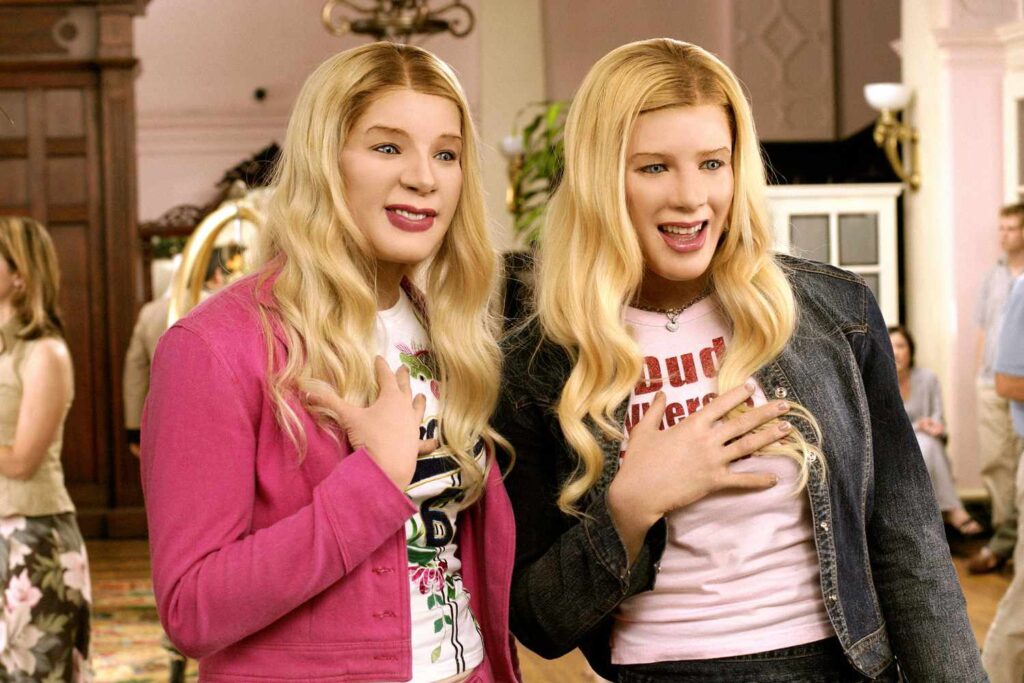
Despite the fact that they are taller than the girls and the latex masks applied to their faces make them look like victims of Botox overkill, no one in the Hamptons seems to notice anything significantly different about “the girls” (one friend guesses that they’ve had collegen treatments to turn their lips from “Cameron Diaz to Jay-Z”). The Copelands squeal and giggle, shop with the girls, go all mean girls on the snooty rich snobs, and participate in a fashion show and a dance-off (okay, that dance-off is pretty funny). They also go out on dates, Marcus in drag with a smitten athlete (the very funny Terry Crews) and Kevin as a man but pretending to be someone else to impress a pretty reporter.

Gender and race-switching are inherently funny but the situations and jokes in this script do very little to build on that energy and sometimes actually get in the way. There are predictable culture clashes, as when the society girls sing along to Vanessa Carleton’s “1000 Miles” and the Copelands have to pretend to know the words. Then, when the rap song comes on…well, you know where this is going. (A twist on this scene later on provides the movie’s most sustained laugh.) There is a lot of gross-out humor involving various body parts and functions, and some leering double entendres. There are also predictable life lessons as the Copelands develop more empathy for women and encourage the society girls to have more self-respect, to insist on the best for and from themselves. Too bad the Wayans forgot to learn that lesson themselves; the insights are delivered with no more enthusiasm, sincerity, or imagination than the comedy.

Parents should know that the movie has very crude and vulgar material for a PG-13, with comedy based on sexual references (including a game where players have to choose between two unappealing sexual encounters), drug jokes, insult humor, and a lot of graphic potty humor. Characters use strong language, not just the usual “almost-R” words but also terms that may concern parents like “yeast infection,” “coke whore,” “bitch fit,” and the n-word. Racial insults and stereotyping are intended to be comic. The movie has some comic and action violence, meaning that a lot of punches are thrown and a few shots are fired but no one is seriously hurt.

Families who see this movie should talk about what Kevin and Marcus learn from pretending to be white women. Why was it so hard for Karen, Lisa, and Gina to feel good about themselves and their relationships?

Families who enjoy this movie will also enjoy the better movies it borrows from, like Some Like it Hot, which was first on the American Film Institute’s funniest movies of all time, and Tootsie, which was second. They may also enjoy Martin Lawrence in drag as an undercover cop in Big Momma’s House. The freshest and funniest Wayans film is still I’m Gonna Git You Sucka.
Related Tags:


Comedy movie review Movies -- format Movies -- Reviews
Clifford’s Really Big Movie

Clifford’s Really Big Movie

Posted on April 17, 2004 at 9:53 am

B
Lowest Recommended Age: Preschool
MPAA Rating: Rated G
Profanity: None
Alcohol/ Drugs: None
Violence/ Scariness: None
Diversity Issues: Diverse characters
Date Released to Theaters: April 23, 2004
Date Released to DVD: July 3, 2004

Clifford’s Really Big Movie
Copyright 2004 Warner Brothers

Clifford is not just a Big Red Dog; he’s a big, red phenomenon, hero of a series of books by Norman Bridwell, an animated PBS series, and even a live road show. Now he has moved (briefly) to the big screen with a low-key feature destined for a quick theatrical release on its way to video and DVD.

Clifford is a really, really big red dog, part of his appeal to toddlers, who live among giants and are thus drawn to huge, powerful but kind creatures who love children (like Barney). Children also like the way that Clifford explores the world around him, learning gentle lessons about getting along with others and solving problems like finding lost toys and not being afraid of a storm.

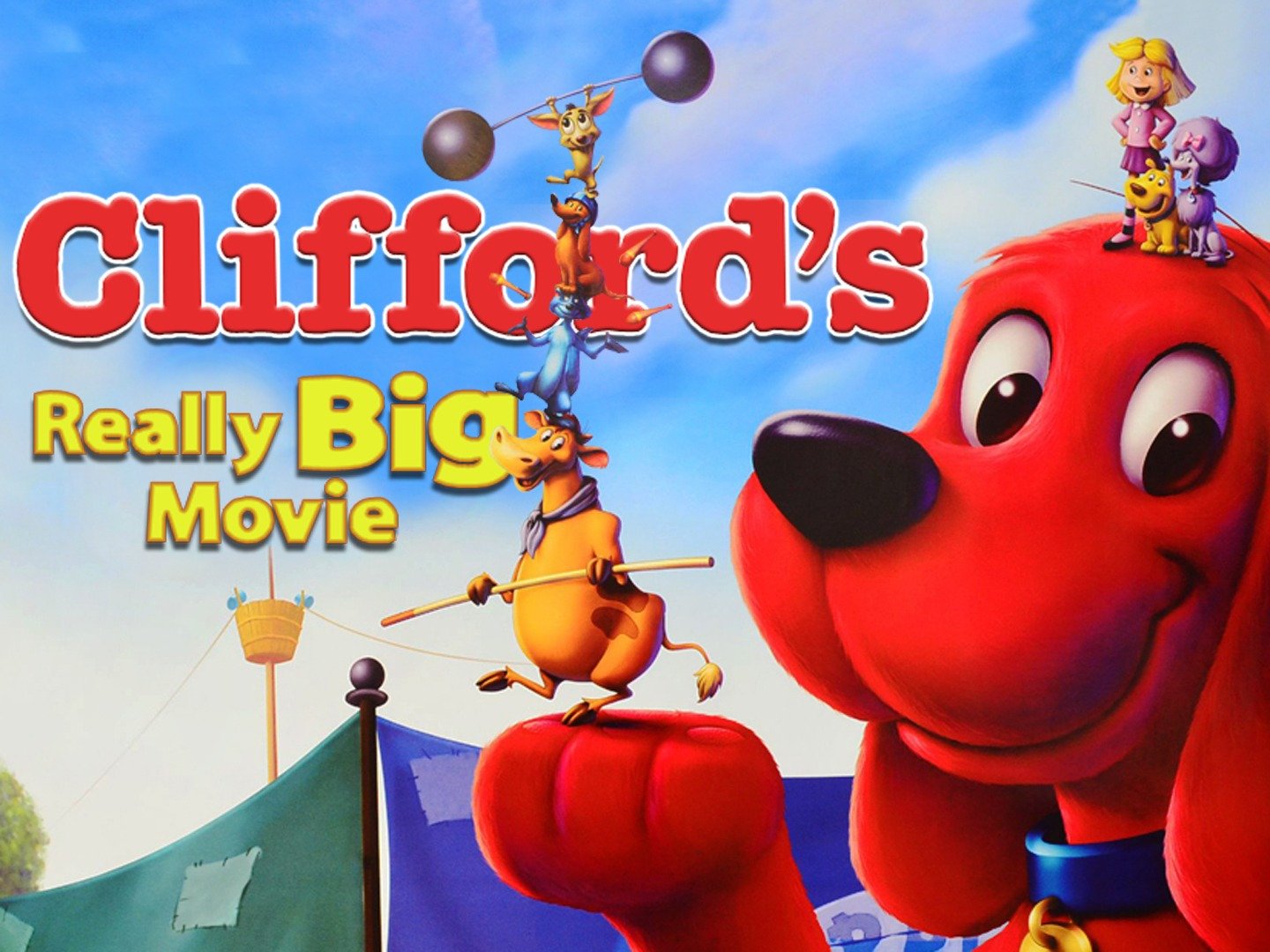
Clifford (voice of the late John Ritter in his last role) lives with Emily Elizabeth and her family on dogbone-shaped Birdwell Island. His best dog friends are T-Bone (voice of Kel Mitchell) and Cleo (voice of Cree Summer). When Clifford overhears Emily Elizabeth’s parents talk to a neighbor about how much he eats, Clifford thinks he is too much of a burden for the family and decides that he, T-Bone, and Cleo should join an animal act and compete for a prize of a lifetime supply of pet Tummy Yummies.

The animal act includes a trapeze artist ferret named Shackelford (voice of Wayne Brady) and a tightrope-walking cow named Dorothy (voice of Jenna Elfman). They are managed by Larry (voice of Judge Reinhold), who loves them very much but has not been able to make the act successful. Their only chance is to win that contest. But, Shackelford says, in order to do that, they need something big. Enter Clifford.

As soon as Clifford and his friends arrive, the act comes together and audiences love it. But Shackelford gets jealous of all the attention Clifford is getting. The daughter of George Wolfsbottom (voice of John Goodman), the wealthy man who owns the Tummy Yummies company, wants Clifford to be her pet. And Emily Elizabeth misses her beloved Clifford, and he misses her, too. Fortunately, everyone in this movie is kind and understanding and loyal, though it takes some longer to get there than others.

The limited animation style looks static on the big screen and the movie is too long for its age group even at 75 minutes. (Actually, I felt it was too long for my age group, too.) The children at the screening I attended fidgeted during the musical numbers and some seemed uncomfortable with even the mild tension in the story. The story itself is questionable, with Clifford and his friends leaving home without thinking about how upsetting that will be for their families. The song lyrics justifying it were downright unsettling at times; it cannot be wise to sing to children about how “You’ve got to be lost if you want to be found….It only gets better after it gets worst, happy ever after needs the scary part first.” It’s fine to let children know that problems can be solved, but this suggests that they cannot be happy unless they make sure something bad happens first.

Parents should know that there is some mild peril and some emotional tension. Some children may be upset when Clifford and his friends leave home or when the dogs lie about not having owners.

Families who see this movie should talk about how Clifford got the wrong idea by hearing only part of what Emily Elizabeth’s parents said about him. What should he have done instead of leaving? Make sure children know that it is never all right for anyone to leave home without talking to the family about what is wrong. Families should also talk about the lie the dogs tell about their dog tags, and about Dorothy’s saying that Shackleford is “not the most secure ferret in the world, but he means well.” Why does Mr. Wolfsbottom’s daughter want to have the biggest of everything? What does it mean to say that “okay does not dazzle?”

Families who enjoy this movie will enjoy the Clifford books and videos. They will also enjoy the books and video starring Lyle, Lyle Crocodile, especially the animated version, which has outstanding songs and voice talent. And they might like to try to make snickerdoodles, the cookies Dorothy and Cleo promise to make together.

Related Tags:


Based on a book DVD/Blu-Ray Fantasy Movies -- format

Mary Poppins

Posted on December 13, 2002 at 5:18 am

A+
Lowest Recommended Age: Kindergarten - 3rd Grade
MPAA Rating: G
Profanity: None
Alcohol/ Drugs: None
Violence/ Scariness: None
Diversity Issues: The cause of votes for women is presented as unimportant, even daffy; subtext that parents should spend time with their children in
Date Released to Theaters: 1964
Date Released to DVD: December 09, 2013
Amazon.com ASIN: B00E9ZAT4Y

marypoppins5In honor of the upcoming “Saving Mr. Banks” and the 50th anniversary of the original film, Disney is releasing a superclifragilisticexplialidocious new edition of Mary Poppins.

Based on books by P.L. Travers (whose reluctance to allow a film to be made is the subject of “Saving Mr. Banks,” the film switches the 1930’s-era setting to the more picturesque London of 1910, where the Banks family has a loving, if rather chaotic, household. A nanny has just stormed out, fed up with the “incorrigible” children, Jane and Michael. Mr. Banks (David Tomlinson) writes an ad for a new nanny and the children compose their own, which he tears up and throws into the fireplace. The pieces fly up the chimney, where they reassemble for Mary Poppins (Julie Andrews), who is sitting on a cloud. The next day, a great wind blows away all of the nannies waiting to be interviewed, as Mary floats down.

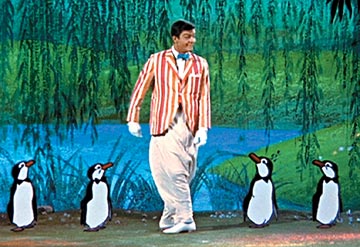
Somehow, she has a mended copy of the qualifications written by the children that Mr. Banks tore up and threw into the fireplace.  To the children’s astonishment, she slides up the banister.Out of her magically capacious carpetbag she takes out a tape measure to determine the measure of the children (“stubborn and suspicious” and “prone to giggling and not tidying up”) and her own (“practically perfect in every way”).  She directs them to clean up the nursery, and shows them how to make it into a game (“A Spoonful of Sugar Helps the Medicine Go Down”). Once it is clean, they go out for a walk, and they meet Mary Poppins’ friend Bert (Dick Van Dyke) drawing chalk pictures on the sidewalk. They hop into the picture and have a lovely time, or, rather, a “Jolly Holiday” in a mixture of live-action and animation that has Bert dancing with carousel horses and penguins.

Mary-Poppins-RooftopMary takes the children ato see her Uncle Arthur (Ed Wynn), who floats up to the ceiling when he laughs, and they find this delightfully buoyant condition is catching. Later, Mr. Banks takes the children to the bank where he works, and Michael embarasses him by refusing to deposit his tuppence because he wants to use it to buy crumbs to feed the birds. There is a misunderstanding, and this starts a run on the bank, with everyone taking out their money. Mr. Banks is fired.

Mr. Banks realizes that he has been too rigid and demanding. He invites the children to fly a kite with him. Mrs. Banks realizes that in working for the vote for women, she had neglected the children. Her work done, Mary Poppins says goodbye, and floats away.

This sumptuous production deserved its many awards (including Oscars for Andrews and for “Chim Chimeree” as best song) and its enormous box office. It is fresh and imaginative, and the performances are outstanding. (Watch the credits carefully to see that Van Dyke also plays the rubber-limbed Mr. Dawes.) The “jolly holiday” sequence, featuring the live-action characters interacting with animated ones, is superb, especially Van Dyke’s dance with the penguin waiters.

The resolution may grate a bit for today’s families with two working parents, but the real lesson is that parents should take time to enjoy their children, not that they should forego all other interests and responsibilities to spend all of their time with them.

Family discussion:  If you were writing a job notice for a nanny, what would it include?  Which of the children’s adventures did you most enjoy and why?

If you like this, try: books by P.L. Travers and the documentary about this film’s Oscar-winning song-writers, The Boys: The Sherman Brothers’ Story. And go fly a kite!

Related Tags:


Based on a book Classic Comedy DVD/Blu-Ray Pick of the Week Family Issues Fantasy For the Whole Family Musical Stories About Kids

The Great Escape

Posted on December 13, 2002 at 5:17 am

A+
Lowest Recommended Age: Middle School
MPAA Rating: Not rated
Profanity: None
Alcohol/ Drugs: Some drinking, smoking
Violence/ Scariness: Very tense moments, characters in peril and many killed
Diversity Issues: People from a variety of backgrounds and countries work together toward a common goal
Date Released to Theaters: 1963
Date Released to DVD: May 7, 2013
Amazon.com ASIN: B00BN3DUVE

great escape

In honor of the Blu-Ray release of this classic film, it is the Pick of the Week – and I am delighted that I have one Blu-Ray to give away.  Send me an email at moviemom@moviemom.com with Escape in the subject line.  I will pick a winner at random on May 15.  Don’t forget your address!  (US addresses only.)

Towards the end of WWII, the Germans built a special high-security prison camp for Allied prisoners with a record of escape attempts. This is the true story of the extraordinary courage and ingenuity of the men imprisoned there, and of their plans for the greatest escape ever. As the British ranking officer explains, when the camp commandant urges him to relax and “sit out the war as comfortably as possible,” his duty is to escape, or, if escape is impossible, to force the enemy to use as many resources as possible to contain them.

Each man contributes his expertise. There are “tunnel kings” to dig the three tunnels, a “forger king” (Donald Pleasence) to forge the papers the soldiers will need when they escape, a “scrounger” (James Garner) to beg, borrow, steal, or obtain through blackmail the materials they need, and others who work as tailors and manufacturers. An American who is something of a loner, Hilts (Steve McQueen) becomes the “cooler king” for his long stints in solitary confinement, as a result of his independent escape attempts. When “Big X” (Richard Attenborough), the British officer who supervises the escape, asks Hilts to go through the tunnel to get information about the area surrounding the camp, and then allow himself to be recaptured, so he can let them know what he has found, he refuses. But when his friend is killed trying to escape, his spirit broken by the camp, Hilts changes his mind.

Seventy-five of the prisoners are able to escape before the tunnel is discovered. The Germans track almost all of them down, and fifty are killed, including Big X. It is to “the fifty” that the film is dedicated.

As in “Stalag 17” and many other films about prison camp, the prisoners in this story must adapt to the direst of circumstances, and they choose differing approaches. Hilts adapts by working on his own, or with one partner, while others work on a massive group escape. Ives and Danny begin to unravel under the stress, not so much a “choice” as an involuntary response.

Unlike other prison camp movies, this one does not dwell on disputes between prisoners or on the deprivations of the prison camp, which seems almost comfortable. It is about the professionalism, courage, resourcefulness, teamwork, and loyalty of every one of the prisoners.

As in a traditional “heist” film, the story focuses on defining a problem and then solving it. They examine the restrictions imposed by their conditions, change the ones they can, and adapt to the ones they cannot. They must also adapt quickly and calmly when the plan does not go as they expected.

The story gives us an exceptional example of teamwork and loyalty. Note the way that the prisoners protect each other. When Danny (Charles Bronson) cannot take it any more and wants to escape on his own, his friend talks him out of it. When the Forger goes blind, Big X wants to leave him behind, for his own protection. But the Scrounger promises to take care of him.

Point out to kids what factors do — and do not — go into the prisoners’ calculations and strategy. Big X is cautioned not to allow his personal wish for revenge determine their strategy. But pride (in the sense of morale) is permitted to be considered. When asked “Have you thought of what it might cost?” he answers, “I’ve thought of the humiliation if we just tamely submit — knuckle under and crawl.” They also consider the risk of failure, to the extent they can. At the end, when the Scrounger asks whether the escape was worth the price, the best the British Commander can do is answer truthfully, “It depends on your point of view.”

Note: The  screenplay was co-written by blockbuster novelist James Clavell (Tai-Pei, Shogun). His own experiences as a prisoner of war in a Japanese prison camp are the subject of “King Rat.” The outstanding musical score is by Elmer Bernstein (“The Magnificent Seven” and “To Kill a Mockingbird”). Richard Attenborough, who played Big X, became a director in the late 1960s of films such as “Gandhi” and “Shadowlands.” He continues to appear as a performer, and played Dr. Hammond in “Jurassic Park” and Kris Kringle in the 1994 version of “Miracle on 34th Street.”

Family discussion: Why are the experts called “kings”?  What makes Hilts change his mind about getting the information they want? Who was right about taking the Forger out through the tunnel, Big X or the Scrounger? Given the results of their action in this story, should officers who have been taken prisoner feel duty-bound to try to escape?

If you like this, try: “Stalag 17” and “King Rat”


Related Tags:


Based on a true story Classic Drama DVD/Blu-Ray Pick of the Week War

The Little Mermaid

Posted on December 13, 2002 at 5:17 am

A+
Lowest Recommended Age: Kindergarten - 3rd Grade
Profanity: None
Alcohol/ Drugs: None
Violence/ Scariness: Some scary scenes, characters in peril
Diversity Issues: None
Date Released to Theaters: 1989
Date Released to DVD: September 30, 2013
Amazon.com ASIN: B0036TGT2A

little mermaid diamondAfter some lackluster years, Disney came back into the top rank of animated features with this superbly entertaining musical, based loosely on the fairy tale by Hans Christian Andersen (but with a happier ending).

Ariel was the first in a series of refreshingly plucky Disney heroines. Instead of dreaming about the day her prince will come, or waiting for a fairy godmother or a Prince’s kiss, Ariel is a spirited and curious mermaid who is willing to take action in order to meet Prince Eric, the man of her dreams, though she is gullible and impetuous in agreeing to the terms demanded by the seawitch in exchange for making it possible for her to go on land.

She goes to the seawitch (Pat Carroll, first rate as Ursula the octopus) to ask her to turn her tail into legs. But Ursula has two conditions. Ariel has to give up her voice. And if Eric does not kiss her within three days, Ariel will become Ursula’s slave forever. She agrees, and has to find a way to persuade Eric to fall in love with her without using her voice, despite Ursula’s crafty plans to prevent it.

NOTE: In addition to the “normal” scariness of the sea witch, some children may find the casual bloodthirstiness of the French chef upsetting, especially in the musical number in which he tries to turn Sebastian into crabmeat.

The wonderful voice characterizations in this film include Buddy Hackett (“The Music Man”) as Scuttle the scavanging seagull and Samuel E. Wright as Sebastian, the calypso-singing crab. The first-class musical score by Alan Menken and Howard Ashman (who worked together on the off-Broadway hit, “Little Shop of Horrors”) ranks with the best of Broadway and won Oscars for Best Score and Best Song (“Under the Sea”). Some viewers criticize the movie for providing yet another wasp-waisted Disney heroine whose whole world revolves around a man. But Ariel is adventuresome, rebellious, and brave. It is true that she makes the mistake of giving up her voice to the sea witch (a very strong female character, to say the least), which provides a good opportunity for family discussion.

A straight to video sequel about Ariel’s daughter called The Little Mermaid II: Return to the Sea is exceptionally good, with first-class animation and a lot of heart and humor.

Related Tags:


Animation Based on a book Classic DVD/Blu-Ray Pick of the Week Fantasy For the Whole Family Musical Romance Talking animals
THE MOVIE MOM® is a registered trademark of Nell Minow. Use of the mark without express consent from Nell Minow constitutes trademark infringement and unfair competition in violation of federal and state laws. All material © Nell Minow 1995-2026, all rights reserved, and no use or republication is permitted without explicit permission. This site hosts Nell Minow’s Movie Mom® archive, with material that originally appeared on Yahoo! Movies, Beliefnet, and other sources. Much of her new material can be found at Rogerebert.com, Huffington Post, and WheretoWatch. Her books include The Movie Mom’s Guide to Family Movies and 101 Must-See Movie Moments, and she can be heard each week on radio stations across the country.

Website Designed by Max LaZebnik