Copyright 2015 Village Roadshow
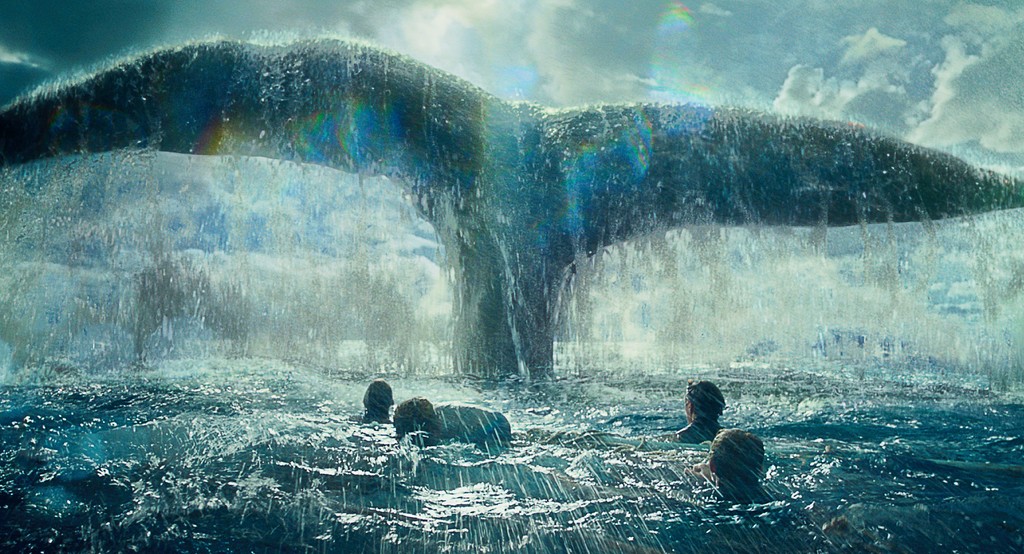
Herman Melville’s Moby Dick is a brilliant novel about humanity, nature, obsession, power, and pretty much everything else, with a lot of technical information about whaling thrown in for good measure and metaphor. Nathaniel Philbrick’s acclaimed book about the tragic real-life whaling expedition that inspired Melville to write Moby Dick is In the Heart of the Sea: The Tragedy of the Whaleship Essex. This film is director Ron Howard’s uneven attempt to give that story the mythic force of Melville’s tale (itself never adequately adapted for film).
Like Moby Dick, this is a story of man against nature, not just the powerful animals man tries to trap and kill but of man against the animalistic elements of his own nature. That is represented, as it so often is, by the conflict between two men. The captain of the Essex is George Pollard (Benjamin Walker). He and everyone on the shop know that he is captain only because he comes from a high-born shipping family. The first mate is Owen Chase (Chris Hemsworth, with his “Rush” director), resentful of Pollard because he was promised the captain job and knows he is more qualified.
On the first night out, Pollard makes a point of cruelly describing Chase’s father’s time in prison to establish his superiority — and his willingness to use humiliation as a management tactic. In his desperation to establish his superiority, he does not realize that it makes him look thuggish and scared. It certainly does not inspire respect or loyalty. But Chase is determined to make it work. This time, if he meets his quota, he has it in writing that his next voyage will be as captain.
The whalers are under enormous pressure. Whale oil powers the world of the 1820’s (there is a clumsy hint that the world may be shifting to fossil fuels). Whaling ships go to sea for years at a time, traveling across the Atlantic to kill whales, extract the blubber, and melt it down.
Ships — whether on water or in space — are ideal settings for stories because they are isolated from the society at large. Everything is heightened because there is no way to leave and no recourse for support or appeal. But that intensity and drama is dissipated here with a useless framing story as author Melville (Ben Whishaw) tries to get the ship’s only survivor (Brendan Gleeson) to tell him what happened. The connection is awkwardly positioned against Moby Dick‘s narrative voice and unforgettable Job-like status as the sole survivor who can carry the story and the survivor character’s sympathetic wife is a distraction and her scenes suggest after-the-fact re-shoots.
Melville was wise to reshape the story. This version has gorgeous scenery, a moving score by Roque Banos, and superb special effects, but the power of the images is undercut by a story that tries to carry more meaning than it can hold.
Parents should know that this is a whaling saga with constant and intense peril and violence including fire, guns, storms, starvation, murder, cannibalism, and sinking ship, many characters injured and killed, brief strong language, and drinking and alcoholism.
Family discussion: Why did Pollard embarrass Chase on the first night out? What were the biggest differences between Pollard and Chase in the way they treated the men? Do you agree with Chase’s “abominable” decision?
If you like this, try: “The Perfect Storm” and Melville’s Moby Dick
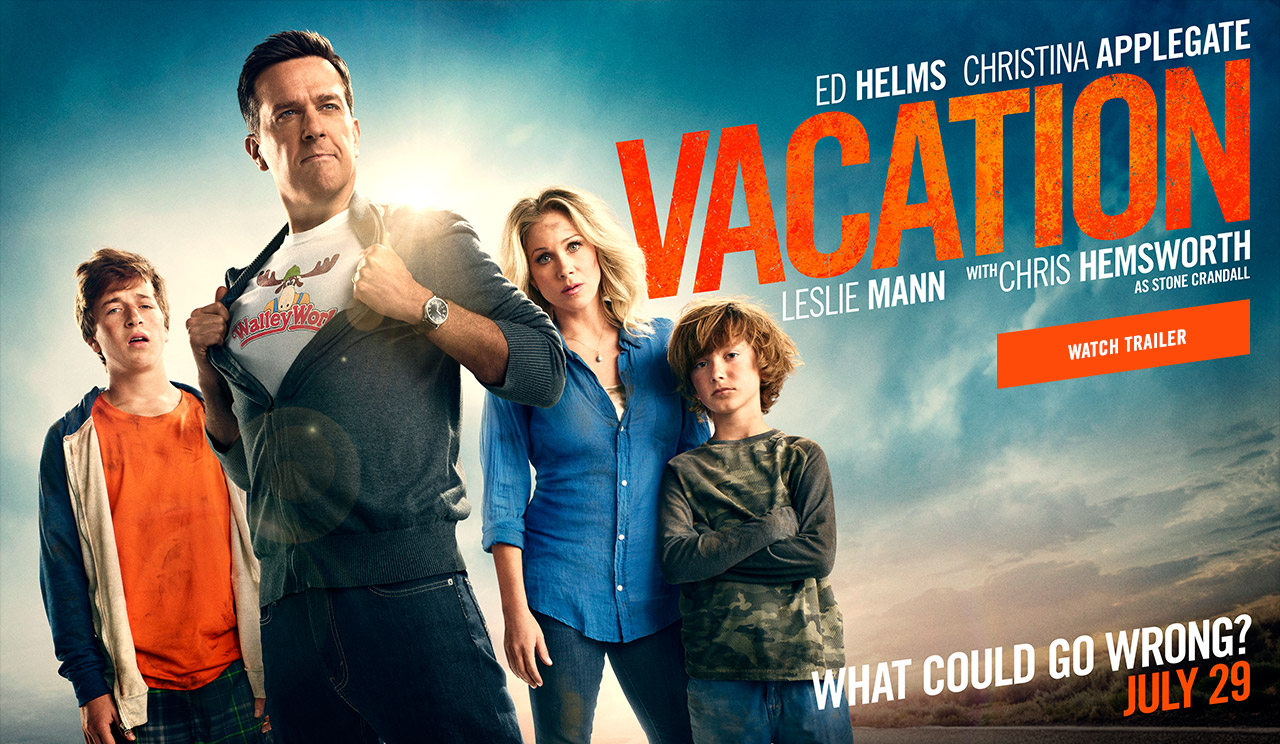
I didn’t like the first one. I didn’t like the sequels. Keep that in mind when I tell you that I really did not like this latest in the gross-out, mean-spirited “Vacation” series, this time with the next generation going on another car trip to Wally World. You know how kids survive long car trips with earphones and DVD players? That’s what I wished I had to help me survive this movie. I even took extra time making my notes to have an excuse to look down at my notebook instead of looking at the screen. This is a movie that finds — or tries to find — humor in mistaking a sewage facility for a natural hot springs (with extended scenes of the cast spreading the “mud” all over themselves), sibling abuse, attempted suicide, a person and an animal in separate instances getting slammed by vehicles, excruciating humiliation, suspected pedophilia, and a misunderstanding of the term “rim job.”
Ed Helms plays Rusty Griswold. He bears no resemblance to the Anthony Michael Hall, who played him in the first film, or the young actors who played the character in the sequels. But Russ bears no resemblance to the character of the earlier movies, either. This Rusty is a genial bumbler who loves his family and works as a pilot for an airline. He and his wife Debbie (Christina Applegate) have two sons. The little one, Kevin (Steele Stebbins), bullies the big one (Skyler Gisondo as James) with constant insults, attacking his manhood, personality, and overall right to exist on the planet.
Russ decides that what the family needs is some bonding time, like on that car trip to the Walley World theme park he somehow remembers very fondly from his childhood. He rents a bright blue car called a Tartan Prancer, which he describes as “The Honda of Albania.” He has no idea what most of the buttons on the car do, but that means we all get to find out together.
The family swings by to visit Rusty’s sister Audrey (Leslie Mann), who is married to a guy who looks like a Norse god, because he is played by Thor himself, Chris Hemsworth. He is a TV weatherman named Stone and he is rancher who intimidates Rusty by being handsome, muscular, wealthy, and good at everything, including being a loving husband, if you don’t count his preventing his wife from having a job outside the home. Oh, and as we and Rusty and Debbie get to see in detail (graphic detail at the end of the movie), he is exceptionally generously endowed and feels very, very good about it. And this is — really — the highlight of the movie.
Hemsworth and Applegate both rise above the material, but the material is below sea level, so that is not saying much.
Parents should know that this movie includes very strong and crude language, very explicit sexual references and some situations, graphic nudity, disturbing scenes, comic mayhem involving people and animals, attempted suicide, apparent vehicular homicide (portrayed as funny), and a lot of bad behavior (portrayed as funny).
Family discussion: What was your family’s best road trip? What road trip would you like to take?
If you like this, try: the original “National Lampoon’s Vacation” and its sequels
Rated PG-13 for intense sequences of sci-fi action, violence and destruction, and for some suggestive comments
Profanity:
Some strong language and jokes about swear words
Alcohol/ Drugs:
Social drinking
Violence/ Scariness:
Extensive and intense sci-fi/comic book violence, some disturbing images, characters injured and killed
Diversity Issues:
None
Date Released to Theaters:
May 1, 2015
Date Released to DVD:
September 28, 2015
Amazon.com ASIN:
B00WAJ8QXC
Copyright Disney Marvel 2015
Hawkeye (Jeremy Renner) sums it up best. Speaking pretty much to himself but also to us in the audience, he notes that he is on a floating city trying to fight off a robot army with arrows. “It doesn’t make sense,” he concedes. And yet, that is where we are, and we’re okay with it.
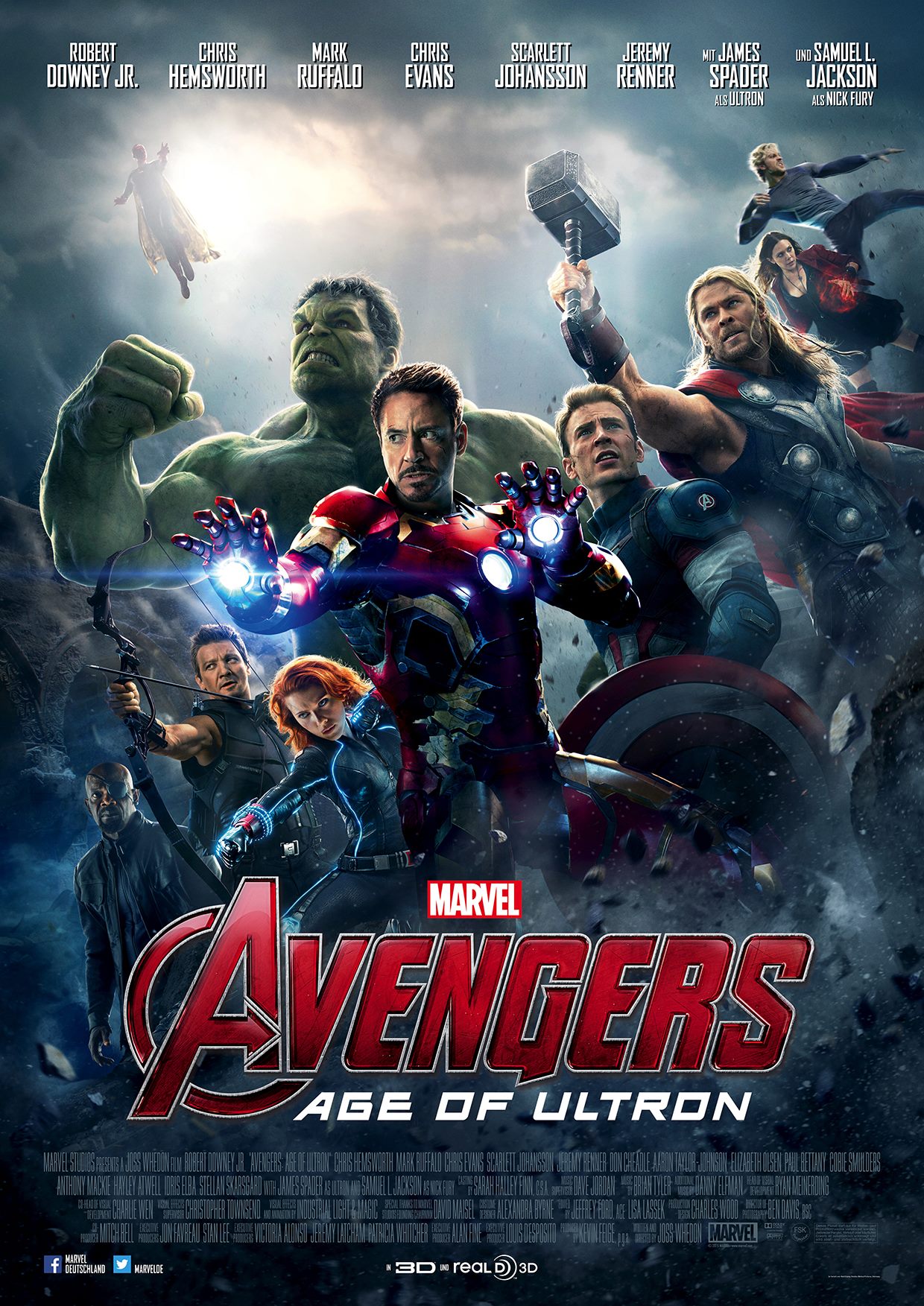
Writer/director Joss Whedon knows that we know that this is some superhero silliness, and once in a while we get to see that the characters know it, too. But he never treats the stories or the fans with anything less than respect. We get wisecracks. We get romance. But most of all, we get rock ’em, sock ’em, 3D action involving super-arrows, a super-strong shield, a super-heavy hammer, a cool bang-a-gong hammer hitting shield moment, a super-big, super-angry green guy, a super-assassin, and that genius arms-dealing billionaire philanthropist, Tony Stark.
In the first “Avengers” movie, we had the fun of seeing the team come together, a sort of Traveling Wilburys supergroup made up of heroes each more than able to carry a movie alone. Iron Man/Tony Stark (Robert Downey, Jr.), the Incredible Hulk/Bruce Banner (Mark Ruffalo), Captain America/Steve Rogers (Chris Evans), Thor (Chris Hemsworth), Hawkeye (Jeremy Renner), and Black Widow/Natasha (Scarlett Johansson) joined forces to defeat Thor’s brother Loki and retrieve the source of his power, one of the six infinity stones (yep, you saw another one in “Guardians of the Galaxy;” feel free to have your mind blown with Marvel universe awesomeness).
Then they had shwarma.
No time for getting acquainted here. We start smack dab in the middle of the action (thank you, 3D), as our merry band is battling the forces of Hydra, but of course not missing a beat in the quip department, even from the bad guys: “The Americans sent circus freaks to attack us.” Burn! (Both literal and metaphor.) Secret weapons hiding out with Hydra include twins who are very angry and damaged because their parents were killed (by weapons from Stark’s company). Now, thanks to some Hydra tinkering, they have superpowers, best summed up as “He’s fast and she’s weird.” He is Quicksilver (Aaron Taylor-Johnson), and she is the Scarlet Witch (Elizabeth Olson). They both have bad Boris and Natasha accents and look like one of the Diane Arbus-like visions in “The Shining.” Her weird powers involve waggling her fingers and red smoke, with some sort of force field and the ability to impose what looks like a very bad acid trip on anyone with a biology-based brain.
But that’s not the problem. The battle with Hydra lasts just long enough to re-introduce us to everyone and not a few updates, especially a new tenderness between the Black Widow and Bruce Banner. Soon, they’re back at their clubhouse/headquarters and Tony asks for three days to investigate Loki’s stone before Thor returns to to Asgard. What could go wrong?
Pretty much everything, as Tony’s hubristic attempt to create a new artificial intelligence to protect humanity ends up as Ultron (James Spader, using that same tone of languid contempt we first heard when he played Blaine’s snooty rich friend in “Pretty in Pink”). Ultron takes one look around and decides humanity is in need of a major reboot, starting with extermination. Anyone who hates the Avengers has a couple of friends in the twins. And, given the little Hydra infestation problem in “Captain America: The Winter Soldier,” our group no longer has access to the massive government tools and technology, while Ultron is tapped into all digital data. It’s tough to come up with a bad guy who can be a credible threat to superheroes, but Ultron and the twins are scary and crazy, so they qualify. “Is this your first time intimidating?” Ultron asks with an arrogant robot sneer.
Yep, another big, big battle lies ahead, and yep, it includes a floating city and an army of robots and awesome stunts. It also involves evacuating civilians, often overlooked in superhero films. It also involves some group dynamic governance issues, as you might expect with so many Alpha males in the room. Shwarma, maybe, revels, now and then, but kumbaya, no, not even Robert’s Rules of Order or majority vote. “We don’t have time for a city hall debate,” Stark says as he doubles down on a bad decision. “I don’t want to hear a ‘man was not meant to meddle’ medley.” Perhaps only Downey could give that line the right zhuzh, but that’s why they pay him the big, big, big bucks, and he nails it.
The interaction is a treat, especially when everyone (with one notable exception) tries to lift Thor’s hammer and no one (with one notable exception) succeeds. There is sparkling banter with a refreshing Whedoneseque twist. Given the challenges of making sure at least nine lead characters get their due in dramatic arcs, quippy zingers, and superhero showmanship, it is inevitable that it will be cluttered. It is perhaps a little less inevitable that the ladies will be squeezed out, entirely off-screen Jane and Pepper dismissed with a couple of lines of dialogue about how busy and important they are, Natasha all nurturing and flirty and beauty taming the beast-ish, though she’s dynamite on a motorcycle. But his willingness to grapple with the existential dilemmas of superheroes and his ability to make those questions so much fun is what superheroes — and movies — are for.
NOTE: Stay through the beginning of the credits to find out who the villain will be in the next chapter. But you don’t need to stay after that as there is no shwarma this time.
Parents should know that this film has extended and graphic sequences of superhero peril and action-style violence with some disturbing images, characters injured and killed, some strong language, and brief crude humor.
Family discussion: How can the Avengers find better ways to resolve their conflicts? Why was Stark so wrong in his design for Ultron?
If you like this, try: the other Marvel movies and the original comics
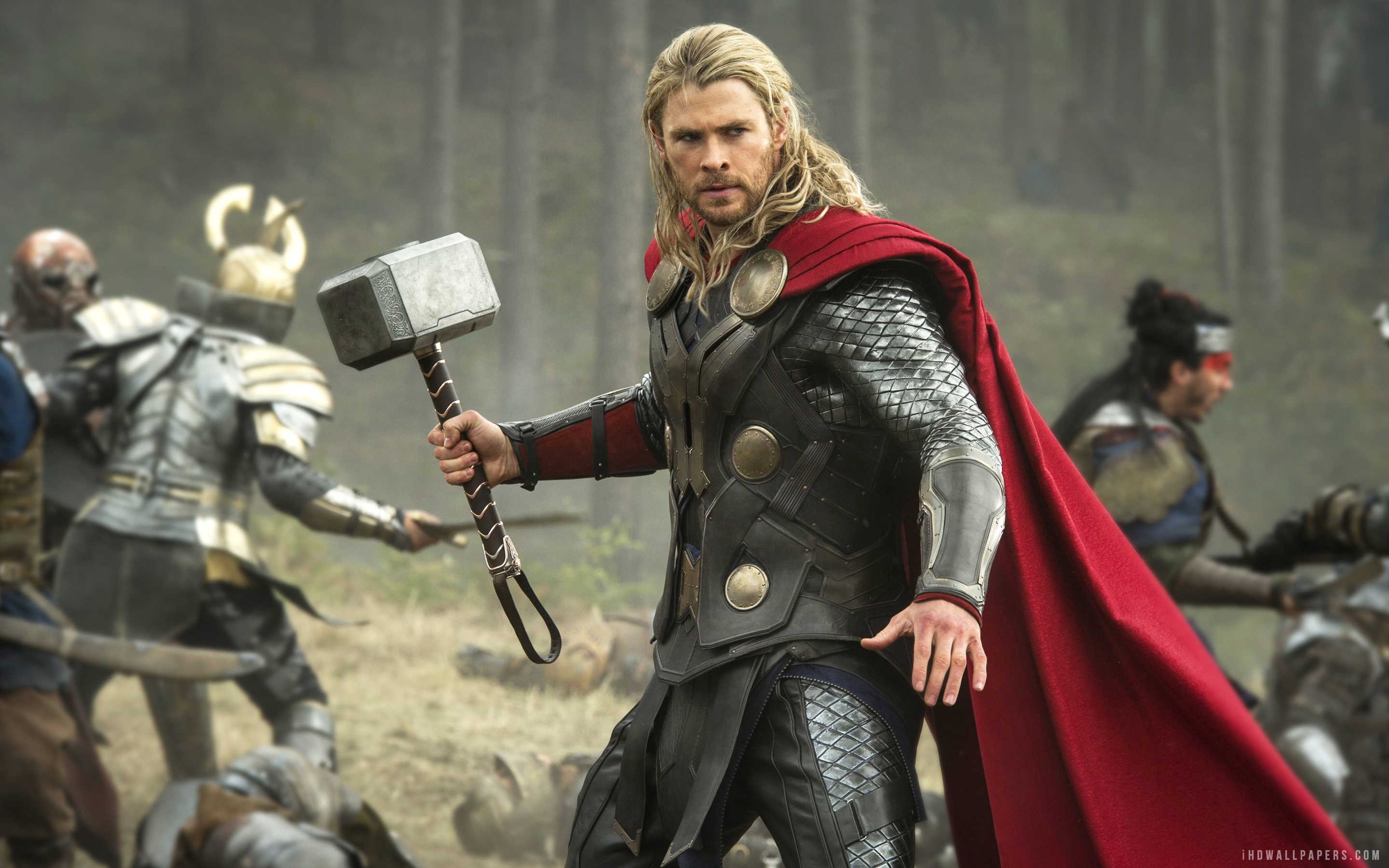
I always say that superhero movies are defined by their villains, and “Thor: The Dark World” has a lulu in Tom Hiddleston‘s Loki, who was not as vanquished at the end of “The Avengers” as we thought. Thank goodness. Loki, the eternal trickster of Norse myth, is imprisoned by his father, Odin (Anthony Hopkins) at the beginning of the story. But a once-in-5000-years celestial line-up brings on an attack by the Dark Elves, let by ninth Dr. Who Christopher Eccleston and “Oz’s” Adewale Akinnuoye-Agbaje, and soon Loki is freed. Chris Hemsworth continues to bring all the requisite charisma and some welcome wit to the heroic Thor and Hopkins is nicely magisterial as the one-eyed Odin, but it is Hiddleston who is clearly having a blast as a god who lives for chaos and brings a jolt of pure devilish pleasure to every scene he is in.
That is particularly welcome because all those scenes in Asgard can get rather ponderous. And the movie begins inauspiciously with some Tolkein-ian mumbo-jumbo about the battle with the Dark Elves and some icky black smokey-stuff that has some important power and a bunch of parallel universes. Who cares — let’s get to the good stuff already.
Meanwhile, back on earth, the world’s most beautiful astrophysicist, Jane Foster (Natalie Portman), is wondering whether her super-boyfriend is ever going to call. Her colleague, Dr. Erik Selvig (Stellan Skarsgård) is running around with his pants off, and sometimes with the rest of his clothes off, too, and her intern (Kat Dennings) and her intern’s intern are helping her investigate some very strange gravitational anomalies. All of this, except for the boyfriend part, relates to this once in a quinti-millennium astrological line-up that opens up portals or melts the boundaries or some crazy thing that lets the parallel universes seep into each other. Jane gets slimed by the black smokey stuff and Thor whisks her away to Asgard. I wish I could say it was a side effect of the smoke that has her more concerned about the significance of meeting her boyfriend’s parents than a scientific inquiry into the nature of the home of the Norse gods, or understanding the life-threatening nature of the Dark Elves’ smoke. But no.
Pantlessness aside, there are some genuinely funny moments, including a surprise appearance by one of the other Avengers and a mid-battle trip on the subway. The fight scenes are strong, well staged by “Game of Thrones” director Alan Taylor, and there are some predictably cool special effects. Rene Russo is fine as Frieda and there are not one but two extra scenes in the credits. But the reason to see the movie is Loki — he should get his own movie next time around.
Parents should know that the movie includes extended comic-book-style action violence with some graphic images, characters injured and killed, a hand chopped off, fatal stabbing, some strong language, and comic nudity (nothing shown).
Family discussion: How does Thor compare to other superheroes? Did you like the touches of comedy or find them distracting?
If you like this, try: “The Avengers” and the first Thor movie.
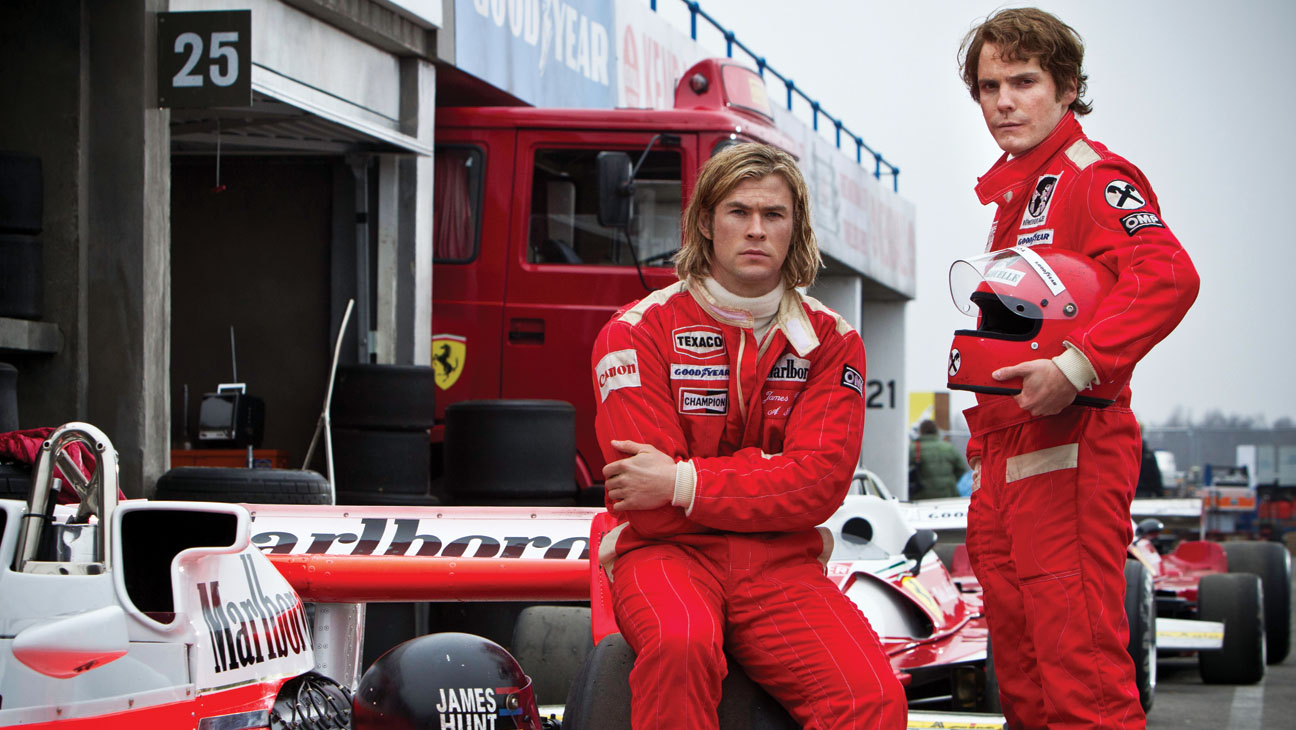
The immensely gifted screenwriter Peter Morgan reunites with his “Frost/Nixon” director Ron Howard and returns to his favorite theme, a real-life drama about the clash between two brilliantly talented but flawed figures. This time it is the bitter rivalry between Formula One race car drivers James Hunt (“Thor’s” Chris Hemsworth) and Niki Lauda (“Inglourious Basterds'” Daniel Brühl). The British Hunt is Maverick to the Austrian Lauda’s Iceman, the Michael to his Sonny, the id to Lauda’s superego.
Both were the rebellious sons of wealthy fathers. Hunt is handsome, careless, and catnip to the ladies. “He will have you pulling your hair out nine days out of ten,” a character says, but on the tenth day, when you need him, he will deliver. Lauda is methodical and analytical. He calculates the odds. But they both know that they are among the very few who know what it feels like to get into a car that is essentially a bomb on wheels and speed it around a racetrack. They both do it not because they like driving in circles but because they like to test themselves. They both like to win, even need to win. And, as they remind us perhaps one or two times too many in this film, they both know that the best way to do that is to compete against one another. “The only people I can get along with are those who can drive fast,” Hunt says. He does not really get along with them, either.
Hemsworth, 30 pounds lighter than his Thor/Avengers muscled-up Norse god look, is able to make Hunt magnetic even in 70’s hair. We meet him as he walks into an emergency room with a bashed nose, not from a racing accident, from a jealous husband. The pretty nurse (Natalie Dormer) asks what he did to anger the husband and he rakishly offers to show her. The curtain rings squeal against the rod as it is quickly swung around and soon he is introducing her to his pit crew as “Nursie.” No time to learn her name, and no need.
Hunt was the James Bond of race car drivers, sexy, sophisticated, and fearless. But I don’t think James Bond ever threw up before a confrontation. “Rebels, lunatics, dreamers,” he tells us about race car drivers. “People who are desperate to make a mark and willing to die for it.” Formula One averaged two deaths a year. But, he adds, “The closer you are to death, the more alive you feel.”
Lauda says his brain is not that strong but his ass is very smart. He can tell from a car’s vibrations under the seat that a fan belt will be in trouble and which tire needs air. He negotiates his driving deals the way he drives, calmly but ruthlessly. He gets up early to walk the track. He calculates risk constantly and accurately. When he explains that one race should be called off because the heavy rainstorm has made conditions unsafe, Hunt, behind on points, persuades the other drivers to vote to continue. Lauda is very badly injured, including burns on his face and severe lung damage. In one of the most extraordinary comebacks in the history of sports, Lauda was back on the track 42 days later, against doctor’s orders but able to compete. In what passed for cheerfulness from the dour Austrian, he told the press that there was one advantage to the skin grafts on his forehead. They don’t sweat, so he would no longer be bothered by sweat dripping in his eyes. And, has his wife told him, you drive with your foot, not your face.
Howard conveys the pressure and the thrill of Formula One racing, giving us the view from inside the helmet, and showing us that Hunt’s air of casual mastery is accompanied by a nervous habit of playing with the cap on his cigarette lighter. He shows us how Hunt and Lauda are always racing, whether it is Hunt visualizing the track or Lauda walking it, competing for the best cars and sponsors, or exchanging barbed comments about whether it is more important to be feared than loved. The action is electrifying, on and off the track.
Parents should know that this movie includes some disturbing images of crashes and injuries, very strong language, sexual references and situations with nudity, drinking, smoking, and drug use, as well as a great deal of reckless behavior.
Family discussion: What were the most important ways in which Hunt and Lauda were alike? If you were a sponsor, which would you hire and why?
If you like this, try: “Winning” with Paul Newman, “Grand Prix” with James Garner, and “Le Mans” with Steve McQueen, and Peter Morgan’s “The Damned United” about another real-life sports rivalry.