Jupiter Ascending

Posted on February 5, 2015 at 5:55 pm
Copyright 2015 Warner Brothers

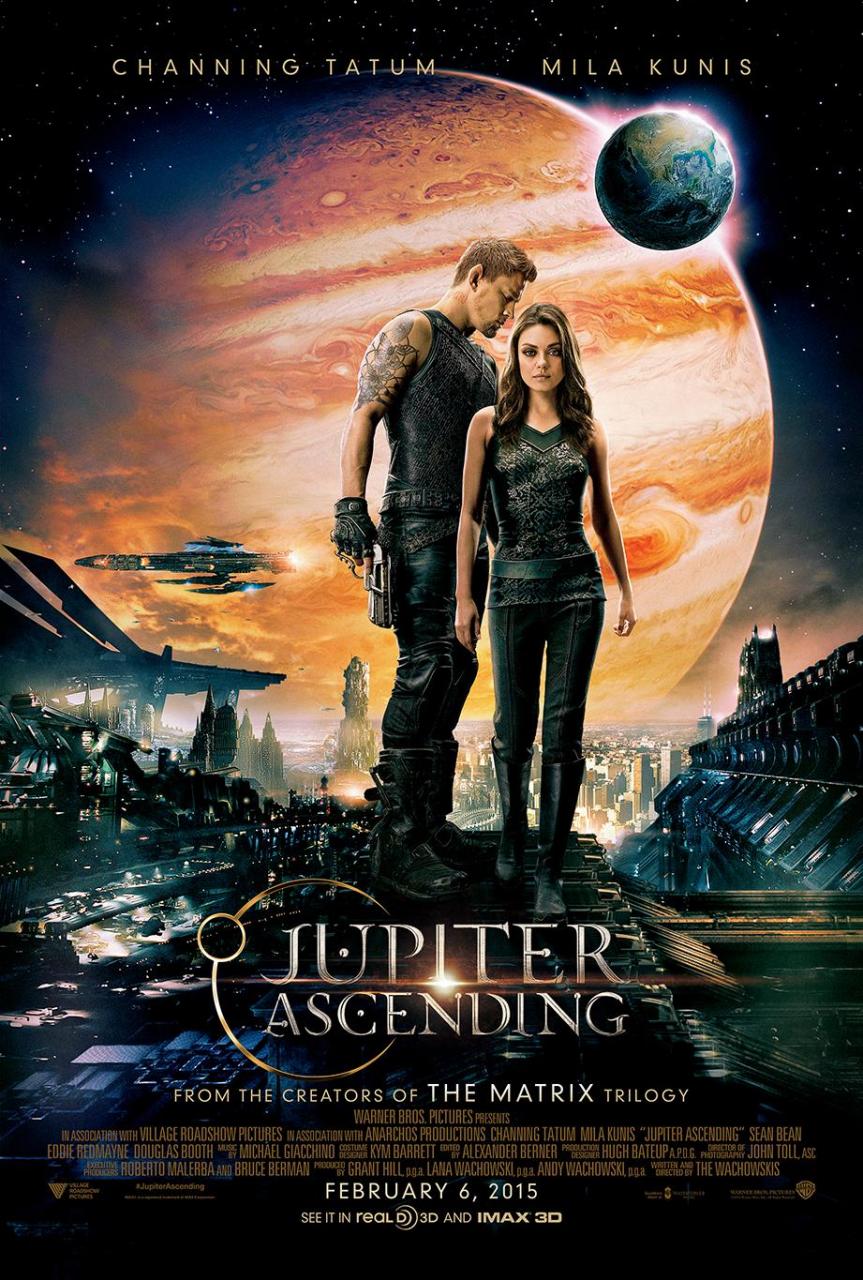
“Jupiter Ascending” was released in early 2015 but it was originally scheduled for release in the summer of 2014. It does feel like a summer movie. Somehow warm weather makes us more in the mood for explosions and less in need of superfluities like plot, character, and dialogue that never feels snicker-worthy. It is not quite up to snuff for this time of year. The story feels like a mash-up of sci-fi/fantasy movies past (especially “Terminator” and “Star Wars”), with a little “Cinderella” and “Princess Bride” added in for romance and some rage against the one percent to add some political heft. It is often downright silly, even snicker-worthy. It is well over the quota for just-in-time saves, both in the falling and about-to-make-an-irrevocable-decision categories.

And yet, it is fun, especially on a big, big screen. And there are even a few moments that are shrewdly conceived and hit the mark. The Wachowskis (“The Matrix” trilogy, “Cloud Atlas,” “Speed Racer”) specialize in vast, colorful, grandly conceived new worlds and in this film they mean that literally. We visit several planets, and each is visually complex, sumptuous, and wildly imaginative, often dazzling. If you’re in the mood for eye candy, head for the box office. Don’t wait to see this one at home.

Mila Kunis plays Jupiter, an illegal alien (get it?) from Russia, working in Chicago as a maid and living with her extended family. “I hate my life,” she says when she has to get up at 4:45 am for another day of scrubbing toilets. But like Neo and Speed Racer, she is special. Not for a particular talent or quality of character but because of her very essence. Like infinite monkeys banging away on infinite typewriters until one of them randomly produces “Hamlet,” it seems that throughout the universe there are so many humans that every so often the random accumulation of cells produces a genetic mix identical to someone who has already lived. Jupiter, whose father was a British astronomer killed in a robbery, turns out to be identical to an intergalactic royal, which makes her a threat to three battling siblings in a dispute over their inheritance. Yes, this is a story about inheritance and real estate. We might as well be back at Downton Abbey or in “King Lear.” The particular piece of real estate they are so concerned about: Earth.

One of the noble siblings wants her captured. Another wants her killed. Just as assassins are about to take her out, Caine (Channing Tatum), a pointy-eared hunk arrives to carry her off like Richard Gere at the end of “An Officer and a Gentleman.” Except that this is the beginning, and he will have many more opportunities to lift her in his manly arms as things develop. He has some cool toys, too, especially some wonderful shoes that operate like a hoverboard crossed with ice skates, so that he glides through the air.

There are some clangers ahead, like the fact that Jupiter’s special genetic makeup is recognized by bees. But there is some fun stuff, too, especially an extended sequence through a delightfully steampunk series of bureaucratic offices that show that even the most highly evolved civilizations we can imagine still have not found a way around petty rules and red tape. In the rare category of both clangish and fun is Eddie Redmayne as Balem (the names are all faintly Latinate, “Hunger Games”-style). If Mount Everest were built on top of wherever over the top lives, he’d be on top of that. But I got a kick out of his full-on commitment to petulant decadence turned up to 11.  And Gugu Mbatha-Raw shows that a spectacularly beautiful and talented woman can take a costume reminicient of John Candy in “Spaceballs” and make it work.

It’s long and messy and unforgivably silly in place, but somewhere under all the eye candy and under-written dialogue there are some interesting ideas about the true meaning of consumption and what, if we had all the time in the world, we would do with it.  I wasn’t sorry to spend some of my limited time seeing Channing Tatum treat the air like a 3D ice rink.

Parents should know that this film has extended sci-fi/fantasy peril and violence, some graphic images including brief torture, characters injured and killed, rear nudity, some strong language, and drinking and sexual references.

Family discussion: If life requires consumption, how do we make responsible choices? How were the siblings different?

If you like this, try: “The Princess Bride,” “Looper,” “The Matrix,” and the “Star Wars” series
Related Tags:


3D Action/Adventure Fantasy Science-Fiction

The SpongeBob Movie: Sponge Out of Water

Posted on February 5, 2015 at 5:55 pm

Copyright Nickelodeon 2015

Our friends from Bikini Bottom are back in another deliriously silly story, so tender-hearted and cheery that there is no way to resist it. Plus, it has superheroes, a pirate played by Antonio Banderas, existential metaphysics, the guitarist from Guns ‘n’ Roses, and a time-traveling space dolphin with the stentorian tones of a classically trained Shakespearean actor. It will amuse newcomers and delight fans.

Banderas plays Burger-Beard, first seen on a desert island in search of hidden treasure. An Indiana Jones-style booby-trap is no match for his wiliness, and soon he is back on his one-man pirate ship (it operates on “automatic pirate”) with his precious booty: an old storybook. It was a popular book. The library check-out card in the pocket on the inside back cover shows that it has been checked out by piratical luminaries like Captain Kidd and Jolly Roger. The book has a story about SpongeBob and his friends as well as some surprising powers which we will find out about later.

The pirate’s book takes us to familiar territory. SpongeBob Squarepants (Tom Kenny) loves his job as a fry cook at the Krusty Krab, making wildly popular Krabby patties. His boss is the money-mad Mr. Krabs, who keeps the secret recipe in his safe. Bikini Bottom’s other eatery is the struggling Chum Bucket, owned by the envious, one-eyed Plankton (Mr. Lawrence), who is far more inventive in coming up with ways to steal the recipe than he is in cooking. Burger-Beard wants the recipe, too, so he can achieve his dream of opening up a food truck made from his pirate boat. When the recipe is stolen, the whole gang, including SpongeBob’s best friend Patrick (Bill Fagerbakke), a dim-witted starfish, and Sandy (Carolyn Lawrence) a scuba-suit-wearing squirrel, have to go on land to get it back.

There are some sweet lessons about teamwork (Plankton literally does not know the meaning of the term) and loyalty, but the best lesson of all is the good cheer and gentle laughter that has made SpongeBob the best-loved animated series on television.

Parents should know that this film has some potty humor, schoolyard language, and mild cartoon-style peril and violence, including a cannon.

Family discussion: Which characters are loyal and why? Why is money so important to Mr. Krabs? If you could write your own story, what would it say?

If you like this, try: the SpongeBob television series and Penguins of Madagascar

Related Tags:


3D Animation Based on a television show Comedy Fantasy For the Whole Family Series/Sequel Talking animals

Black or White

Posted on January 29, 2015 at 5:58 pm

Copyright 2014 Relativity

Writer-director Mike Binder sure likes to get Kevin Costner drunk. As in his uneven but impressive “The Upside of Anger,” Binder once again has Costner playing a man who is a little lost and usually shnockered, a role well suited for Costner’s loose-limbed, naturalist wryness. Binder’s strengths are evident here. He creates complex, unhappy characters who are articulate without being artificially quippy. He casts superb actors and gets outstanding performances (“The Upside of Anger,” flawed as it was, is worth seeing just to watch Joan Allen work through so many variations on ferocity, loss, and doubt). And in this film, he takes a highly charged situation that could easily be overly melodramatic, formulaic, or polemical and gives it nuance and dignity. No matter what your inclination on the custody dispute over a biracial child at the center of the film, you will rethink it.

Costner plays Elliot, a lawyer who learns in the first moments of the film that his wife Carol (Jennifer Ehle) has been killed in a car accident. She has had most of the responsibility of caring for their granddaughter Eloise (Jillian Estell), who has lived with them since she was born, because her mother, then just 17 years old, died in childbirth.

Elliot is so overwhelmed by loss that the next morning he takes Eloise to school without telling her what happened. He has no idea of what the morning routine is, how to fix Eloise’s hair, or even where exactly the school is located.

That afternoon, with some bolstering of his courage via alcohol and his law partner, Elliot finally tells Eloise that her grandmother has died. He is committed to continuing to care for her. But her other grandmother, Rowena (a terrific Octavia Spencer) wants to have a bigger role in Eloise’s life. She files for joint custody. Her brother Jeremiah (Anthony Mackie), a successful litigator, tells her that if she wants to succeed, she will have to have a more powerful argument than her rights as the child’s grandmother. She will have to claim that Elliot is not a suitable guardian for a black child. “Do you want what is best for the child?” asked Jeremiah. “Then has a problem with black people.” Elliot’s counsel urges him to be aggressive. “Are you okay getting ugly?”

Rowena and Elliot respect, even have some affection for one another. Each knows the other is far more than the extremes alleged in the court filings. But the system is not set up for anything but extremes. Jeremiah is successful in getting the case before a black woman judge (the excellent Paula Newsome), and both sides think she will be inclined to give Eloise to her black relatives.

But both sides are vulnerable, and, as the judge has warned them, once a child is in the system it is within her power to decide that neither grandparent should have custody. Elliot and Rowena both understand that the litigation will bring them to the brink of mutually assured destruction. But things heat up. Rowena brings in her son Reggie (André Holland), Eloise’s father and amends the suit to call for full custody, saying Elliot is not fit to raise Eloise because he drinks.  While his legal claim is stronger on paper because he is her parent, his claim is also weaker because he has a record of drug use and criminal behavior and has never cared for or even spent time with his daughter. We see the contrast between Elliot’s big, luxurious, but empty house and Rowena’s crowded, chaotic, but loving home. Elliot is white and male. Can he understand Eloise? Both of Eloise’s grandparents are still struggling with their failures as parents the first time around as well.

Binder continues to be better with the small moments than the big ones, and there are affecting one-on-one moments with Reggie and his mother and uncle, and with Elliot and Rowena. But he still has trouble with finding a good way to end a story, and he has no idea of how to write for a child. Estell has a likeable screen presence, but is asked to deliver some unforgivable lines that are far too idealized and age-inappropriate for her character. It is too bad that a film that shows exceptional sensitivity to its adult characters so badly fails the girl on whose behalf they are fighting.

Parents should know that this film includes some strong language, including racist epithets, drug and alcohol abuse, and sad offscreen deaths.  The family issues and custody battle may be upsetting to some viewers.

Family discussion: If you were the judge, where would you put Eloise? Why does Duvon write so many papers? Why does he learn so many languages?

If you like this, try: Clover and “Losing Isaiah”

Related Tags:


Courtroom Drama Family Issues Inspired by a true story Race and Diversity

Strange Magic

Posted on January 24, 2015 at 5:25 pm

Copyright 2015 Touchstone Pictures

Despite the big names behind it, including George Lucas, who came up with the story and produced, it feels like a straight-to-DVD, about the level of Disney’s Tinkerbell series. It’s bright, colorful, self-affirming, and bouncy. And, likely to be appreciated more by the adults than the kids in the audience, there is a Glee-style mix, or, perhaps re-mix, of assorted songs from the 60’s through today. But that isn’t enough to make it work on a big screen.

It is supposedly inspired by Shakespeare’s A Midsummer Night’s Dream, but the only similarities are the forest, the fairies, and the love potion.
It takes place in an enchanted world that is divided in parts, whose generic names are characteristic of the dim pilot light of the creative imagination at work  here.  The happy, colorful Fairy Kingdom is ruled by a king (Alfred Molina) with two daughters.  The Dark Forest is ruled by the gnarled, bitter Bog King (Alan Cumming) who hates the idea of love because it is chaotic. “Love is dangerous.  It weakens.  It rots.  It destroys order.  Without order, there is chaos.”

The fairy king’s oldest daughter is the brave and responsible Marianne (Evan Rachel Wood), who, as the movie begins, is thrilled that she is about to marry the handsome Roland (Sam Palladio). She flies through the kingdom singing a sweet, girl pop version of the Elvis classic, “I Can’t Help Falling in Love With You.”  Her younger sister is Dawn (Meredith Anne Bull), who has good intentions but is impetuous and a little naive. Her best friend is an elf named Sonny (Elijah Kelley), who patiently listens to Dawn talk about her various crushes and does not let her know that he is in love with her.  They have a cute duet to Bob Marley’s “Three Little Birds.”

Marianne discovers Roland kissing another girl and breaks their engagement. But Roland wants to be king, and that means he must persuade Marianne to be his wife. He persuades Sonny to cross the border into the Bog King’s domain to get a love potion from the Sugar Plum Fairy (Kristin Chenoweth), who was imprisoned by the Bog King. Sonny agrees so he can get some for Dawn, to make her fall in love with him. Sonny has a lot of adventures on the way to obtaining the potion, and the Sugar Plum Fairy insists on getting out of her cage in return for her services. Sonny gets the glowing green potion, but just as in Shakespeare, it does not work as intended.  The Bog King captures Dawn, demanding the potion as ransom.  Marianne flies in to the rescue, but so do Sonny and Roland, creating some confusion and misunderstandings.  And a lot of singing.  The well-chosen tunes include: “What Do You Get When You Fall In Love?,” “Marianne,” “I Want to Dance With Somebody,” “When You’re Strange,” “Love is Strange,” “Sugarpie Honeybunch,” “Crazy Little Thing Called Love,” “Tell Him,” and “Wild Thing.”

There is an unexpectedly endearing romance, and the usual kids-film messages about the importance of what’s inside us.  But the light-weight storyline is weighed down by sub-standard design and low-level animation that relies too much on algorithms and not enough on imagination.

This is where looks do matter, and this film cannot overcome the clunkiness of its design.

Parents should know that there is some fairytale peril and violence, including some scary creatures, some mild gender humor including an accidental same-sex kiss portrayed as gross (really? In 2015?), and brief potty humor.

Family discussion: Why did Marianne and Bog have trouble trusting others? Why did Bog start to be nice?

If you like this, try: “The Book of Life” and the Tinkerbell series of DVDs.

Related Tags:


Animation Fantasy Musical

Mortdecai

Posted on January 23, 2015 at 9:36 am

Copyright Lionsgate 2015

There’s a lot of noise in “Mortdecai” but what I remember most is the silences where everything pauses for a moment to allow the audience to laugh without drowning out the next witty riposte. Nope, just crickets, as there was no laughter, just grim resolve on the part of those of us professionally obligated to stick it out through the bitter end.

“Mortdecai” is based on series of 1970’s comic novels by Kyril Bonfignioli about an art dealer with connections to the upper class and the criminal underground, which provide him with many opportunities for mischief. I’m sure they are all high-spirited and merry and racy and fun, but by the evidence of this film they are also dated, overly precious, and not susceptible to translation into film. Perhaps it was possible decades ago and in print rather than on screen to find it funny when someone is repeatedly shot and injured, often accidentally by his employer, or when someone else is shot and killed. But not now and not like this.

Maybe gag reflexes brought on by Mortdecai’s mustache and widespread barfing brought on by tampering with a sumptuous buffet can be funny when left to the imagination. Not likely, but clever writing might just make it possible as our imaginations are very good at filtering descriptions according to our comfort levels. It’s another thing entirely when it is unavoidably seen and heard. Cue the crickets.

Over the past few years, with the exception of a brief appearance in “Into the Woods” Johnny Depp has made one catastrophically bad movie after another. As proof of the adage that no good deed goes unpunished, the success of his offbeat, fey Captain Jack Sparrow, initially objected to by the studio execs who were very unhappy with the early footage, has given Depp license to go way over the top with quirks and twitches in films like “The Lone Ranger” and “Tusk.” As I noted in my review, in “Transcendence” his performance was so robotic when he was playing a human that it hardly made a difference when he turned into a computer. Here, as the title character, a caricature of a pukka sahib colonial twit/Brit, embodies the fatal combination of profound unpleasantness with the expectation of being seen as irresistibly adorable not just by the other characters but by the audience.

Paul Bettany provides the film’s only bright moments as Jock Strapp, Mordecai’s Swiss army knife of a sidekick, as adept at ironing his lordship’s handkerchiefs as he is at hand-to-hand combat, getaway car driving, anticipating that Lady Mortdecai (Gwyneth Paltrow, looking like the cover of Town and Country in very fetching riding gear) will want the guest room made up for her husband as soon as she sees his new mustache, and bedding many, many, many ladies. Ewan McGregor does his valiant best but is wasted as the Oxbridge-educated MI5 official (and former classmate of Mortdecai, with a crush on Lady M). Director David Koepp, whose “Premium Rush” was a nifty little thriller with unexpected freshness and wit, has stumbled here with a film that is badly conceived in every way, like its title character imagining itself as clever and endearing when in reality it is dull and repellent.

Parents should know that this movie includes strong and crude language, drinking and comic drunkenness, sexual references and situations, some crude, bodily function humor, comic peril and violence including guns, with characters injured and killed.

Family discussion: What was the best way to resolve the issue of the mustache? Who should have the Goya painting?

If you like this, try: The Mortdecai Trilogy and the Austin Powers films

Related Tags:


Based on a book Comedy Crime Satire
THE MOVIE MOM® is a registered trademark of Nell Minow. Use of the mark without express consent from Nell Minow constitutes trademark infringement and unfair competition in violation of federal and state laws. All material © Nell Minow 1995-2026, all rights reserved, and no use or republication is permitted without explicit permission. This site hosts Nell Minow’s Movie Mom® archive, with material that originally appeared on Yahoo! Movies, Beliefnet, and other sources. Much of her new material can be found at Rogerebert.com, Huffington Post, and WheretoWatch. Her books include The Movie Mom’s Guide to Family Movies and 101 Must-See Movie Moments, and she can be heard each week on radio stations across the country.

Website Designed by Max LaZebnik