
The Boy Next Door

Posted on January 22, 2015 at 5:57 pm

Copyright 2015 Universal

Even by the very low standards of January movies, “The Boy Next Door” still manages to be a disappointment. It even manages to disappoint beyond the very dim expectations for director Rob Cohen, His “Alex Cross” and “Stealth” were both on my year-end worst lists and his entry in the “Fast and Furious” franchise (the first) is by far the least of the series. This dumb, thrill-less thriller, produced by star Jennifer Lopez, has no surprises, with the possible exception of how she manages to have such perfect hair and lipstick in every scene, even when she is being chased by a maniac.

Lopez plays Claire Peterson, a high school English teacher (specializing in “the classics”), living with her teenage son, Kevin (Ian Nelson), and separated from her husband, Garrett (John Corbett, who needs to raise his fees for those Walgreen ads so he can stay away from drek like this), who was sleeping with his secretary but now wants Claire to forgive him and start over.  Claire is hurt and finds it hard to trust Garrett again.  Her generic sassy best friend, Vicki (Kristin Chenoweth) wants her to date other men and have some fun.  But the blind date Vicki sets up is a disaster.  Claire is lonely and relationships seem scary and complicated.  Garrett and Kevin are off camping and she is alone.  

She gets a distress call from the hunky 19-year-old next door.  He’s great with anything mechanical and easily fixed her garage door.  But it seems that he does not know how to defrost a chicken.  Out of concern for possible botulism, which can definitely have an adverse impact on hotness, she goes over there.  Of course.  And it’s raining.  Of course.  And he tells her she is beautiful.  And starts to kiss her. And take her clothes off.  And then they engage in activities that, as she will find, are even higher-risk than undercooked chicken.

But (spoiler alert) the lip gloss stays perfect throughout.

At least the walk of shame is a short one.  She lives next door.  And she thinks she knows how to talk to teenagers.  She explains, kindly, that it was not his fault and tries impose some boundaries.  But he does not want to go along.  And we’re only 30 minutes in, so that means one third build-up to sex, two-third still ahead for him to make her feel threatened until (spoiler alert) a big, violent, confrontation.

We don’t need a lot of sophistication and subtlety from thrillers like this one.  We just need the plot to be not completely laughable, the characters not completely incomprehensibly idiotic, and the action not something we’ve seen a dozen times before.  This movie fails on all counts.  The script barely qualifies as dialogue, with exposition-heavy lines that all land with a thud except for the ones that land with a splat.  But that’s still better than what passes for wit.  Garrett has been sleeping with his secretary on business trips to San Francisco, so Vicki quips, painfully, “That gives new meaning to ‘San Francisco treat,'” which would not have qualified as movie-worthy even when those old Rice-a-Roni ads were still in heavy rotation.  And even that’s still better than what passes for suspense.  (Okay, actual spoiler alert coming here, in case anyone cares.)  When the bad guy starts monologuing to a motionless good guy we cannot see or hear, it’s a pretty safe bet that Elvis has left the building, and by Elvis I mean life.  The biggest disappointment of all?  It’s not even stupid enough to be dumb fun — with the possible exception of fan of “the classics” Claire’s delighted response to a gift from the hunk next door, a “first edition” by Homer, who lived centuries before the invention of the printing press.

Parents should know that this film includes extreme peril and violence including guns, knives, and other weapons and fire, characters injured and killed, graphic and disturbing images, very strong language, nudity and explicit sexual situations.

Family discussion: How did Claire’s blind date make her more vulnerable to Noah? How did Noah’s past affect his view of Claire’s marriage?

If you like this, try: “Firstborn” and “The Crush”
Related Tags:


Not specified

Spare Parts

Posted on January 15, 2015 at 5:58 pm

Copyright Lionsgate 2014

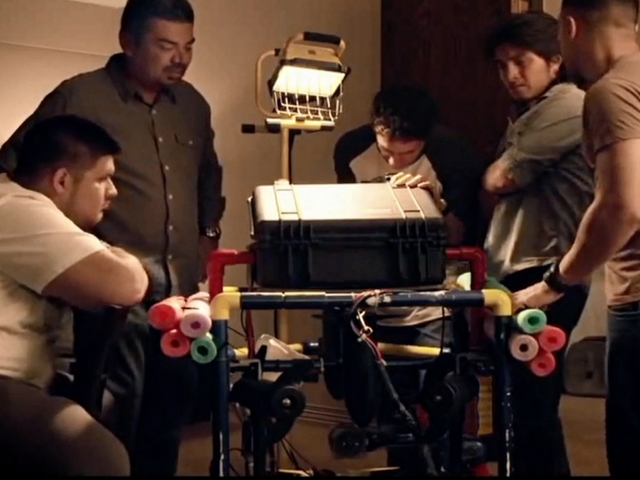
It really happened. Four undocumented high school kids from the poorest of communities took on the most brilliant engineering students from the country’s top colleges in a robotics competition and won. The contest results were one in a million, but once it happened, the movie version was inevitable. George Lopez produced the film and stars as the students’ reluctant coach and teacher, Fredi Cameron (based on the two real-life teacher/coaches, Allan Cameron and Fredi Lajvardi).

Unlike its robotic superstar, there is not much ingenuity in the storyline. Everything added on, especially the fictionalized backstory for Cameron, is predictable and superfluous and distracting. Lopez is an amiable presence, but these detours reveal his limits as an actor. We want to focus on the students and their robot, to see them solve problems in engineering and teamwork (which is a form of engineering, too). But too much of the running time is devoted to Cameron’s past and his possible romance with a fellow teacher, played by the always-wonderful Marisa Tomei. If she played the coach, this would have been a much better movie. Still, with a storyline like this one, it cannot help being fun to watch.

Cameron is an engineer with a PhD who tells the school’s principal (Jamie Lee Curtis, in a performance of great warmth and wit) he wants a temporary job as a substitute teacher. She notes that he has moved around a lot, but she does not have any alternatives. He agrees to coach the school’s engineering club because he is assured no one will want to join.

Oscar (Carlos PenaVega) shows up with a flier. He is an outstanding JROTC cadet and was crushed to learn that he cannot join the US Military without proof of citizenship. He thinks participating in a NASA-sponsored robotics competition will make it harder to be turned down. Cameron reluctantly agrees to help.

They assemble a team that includes the brain (David Del Rio), the kid who always gets into trouble but is a whiz at mechanics (José Julián), and the muscle (Oscar Javier Gutierrez II) — one problem they cannot engineer around is that someone has to be strong enough to lift their robot. Each has his own challenges. The brain is bullied at school. The troublemaker is under a lot of pressure to take care of his brother. The muscle has to be able to pass a tough oral exam at the competition to show that every member of the team understands the details of the robot. Oscar falls in love with a pretty classmate named Karla (sweetly played by PenaVega’s real-life wife, Alexa), but worries that his illegal status puts her at risk. All of the students are hiding from the ICE, which has already sent one of their mothers back to Mexico.

And then there is the challenge of the competition itself. Not only does this robot have to operate underwater, it has to execute an immensely complicated series of tasks in a limited time period. When the team shows up, they are so certain they will lose anyway that they decide they might as well compete with the college teams instead of the other high school teams. The night before they have to compete the robot has a disastrous leak. Their very creative and inexpensive (and hilarious) solution is one of the film’s high points.

The film’s name refers to more than the repurposed junk used to assemble the robot. Their triumph is bittersweet because their undocumented status prevents them from taking the opportunities available to those who are citizens. This film makes it clear that it is our loss, as it prevents our country from benefiting from the perseverance and skill that made an $800 robot created by kids kick the robotic butt of the $18,000 robot from MIT.

Parents should know that this film includes some teen crime including armed robbery, violence including bullying, some strong language and tense family confrontations and teen kissing.

Family discussion: What was the team’s most difficult challenge? Who was the teacher who inspired you the most and why?

If you like this, try: the book by Joshua Davis, Spare Parts: Four Undocumented Teenagers, One Ugly Robot, and the Battle for the American Dream, and films like “October Sky” and “Stand and Deliver”

Related Tags:


Based on a true story Drama High School School Stories about Teens

On DVD This Week: Sacred Journeys

Posted on January 6, 2015 at 8:00 am

Sacred Journeys With Bruce Feiler comes out this week on DVD. If you missed it on PBS, here is your chance to travel along with pilgrims and worshippers around the world.

200 million people go on a pilgrimage each year. They set out from the ordinary, and seek the extraordinary.

Sacred Journeys takes viewers on some of the most celebrated, challenging and spectacular religious pilgrimages on earth. In this landmark six-part series, we travel with American pilgrims looking to transform their lives as they visit places deeply meaningful to their faith. And our cameras gain privileged access to places rarely seen by viewers before.

A pilgrimage at its core is a gesture of action. Pilgrims feel a deeper connection to their faith. They feel closer to God. In a world in which more and more things are digital and ephemeral, a sacred journey gives the pilgrim the chance to experience something real.

Pilgrimage today is more alive than ever before. But you can’t experience its wonders unless you go.

Related Tags:


Spiritual films Television

Into the Woods

Posted on December 24, 2014 at 5:55 pm

Copyright Disney Studios 2014
Copyright Walt Disney Pictures 2014

This is not a Disney movie. Oh, well, yes, it is a Disney movie in the sense that it is produced by Disney, which is the only possible explanation for the PG rating (and the slightly sweetened storyline), but this is not the happily ever after fairy tale story time we are used to from Disney. You didn’t remember that in the original version of Cinderella the mean stepsisters sliced off pieces of their feet to try to fit into the slipper the prince was using to find his true love?  That’s because it was, well, cut out of the classic Disney animated version as well as most contemporary printed versions.  But it’s back here, in a complicated, challenging retelling of classic fairy tales where having your wish granted may leave you worse off than you were before.

Parents looking for a movie for the family for the holidays need to know that this is not this year’s “Frozen.”  It is a sung-through (almost no spoken dialogue) and there are characters who are injured and killed, including parents of young children. It is a darker take on fairy tales.  The characters struggle with the consequences of their wishes and of the actions they take when they want something desperately. They lie and they steal to get what they want. And they learn that no one is all bad or all good. “Though scary is exciting, nice is different from good.”

Writer James Lapine says the idea came from a conversation with his frequent collaborator, Stephen Sondheim, who wanted his next project to be about a quest. Lapine wanted to write something about fairy tales.  And so “Into the Woods” became that project, a mash-up of many different classic fairy tales with a witch, and giants, and a dark place where the paths are not clear, a place for people who are yearning for something and willing to take some risks.  “I wish,” they all sing as the movie begins.  Cinderella, with her evil stepmother (Christine Baranski) and mean girl stepsisters, wishes to go to the festival held by the royal family.  The baker (James Corden) and his wife (Emily Blunt) wish for a child.  A boy named Jack (Daniel Huttlestone, who has a voice like a bell), wishes his milky-white cow would give milk and his mother (Tracy Ullman) wishes they had money so they could have enough to eat.  And a girl in a red riding hood (the very gifted Lilla Crawford) wants some bread to take to her grandmother (and some pastries for herself).

And there’s a witch (Meryl Streep) who wishes for something, too.  She tells the baker and his wife that she will remove the curse that is keeping them from having a child if they will bring her four things: a cow white as milk, hair gold as corn, a cape red as blood, and a slipper pure as gold.  The problem is that all of these items are essential props in other stories.  If the baker and his wife take them, then Jack will not have a cow to trade for magic beans, Rapunzel will not have hair to let down so her prince can climb the tower, Red Riding Hood will not be able to go to her grandmother’s house, and Cinderella’s prince will not be able to find her.  What happens to wishes when they cancel each other out? When one person’s wish is another’s nightmare? And when the handsome prince explains that he was raised to be Charming, but not necessarily Sincere? Is there any good in being good?

The characters explore themes of innocence, and the competing urges to protect children by keeping them from knowing about the dangers of the world and to protect them by making sure they understand those dangers. “How do you say it will all be all right/When you know that it might not be true?”

Even the witch tries to protect her (stolen) daughter from the scary world outside her tower. But children do not listen. They will grow up and want to leave, even if it means learning “secrets I never wanted to know,” as Red Riding Hood sings thoughtfully, after she is rescued from the belly of the wolf. On the other hand “children will listen,” sometimes when we don’t want them to, so we need to be careful in setting a good example and in taking care of them. And somehow, it is in taking care of them we become most fully ourselves. “Fairy tales understood us before we understood them,” we are told. This exploration of fairy tale themes shows us that they still understand us better than we understand ourselves.

Parents should know that this film includes fairy tale/fantasy peril and violence with some characters injured and killed (including two parents of children), some disturbing images and troubling situations, mild sexual references and non-explicit situations with some kissing.

Family Discussion:  What is your favorite fairy tale and why?  In the song where everyone blames someone else, who is right?

If you like this, try:  Revisionist fairy tales “Ella Enchanted,” “Stardust,” and “Ever After” and, for more from Sondheim, Six by Sondheim and Sondheim: The Birthday Concert

Related Tags:


Based on a book Based on a play Fantasy Musical

Big Eyes

Posted on December 24, 2014 at 5:14 pm

Copyright Weinstein Company 2014

In Woody Allen’s 1973 film “Sleeper,” set in a decadent future, Diane Keaton plays a superficial socialite who tries to think of the highest compliment she can give to an amateurish painting.  “Oh, it’s Keane! It’s pure Keane!” she exclaims.  Audiences of that time would recognize that reference to Walter Keane, responsible for the wildly if inexplicably popular “big eyes” paintings of sad-looking waifs.  When the concept of “kitsch” (cheap, popular, low-brow, and corny “art”) first came to the United States in the 1970’s, the Keane images were often used as an example.

Note that word “responsible.”  Walter Keane (Christoph Waltz) was “responsible” for the success of the paintings but he was not responsible for producing them.  It was revealed in a dramatic trial that while Walter Keane claimed credit as the sole artist behind the paintings (and prints and books), he had never put a brush to canvas.  Every one of the paintings was created by the only artist in the family, his wife, Margaret (Amy Adams).

Director Tim Burton, whose film about notoriously awful movie director Ed Wood is one of his best, has created another very good film about very bad art.  Like that film, “Big Eyes” is highly stylized, with heightened period detail exaggerated to reflect and comment on the art that it depicts.  At one point, in some distress, Margaret pushes a shopping cart through a grocery story, seeing the big eyes in the faces of everyone she looks at.

This film also draws on the 60’s era beginning stages of the women’s movement to anchor the story.  Margaret took her daughter and left her first husband at a time when most middle class women were expected to stay home and defer to their husbands.  She arrived in San Francisco at the dawn of the “consciousness raising” era, at the epicenter of movements advocating more focus on individual needs and personal fulfillment.  But Margaret still thought of herself as powerless in her relationship with Walter, in part because it was her nature and the way she was raised to defer and get along, partly because she was dependant on him.  She married him in a hurry because her ex-husband was threatening to sue her for custody at a time when single mothers who left their husbands and had to find jobs had very few rights.  “I’m a divorcee with a child,” she tells a friend.  “Walter is a blessing.”

It was also partly because she loved him, at first.

Margaret was pretty good at painting the pictures, but Walter was undeniably a world-class genius at selling them.  He was very good at marketing up: he sold to movie stars and appeared as a guest on the Tonight Show with Johnny Carson.  He got a commission for a mural at the World’s Fair.  And he was even better at marketing down. When he noticed that people who could not afford the paintings were taking home posters from the gallery, he realized that there was an opportunity there.  “Would you rather sell one $500 painting or a million crappy reproduced posters?”  Pretty soon there were Keane images for every budget, with the originals in an art gallery and the copies in stores, alongside kitchen utensils and t-shirts.

Margaret signed her work “Keane,” and Walter slipped easily into taking credit for it.  He told Margaret (correctly) that no one took women artists seriously and that (also correct) that he was willing to do the kind of glad-handing and public appearances that she is not.  So, she stays locked in her studio painting all the time, increasingly isolated, finally even from her own sense of who she is.

The eerie look in the big eyes of the children in the paintings begins to seem haunting. Margaret realizes that she has to leave another husband. And she has to tell the truth.

Tim Burton has a story with the grotesquerie built in, not just the outlandish images but the turbulence of the era. Waltz has the showier role and delivers as a man whose ebullience mutates into a grandiosity from which there was no return. Adams, as the woman whose passion for expression grows — finally — into the ability to speak for herself with her voice as well as her brush.

Parents should know that this film includes some disturbing themes including emotional abuse, broken marriages, fraud, some sexual references, and brief strong language.

Family Discussion:  Who was responsible for the success of the big eye paintings?  Why did Walter lie and why did Margaret let him?

If you like this, try:  “Ed Wood” from the same director

Related Tags:


Based on a true story Drama
THE MOVIE MOM® is a registered trademark of Nell Minow. Use of the mark without express consent from Nell Minow constitutes trademark infringement and unfair competition in violation of federal and state laws. All material © Nell Minow 1995-2026, all rights reserved, and no use or republication is permitted without explicit permission. This site hosts Nell Minow’s Movie Mom® archive, with material that originally appeared on Yahoo! Movies, Beliefnet, and other sources. Much of her new material can be found at Rogerebert.com, Huffington Post, and WheretoWatch. Her books include The Movie Mom’s Guide to Family Movies and 101 Must-See Movie Moments, and she can be heard each week on radio stations across the country.

Website Designed by Max LaZebnik