Steve Coogan co-wrote and stars in “Philomena,” based on the true story of an Irish woman searching for the son she gave up for adoption fifty years earlier. As an unwed pregnant teenager she was sent to a convent-run home. Her son was taken from her and adopted by an American family. A journalist whose background was in political reporting and had never done a “human interest” story helped her find out what happened to her son. Coogan plays Martin Sixsmith, the journalist, and Philomena is radiantly played by Dame Judi Dench. Coogan and I chatted about his real-life experiences with Philomena and Dame Judi.
I saw in the New York Times that you are a fan of the classic British comedy Kind Hearts and Coronets .
.
I like it because it’s very, very British. Knowing that in cinema today, the Americans are all pervasive, and even if you make good films, if your film won’t work in America, then it’s not going to work, period. And it’s nice to do films that work in America not because you’ve made it like that but because it just happens that it’s going to work there. It’s one of the films that I watch on a rainy afternoon. It has a kind of soft twinkle in its eyes. It’s about a man murdering all the people in line between him and the Duke. And the idea that you actually like that man. It’s just a real achievement to make an audience like this pompous man. Somehow it’s like counter-intuitive. And there’s this dark humor and it’s funny, it has this sort of mischievousness.
Tell me about taking on the challenge of both a true story and a book, and adapting it into a movie.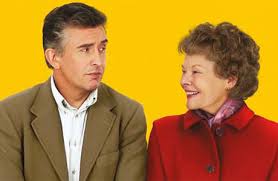
I was involved in a lot of comedy, and frequently comedy is is smart, but is also cynical. It seems to me that so many movies these days have a streak of cynicism in them. But it’s like that’s for the masses and you can’t have an intelligent movie that says something constructive and sincere. And sincerity seems to me, is in very short supply in films. The cynicism and irony, if you like, is a refuge, actually, ultimately, it’s quite a cowardly thing. I wanted to see if I could do something that’s the most avant-garde thing you can think of. The only 4 letter word left, that is, a profanity is the word “love.” And I really want to do something, a film, that there was about something sad and tragic, but I want to do something that added without something pretentious, added just a little, a tiny amount to the sum total of human happiness, rather than something that is bleak.
To me the most powerful moment in the movie is when she says “I forgive you” and your character says “I don’t.”
My background is I was raised a Catholic. A very large family. I’m not religious now, but the values that I was given for my background from people who are still religious in my life are important to me. I don’t think there’s a contradiction but to me this is a duality and I wanted to challenge my own cynicism this way through the movie. And also in my anger toward the church as an institution, I didn’t want to castigate people of simple faith. My parents are people like that. I respect them. They are good people. My parents’ foster children, they are very kind, good people basically, but all have their faults, they’re not perfect but they’re basically good people. I wanted to dignify those kind of people. All these scandals that have engulfed the Catholic Church in particular, sometimes, I’ve forgotten that it’s all those ordinary people, unremarkable people who lead quiet dignified lives, and they are not sexy. Through Philomena, I want to dignify that. I want to show both sides, show some balance. I spoke to Philomena, I spoke to Martin, to find out where they were coming from. I put a lot of myself into Martin. Philomena’s character, we exaggerated the comedy of her, she’s a little bit eccentric, but not as quite as dirty as the Philomena in the movie. That was cranked up a little. And there were a lot of old Irish women like that, so I don’t mind the audience being, sometimes you can leave the audience at the dark and invite them to judge her the way Martin judges her.
She keeps surprising you which is one of the lovely things in the film. She seems very parochial and with narrow experience but she is quite open and frank about the prospect that her son might be gay.
I saw some comments that were saying, she wouldn’t be so laid back about Martin being gay. I asked her to her face, “Did it bother you?” She said, “I was a nurse. I worked with a lots of guys who were gay. It didn’t really bother me. And in fact I kind of thought he might have been.” So it was like, “Okay, I’ll put that in the story.” And I also said to her, “Do you forgive them for what they did to you?” That’s where I got the idea of, and I said “Do you forgive them?” She said, “Yes I do. Her daughter sat next to her and said, “I don’t.” And I thought that was really interesting. If you’re very pious in the sights of others, you can’t demand that everyone forgives everyone. It’s not a thing you can prescribe, it’s up to individuals. But I always thought the audience would not be in the mood and so I had to give them a moment and that when Martin’s very angry. But also, it’s a conversation and it’s in the ebb and flows that I wanted Martin to show that the other conversation we’re having is not just about those who are religious and those who are non-religious but also the idea of intellect versus intuition and to show that how very important learning and enlightenment are. I want to show that even with all that intellect, he still learns something from the intuition of an old Irish lady.
And here you are in the road again, as in your wonderful movie The Trip .
.
That was just accidental, I didn’t realize that there’s a lot of scenes with me and Judi in a car. It was kind of accidental really. But what was good was it meant that they were forced to be together.
In my state as a writer, you sort of get bored with just writing comedy for its own sake. It’s very enjoyable but it’s a visceral pleasure, comedy. It’s really enjoyable and you get it right, it’s great, you laugh, and all these endorphins, it’s wonderful. But actually, I just thought, I want to talk about something that is about something. Why can’t I do something that’s about something of substance, and put comedy in it because I think reality is more like that anyway. People laugh at funerals, they do in the wake, or they talk about people, they want to laugh. They are talking about the person who has died, they tell funny stories about him, it’s totally human, it’s not an odd thing. You always see funerals in movies, everyone’s dressed in black, and always very somber, and they walk away with umbrellas. Actually people in wakes they don’t stand there in the rain, people laugh.
To me it was not completely real or truthful. But I also knew it was a way of making a film serious about, more palatable and not worthy to talk about things of substance, doesn’t mean you have to go “oh boy, do I have to do that now?” It’s like when you look at a menu of movies these days, you think I want to watch that film but…I want to make that films that I should go out to see. A film I want to go and see.
I also saw a similarity to your other film this year, What Maisie Knew. Once again, you’re playing someone who knows he can be an insensitive cad.
I like to do work which has the potential to fail. That almost, by definition, that makes it interesting. Rather than I have to do this easily. I always don’t know how to do that thing, of doing a character who has total integrity. Which is, I mean people like Harrison Ford, he’s not going to do something despicable just because of the baggage he carries. And George Clooney certainly has that, doesn’t he? But I don’t know, I actually think that’s harder because it’s more interesting when you’re trying to struggle, trying to conceal something or trying to project something. It’s to get teeth more into it.
Who else did you talk to in researching this script?
I also had to talk to some nuns when I retraced Martin’s steps. I went to the Abbey and spoke to the nuns who were there and I used that as a basis for some of the dialogue. And also, I watched some footage of Anthony with Philomena which she hadn’t seen before. I sat down in Martin’s house and she reached over to my hand and started crying because she hadn’t seen this footage. She grabbed my hand and said “I did love him you know.” And I put in the movie. She does to Martin when they’re in a salad bar, she grabs his hand, and says “I did love him” when in fact she did that to me. I kind of lived a little bit of the movie myself.
What is it like to work with Dame Judi Dench?
I was scared through whole thing. I went to her house and read her the story. When I told her the story, in fact early on, when she just answered the door, and I was on my way up to my place in the country. She made me a cup of tea and after she sounded very excited and she offered to make me a sandwich, and she made me a sandwich for my long journey. And then I drove off, then I came back a few months later with the script. When I went back to writing process after to that, I said, “Jeff, look, we might have to use less writing for her.” So we put scenes in and I remember saying to Jeffery, “We don’t dialogue here. We just need her face, with the cameras close in on her face looking at the last time she saw her child, Judi Dench’s face will do everything. Let’s use her, you know, we got Judi Dench, you need to use her, let’s not waste her.” So that’s wonderful, knowing I’d be acting it with her.
I thought could probably pull this off. But there were certainly question marks from other people. No one else is going to give me; I wouldn’t be in this part without producing it so I’m going to give it to myself. That’s for start there. I thought, “Yes, well there’s a chance I could fail, there’s a chance I could be blown off screen by this hugely charismatic woman.”
I was nervous on one level but spending time with her on set, she had very good sense of humor. I have a Porsche sports car and she was more interested in looking at my sports car and going oh isn’t it cool and sexy. She has a sporty BMW soft top. She drove me for a pub lunch in her convertible sports car. Which I thought was as close as I was going to being James Bond. She’s not precious and she’s very self-effacing and able to laugh at herself and mischievous but dignified at the same time. On the set, I was making her laugh all the time.
And also, I saw her struggling. At one point she told me, “Give me a note, give me a note, give me a note. What do you think about what I’m doing?” She was totally open to it. She challenged me on some of the words sometimes. She made a really good observation, a very subtle one where I wrote a line when she’s talking about her son. In the dialogue, I wrote, “I always knew he was sensitive little soul.” She said, “You’d say that about someone else’s child. You wouldn’t say ‘he’s a sensitive little soul’ about their own child. They’d just say ‘he was a sensitive little boy’. Soul is slightly distancing.”
And I said “Oh yeah you’re right, you’d say that about someone else’s child. ‘Oh he’s a sensitive little soul, isn’t he?’ You’d say that about someone else, you say that about your own child.” I thought “that’s really, really subtle, but actually true” She was totally game for stuff. Even now, it’s just a thing I can’t quite believe I did it and was able to counterbalance her in some small ways, that I provided a foil for her.
Although of course, it’s slightly daunting, far worse than to act with someone who couldn’t act. Because then you have got nothing. What she’s doing is raising your game all the time because she happen to bring your A game. So it’s an atmosphere. All I’m doing to her is just reacting. All I do is react to what she’s giving me. So she’s giving you gifts all the time.

 , a group of expatriate Brits came to India, mostly because they could no longer afford to live in the UK. The energetic and eternally optimistic young owner of a dilapidated hotel decided to “outsource old age.” Just as he saw the beauty of the ancient, crumbling building, he saw the grace, and the revenue stream, of people no longer valued in the place they had lived their lives.