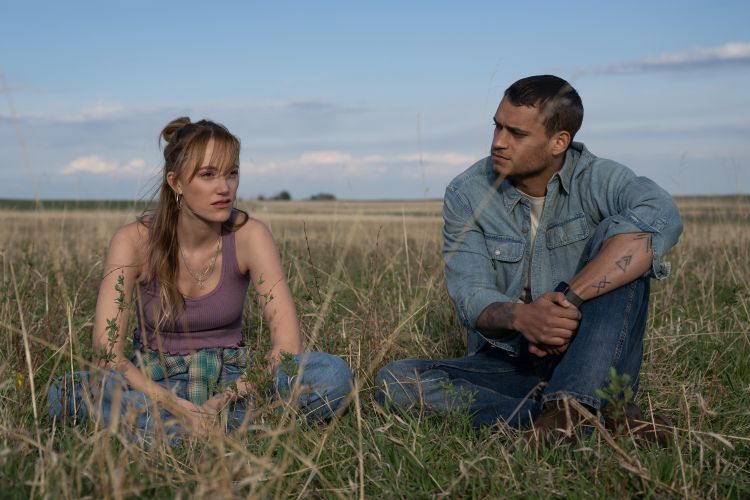
Reminders of Him

Reminders of Him

Posted on March 12, 2026 at 12:21 pm

B-
Lowest Recommended Age: High School
MPAA Rating: Rated PG-13 sexual content, strong language, drug content, some violent content, and brief partial nudity
Profanity: Some strong language including f-word
Alcohol/ Drugs: Alcohol and drugs
Violence/ Scariness: Fatal car crash, brief scuffle with a couple of punches
Diversity Issues: Diverse characters
Date Released to Theaters: March 13, 2026
Reminders of Him
Copyright 2026 Universal Pictures

Before it was eclipsed by the superior guide to movies by Leonard Maltin, the late Steven H. Scheuer’s 1970s Movies on TV, dismissively referred to some romantic dramas as “for the ladies.” If he was still writing, the third firm based on a popular Colleen Hoover novel, this one co-written and co-produced by Hoover, would likely merit that description, along with “weepie” and possibly “syrupy.” It’s a story of redemption, reunion, healing, and romance, glossily filmed, with talented and attractive performers, which almost makes up for the fact that it may be watchable but it is not very good.

It stars Maika Monroe, more recently known for horror films like “Longlegs,” but worth checking out her earlier romantic drama, “After Everything,” opposite pre-“Bear” Jeremy Allen White. She plays Kenna, who returns to her home town after being released early for good behavior from a seven-year prison sentence. She asks the cab driver to stop at a. makeshift roadside memorial and takes the cross, telling us “Scotty hated memorials.”

She has returned home because she wants to see the daughter who was taken from her minutes after birth, now almost six years old and being raised by her grandparents, Grace (Lauren Graham) and Patrick (Bradley Whitford).

As Kenna starts from scratch, moving into a seedy apartment building. The landlord (“Schitt’s Creek’s Jocelyn, Jennifer Robertson), insists that Kenna take a kitten. No one wants to hire a felon. But a kind-hearted assistant manager at a grocery store played by country star Laney Wilson gives her a chance as a bagger.

Kenna stops by what used to be a bookstore/cafe that she loved. It is now a bar owned by Ledger (Tariq Withers). He is drawn to her but she is not ready to make a friend. And then it turns out there is a connection. Scotty, whose memorial Kenna destroyed, was Ledger’s lifelong best friend. He is a former NFL player, now living in his childhood home, across the street from Grace, Patrick, and the daughter Kenna is desperate to see, Diem (Zoe Kosovic). Ledger is devoted to Diem and she adores him.

When Ledger finds out that Kenna is the one who was convicted of vehicular manslaughter after the car accident that killed Scotty (played in flashbacks by Rudy Pankow, who even seen briefly is able to make us understand why everyone misses Scotty so much), he is furious, and he prevents her from seeing Diem. But he is still drawn to her. As he realizes how vulnerable and devastated she is, he offers her a part-time job at the bar. They begin to warm to each other.

It’s very soapy. As often happens with an adaptation of a book with an army of fans, there are details and characters that seem barely sketched in because a film script won’t have the time to develop them that an author has in a novel and a reader has the opportunity to fill in as she pictures the story in her mind. The situations and attempts at humor are contrived and the dialogue is clunky except when it is said by Diem or by Kenna’s neighbor and fellow bagger, a spunky young woman with Down syndrome named Lady Diana (the appealing Monika Myers), when it is just sugary. It ham-handedly signals Kenna’s increasing confidence by having her start combing her hair and go from tiny cut-offs to pants. The scene with Scotty and Ledger laughing when high as teenagers is not nearly as endearing as it tries to be. The story feels like Temu Nicholas Sparks. But Monroe and Withers give strong performances, doing much more than the script to make us feel the conflicts and chemistry of Kenna and Ledger. That plus the inherent belief in the themes of second chances make it watchable, if pleasantly forgettable.

Parents should know that this film includes mature material including a fatal car crash, a guilty plea to vehicular homicide while under the influence of drugs, custody issues, alcohol and drug use, sexual references and non-explicit situations, and some strong language.

Family discussion: Was Kenna’s sentence fair? What made Ledger change his mind about her?

If you like this, try: the book by Colleen Hoover as well as “The Lucky One,” “An Unfinished Life,” “Gifted,” and “What Maisie Knew”
Related Tags:


Based on a book Drama movie review Movies -- format Movies -- Reviews Romance

Exclusive Clip: Middle School – The Worst Years of My Life

Posted on January 3, 2017 at 8:00 am

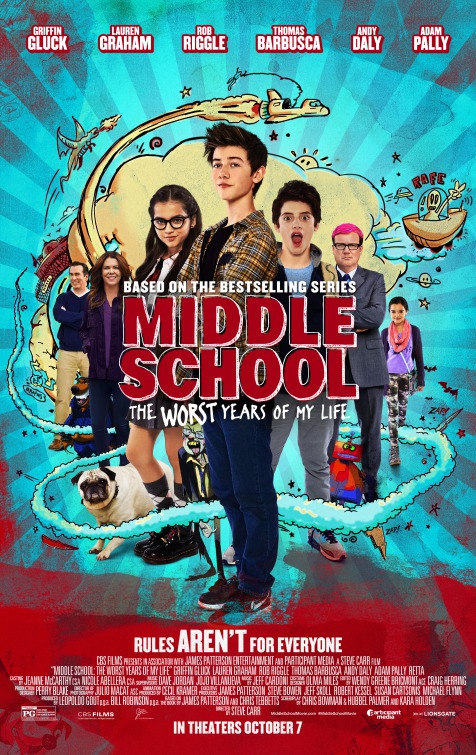
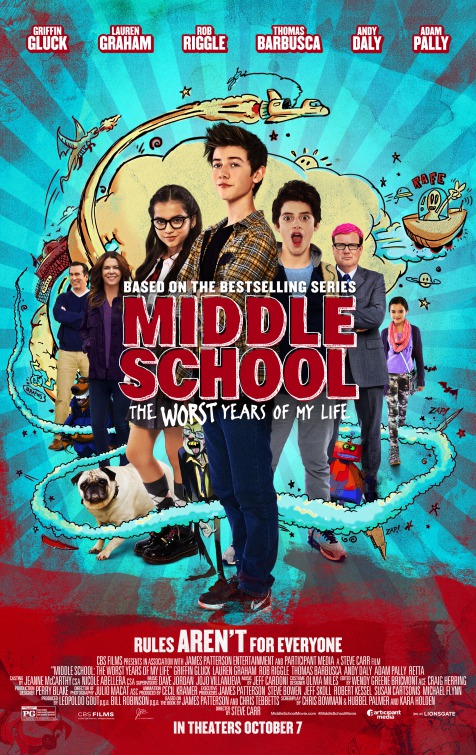
The delightful and surprisingly wise film Middle School: The Worst Years of My Life is available today on DVD/Blu-Ray and we are honored to be able to present an exclusive behind the scenes clip about the main character’s pesky younger sister from the DVD extras.

Related Tags:


Behind the Scenes Trailers, Previews, and Clips

Behind the Scenes: Gilmore Girls are Back!

Posted on November 22, 2016 at 8:00 am

I’m so excited about the reboot of “The Gilmore Girls,” coming to Netflix on November 25, 2016.

Here’s what I wrote about the show in 2004:

This week’s episode of “The Gilmore Girls” is the season finale, but for me it is the end of something much more important. It is the last time my daughter Rachel and I will watch the show together because she is leaving for college in the fall. When she goes, one of the things I will miss most is our Tuesday night post- “Gilmore” discussions.

Both of my children usually think it is a little unseemly of me to enjoy the music or movies they like, but with “The Gilmore Girls” the fact that Rachel and I both love the show has been as great a pleasure as watching the program itself.

Rachel was about 14 when she first told me about “The Gilmore Girls,” then in its second year. It sounded sitcom-y and formulaic — a single mother who had a baby at age 16, her daughter Rory, then 16 herself, and their relationship with the mother’s wealthy parents.

I politely tried to think of something nice to say: “Rory is a pretty name.”

“Her real name is Lorelai, like her mother,” Rachel said matter-of-factly. “But that’s because she was so young when she had her that she didn’t have good judgment, and mistakenly just gave her own name when the hospital asked her what the baby’s name was.” Well now, this was interesting. A television show had informed my daughter that teenagers can make foolish choices they later regret, and she liked it?

I got another surprise when I sat down with her to watch the next episode, about Lorelai’s reluctant agreement to organize a school fundraiser.

Amazingly, this did not follow the standard television formula for comedy plus warmth: Incompetence leads to comic mayhem, happily concluding when a powerful character either intervenes or is delighted with the unexpected outcome; then everyone learns a lesson and lives happily ever after until next week.

This was different. Lorelai was confident and capable. The characters were complicated and intelligent. There was plenty of humor and warmth, but it came from the people and the dialogue. And that dialogue — it was fast, funny and dazzlingly, omni-culturally literate, sprinkled with references from Henry David Thoreau to feng shui, Kofi Annan, Joseph Campbell and any television star who was ever featured on a lunchbox in the 1980s. I was hooked.

“It’s easy to make things funny if people mess it up,” producer-writer Amy Sherman-Palladino said in a telephone interview. “It’s harder to make people qualified at what they are doing and find the comedy somewhere else. Lorelai can be a bit of a kid, but this is a woman who made a life for herself with no formal education, a woman of great determination and great competency.”

Sherman-Palladino wanted to make sure Lorelai was the kind of person who would create a cheerful, loving environment for her daughter. She also wanted Lorelai to read, because of her own curiosity about the world and to keep up with her brainy child.

And she wanted Lorelai and Rory to be irreverent, but not snarky. “They don’t take things seriously, but they are genuine. They know how goofy some of their town’s festivals are, but they truly love them,” she said.

The same could be said about the show’s quirky characters. One of the best is Rory’s roommate, the hyper-focused, hyper-competitive Paris.

“Rory’s nemesis has to be not the popular girl with the blond hair and perfect stomach dating the football player, but the smartest girl, the one who, in the womb, was preparing for her SATs,” Sherman-Palladino said.

“With Rory, I wanted to write about a teenage girl whose focus in life was books, music, reading, Harvard; friends with her mom; who was not interested in being in a clique. She needs challenges, and Paris is relentless. Rory will want to stay close to that kind of person because it keeps her sharp, her eyes focused on the prize.

She said she liked the contrast between “Rory’s complete acceptance of people for who they are” and Paris, “who is not willing to accept anyone, even herself.”

One of Sherman-Palladino’s best ideas was to bump the mother-daughter conflict in the show up a generation. The clash is between Lorelai and her mother, Emily, who is firmly committed to traditional standards of behavior. Lorelai was estranged from her parents for 16 years, until she needed their help to pay for Rory’s tuition at a private school. In return, they insisted that Lorelai and Rory have dinner with them once a week.

“Their last real interaction was when Lorelai was 16, so they didn’t have the softening, growing-up years,” Sherman-Palladino said. “They revert back to the rebellious 16-year-old and judgmental mother.”

Teenagers get to see Lorelai as both idealized mother-as-friend with her daughter and as conflicted, angry and needy with her own mother.

Rachel has grown up with Rory, and we have loved watching together as Rory found her way through the challenges of high school, friends, boyfriends, family, applying to college and her first year at Yale.

I hope one lesson Rachel has learned from Rory is how easy it is to stay in close touch with home, even from a dorm room.

She and I and some friends are planning a “Gilmore Girls” marathon party to watch the first year of the show, just out on DVD, so we can catch up on the episodes we missed. I hope families whose daughters were too young for the show when it began will watch it together on DVD too.

I am looking forward to going back in time to when Rory was just starting high school. If only I could do the same with Rachel.

Related Tags:


Television
Middle School: The Worst Years of My Life

Middle School: The Worst Years of My Life

Posted on October 6, 2016 at 5:53 pm

B+
Lowest Recommended Age: Middle School
MPAA Rating: Rated PG for rude humor throughout, language and thematic elements
Profanity: Some schoolyard language
Alcohol/ Drugs: Social drinking (adult)
Violence/ Scariness: Some peril, sad off-screen death of a child, parental abandonment and marital break-up, cartoonishly exaggerated adult villains, some misbehavior including vandalism and mayhem
Diversity Issues: Diverse characters
Date Released to Theaters: October 7, 2016
Date Released to DVD: January 2, 2017
Amazon.com ASIN: B01LTHWXX4

Copyright Lionsgate 2016

This just might be the most accurate movie title of all time. Middle school is pretty much the worst years of everyone’s life. Terrible stress and tragedy happens at all ages, but it is the years from 12 to 14 where the internal turmoil and agonizing uncertainty are so acute that we still wince remembering them decades later. This film, based on the series of books by mega-bestselling author James Patterson (with Chris Tebbetts and illustrations by Laura Park) has some delightfully satisfying moments of fantasy revenge against a tyrannical, rules-obssessed principal and a borderline-abusive potential stepfather. But it sneaks in some quietly touching and surprisingly wise insights about loss and working with a “new normal.” Bright direction and an exceptionally engaging cast of kids make this film a genuine fall family treat.

Rafe Khatchadorian (Griffin Gluck) has been expelled from two schools (we never find out why) and has just one more chance. He would rather stay home all day and draw pictures in his notebook, where he has created a whole world of monsters and aliens, charmingly animated. “There’s a big world out there,” Rafe’s mother (Lauren Graham) tells him. “There’s a big world in there, too,” he says. And it is clear that is the world he prefers.

He does not even make it inside the building, though, when he meets the new school’s Principal Dwight (Andy Daly), who cares about just two things: his rules, and the school’s test score ranking. Dwight’s rules basically outlaw anything that is fun, friendly, expressive of individuality, or likely to keep the school from the #1 test score ranking Dwight cherishes so deeply that he has cultivated a number 1 bush by topiary in front of the school. Dwight’s consigliere/enforcer is Ida Stricker (“Parks and Recreation’s” Retta). So, bright, patterned shirts, talking in the hallways, even drawing in a notebook — all banned. There’s also a school bully who threatens to give Rafe “a wedgie so bad you’ll be able to taste your underwear.”

But there are three bright spots. Rafe’s best friend, Leo (Thomas Barbusca), is always there to make him laugh and spur him on. There’s a friendly girl named Jeannie (Isabela Moner), and a kind, sympathetic teacher (“Happy Endings'” Adam Pally) who uses the Drake and the Wu-Tang Clan to teach the class about macroeconomic trends. Rafe decides to take on Dwight by breaking every rule, with Leo’s help. Meanwhile, Rafe’s mom is getting serious with the boyfriend Rafe and his sister call “Bear” (Rob Riggle in his usual role of a walking Axe body spray).

The revenge fantasy is funny and satisfying, mostly about making the pompous Principal Dwight look silly. And it gives Rafe a way to begin to make new friends, to resolve issues with the school bully, and to think through the other problems in his life.

The film is bright and fun, like its sparkling soundtrack of pop songs. The young actors are refreshingly natural and Barbusca has great comic timing. Rafe’s sister Georgia (Alexa Nisenson) and love interest Jeanne (Isabela Moner) are real characters, smart and capable. When the more serious issues arise, it is organic and sensitively handled. The pranks are signed RAFE, which stands for “rules aren’t for everyone.” But this movie is.

Parents should know that this film includes schoolyard epithets, potty humor, references to death of a child, parental abandonment, and marital breakup, comically exaggerated adult villains, cartoon-style peril, and tween misbehavior including driving and mild vandalism.

Family discussion: What is the best way to challenge unfair rules? What school rules would you like to change?

If you like this, try: “Harriet the Spy,” “How to Eat Fried Worms,” and the book series that inspired the film

Related Tags:


Based on a book Comedy Coming of age DVD/Blu-Ray Pick of the Week Family Issues School Stories About Kids Tweens
THE MOVIE MOM® is a registered trademark of Nell Minow. Use of the mark without express consent from Nell Minow constitutes trademark infringement and unfair competition in violation of federal and state laws. All material © Nell Minow 1995-2026, all rights reserved, and no use or republication is permitted without explicit permission. This site hosts Nell Minow’s Movie Mom® archive, with material that originally appeared on Yahoo! Movies, Beliefnet, and other sources. Much of her new material can be found at Rogerebert.com, Huffington Post, and WheretoWatch. Her books include The Movie Mom’s Guide to Family Movies and 101 Must-See Movie Moments, and she can be heard each week on radio stations across the country.

Website Designed by Max LaZebnik